
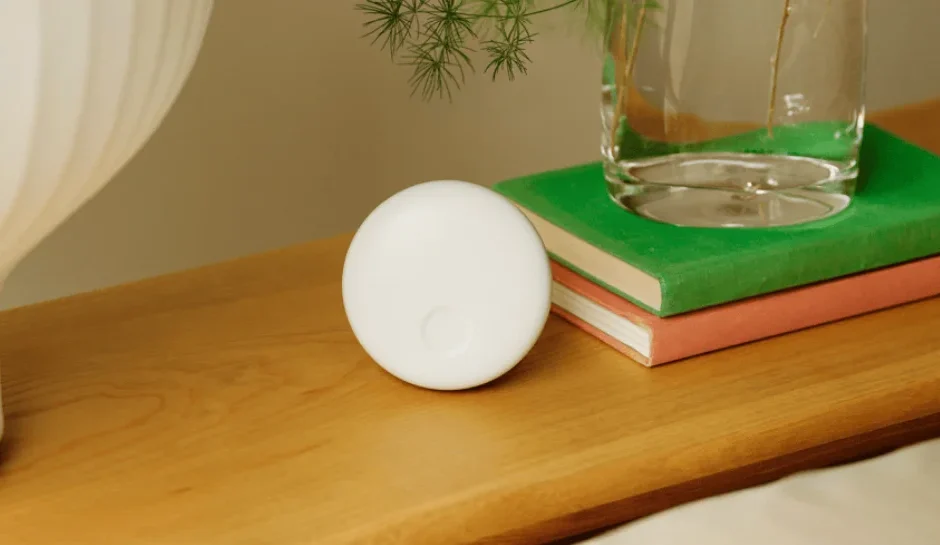

Airthings Wave Enhance Smart Radon Detector
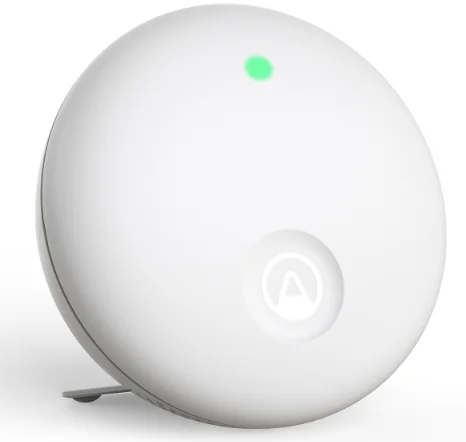
Features and content
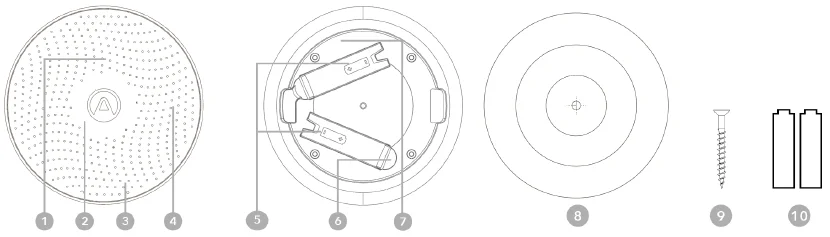
- Power indicator
- Light ring
- Motion sensor
- Air inlets
- Battery compartments (observe polarity symbols)
- One-time battery tab
- Individual serial number
- Mounting bracket
- Screw
- 2 AA batteries, inserted
Power indicator
Flashing dot every 20 seconds
- Green: battery level okay
- Blue: Bluetooth connectivity active
- Red: Replace batteries
Light ring
Visual indication of your air quality levels.
- Green: Good
- Yellow: Warning
- Red: Danger
(Go to airthings.com/mylevels for more information on air quality action levels)
Air inlets
This is where air comes into your detector.
Audio alarm
The device can give you audio alerts if your air quality levels are violating the recommended amount. In case of audio alerts, simply wave in front of the device to snooze alerts.
Wave sensor
Simply wave in front of your detector to activate the light ring.
Easy to mount
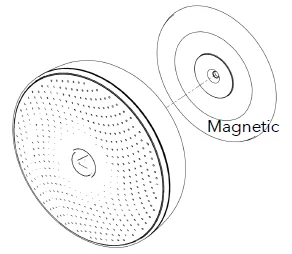
Fix the mounting bracket to the ceiling or wall. Make sure you use appropriate screws for your wall type. The screws included are intended for wood or drywall. Do not place it close to vents or windows. Minimum 1 meter / 3 feet distance.
Thanks to the built-in magnet, simply snap the unit onto the mounted bracket. Then rotate it to the desired position.
Basics of the App
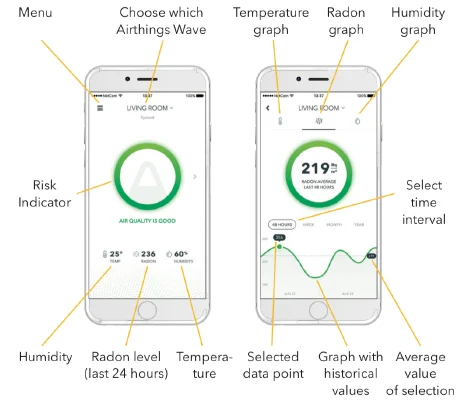
Daily use
Wave in front of your device to see a visual indication of your daily radon levels. Leave your Wave uninterrupted for at least 1 week to get a quality average reading for radon.
Make sure you always have Bluetooth enabled on your phone and the app running in the background. Every time you move within Bluetooth range of your device, the latest data will be downloaded automatically.
You will be notified if any actions are needed through the app.
Integrations
The Airthings Wave shares data to your mobile device as well as the Airthings Dashboard—a free online platform that provides quick access to view, customize, and analyze sensor data from multiple Airthings devices.
The Airthings Wave is integrated with Amazon Alexa and IFTTT. With Amazon Alexa, use voice commands to control your device. IFTTT integration allows users to create or access useful recipes for their devices to follow and integrate with third-party products. Sign up for our newsletter for the latest updates.
Glow ring
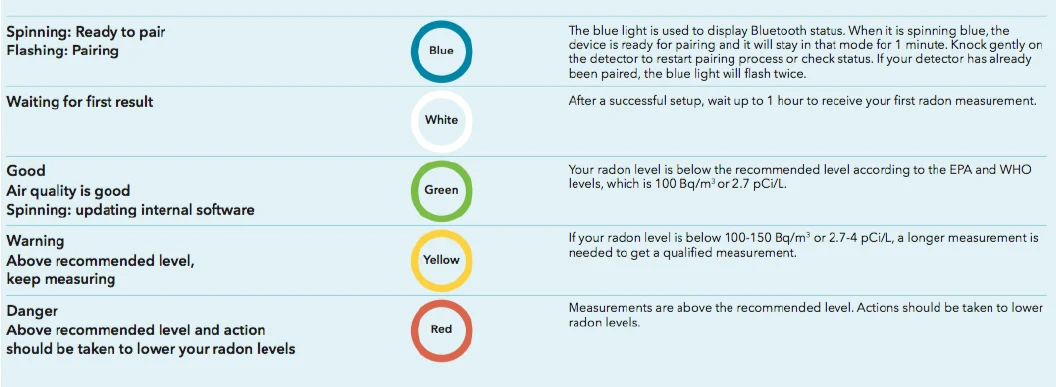
Sensor icons
Temperature
Indoor temperatures can affect performance, mood, and comfort level. Individual sleep patterns are also affected by indoor air temperature.
Radon
Decrease exposure to this radioactive gas that accumulates in buildings and homes. It is the number one cause of lung cancer among non-smokers, but it can be managed with continuous monitoring.
Humidity
Too much or too little humidity can affect allergies and cold or flu symptoms. When humidity levels are too high, mold and rot will occur. Low humidity levels cause static electricity, dry skin and hair, and increased susceptibility to colds and respiratory illness.
Color coding and action levels
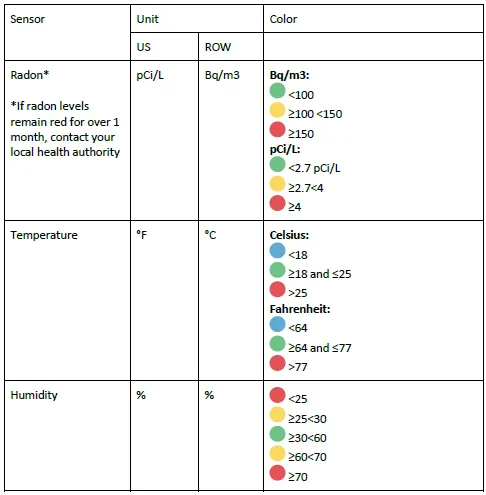
Troubleshooting
First and foremost, always make sure that you have updated to the latest device software
- In the device settings menu, click Update Device.
Not able to connect to my device
- Make sure you have the detector within the range of 2-5 meters or 5-15 feet.
- Check if Bluetooth is turned on.
- Check if the power indicator is blinking.
Need to turn off the audio alert
- In the iOS app, go to the device settings menu and update the radon alarm settings.
- Wave in front of the detector to snooze for 1 month.
My app is not updated when running in background mode
- Open your phone settings and verify that the Airthings Wave app is running in the background. You can usually find this in the app manager section of your phone settings.
- Make sure you are in Bluetooth range periodically.
No response from the light ring
- Check if the power indicator is blinking.
- If the power indicator is blinking red or not blinking at all, the battery level is low. First, sync your data and then replace the batteries. We recommend AA alkaline (LR6).
If you need further assistance, read our Frequently Asked Questions, or simply contact support at support.airthings.com.
Technical specifications
- Power supply: 2 AA 1.5V alkaline (LR6), 3.0V nominal (2×1.5V), 3.8V maximum, 1.8V minimum (depleted batteries), 500mA max current draw
- Dimensions: Diameter: 120 mm (4.72in), Height: 36 mm (1.42in)
- Weight: 219g including 2 batteries (7.7 oz)
- Operational and storage environment: Temperature: 4 °C (39 °F) to +40 °C (104 °F), Relative humidity: < 85%
- Initial accuracy/precision at 100 Bq/m3 (2.7 pCi/L): 7 days < 10%, 2 months < 5%
- Measurement range: 0 Bq/m3 to 50,000 Bq/m3 (0 pCi/L to 1350 pCi/L)
Within the first week, the accuracy levels of the Airthings Wave are within 10% at one standard deviation, measured at 100 Bq/m3 (2.7 pCi/L). After a month, the accuracy increases drastically to within 5% at one standard deviation, measured at 100 Bq/m3 (2.7 pCi/L). As the device gathers data, the accuracy of readings increases drastically.
All Airthings detectors have been tested directly against the AlphaGUARD reference device—the professional radon monitoring benchmark with which all radon detectors and tests are referenced.
Safety and maintenance
The Airthings Wave Plus is intended for indoor use only. Avoid direct exposure to sunlight for long periods. Avoid exposure to direct heat sources. For correct usage, make sure the detector is operating in the specified temperature range (see technical specifications).
Exposure to high humidity might permanently alter the detector sensitivity or damage it.
Do not disassemble. If the detector does not work as specified or you are in doubt, contact your local dealer or visit us at Airthings.com.
Use a dry cloth to clean the detector.
When replacing the batteries, pay attention to the polarity marks. Use AA alkaline (LR6) batteries.
Always snap the mounting bracket to the detector’s rear side to protect the batteries, even when the detector is not permanently mounted.
Disposal: electronic equipment.
For more Manuals by Airthings, visit ManualsLibraryy
Airthings Wave Enhance Smart Radon Detector-FAQs
What is a normal radon level in a home?
The average indoor radon level is about 1.3 pCi/L. The EPA recommends fixing your home if levels are 2–4 pCi/L or higher.
How long do the batteries last?
Wave Radon and Wave Plus use 2 AA batteries lasting about 1 year. Wave Mini uses 3 AA batteries, lasting 2–3 years.
Does the detector need calibration?
Yes, CO2 and VOC sensors need 1 week to calibrate, and the radon sensor stabilizes over 30 days.
Can I open windows or run AC during a radon test?
No. Opening windows or running AC can skew results and give artificially low readings.
What are the symptoms of radon exposure?
Radon is odorless and invisible, but long-term exposure increases lung cancer risk. Symptoms from high exposure may include shortness of breath, chronic cough, chest pain, or hoarseness.
What are the symptoms of radon exposure?
Radon is odorless and invisible, but long-term exposure increases lung cancer risk. Symptoms from high exposure may include shortness of breath, chronic cough, chest pain, or hoarseness.
How accurate is Airthings Wave?
Wave Enhance is highly accurate when placed correctly and allowed to stabilize. Radon readings are reliable once calibration is complete.
How do I clean my Airthings Wave?
Wipe the device gently with a soft, dry cloth. Avoid water or cleaning chemicals on the sensor openings.
Does an air purifier remove radon?
No. Radon is a gas, and standard air purifiers cannot effectively remove it from indoor air.
How often should I check or service the radon system?
Regularly monitor readings via the app. Long-term, re-test your home every 2 years or after major renovations.
When are radon levels highest?
Radon tends to peak in winter and early spring when homes are sealed and ventilation is reduced.