
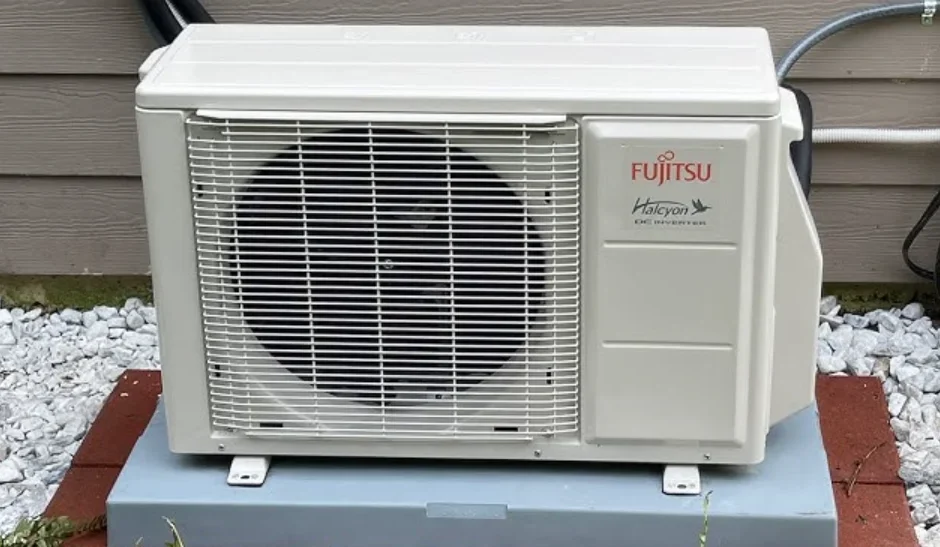

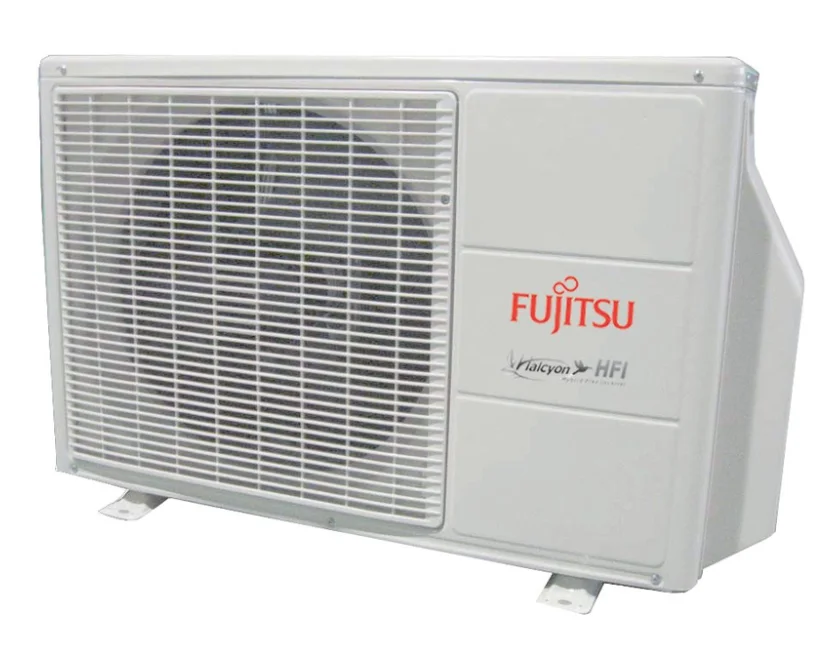
Fujitsu AOU24RLXFZ Outdoor Unit
SAFETY PRECAUTIONS
This installation manual describes how to install the outdoor unit only. To install the indoor unit, refer to the installation manual included with the indoor unit.
IMPORTANT!
Please Read Before Starting
This air conditioning system meets strict safety and operating standards. As the installer or service person, it is an important part of your job to install or service the system so it operates safely and efficiently.
For safe installation and trouble-free operation, you must:
- Carefully read this instruction booklet before beginning.
- Follow each installation or repair step exactly as shown.
- Observe all local, state, and national electrical codes.
- Pay close attention to all danger, warning, and caution notices given in this manual.
When Wiring
ELECTRICAL SHOCK CAN CAUSE SEVERE PERSONAL INJURY OR DEATH. ONLY A QUALIFIED, EXPERIENCED ELECTRICIAN SHOULD ATTEMPT TO WIRE THIS SYSTEM.
- Do not supply power to the unit until all wiring and tubing are completed or reconnected and checked.
- Highly dangerous electrical voltages are used in this system. Carefully refer to the wiring diagram and these instructions when wiring. Improper connections and inadequate grounding can cause accidental injury or death.
- Ground the unit following local electrical codes.
- Connect all wiring tightly. Loose wiring may cause overheating at connection points and pose a possible re-hazard.
When Transporting
Be careful when picking up and moving the indoor and outdoor units. Get a partner to help, and bend your knees when lifting to reduce strain on your back. Sharp edges or thin aluminum fins on the air conditioner can cut your fingers.
When Installing…
- …In a Ceiling or Wall
Make sure the ceiling/wall is strong enough to hold the unit’s weight. It may be necessary to construct a strong wood or metal frame to provide added support. - …In a Room
Properly insulate any tubing run inside a room to prevent “sweating” that can cause dripping and water damage to walls and floors. - …In Moist or Uneven Locations
Use a raised concrete pad or concrete blocks to provide a solid, level foundation for the outdoor unit. This prevents water damage and abnormal vibration. - …In an Area with High Winds
Securely anchor the outdoor unit down with bolts and a metal frame. Provide a suitable air baffle. - …In a Snowy Area (for Heat Pump-type Systems)
Install the outdoor unit on a raised support that is higher than the drifting snow. Provide snow vents.
When Connecting Refrigerant Tubing
- Keep all tubing runs as short as possible.
- Use the flare method for connecting tubing.
- Apply refrigeration compressor oil (or equivalent) used for the outdoor unit to the matching surfaces of the flare and union tubes before connecting them, then tighten the nut with a torque wrench for a leak-free connection.
- Check carefully for leaks before starting the test run.
NOTE:
Depending on the system type, liquid and gas lines may be either narrow or wide. Therefore, to avoid confusion, the refrigerant tubing for your particular model is specified as either “small” or “large” rather than as “liquid” or “gas”.
When Servicing
- Turn the power OFF at the main circuit breaker panel before opening the unit to check or repair electrical parts and wiring.
- Keep your fingers and clothing away from any moving parts.
- Clean up the site after you finish, remembering to check that no metal scraps or bits of wiring have been left inside the unit being serviced.
- After installation, explain correct operation to the customer, using the operating manual.
- Be sure to read this Manual thoroughly before installation.
- The warnings and precautions indicated in this Manual contain important information about your safety. Be sure to observe them.
- Hand this Manual, together with the Operating Manual, to the customer. Request the customer to keep them on hand for future use, such as for relocating or repairing the unit.
- After installation, explain correct operation to the customer, using the operating manual.
- Be careful not to scratch the air conditioner when handling it.
- After installation, explain correct operation to the customer, using the operating manual.
- Let the customer keep this installation manual because it is used when the air conditioner is serviced or moved.
- All Fujitsu General products are manufactured to metric units and tolerances. United States customary units are provided for reference only. In cases where exact dimensions and tolerances are required, always refer to metric units.
ABOUT THE PRODUCT
Precautions for using R410A refrigerant
WARNING
The basic installation work procedures are the same as those of conventional refrigerant models. However, pay careful attention to the following points:
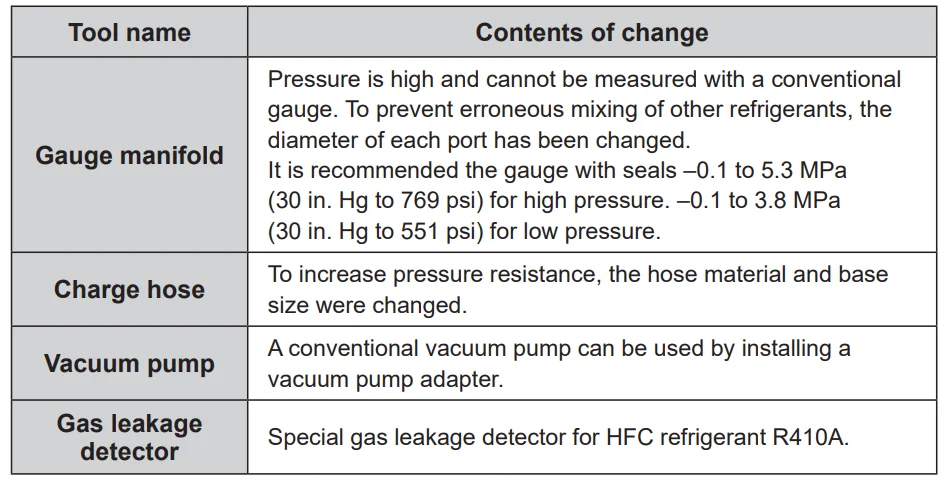
- Since the working pressure is 1.6 times higher than that of conventional refrigerant (R22) models, some of the piping, installation, and service tools are special. (See the table below.) Especially, when replacing a conventional refrigerant (R22) model with a new refrigerant R410A model, always replace the conventional piping and flare nuts with the R410A piping and flare nuts.
- Models that use refrigerant R410A have a different charging port thread diameter to prevent erroneous charging with conventional refrigerant (R22) and for safety.
- Therefore, check beforehand. [The charging port thread diameter for R410A is 1/2 UNF 20 threads per inch.]
- Be careful that foreign matter (oil, water, etc.) does not enter the piping when using refrigerant models. Also, when storing the piping, securely seal the openings by pinching, taping, etc.
- When charging the refrigerant, take into account the slight change in the composition of the gas and liquid phases, and always charge from the liquid phase side whose composition is stable.
Special tools for R410A
Copper pipes
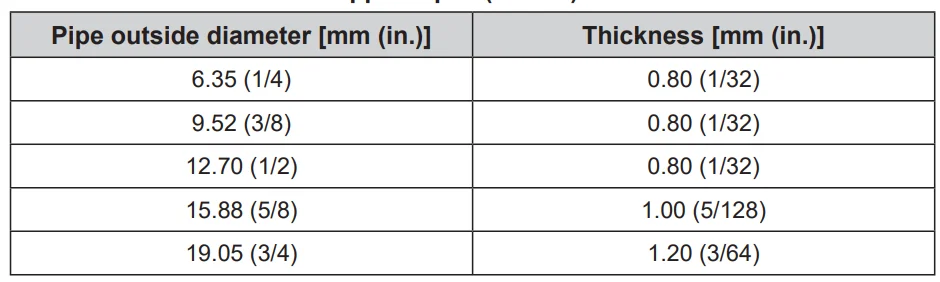
It is necessary to use seamless copper pipes, and the amount of residual oil should be less than 40 mg/10 m (0.004oz/100ft). Do not use copper pipes having a collapsed, deformed or discolored portion (especially on the interior surface). Otherwise, the expansion valve or capillary tube may become blocked with contaminants. As an air conditioner using R410A incurs pressure higher than when using conventional refrigerant, it is necessary to choose adequate materials. Thicknesses of copper pipes used with R410A are as shown in the table. Never use copper pipes thinner than that in the table even when it is available on the market.
Thicknesses of Annealed Copper Pipes (R410A)
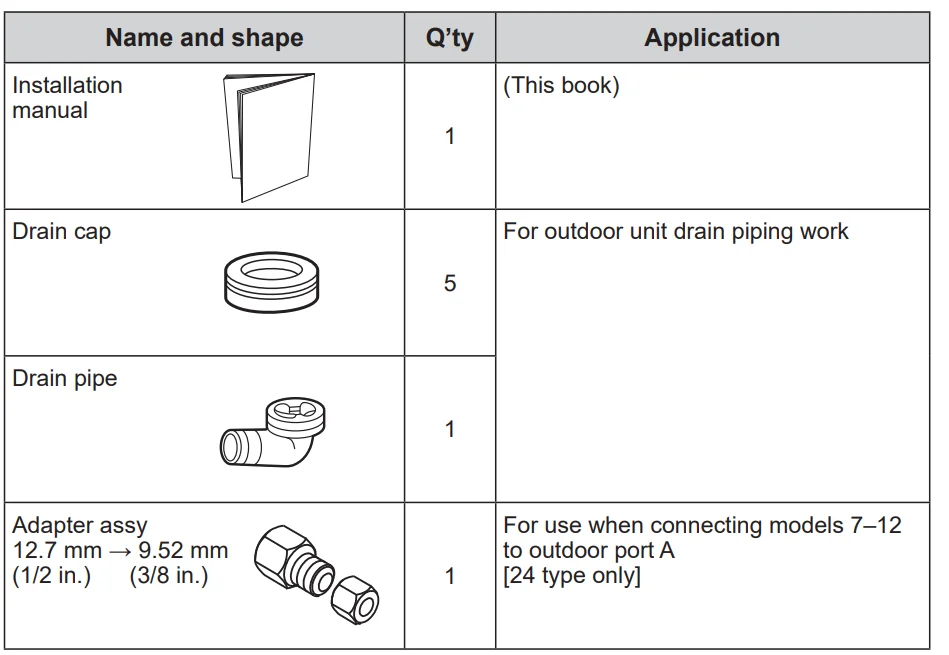
Accessories
WARNING: For installation purposes, be sure to use the parts supplied by the manufacturer or other prescribed parts. The use of non-prescribed parts can cause serious accidents such as the unit falling, water leakage, electric shock, or fire.
Do not throw away the connecting parts until the installation has been completed.
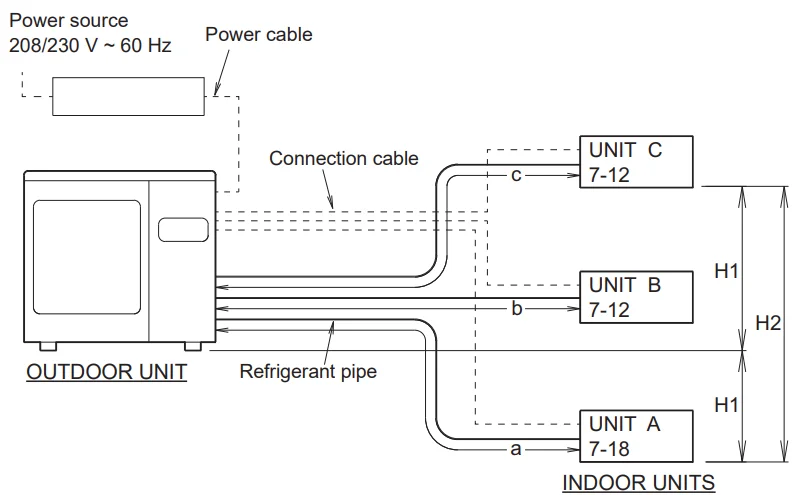
System configuration
Layout example for the indoor units and the outdoor unit
OUTDOOR UNIT:24 type
Connectable indoor unit capacity type
CAUTION: The total capacity of the indoor units connected must be between 14,000 and 27,000 BTU. Connection patterns are restricted. Normal operation is not guaranteed if connected pattern in the combination not listed below. The product may be damaged. Surely connect in accordance with the combination in the following connection pattern.
- To install an indoor unit, refer to the installation instruction sheet included with the indoor unit.
Indoor unit connection pattern
24 type
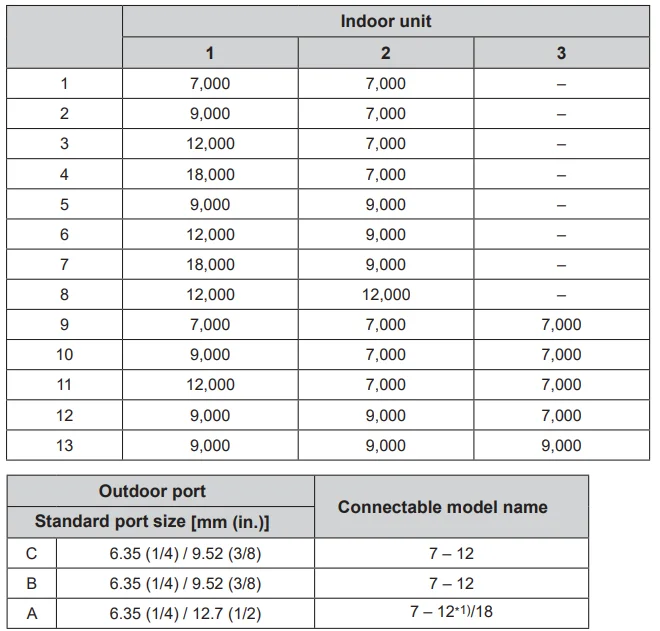
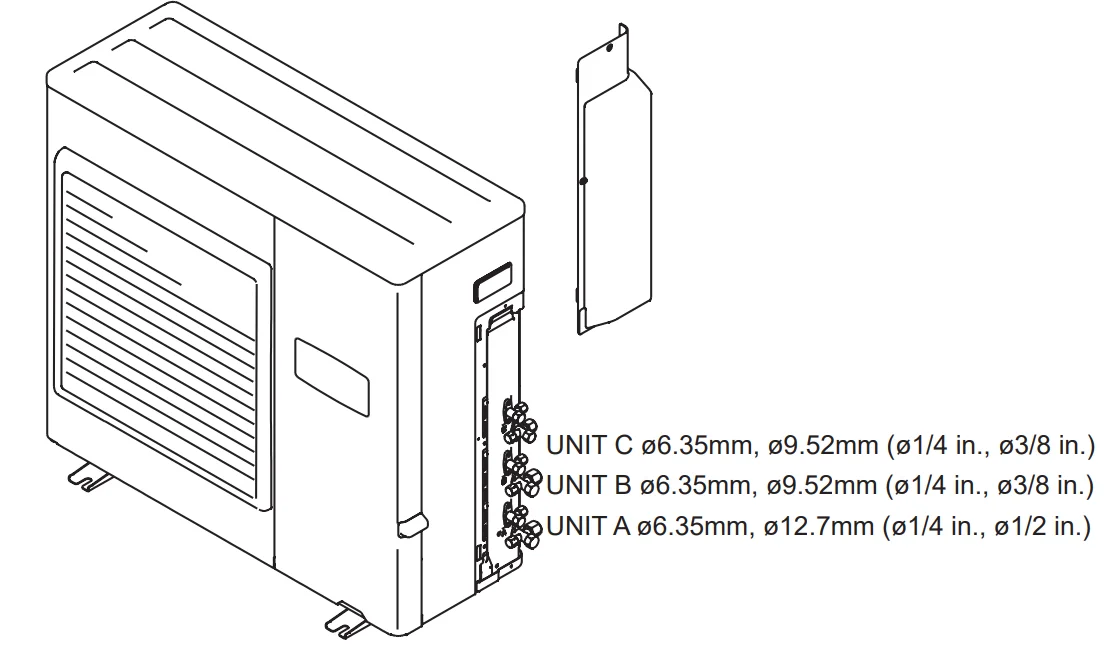
*1) When connecting models 7–12 to the outdoor unit, the included adapter is necessary. For more information, refer to “4.1.3. How to use the adapter”.
Limitation of refrigerant piping length
CAUTION: The total maximum pipe lengths and height difference of this product are shown in the table. If the units are further apart than this, correct operation cannot be guaranteed.
24 type
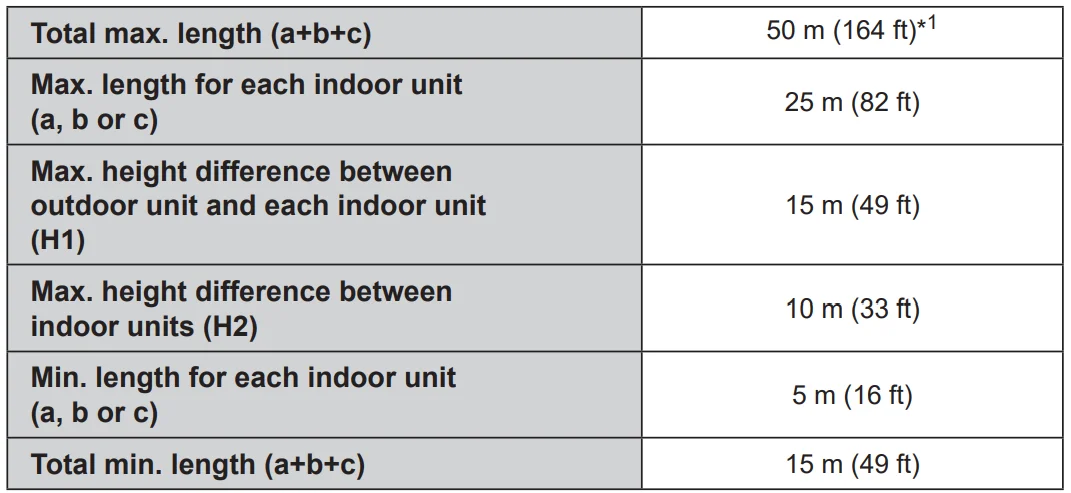
*1 If the total piping is longer than 30 m (98 ft), additional refrigerant charging is necessary. (For more information, refer to “6.2 Additional charging”.)
OUTDOOR UNIT:18 type
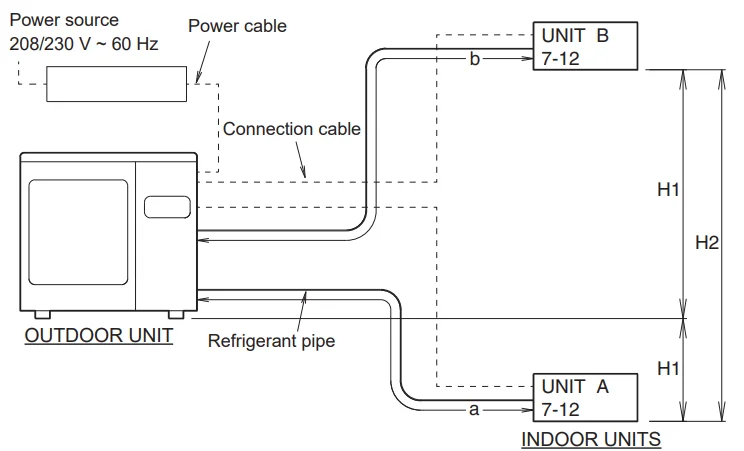
Connectable indoor unit capacity type
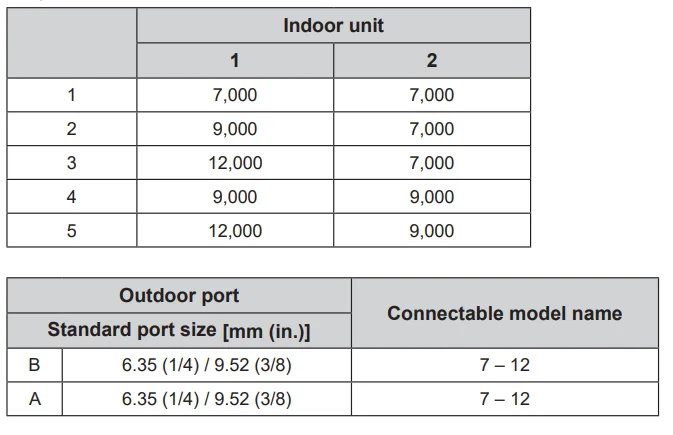
CAUTION: The total capacity of the indoor units connected must be between 14,000 and 21,000 BTU. Connection patterns are restricted. Normal operation is not guaranteed if connected pattern in the combination not listed below. The product may be damaged. Surely connect in accordance with the combination in the following connection pattern.
- To install an indoor unit, refer to the installation instruction sheet included with the indoor unit.
Indoor unit connection pattern
18 type
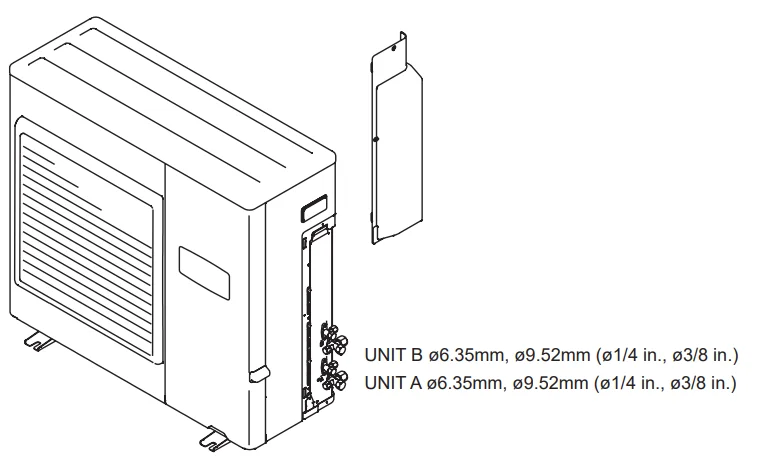
Limitation of refrigerant piping length
CAUTION: The total maximum pipe lengths and height difference of this product are shown in the table. If the units are further apart than this, correct operation cannot be guaranteed.
18 type
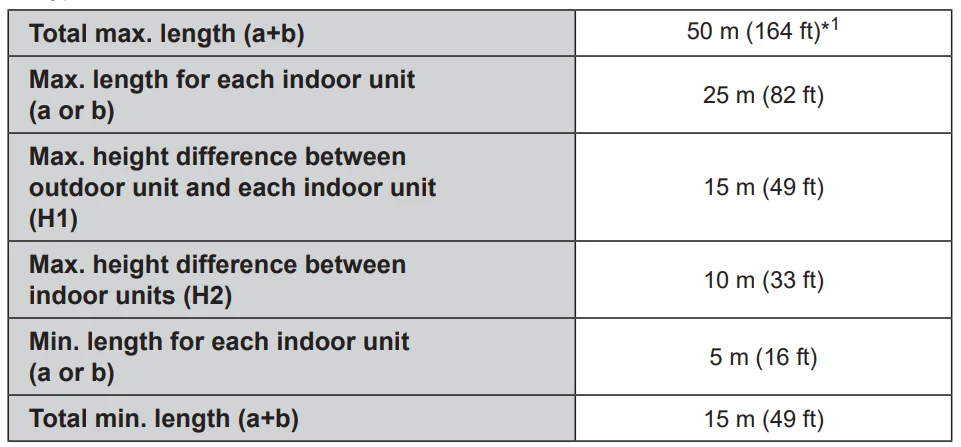
*1 If the total piping is longer than 30 m (98 ft), additional refrigerant charging is necessary. (For more information, refer to “6.2 Additional charging”.)
Selecting pipe sizes
The diameters of the connection pipes differ according to the capacity of the indoor unit. Refer to the following table for the proper diameters of the connection pipes between the indoor and outdoor units.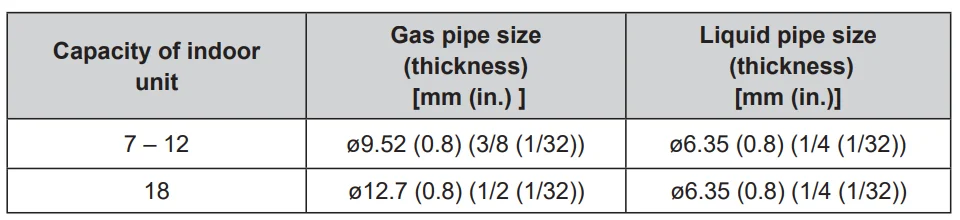
CAUTION: Operation cannot be guaranteed if the correct combination of pipes, valves, etc., is not used to connect the indoor and outdoor units.
INSTALLATION WORK
Please obtain the approval of the customer when selecting the location of installation and installing the unit.
Selecting an installation location
CAUTION
Do not install the outdoor unit in the following areas:
- An area with high salt content, such as at the seaside. It will deteriorate metal parts, causing the parts to fail or the unit to leak water.
- Area filled with mineral oil or containing a large amount of splashed oil or steam, such as a kitchen. It will deteriorate plastic parts, causing the parts to fail or the unit to leak water.
- An area that generates substances that adversely affect the equipment, such as sulfuric gas, chlorine gas, acid, or alkali. It will cause the copper pipes and brazed joints to corrode, which can cause refrigerant leakage.
- Area containing equipment that generates electromagnetic interference. It will cause the control system to malfunction, preventing the unit from operating normally.
- Area that can cause combustible gas to leak, contains suspended carbon fibers or flammable dust, or is volatile in flammables such as paint thinner or gasoline. If gas leaks and settles around the unit, it can cause a fire.
- Area that has heat sources, vapors, or the risk of the leakage of flammable gas in the vicinity.
- Area where small animals may live. It may cause failure, smoke or fire if small animals enter and touch internal electrical parts.
- Area where animals may urinate on the unit or ammonia may be generated. Please install the outdoor unit without a slant. Install the outdoor unit in a well-ventilated location away from rain or direct sunlight. If the outdoor unit must be installed in an area within easy reach of the general public, install as necessary a protective fence or the like to prevent their access. Install the outdoor unit in a location that would not inconvenience your neighbors, as they could be affected by the air ow coming out from the outlet, noise, or vibration. If it must be installed in proximity to your neighbors, be sure to obtain their approval. If the outdoor unit is installed in a cold region that is affected by snow accumulation, snowfall, or freezing, take appropriate measures to protect it from those elements. To
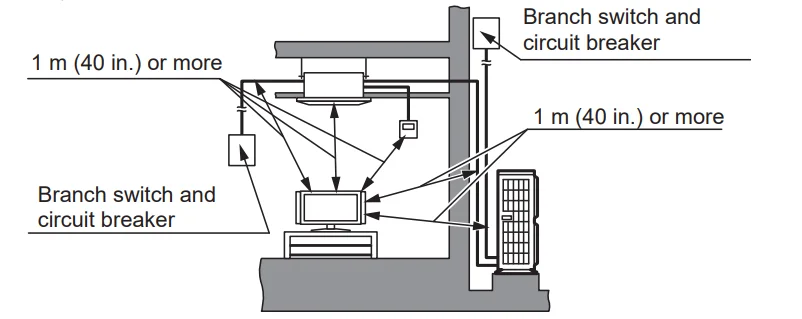
ensure a stable operation, install inlet and outlet ducts. Install the outdoor unit in a location that is away from exhaust or the vent ports that discharge vapor, soot, dust, or debris. - Install the indoor unit, outdoor unit, power supply cable, connection cable, and remote control cable at least 1 m (40 in.) away from a television or radio receiver. The purpose of this is to prevent TV reception interference or radio noise. (Even if they are installed more than 1 m (40 in.) apart, you could still receive noise under some signal conditions.)

Drain installation
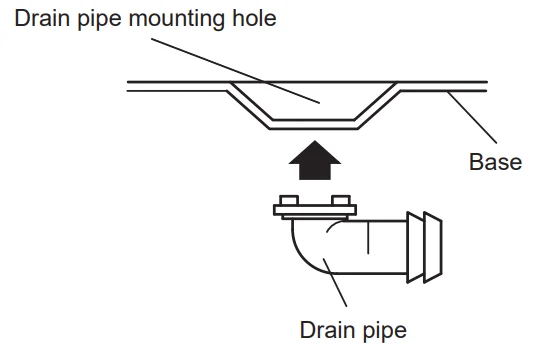
Outdoor unit to be fasten with bolts at the four places indicated by the arrows without fail.
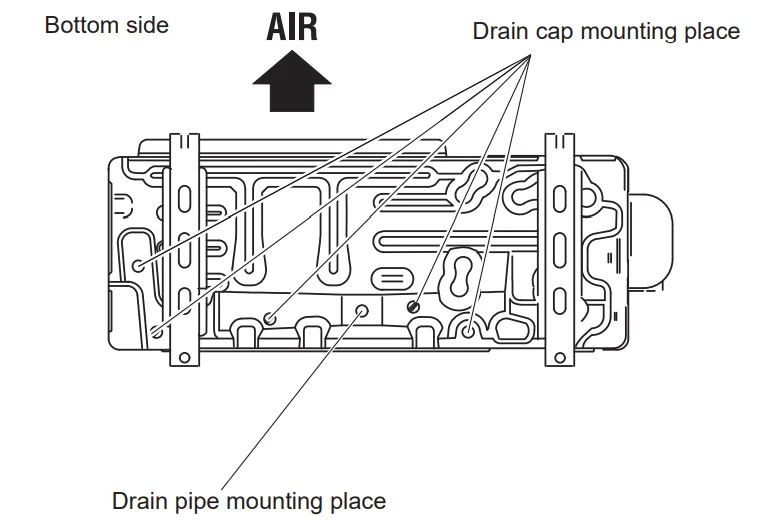
Since the drain water flows out of the outdoor unit during heating operation, install the drain pipe and connect it to a commercial 16 mm (5/8 in.) hose. (Reverse cycle model only). When installing the drain pipe, plug all the holes other than the drain pipe mounting hole in the bottom of the outdoor unit with putty so there is no water leakage. (Reverse cycle model only).
PIPE INSTALLATION – 1
Flare connection (pipe connection)
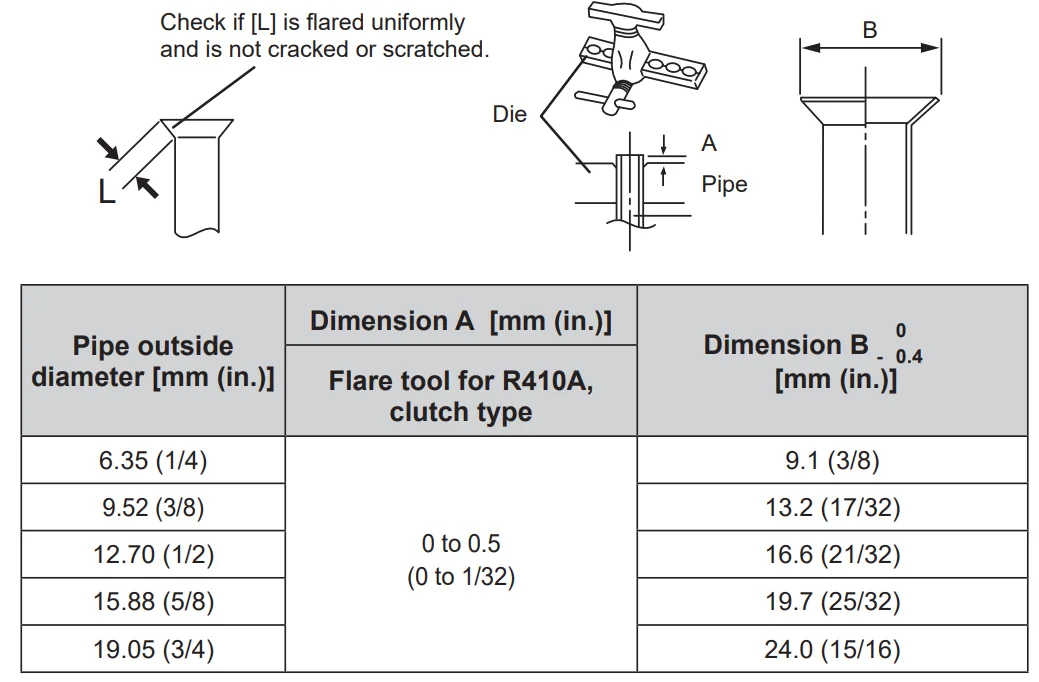
Flaring
- Use a special pipe cutter and flare tool exclusive for R410A.
- Cut the connection pipe to the necessary length with a pipe cutter.
- Hold the pipe downward so that the cuttings will not enter the pipe and remove any burrs.
- Insert the flare nut (always use the flare nut attached to the indoor and outdoor units, respectively) onto the pipe and perform the flare processing with a flare tool. Leakage of refrigerant may result if other flare nuts are used.
- Protect the pipes by pinching them or with tape to prevent dust, dirt, or water from entering the pipes.
 When using conventional flare tools to flare R410A pipes, the dimension A should be approximately 1/32 in. more than indicated in the table (for aring with R410A flare tools) to achieve the specified flaring. Use a thickness gauge to measure the dimension A.
 When using conventional flare tools to flare R410A pipes, the dimension A should be approximately 1/32 in. more than indicated in the table (for aring with R410A flare tools) to achieve the specified flaring. Use a thickness gauge to measure the dimension A.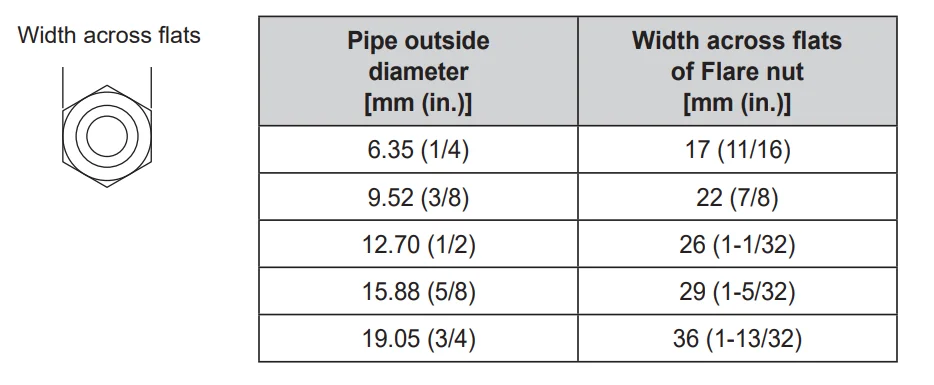
PIPE INSTALLATION – 2
Checking gas leakage and purging air
Gas leak checks are performed using either vacuum or nitrogen gas, so select the proper one depending on the situation.
Checking gas leaks with a vacuum:
- Check if the piping connections are secure.
- Remove the cap of the 3-way valve, and connect the gauge manifold charge hoses to the charging port of the 3-way valve.
- Open the valve of the gauge manifold fully.
- Operate the vacuum pump and start pump down.
- Check that the compound pressure gauge reads -0.1 MPa (500 microns), and operate the vacuum pump for 30 minutes or more in each valve.
- At the end of pump down, close the valve of the gauge manifold fully and stop the vacuum pump. (It checks that leave as it is for about 10 minutes, and a needle does not return.)
- Disconnect the charge hose from the 3-way valve charging port.
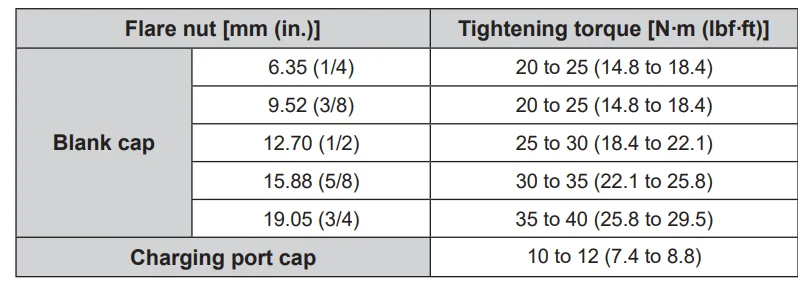
- Remove the blank caps and fully open the spindles of the 2-way and 3-way valves with a hexagon wrench. [torque: 6 to 7 N · m (4.4 to 5.2 lbf·ft)].
- Tighten the blank caps and charging port cap of the 2-way valve and 3-way valve to the specified torque.
Checking gas leaks with nitrogen gas:
- Check if the piping connections are secure.
- Remove the cap of the 3-way valve, and connect the gauge manifold charge hoses to the charging port of the 3-way valve.
- Pressurize with nitrogen gas using the 3-way valve charging port.
- Do not pressurize up to the specified pressure all at once but do so gradually.
- Increase the pressure up to 0.5 MPa (73 psi), let it sit for about 5 minutes and then check for any decrease in pressure.
- Increase the pressure up to 1.5 MPa (218 psi), let it sit for about 5 minutes and then check for any decrease in pressure.
- Increase the pressure up to the specified pressure (the pressure designed for the product) and then make a note of it.
- Let it sit at the specified pressure and if there is no decrease in pressure, then it is satisfactory. If a pressure decrease is confirmed, there is a leak, so it is necessary to specify the leak location and make minor adjustments.
- Discharge the nitrogen gas and start removing the gas with a vacuum pump.
- Open the valve of the gauge manifold fully.
- Operate the vacuum pump and start pump down.
- Check that the compound pressure gauge reads -0.1 MPa (500 microns), and operate the vacuum pump for 30 minutes or more in each valve.
- At the end of pump down, close the valve of the gauge manifold fully and stop the vacuum pump.
- Disconnect the charge hose from the 3-way valve charging port.
- Remove the blank caps and fully open the spindles of the 2-way and 3-way valves with a hexagon wrench. [torque: 6 to 7 N · m (4.4 to 5.2 lbf·ft)].
- Tighten the blank caps and charging port cap of the 2-way valve and 3-way valve to the specified torque.

TEST RUN
The test run method may be different for each indoor unit that is connected. Refer to the installation instruction sheet included with each indoor unit.
Make a test run in accordance with the installation Manual for the indoor unit
- Indoor unit
- Is the operation of each button on the remote control unit normal?
- Does each lamp light normally?
- Does the air flow direction of the louver operate normally?
- Is the drain normal?
- Is there any abnormal noise and vibration during operation?
- Outdoor unit
- Is there any abnormal noise and vibration during operation?
- Will noise, wind, or drain water from the unit disturb the neighbors?
- Is there any gas leakage?
- Do not operate the air conditioner in the test running state for a long time.
- For the operation method, refer to the operating manual and perform an operation check.
Outdoor unit LED
When a malfunction occurs in the outdoor unit, the LED on the circuit board lights to indicate the error. Refer to the following table for the description of each error according to the LED.
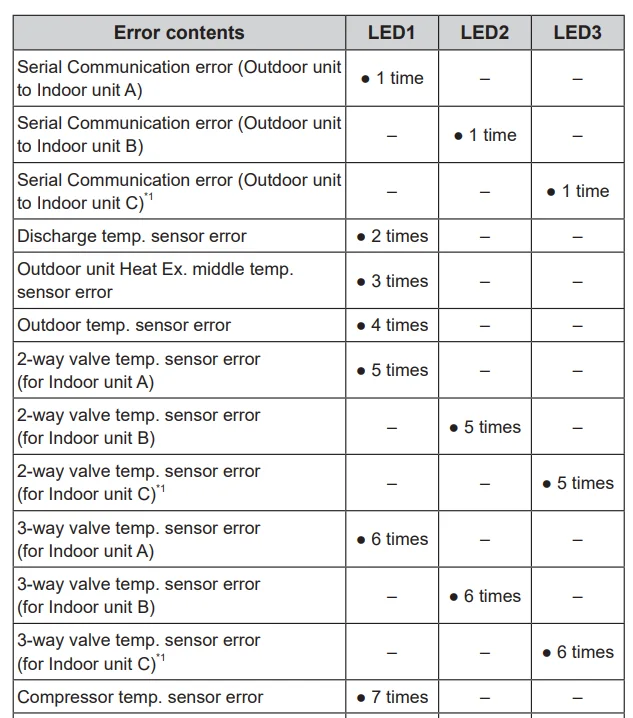
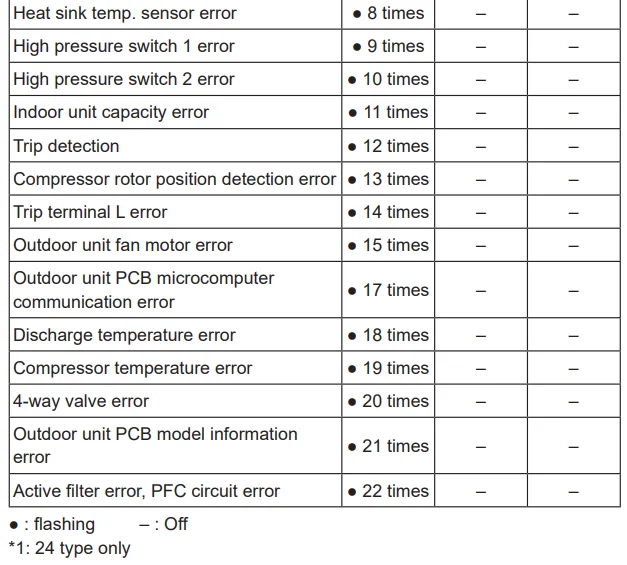
PUMP DOWN
PUMP DOWN OPERATION
To avoid discharging refrigerant into the atmosphere at the time of relocation or disposal, recover refrigerant by doing the cooling operation or forced cooling operation according to the following procedure. (When the cooling operation cannot start in winter, and so on, start the forced cooling operation.)
- Do the air purging of the charge hose by connecting the charging hose of the gauge manifold to the charging port of 3 way valve (At least one unit of connected units) and opening the low-pressure valve slightly.
- Close the valve stem of 2 way valve (All connected units) completely.
- Start the cooling operation or following forced cooling operation. (All connected units) When using the remote control unit Press the TEST RUN button after starting the cooling operation by the remote control unit. The operation indicator lamp and timer indicator lamp will begin to flash simultaneously during the test run. When using the MANUAL AUTO button of the indoor unit (The remote control unit is lost, and so on) Keep pressing the MANUAL AUTO button of the indoor unit for more than 10 seconds. (The forced cooling operation cannot start if the MANUAL AUTO button is not kept pressed for more than 10 seconds.)
- Close the valve stem of 3 way valve (All connected units) when the reading on the compound pressure gauge becomes 0.05 ~ 0 MPa (7.3 ~ 0 psi).
- Stop the operation. (All connected units) Press the START/STOP button of the remote control unit to stop the operation. Press the MANUAL AUTO button when stopping the operation from the indoor unit side. (It is not necessary to press on for more than 10 seconds.)
CAUTION: During the pump-down operation, make sure that the compressor is off before you remove the refrigerant piping. Do not remove the connection pipe while the compressor is in operation with the 2 or 3-way valve open. This may cause abnormal pressure in the refrigeration cycle, leading to breakage and injury.
CUSTOMER GUIDANCE
Explain the following to the customer in accordance with the operating manual:
- Starting and stopping method, operation switching, temperature adjustment, timer, air flow adjustment, and other remote control unit operations.
- Air filter removal and cleaning.
- Give the operating manual and installation instruction sheet to the customer.
For more manuals by Fujitsu, visit ManualsLibraryy
Fujitsu AOU24RLXFZ Outdoor Unit-FAQs
What are common issues with Fujitsu outdoor units?
During cooling or dry mode, you may see light mist from the indoor unit due to condensation. In heating mode, steam from the outdoor unit is normal during defrost cycles.
What are the main specifications of the Fujitsu AOU24RLXFZ?
This outdoor unit provides 22,000 BTU cooling and 24,000 BTU heating, operates on 208/230V, uses inverter technology, and delivers high efficiency with 18 SEER performance.
What refrigerant does the Fujitsu AOU24RLXFZ use?
The AOU24RLXFZ model uses R-410A refrigerant, which offers stable performance and efficient heat transfer.
What is the minimum outdoor temperature this unit can operate in?
Fujitsu mini-split systems are designed to work in cold climates, with some models operating efficiently down to -15°F, depending on configuration.
How long does a Fujitsu air conditioner usually last?
With proper maintenance, Fujitsu air conditioners typically last 10 to 15 years or longer.
Is it normal for the unit to run continuously?
Yes. Fujitsu inverter systems are designed for continuous operation and automatically adjust output to maintain efficiency.
At what temperature do mini-split systems stop working?
Most mid-range mini splits operate efficiently down to 20°F, while advanced Fujitsu models can continue heating in much colder conditions.
Why is my Fujitsu outdoor unit not turning on?
Possible causes include power issues, a faulty capacitor, thermostat signal problems, or a tripped breaker. Basic checks should be done before calling a technician.
What is the 3-minute rule for air conditioners?
After turning the unit off, wait at least 3 minutes before restarting. This allows system pressure to balance and protects the compressor.