
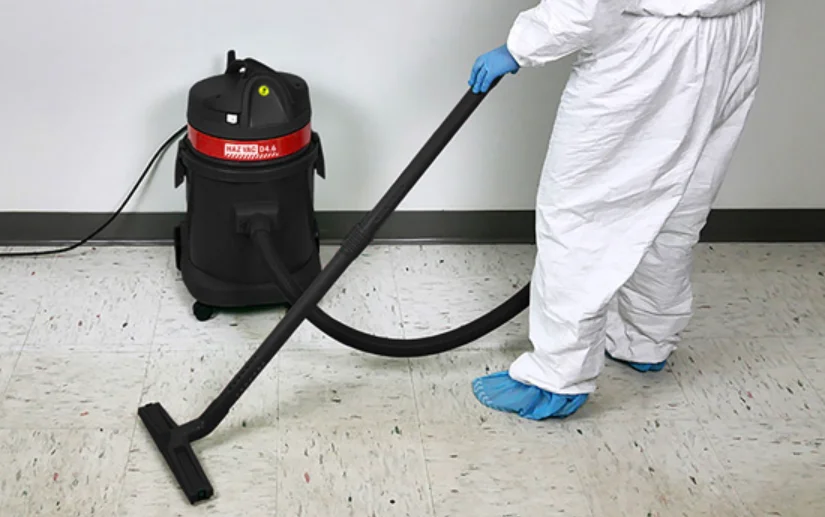

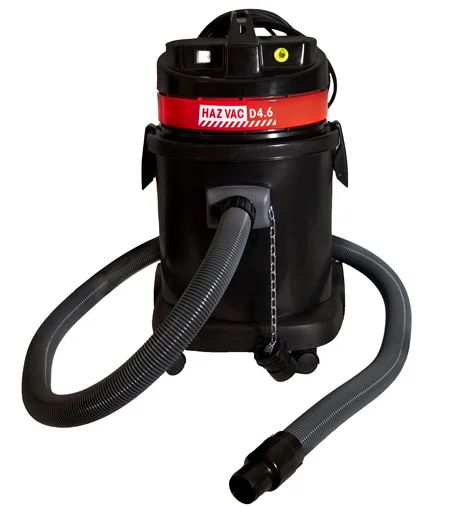
Atrix ATIAHV Hazardous Particulate D4.6 HEPA Vacuum
INTRODUCTION
This manual describes your vacuum cleaner’s features. It is the owner’s responsibility to make sure that the vacuum cleaner is used by people informed about this handbook of instructions. It is not permitted for the owner to modify, use, or tamper with the vacuum cleaner for purposes different from those described in this handbook; otherwise, the warranty is no longer effective and exempts the manufacturer from every responsibility for possible damages to people or things.
In case of loss or damage to the handbook, please contact the manufacturing company. In case of sale of the vacuum cleaner, please attach the present handbook of instructions to the machine or inform the buyer about the manufacturing company. The vacuum cleaner is fully tested before delivery, in order to ensure the good performance of the appliance. This is done according to strict internal procedures and with modern yearly certified electrical tests.
INTENDED USE
- An appliance designed to vacuum dust and light debris.
- Not suitable for picking up liquids.
- Solid, powerful, and easy to use, it is also equipped with efficient tools for a rapid and complete cleaning.
- This vacuum cleaner is suitable for collective use: for example, in hotels, schools, factories, shops, etc.
INSTRUCTIONS THAT MUST BE STRICTLY FOLLOWED – SAFE USE
Read the manual before use, in order to work in a safe environment.
- Warning: Before using the appliance, the device must be correctly assembled. Check that all the equipped filtering elements are in place and efficient.
- Caution: Do not use outdoors.
- Warning: Use only with dust or dry materials.
- Warning: Do not pick up liquids.
- This appliance must be kept out of the reach of children, of people with reduced physical, sensory, or mental abilities, or lacking experience and knowledge.
- CAUTION: Children must be kept under control; do not allow children to use the appliance as a toy.
- WARNING: Users must be properly trained to use the machine.
- CAUTION: Components used in packaging (ex, plastic bags) can be dangerous; keep away from children, animals, and people not aware of their actions.
- To correctly dispose of the packaging, follow the local standards in force.
- Make sure that the voltage of the electrical mains is the same as that indicated on the rating plate of the vacuum cleaner. Verify that the socket is compatible with the plug. The power cable must always be unrolled before using the appliance. Do not use the cable coiled.
- Do not handle or use a plug or appliance with wet hands.
- Do not pick up anything that can damage the filtering elements (such as glass or metal).
- Do not use the electrical cord to move or lift the machine.
- Never immerse the machine in water, and never use a pressure jet of water to clean the machine.
- Do not use this appliance beyond 2000 m (6560 ft) above sea level.
- WARNING: This machine is not suitable for picking up dangerous dust.
- CAUTION: Don’t pick up flammable, incandescent, explosive, or toxic dust or blends. Maximum temperature allowed is 40°C (104°F).
- Warning: Any application not described in this manual is potentially dangerous; therefore, it must be avoided.
- Warning: Do not leave a working machine unsupervised. Always unplug the machine if the appliance is not working. Keep away from children and from people not aware of their actions.
- WARNING: This appliance must be used, assembled, fixed, and moved on a safe and not sloping plane.
- WARNING: This appliance must be stored, considering its weight, on a solid, steady, safe, and not sloping plane, indoors and in a dry area.
- WARNING: Do not use outdoors or in a damp or cold environment.
- WARNING: Keep hands, feet, ears, loose clothing, hair, and all parts of the body (human or animals) away from openings.
- WARNING: If the appliance is provided with a supplementary socket, do not use a tool exceeding the power reported on the socket. Non-observance of these rules could result in damage and injuries, or even be lethal to the user.
- Do not allow the power cord to come into contact with the rotating brushes of the carpet cleaning head.
- Warning: Use only original spare parts. Using other accessories might compromise the operator’s safety.
- Warning: This machine is not suitable for picking up dust in environments where electrostatic discharges or sparks can cause damage to electronic components and persons.
- Warning: It is forbidden to tamper with or modify the appliance. Failure to comply with these instructions could cause serious accidents and damage to the user, which can also lead to death. Tampering will void the warranty.
- The manufacturer refuses all responsibility for damages or injuries due to improper use of the machine or in case of failure to comply with the instructions given in this manual.
- Always disconnect the power cord from the power source before operating.
- After every use and before sending the appliance to technical assistance, the vacuum cleaner must be disassembled, cleaned, and overhauled to avoid hazards for the maintenance staff.
- Do routine maintenance. Inspect gaskets, seals, plastic parts, filters, switches, and replace those that have begun to leak or are damaged.
- Using a machine with a damaged power cord could result in electrocution. Check the cord looking for cuts, cracks, or the aging signs of aging and replace it if it’s necessary.
- Only an authorized service centre can replace the power cord of the appliance.
- If extension cords are used, ensure that the cable rating is suitable for use with the equipment. Keep dry at all times. Avoid contact with conductive surfaces.
- Don’t let children clean the appliance if they are not under the supervision of an adult.
- Only an authorized service centre can do repairs or maintenance of the appliance. Use only original spare parts.
- To keep the appliance fully functional, it is necessary to clean the polyester filter by shaking it after every use and replace the filtering bag if it’s full.
- Clean every part of the appliance after each use: empty the tank, shake the filters, replace the filtering bag if it’s full, and clean the machine with a damp cloth before storing the vacuum cleaner.
NOISE
- Values measured according to EN 60704-1 (1997) / EN 60704-2-1 (2001) / ISO 3744 standards.
- The sound pressure level weighted A of the appliance is less than 70 dB (A).
VIBRATIONS
- Hand-arm vibrations on the suction hose are less than 2.5 m/s² as recommended by ISO 5349-1.
- Under adverse network conditions, the appliance may cause temporary drops in voltage.
COMPONENT DESCRIPTION
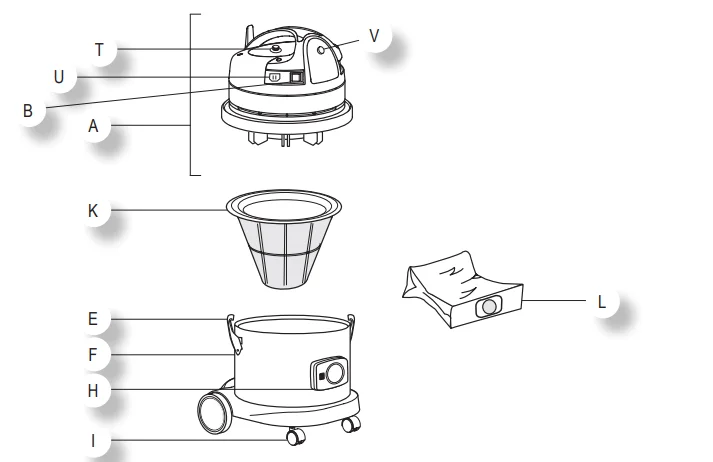
- A – Motor head
- B – Switch
- E – Hooks
- F – Tank
- H – Inlet
- I – Castor wheels
- K – Main filter to insert into the tank (filtering cartridge as an alternative)
- L – Filter bag to apply on top of deflector. This filter does not exclude the use of a polyester filter, which still has to be used.

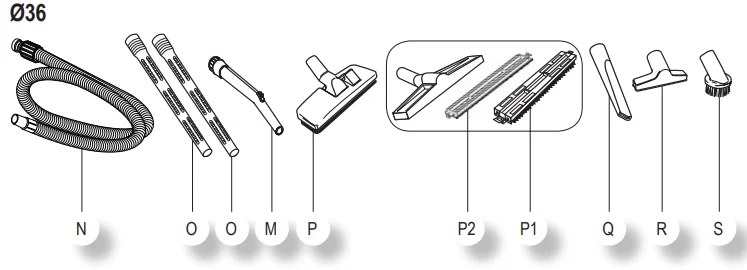
- M – Wand
- N – Flexible hose
- O – Hose
- P – Double-use brush
- P1 – Dust brush
- P2 – Carpet brush
- Q – Crevice nozzle
- R – Upholstery nozzle
- S – Round brush
- T – Speed regulator (optional)
- U – Electric floorhead additional socket (optional)
- V – Warning light (optional)
- W – Detachable power cord (optional)

DRY PICK UP
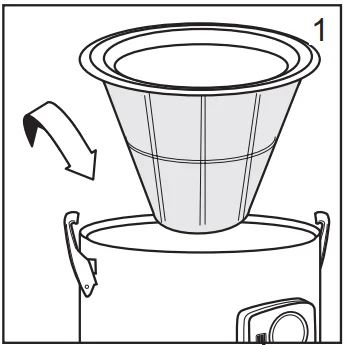
- Insert the main polyester filter into the tank (Fig. 1).

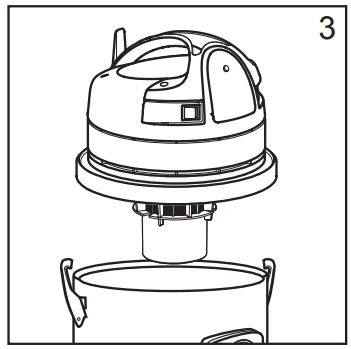
- Mount the head on top of the tank and lock it with hooks (Fig. 3).

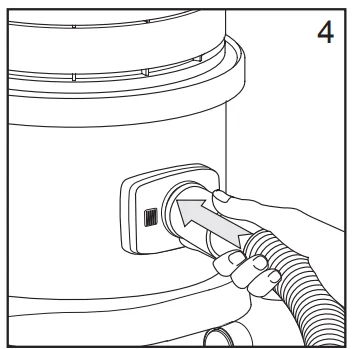
- Push the hose into the hose inlet (Fig. 4).

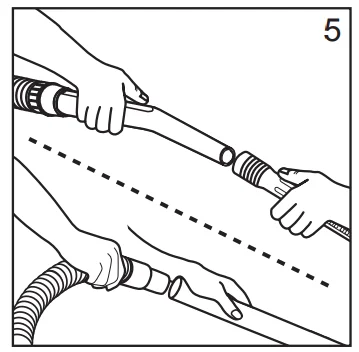
- Attach the wand and desired tool to the hose ends (Fig. 5).

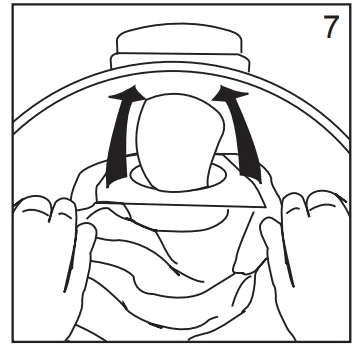
- If your vacuum is equipped with a paper bag, slide the paper bag over the deflector (Fig. 7).

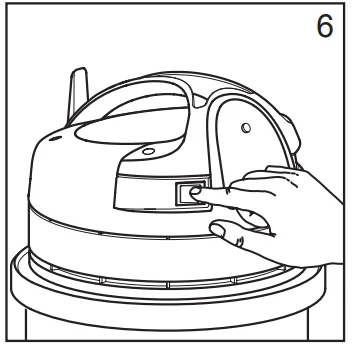
- Plug the power cord into a properly grounded outlet and turn the cleaner on (Fig. 6).

IMPORTANT INFORMATION ABOUT OPTIONAL VERSIONS:
Appliance with full filter warning light (optional)
- When the warning light activates, it means that the filtering bag -L- is full.
- When the light is on, change the filter bag as soon as possible and clean the main filter -K-.
- Warning: Stop using your vacuum cleaner if the warning light is on.
- Overheating can take place, causing permanent damage to the engine.
- While vacuuming soft surfaces like carpets, couches, etc., the warning LED can light even if the filter bag is not full. If you move the tool away from the surface and the light turns off, you can keep working.
Appliance with floor head and additional socket (optional)
- The socket -U- is designed to connect a floor head.
- WARNING: Maximum power allowed is 200 W.
- Don’t connect electrical floor brushes to a bigger load. This may result in a fire hazard or electric shock.
Appliance with speed regulator (optional)
With the speed regulator -T- you can increase or lower the vacuum suction power (Fig. 8).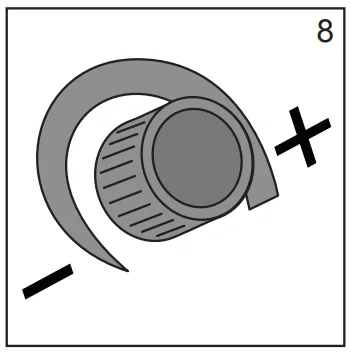
Appliance with detachable cable (optional)
With this version, you can detach the power cord.
Motor with thermal protection (optional)
The motor has a thermal device that prevents dangerous overheating that can cause motor failure. It turns the motor off when excessive heat is generated to prevent burning and damage.
WARNING: Thermal protection intervenes when one of these parts is clogged:
- filter bag -L-
- main filter -K-
- flexible hose -N-
- tool
Disconnect the appliance from the mains, unclog the obstructed part, and wait 20/30 minutes. Once the motor cools down, the thermal protector resets itself. For more details visit: www.atrix.com.
For More Manuals By Atrix, Visit ManualsLibraryy.
Atrix ATIAHV Hazardous Particulate D4.6 HEPA Vacuum-FAQs
What is a HEPA vacuum?
A HEPA vacuum uses a High-Efficiency Particulate Air (HEPA) filter to capture tiny particles like dust, pollen, mold spores, and other allergens. This ensures that the air released by the vacuum is much cleaner than ordinary vacuums.
Why should I choose a vacuum with a HEPA filter?
HEPA vacuums trap nearly all fine particles, making them ideal for homes with allergy sufferers, sensitive environments, or workplaces with hazardous dust. They prevent dust and allergens from circulating back into the air.
How clean is the air from a HEPA vacuum?
The air exhausted from a HEPA vacuum is significantly cleaner because the filter captures 99.97% of particles as small as 0.3 microns, including microscopic allergens and dust.
Can I use a HEPA vacuum for hazardous dust like silica?
Yes. HEPA vacuums are required by safety standards (like OSHA) for cleaning hazardous dust, including silica, to prevent harmful particles from spreading in the air.
How often should I replace the HEPA filter?
Depending on use and environment, a HEPA filter typically lasts between 6 months to 3 years. A clogged or damaged filter reduces efficiency and may release trapped pollutants back into the air.
Can HEPA filters be washed and reused?
Some HEPA filters are washable, but many are not. Washing non-washable filters can damage them and reduce effectiveness. Always check the manufacturer’s instructions.
What happens if I don’t replace a full HEPA filter?
If ignored, a full filter can break or release trapped particles, polluting your home or workplace and potentially causing respiratory issues.
How is a HEPA vacuum different from a regular vacuum?
Regular vacuums often release fine dust and allergens back into the air. HEPA vacuums trap these particles, ensuring cleaner air and better protection against allergens.
Can I use a HEPA vacuum for liquids?
No, most HEPA vacuums, including the Atrix ATIAHV, are designed for dry particulate matter. Using them with liquids may damage the unit or the filter.
Are HEPA vacuums worth the investment?
Absolutely. They maintain cleaner environments, reduce allergens, and comply with safety standards for hazardous dust, making them essential for homes, workshops, or industrial spaces.