
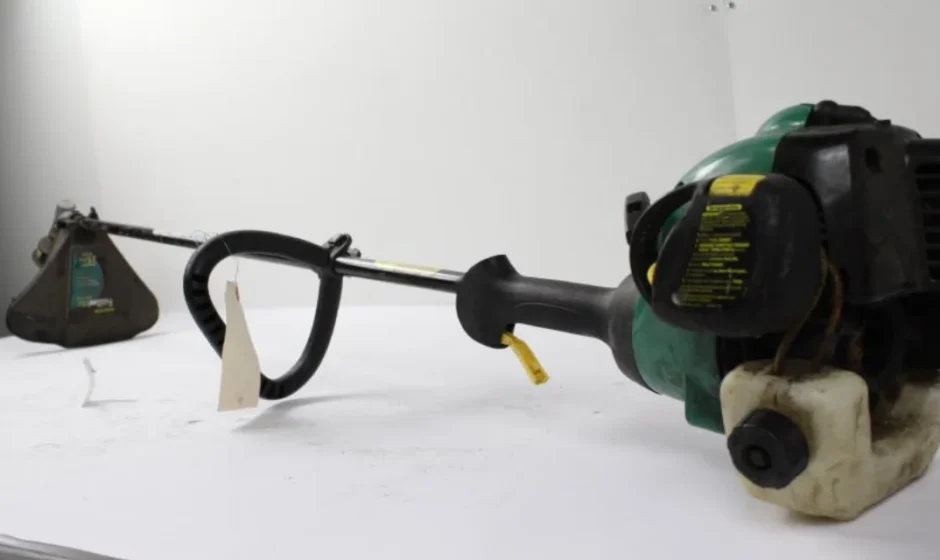

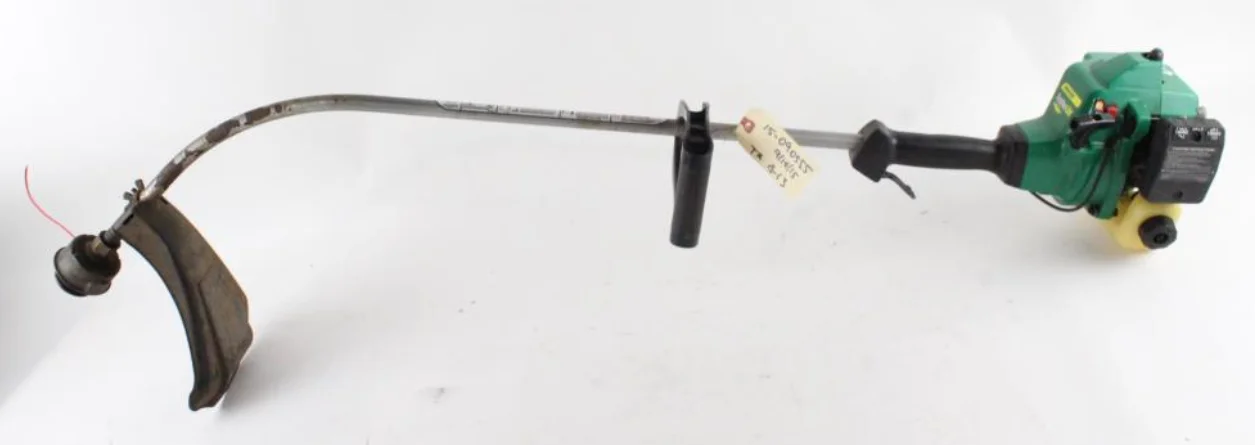
Weed Eater TE475 Gas String Trimmer
SAFETY RULES
WARNING: When using gardening appliances, basic safety precautions must always be followed to reduce the risk of fire and serious injury. Read and follow all instructions. This power unit can be dangerous! The operator is responsible for following the instructions and warnings on the unit and in the manual. Read the entire instruction manual before using the unit! Be thoroughly familiar with the controls and the proper use of the unit. Restrict the use of this unit to persons who have read, understand, and will follow the instructions and warnings on the unit and in the manual. Never allow children to operate this unit.
DANGER: Never useblades or flailing devices. This unit is designed for line trimmer use only. Use of any other accessories or attachments will increase the risk of injury. If situations occur that are not covered in this manual, use care and good judgment. If youneed assistance, contact your authorized service dealer or call 1-800-554–6723.
OPERATOR SAFETY
- Dress properly. Always wear safety glasses or similar eye protection when operating or performing maintenance on your unit (safety glasses are available). Eye protection should
be marked Z87. - Always wear a face or dust mask if the operation is dusty.
- Always wear heavy, long pants, long sleeves, boots, and gloves. Wearing safety leg guards is recommended.
- Always wear foot protection. Do not go barefoot or wear sandals. Stay clear of the spinning line.
- Secure hair above shoulder length. Secure or remove loose clothing or clothing with loosely hanging ties, straps, tassels, etc. They can be caught in moving parts.
- Being fully covered also helps protect you from debris and pieces of toxic plants thrown by the spinning line.
- Stay Alert. Do not operate this unit when you are tired, ill, upset, or under the influence of alcohol, drugs, or medication. Watch what you are doing; use common sense.
- Wear hearing protection.
- Never start or run inside a closed room or building. Breathing exhaust fumes can kill.
- Keep handles free of oil and fuel.
WARNING: The engine exhaust from this product contains chemicals known totheState ofCalifornia to cause cancer, birth defects, or other reproductive harm.
SAFETY NOTICE: Exposure to vibrations through prolonged use of gasoline-powered hand tools could cause blood vessel or nerve damage in the fingers, hands, and joints of people prone to circulation disorders or abnormal swellings. Prolonged use in cold weather has been linked to blood vessel damage in otherwise healthy people. If symptoms occur, such as numbness, pain, loss of strength, change in skin color or texture, or loss of feeling in the fingers, hands, or joints, discontinue the use of this tool and seek medical attention. An anti-vibration system does not guarantee the avoidance of these problems. Users who operate power tools on a continual and regular basis must monitor their physical condition and the condition of these tools closely. SPECIAL NOTICE: This unit is equipped with a temperature-limiting muffler and spark-arresting screen, which meets the requirements of CaliforniaCodes 4442 and 4443. All U.S. forest land and the states of California, Idaho, Maine, Minnesota, New Jersey, Oregon, and Washington require by law that many internal combustion engines be equipped with a spark-arresting screen. If you operate in a locale where such regulations exist, you are legally responsible for maintaining the operating condition of these parts. Failure to do so is a violation of the law. For normal homeowner use, the muffler and spark-arresting screen will not require any service. After 50 hours of use, we recommend that your muffler be serviced or replaced by your authorized service dealer.
ASSEMBLY
WARNING: If received assembled, repeat all steps to ensure your unit is properly assembled and all fasteners are secure. Examine parts for damage. Do not use damaged parts.
NOTE: If you need assistance or find parts missing or damaged, call 1-800-554-6723. It is normal for the fuel filter to rattle in the empty fuel tank. Finding fuel or oil residue onmuffler is normal due to carburetor adjustments and testing done by the manufacturer.
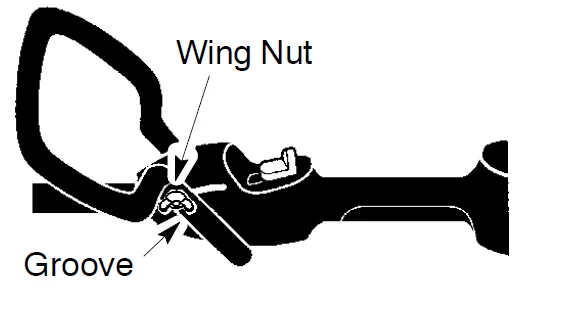
ADJUSTING THE ASSIST HANDLE
- Loosen the wing nut on the handle.
- Pivot the handle to a comfortable position; retighten the wing nut.
ATTACHING SHIELD
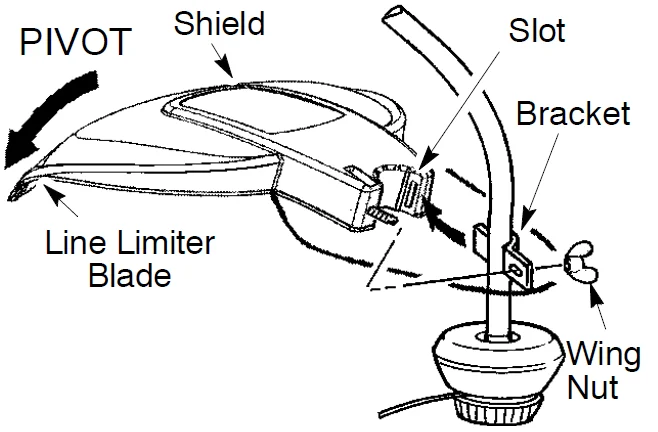
WARNING: The shield must be properly installed. The shield provides partial protection from the risk of thrown objects to the operator and others and is equipped with a line limiter blade, which cuts excess line to the proper length. The line limiter blade (on the underside of the shield) is sharp and can cut you. For proper orientation of the shield, see KNOW YOUR TRIMMER illustration in the OPERATION section.
- Remove the wing nut from the shield.
- Insert the bracket into the slot as shown.
- Pivot shield until the bolt passes through the hole in the bracket.
- Securely tighten the wing nut onto the bolt.
OPERATION
KNOW YOUR TRIMMER
READ THIS INSTRUCTIONMANUAL AND SAFETYRULES BEFOREOPERATING YOURUNIT. Compare the illustrations with your unit to familiarize yourself with the location of the various controls and adjustments. Save this manual for future reference.
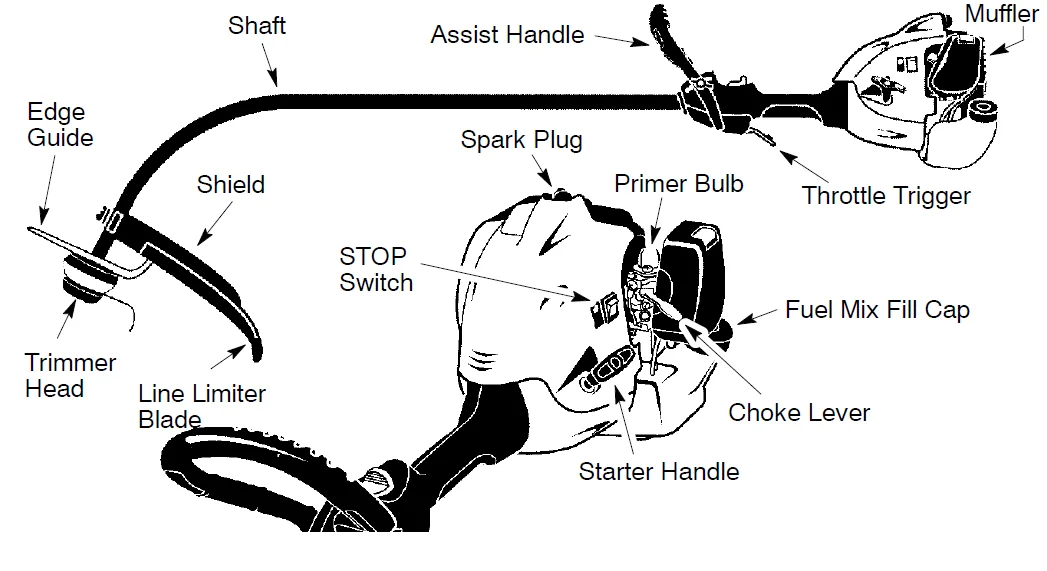
STOP SWITCH
The STOP switch is used to stop the engine. To stop the engine, push and hold the switch in the STOP position until the engine stops.
PRIMER BULB
The PRIMER BULBremoves air fromthecarburetor and fuel lines and fills them with fuel. This allows you to start the engine with fewer pulls on the starter rope. Activate the primer bulb by pressing it and allowing it to return to its original form.
CHOKE
The CHOKE helps to supply fuel to the engine to aid in cold starting. Activate the choke by moving the choke lever to the FULL CHOKE position. After the engine attempts to start, move the choke lever to the HALF CHOKE position. Once the engine has started, move the choke lever to the RUN position.
EDGE GUIDE
The EDGEGUIDE protects the unit fromcontacting the ground during edging.
BEFORE STARTING THE ENGINE
WARNING: Be sure to read the fuel information in the safety rules before you begin. If you do not understand the safety rules, do not attempt to fuel your unit. Call 1-800-554-6723.
FUELING ENGINE
WARNING: Remove fuel cap slowly when refueling. This engine is certified to operate on unleaded gasoline. Before the operation, gasoline must be mixed with a good quality synthetic 2-cycle air-cooled engine oil designed to be mixed at a ratio of 40:1. Poulan/WEED EATER brand synthetic oil is recommended. Mix gasoline and oil at a ratio of 40:1. A 40:1 ratio is obtained by mixing 3.2 fluid ounces (95ml) of oilwith 1 gallon (4 liters) of unleaded gasoline. DO NOT USE automotive oil or marine oil. These oils will cause engine damage. When mixing fuel, follow the instructions printed on the container. Once oil is added to gasoline, shake the container momentarily to ensure that the fuel is thoroughly mixed. Always read and follow the safety rules relating to fuel before fueling your unit.
CAUTION: Never use straight gasoline in your unit. This will cause permanent engine damage and void the limited warranty.
HOW TO STOP YOUR UNIT
- To stop the engine, push and hold the STOP switch in the STOP position until the engine stops.
- If the engine does not stop, move the choke to the FULL CHOKE position.
HOW TO START YOUR UNIT
WARNING: The trimmer head will turn while starting the engine. Avoid any contact with the muffler. A hot muffler can cause serious burns.
NOTE: Make sure approximately 3 — 4 inches (8 — 10 cm) of line is extended from the cutting head before starting the unit. This will allow the line to advance properly once the unit starts.
STARTING A COLD ENGINE (or a warm engine after running out of fuel)
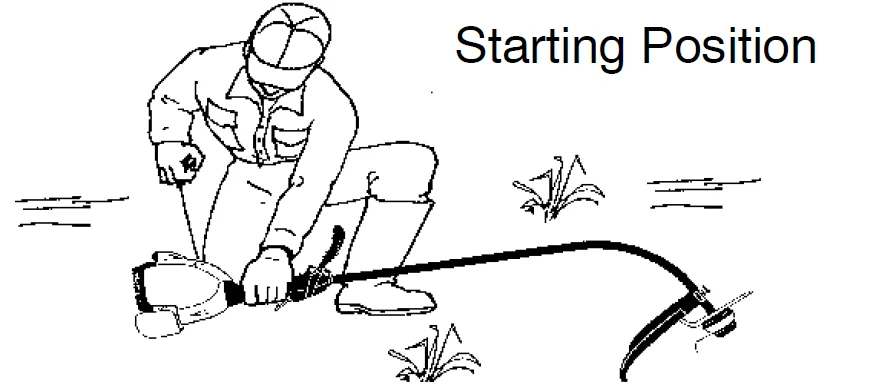
- Set the unit on a flat surface.
- Slowly press the primer bulb 6 times.
- Move the choke lever to the FULL CHOKE position.
- Squeeze the throttle trigger fully and hold through all remaining steps.

- Pull the starter rope handle sharply until the engine sounds as if it is trying to start, but do not pull the rope more than 6 times.
- As soon as the engine sounds as if it is trying to start, move the choke lever to the HALF CHOKE position.
- Pull the starter rope sharply until the engine runs, but no more than 6 pulls.
NOTE: If the engine doesn’t start after 6 pulls (at the HALF CHOKE position), move the choke lever to the FULL CHOKE position and press the primer bulb 6 times. Squeeze and hold the throttle trigger and pull the starter rope 2 more times. Move the choke lever to the HALF CHOKE position and pull the starter rope until the engine runs, but no more than 6 pulls. If the engine still doesn’t start, it is probably flooded. Proceed to STARTING A FLOODED ENGINE. - Once the engine starts, allow it to run 10 seconds, then move the choke lever to the RUN position. Allow the unit to run for 30 more seconds at RUN before releasing the throttle trigger.
NOTE: If the engine dies with the choke lever in the RUN position, move the choke lever to the HALF CHOKE position and pull the rope until the engine runs, but no more than 6 pulls.
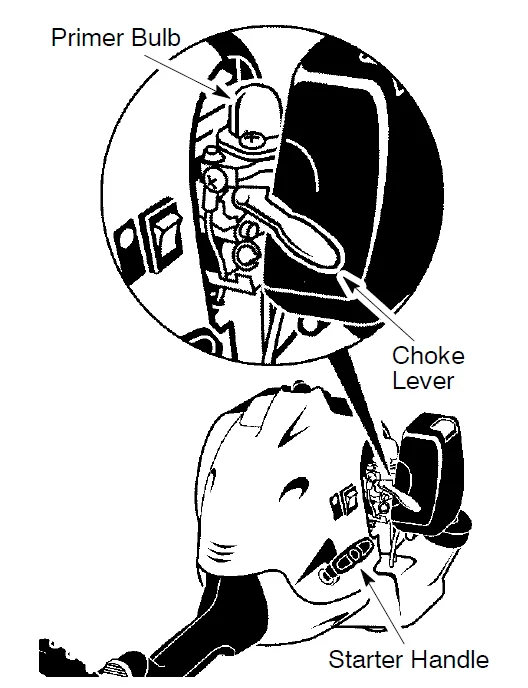
STARTING A WARM ENGINE
- Move the choke lever to the HALF CHOKE position.
- Squeeze and hold the throttle trigger. Keep the throttle trigger fully squeezed until the engine runs smoothly.
- Pull the starter rope sharply until the engine runs, but no more than 6 pulls.
- Allow the engine to run 15 seconds, thenmove the choke lever to RUN.
NOTE: If the engine has not started, pull the starter rope 5more pulls. If the engine still does not run, it is probably flooded.
STARTING A FLOODED ENGINE
Flooded engines can be started by placingthe choke lever in theRUN position; then, pull the rope to clear the engine of excess fuel. This could require pulling the starter handle many times, depending on how badly the unit is flooded. If the unit still doesn’t start, refer to the TROUBLESHOOTING TABLE or call 1-800-554-6723.
OPERATING INSTRUCTIONS
It is recommended that the engine not be operated for longer than 1 minute at full throttle.
OPERATING POSITION
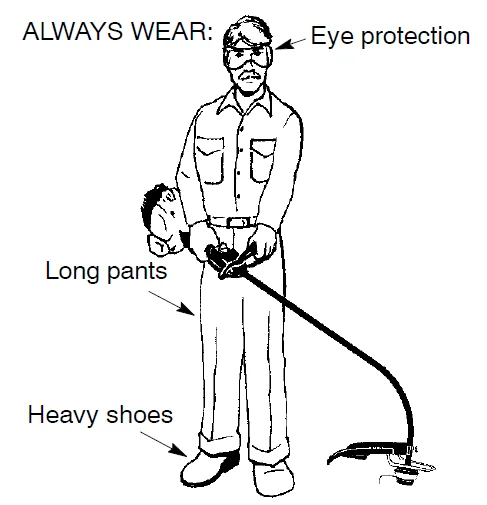
Cut from your right to your left.
WARNING: Alwayswear eyeprotection. Never lean over the trimmer head. Rocks or debris canricochet or be thrownintoeyes and face and cause blindness or other serious injury. Do not run the engine at a higher speed than necessary. The cutting line will cut efficiently when the engine is run at less than full throttle. At lower speeds, there is less engine noise and vibration. The cutting line will last longer and will
be less likely to “weld” onto the spool. Always release the throttle trigger and allow the engine to return to idle speed when not cutting. To stop engine:
- Release the throttle trigger.
- Push and hold the STOP switch in the STOP position until the engine stops.
TWIST AND EDGE
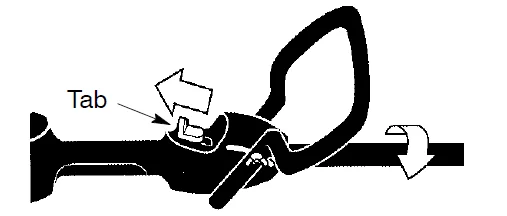
The Twist and Edge feature allows for easy edging of sidewalks, patios, driveways, etc.
- Pull the tab toward the engine.
- Twist the shaft to the edging position; release the tab.
MAINTENANCE
WARNING: Disconnect the spark plug before performing maintenance except for carburetor adjustments.
CHECK FOR LOOSE FASTENERS AND PARTS
- Spark Plug Boot
- Air Filter
- Housing Screws
- Assist Handle Screws
- Debris Shield
CHECK FOR DAMAGED OR WORN PARTS
Contact an authorized service dealer for the replacement of damaged or worn parts.
- STOP Switch — Ensure the STOP switch functions properly by pushing and holding the switch in the STOP position. Make sure the engine stops. Restart the engine and continue.
- Fuel Tank — Discontinue use of the unit if the fuel tank shows signs of damage or leaks.
- Debris Shield — Discontinue use of the unit if the debris shield is damaged.
INSPECT AND CLEAN THE UNIT AND LABELS
- After each use, inspect the complete unit for loose or damaged parts. Clean the unit and labels using a damp cloth with a mild detergent.
- Wipe off the unit with a clean, dry cloth.
CLEAN AIR FILTER
A dirty air filter decreases engine performance and increases fuel consumption and harmful emissions. Always clean after every 5 hours of operation.
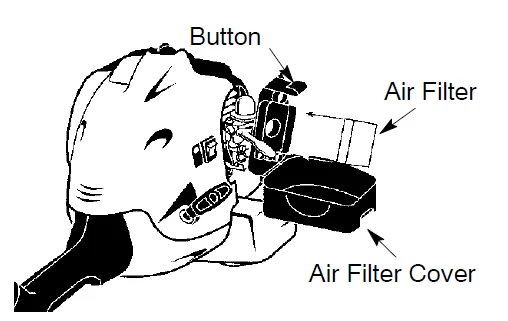
- Clean the air filter cover and the area around it to keep dirt from falling into the carburetor chamber when the cover is opened.
- Open the air filter cover by pushing the button (see illustration). Remove the air filter.
NOTE: To avoid creating a fire hazard or producing harmful evaporative emissions, do not clean the filter in gasoline or other flammable solvents. - Wash the filter in soap and water.
- Allow the filter to dry.
- Replace the air filter and close the cover.

MUFFLER AND SPARK ARRESTING SCREEN
WARNING: The muffler on this product contains chemicals known to the State of California to cause cancer.
As your unit is used, carbon deposits build up on the muffler and spark-arresting screen. For normal homeowner use, however, the muffler and spark-arresting screen will not require any service. After 50 hours of use, we recommend that your muffler be serviced or replaced by your authorized service dealer.
REPLACE SPARK PLUG
Replace the spark plug each year to ensure the engine starts more easily and runs better. Set spark plug gap at 0.025 inch (0.6 mm). Ignition timing is fixed and nonadjustable.
- Twist, then pull off the spark plug boot.
- Remove the spark plug from the cylinder and discard it.
- Replace with Champion RCJ-6Y spark plug and tighten securely with a 3/4 inch (19 mm) socket wrench.
- Reinstall the spark plug boot.
SERVICE AND ADJUSTMENTS
LINE REPLACEMENT
Pre-wound spools offer the most convenient method for replacing line and ensuring optimum performance.
- Replacement spools are color-coded to ensure the use of the correct spool with your unit. Be sure to use the same color spool as the existing spool.
NOTE: Always clear dirt and debris from cutting head components when performing any type of maintenance. - Hold the spool and unscrew the cap by turning in the direction shown on top of the cap.
- Remove the line guide ring and spool.
NOTE: When removing and/or installing the spool, ensure the dust cup remains installed over the shaft. Use a pre-wound spool or refill spool with line. If usinga pre–wound spool, remove the tape strip from the line and the spool.
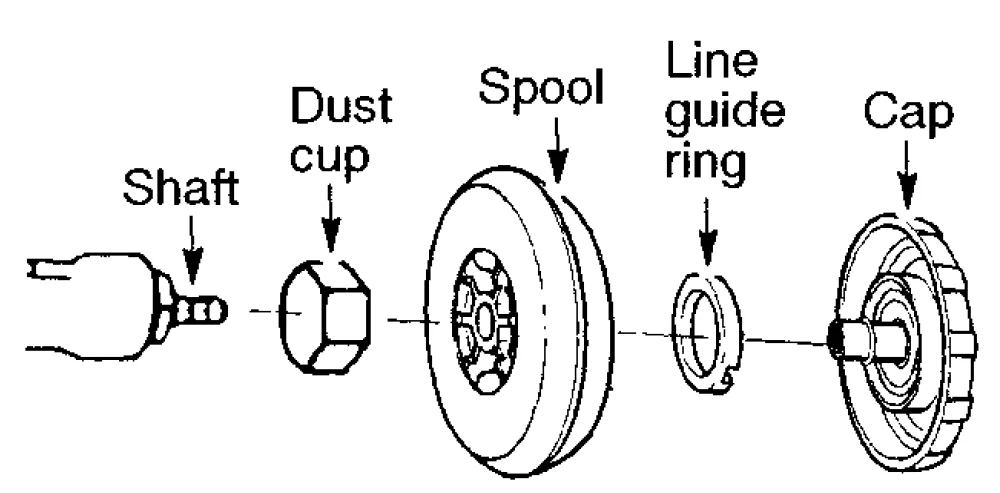 Use a pre-wound spool or refill spool with line. If usinga pre–wound spool, remove the tape strip from the line and the spool.
REFILLING THE SPOOL WITH LINE
WARNING: Use only 0.080” (2mm) diameter round line. Other sizes and shapes of line will not advance properly and will result in improper cutting head function, which can cause serious injury. Do not use other materials such as wire, string, rope, etc.A wire can break off during cutting and become a dangerous missile that can cause serious injury.
- Cut a length of 25 feet of 0.080” (2 mm) diameter round WEED EATER brand line.

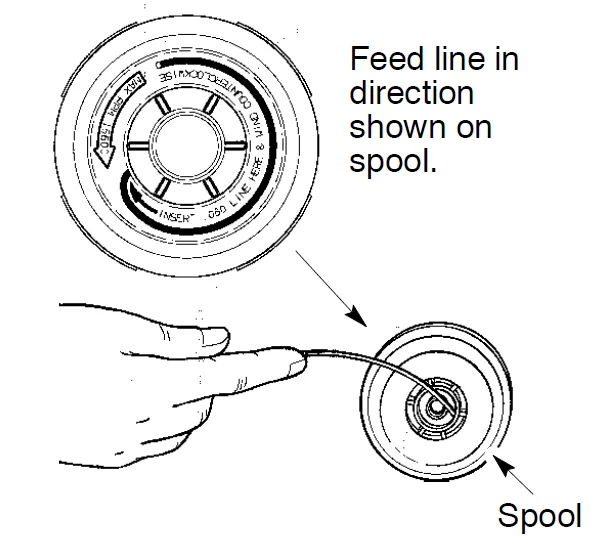
- Insert one end of the line into the center cavity of the empty spool. Ensure the line will feed into the spool in the direction shown on the spool (counterclockwise).
- Continue feeding line into spool, leaving 4 — 6 inches (10 — 15 cm) unwound fromcenter of the spool.
INSTALLING A SPOOL WITH A LINE
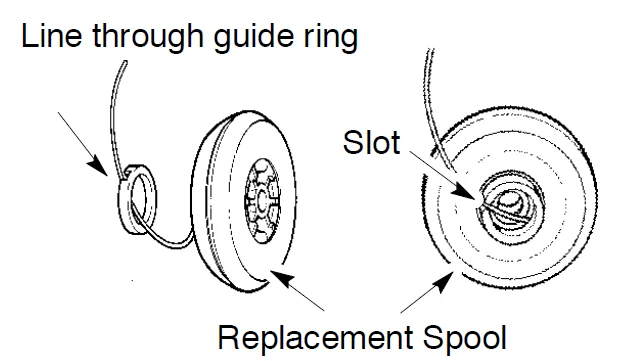
- Install replacement spool.
- Thread the line through the line guide ring.

- Rest the guide ring on the spool and place the line throughslot. Allowline toextend4– 6inches (10 — 15 cm) from the center of the spool.
- Ensure the line remains in the slot while screwing the cap onto the shaft. Only tighten the cap hand tight!
CARBURETOR IDLE SPEED ADJUSTMENT
WARNING: Keep others away when making idle speed adjustments. The trimmer head will be spinning during this procedure. Wear your protective equipment and observe all safety precautions.
The carburetor has been carefully set at the factory. Adjustmentsmay benecessary if you notice any of the following conditions:
- The engine will not idle when the throttle is released. Make adjustments with the unit supported so the cutting attachment is off the ground and will not make contact with any object. Hold the unit by handwhile running andmaking adjustments. Keep all parts of your body away from the cutting attachment and muffler.
To adjust idle speed:
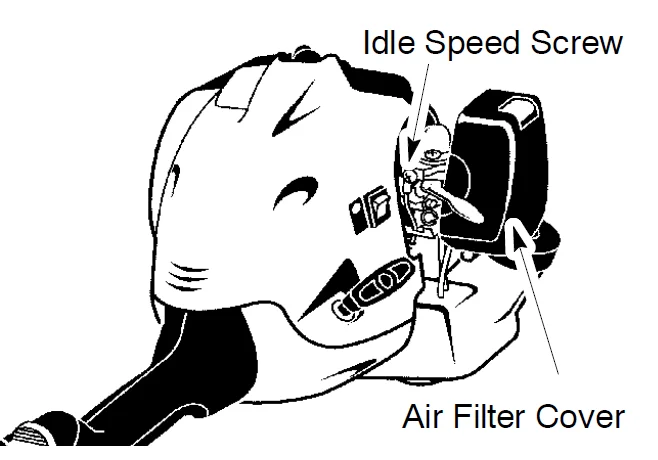
Allow the engine to idle. Adjust speed until engine runs without stalling (idle speed too slow).
- Turn the idle speed screw clockwise to increase engine speed if the engine stalls or dies.
- Turn the idle speed screw counterclockwise to decrease engine speed.
 If you require further assistanceor are unsure about performing this procedure, contact an authorized service dealer or call 1–800–554–6723.
 If you require further assistanceor are unsure about performing this procedure, contact an authorized service dealer or call 1–800–554–6723.
STORAGE
WARNING: Perform the following steps after each use:
- Allow the engine to cool, and secure the unit before storing or transporting.
- Store unit and fuel in a well-ventilated area where fuel vapors cannot reach sparks or open flames from water heaters, electric motors or switches, furnaces, etc.
- Store unit with all guards in place. Position the unit so that no sharp objects can accidentally cause injury.
- Store unit and fuel well out of the reach of children.
SEASONAL STORAGE
Prepare the unit for storage at the end of the season or if it will not be used for 30 days or more. If your unit is to be stored for a period of time:
- Clean the entire unit before lengthy storage.
- Store in a clean, dry area.
- Lightly oil external metal surfaces.
FUEL SYSTEM
Under FUELING ENGINE in the OPERATION section of this manual, see the message labeled IMPORTANT regarding the use of gasohol in your engine. Fuel stabilizer is an acceptable alternative in minimizing the formation of fuel gum deposits during storage. Add stabilizer to the gasoline in the fuel tank or fuel storage container. Follow the instructions found on the stabilizer container. Run the engine for at least 5minutes after adding stabilizer.
ENGINE
- Remove the spark plug and pour 1 teaspoon of 40:1, 2-cycle engine oil (air-cooled) through the spark plug opening. Slowly pull the starter rope 8 to 10 times to distribute oil.
- Replace the spark plugwith new one of the recommended type and heat range.
- Clean air filter.
- Check the entire unit for loose screws, nuts, and bolts. Replace any damaged, broken, or worn parts.
- At the beginning of the next season, use only fresh fuel with the proper gasoline-to-oil ratio.
OTHER
- Do not store gasoline from one season to another.
- Replace your gasoline can if it starts to rust.
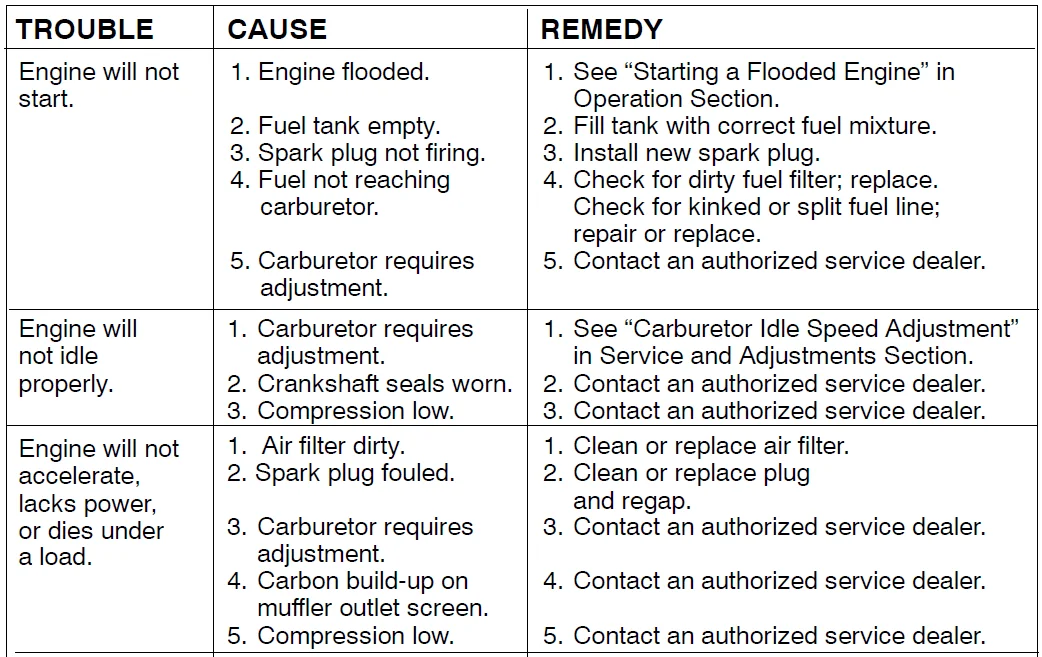
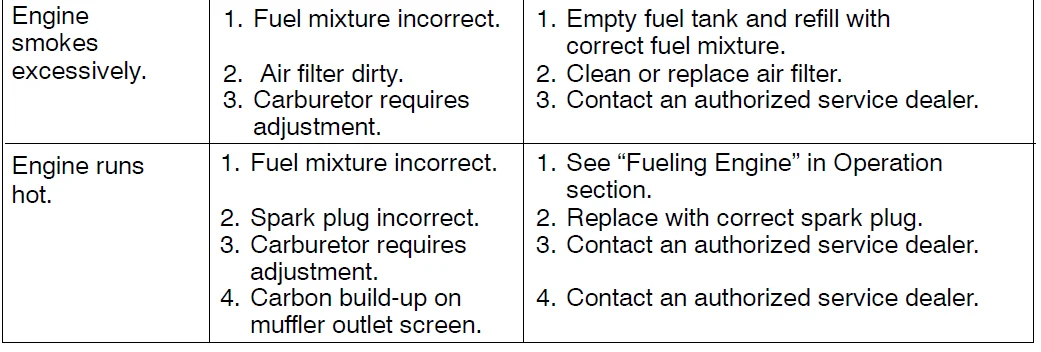
TROUBLESHOOTING TABLE
WARNING: Always stop the unit and disconnect the spark plug before performing all of the recommended remedies below, except remedies that require operation of the unit.
LIMITED WARRANTY
WEED EATER, a division of Husqvarna Consumer Outdoor Products N.A., Inc., warrants to the original consumer purchaser that each new WEED EATER brand gasoline tool or attachment is free from defects in material and workmanship, and agrees to repair or replace under this warranty any defective gasoline product or attachment as follows from the original date of purchase.
2 YEARS — Parts and Labor, when used for household purposes.
90 DAYS — Parts and Labor, when used for commercial, professional, or income-producing purposes.
30 DAYS — Parts and Labor, if used for rental purposes. This warranty is not transferable and does not cover damage or liability caused by improper handling, improper maintenance or alteration, or the use of accessories and/or attachments not specifically recommended by WEED EATER for this tool. This warranty does not cover tune-up, spark plugs, filters, starter ropes, cutting line, or rotating head parts that
will wear and require replacement with reasonable use during the warranty period. This warranty does not cover pre-delivery setup or normal adjustments explained in the instruction manual. This warranty does not cover transportation costs. In the event you have a claim under this warranty, you must return the product to an authorized service dealer.
For more manuals by Weed Eater, visit ManualsLibraryy
Weed Eater TE475 Gas String Trimmer-FAQs
What is the difference between a weed eater and a string trimmer?
There is no real difference. “Weed Eater” is a brand name, while “string trimmer” is the general term for the tool used to cut grass and weeds along edges and tight spaces.
What fuel mix does the Weed Eater TE475 use?
The TE475 is a 2-cycle engine and typically uses a 50:1 fuel ratio — that means 1 litre of petrol mixed with 20 ml of 2-stroke oil.
What happens if the 2-stroke mix is wrong?
Too little oil can overheat and damage the engine. Too much oil can cause excessive smoke, carbon buildup, and poor performance.
Why won’t my gas trimmer start?
Common reasons include stale fuel, clogged carburetor, dirty air filter, faulty spark plug, or blocked fuel lines. Replacing old fuel and cleaning filters often solves the issue.
Why does my weed eater stall when I press the throttle?
This usually happens due to a dirty carburetor, clogged fuel filter, bad fuel mix, or restricted airflow from a dirty air filter.
How long does a gas string trimmer typically last?
With proper maintenance, a quality gas trimmer like the TE475 can last 5–10 years or more.
What maintenance does the TE475 require?
Regular maintenance includes cleaning or replacing the air filter, checking the spark plug, using fresh fuel mix, inspecting fuel lines, and cleaning the cutting head.
How do I replace the string on the trimmer head?
Remove the spool cap, wind the correct size trimmer line evenly onto the spool, thread the ends through the eyelets, and reassemble securely.
Is a 2-stroke trimmer better than a 4-stroke?
2-stroke engines are lighter and have better power-to-weight ratio. 4-stroke engines are quieter and more fuel-efficient but heavier.