
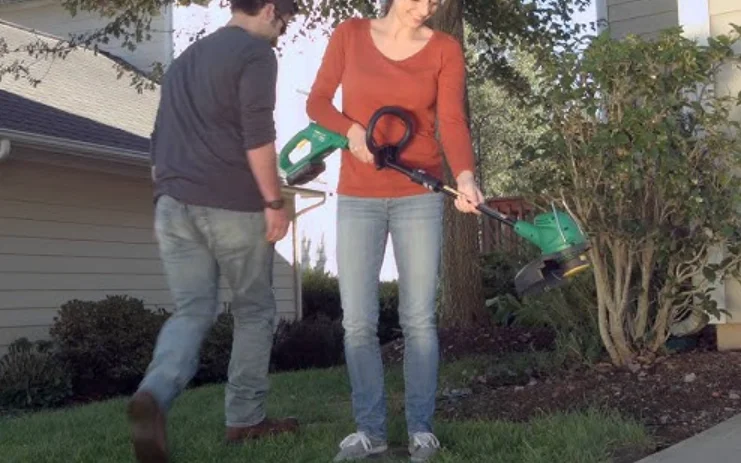

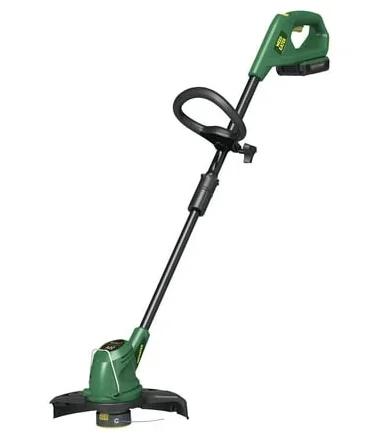
Weed Eater WE20VT String Trimmer
SAFETY RULES
WARNING: READ ALL SAFETY WARNINGS AND ALL INSTRUCTIONS. Failure to follow all instructions listed below may result in electric shock, fire, and/or serious personal injury.
WARNING: When using this device, safety precautions must be followed. For your own safety and that of bystanders, please read these instructions before operating the device. Do not use the device without reading the instruction manual.
OPERATOR SAFETY
- This string trimmer is designed for cutting grass and soft vegetation, as well as edging in areas not accessible with a lawn mower.
- This string trimmer is not designed for cutting hedges, shrubs, bushes, flowers, or for composting purposes.
- Keep the work area clean and well-lit. Cluttered or dark areas invite accidents.
- Do not operate the string trimmer in explosive atmospheres, such as in the presence of flammable liquids, gases, or dust.
- Keep children and bystanders away while operating the string trimmer. Distractions can cause you to lose control.
- Do not expose the string trimmer to rain or wet conditions.
- Restrict the use of this unit to people who read, understand, and follow the unit and manual warnings and instructions.
- Children should be supervised to ensure that they do not play with the device.
- Never allow children or people unfamiliar with the instructions to use the device.
- Turn the string trimmer off while people, children, or pets are nearby.
- Only use the string trimmer in daylight or good artificial light.
- Before using the device and after any impact, check for signs of wear or damage and repair as necessary.
- Never operate without a guard or with a damaged guard.
- Keep hands and feet away from the trimmer cutting line at all times, especially when turning the unit on.
- Take care against injury from any device fitted for trimming the cutting line length. After extending the new cutting line, always return the device to its normal operating position before switching on.
- Never use replacement parts or accessories not provided or recommended by the manufacturer.
- Disconnect the battery pack from the tool before making any adjustments, changing accessories, or storing the tool. Such preventative safety measures reduce the risk of starting the tool accidentally.
- Store idle tools out of reach of children and other untrained persons. Tools are dangerous in the hands of untrained users.
- Always ensure that ventilation openings are kept clear of debris.
- Dress properly. Do not wear loose clothing or jewelry. Contain long hair. Keep your hair, clothing, and hands away from moving parts. Loose clothes, jewelry, or long hair can be caught in moving parts.
- Always wear eye protection that complies with ANSI Z87.1.
- Use personal protective equipment. Always wear eye protection. Protective equipment, such as a dust mask, non-skid safety shoes, a hard hat, or hearing protection, used for appropriate conditions, will reduce personal injuries.
- Do not overreach. Keep proper footing and balance at all times. Proper footing and balance enable better control of the tool in unexpected situations.
- Stay alert. Do not operate the string trimmer when you are tired, ill, or under the influence of alcohol, drugs, or medication.
- Store the string trimmer indoors, out of reach of children.
- Do not charge or operate cordless tools in damp locations or in the rain. Following this rule will reduce the risk of electric shock.
- Keep all bystanders, children, and pets at least 50 ft. away.
- Use the right tool – Do not use the tool for any job except that for which it is intended.
- Avoid unintentional starting – Do not carry the string trimmer with fingers on the switch. Be sure the battery is removed while transporting.
- Do not force the tool. Use the correct tool for your application. The correct tool will do the job better and safer at the rate for which it is designed.
- Maintain the tool with care. Keep vents clean for the best and safest performance. Follow instructions for proper maintenance. Do not attempt to clear clogs from the tool without first disconnecting the battery.
- Check damaged parts – Before further use of the tool, a guard or other part that is damaged should be carefully checked to determine that it will operate properly and perform its intended function. Check for alignment of moving parts, binding of moving parts, breakage of parts, mounting, and any other condition that may affect its operation. A guard or other part that is damaged should be properly repaired or replaced by an authorized service center unless indicated elsewhere in this manual.
- For use only with WE20VRB battery and WE20VCH charger.
- Do not open or mutilate the battery. Released electrolyte is corrosive and may cause damage to the eyes or skin. It may be toxic if swallowed.
- Exercise care in handling batteries in order not to short the battery with conducting materials such as rings, bracelets, and keys. The battery or conductor may overheat and cause burns.
ASSEMBLY
PACKING LIST
This product requires assembly.
- 20V String Trimmer
- Auxiliary Handle
- Guard
- 20V 2Ah Battery
- 20V Charger
- Instruction Manual
If any parts are damaged or missing, please call 1-855-378-6903.
BATTERY REMOVAL
- Press in and hold the latch button (1) with a firm grip.
- Grasp the trigger handle (2) firmly. Pull the battery pack out of the handle.
BATTERY INSTALLATION
- Align the tongue (3) of the battery pack with the cavity in the handle housing.
- Grasp the trigger handle (2) firmly.
- Push the battery pack into the handle until both sides lock. The latch button will click when locked into place.
- Do not use force when inserting the battery pack. It should slide into place and click.

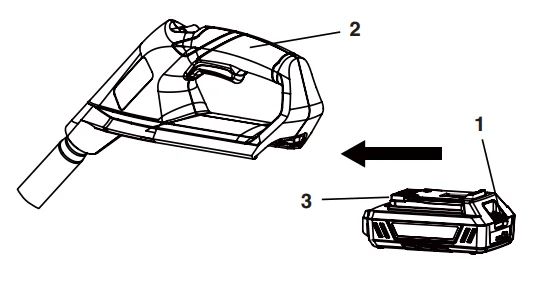
NOTE: The battery pack fits snugly into the handle to prevent accidental dislodging. It may require a strong pull to remove.
IMPORTANT: The battery is not shipped fully charged. It is recommended that the battery be fully charged before initial use. With regular use, the battery pack will take 4 hours or less to charge fully. It is recommended that the battery be charged every 3 months when the hedge trimmer is not in use. The battery’s run time will improve after the third or fourth charge.
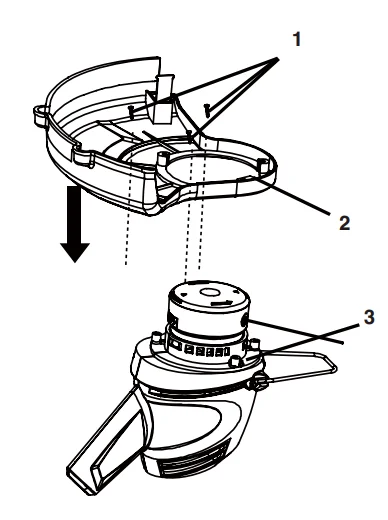
GUARD ASSEMBLY
- Remove the battery pack.
- Invert the string trimmer to access the bottom of the motor housing.
- Place the guard (2) onto the bottom of the motor housing (3).
- Align the screw holes on the guard with the screw holes on the motor housing.
- Insert the 3 screws (1) into the guard, connecting to the motor housing. Tighten the guard into place.

WARNING: To avoid injury and to reduce the risk of electric shock or fire:
- Replace the battery pack or charger immediately if the battery case or charger cord is damaged.
- Always make sure the string trimmer switch is OFF before inserting or removing the battery pack.
- Always make sure the battery pack is removed and the switch is turned OFF before replacing spools or adjusting the line.
- Read, understand, and follow the battery charger instructions.
SHAFT ASSEMBLY
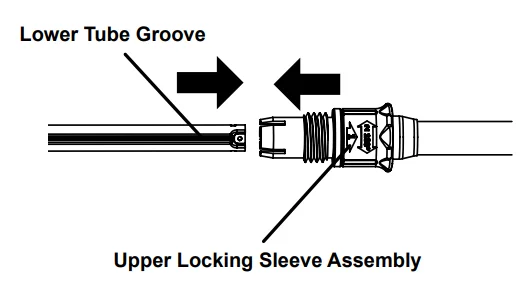
- Align the lower tube groove with the groove inside the upper locking sleeve assembly. Push tubes together until they snap into place.

- Try to pull the tubes back apart. If the tubes do not come apart, they are properly snapped into place. If the tubes come apart, repeat step 1 and push until the tubes snap into place.
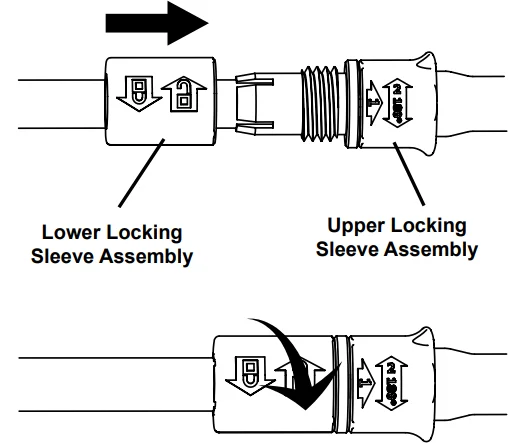
- Slide the lower locking sleeve assembly over the upper locking sleeve assembly and tighten by turning clockwise.

AUXILIARY HANDLE ASSEMBLY
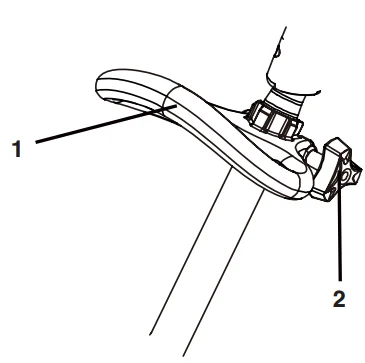
- Position the auxiliary handle (1) onto the upper portion of the trimmer shaft.
- Once the auxiliary handle is in the desired location, tighten the knob (2) until locked into position.
- Before operating the string trimmer, make sure the auxiliary handle (1) is tightly locked into position.
- Turn the auxiliary handle adjustment knob (2) clockwise to lock the handle securely into position.

WARNING: To avoid injury, adjust the auxiliary handle for optimum control and balance. Do not overreach when operating the string trimmer. Keep a proper balance at all times for better control of the tool in unexpected situations.
CUTTING LINE
A pre-wound spool is pre-installed on the string trimmer. When the cutting line needs to be replaced, insert a new spool.
OPERATION
KNOW YOUR STRING TRIMMER
The safe use of this product requires an understanding of the information in this instruction manual, as well as knowledge of the project you are attempting. Before using this product, familiarize yourself with all operating features and safety rules.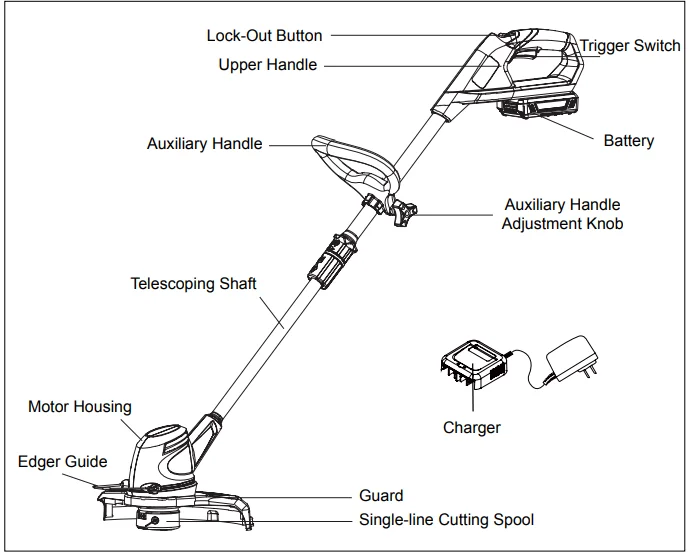
TO TURN ON/OFF
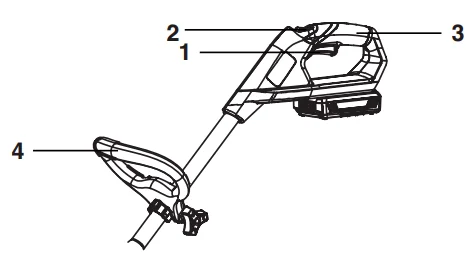
- Place one hand on the trigger handle (3). Place the other hand on the auxiliary handle (4).
- Slide the lock-out button (2) toward the rear of the handle and hold.
- Squeeze the trigger switch (1). The string trimmer will turn ON.
- Release the lock-out button (2). The string trimmer will stay on as long as the trigger switch (1) is squeezed ON.
- Release the trigger switch (1) to stop.

TELESCOPING SHAFT
The shaft can be extended or shortened for ease of use.
- Unscrew the shaft coupler and slide it to the desired position.
- Tighten the shaft coupler.
EDGING FUNCTION
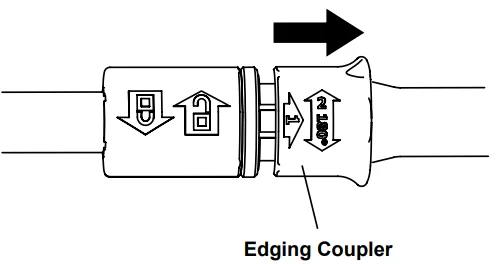
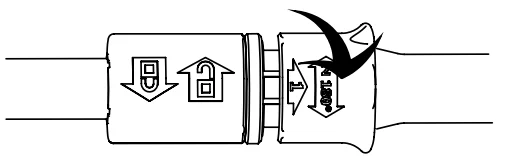
The string trimmer is equipped with an edging feature for use on multiple surfaces. This includes sidewalks, walkways, patios, and driveways. It is great for clearing overgrown grass from manicured surfaces.
- Pull up the Edging Coupler and turn the handle end counterclockwise.

- Release the Edging Coupler when the handle has been rotated 180°.

- Flip the edging guide down until it locks into place.
ADJUST THE CUTTING PATH
The cutting path can be adjusted from 10”-12” (25.5-30.5 cm). A Philips head screwdriver (not supplied) is required. Loosen the screw and turn the cutter 180°, then tighten the screw.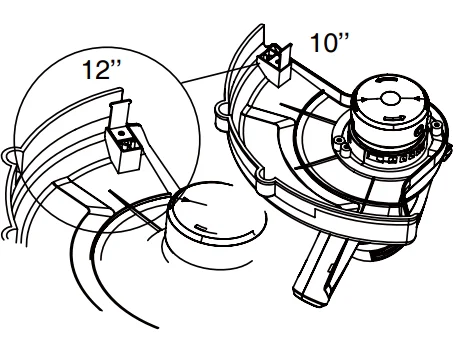
WARNING: To avoid injury:
- Do not squeeze the trigger while the string trimmer/edger is inverted.
- Do not carry the string trimmer/edger with your finger on the trigger switch. Avoid unintentional starting.
LENGTHENING THE LINE
While the string trimmer is operating, the cutting line gets worn down and becomes shorter. This trimmer is equipped with Automatic Line Advancement, which automatically feeds additional line to the correct length as it wears down. If the line does not automatically advance, the trimmer line may be tangled or empty. To advance the line, restart the trimmer. Upon starting, the line will automatically advance.
MAINTENANCE
CHARGING PROCEDURE
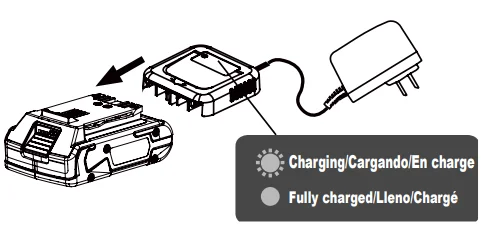
- Plug the charger into an AC power outlet.
- Slide the charger over the battery pack terminals. Make sure the charger and battery are fully connected.
- When the battery is charging, the LED will blink; when the battery is fully charged, the LED will stop blinking but will remain illuminated.

CHECKING BATTERY CAPACITY
Press the Battery Capacity Indicator (BCI) button. The lights will illuminate according to the battery’s current power level. See the chart below: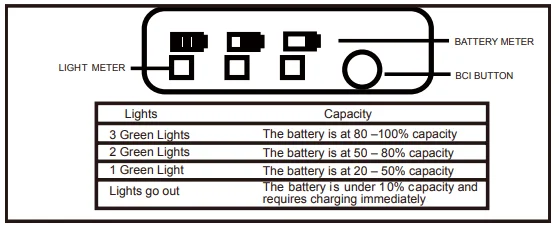
CHARGER MAINTENANCE
- Keep the charger clean and clear of debris. Do not allow foreign material to get into the recessed cavity or onto the contacts. Wipe the charger clean with a dry cloth. Do not use solvents or water, and do not place the charger in wet conditions.
- Unplug the charger when there is no battery pack in it.
- Fully charge the batteries before placing them in storage.
- Store the charger at normal room temperature. Do not store it in excessive heat. Do not use the charger in direct sunlight. Recharge at temperatures between 32°F and 104°F (0-40°C). If the battery pack is hot, allow it to cool down before recharging.
BATTERY PACK
- Store the battery pack fully charged.
- Once the charging light turns green, remove the battery from the charger and disconnect the charger from the outlet.
- After charging, the battery pack may be stored on the charger, as long as the charger is not plugged in.
CUTTING LINE
- Use only .065” (1.65mm) diameter cutting line. Other sizes will not advance properly and could result in failure or cause serious injury.
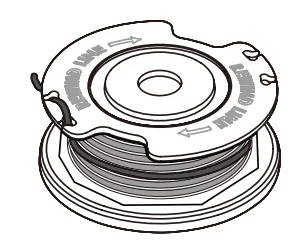
- Always wind the line in the same direction as the arrow on the spool.
CLEANING
- Wipe the outside of the string trimmer with a dry, soft cloth. Do not hose down or wash with water.
- Scrape the guard and spool area to remove dried clippings and mud.
- Brush or blow dust, debris, and grass clippings out of the air vents. Keep them free of obstruction.
CAUTION: Do not use strong solvents or detergents on the plastic housing or plastic components. Certain household cleaners may cause damage and may also cause a shock hazard.
WARNING: To avoid the risk of fire, electric shock, or electrocution:
- Do not use a damp cloth or detergent on the battery or battery charger.
- Always remove the battery pack before cleaning, inspecting, or performing any maintenance on the string trimmer.
SERVICE AND ADJUSTMENTS
SPOOL REMOVAL
- Remove the battery from the trimmer.
- Invert the string trimmer to access the spool.
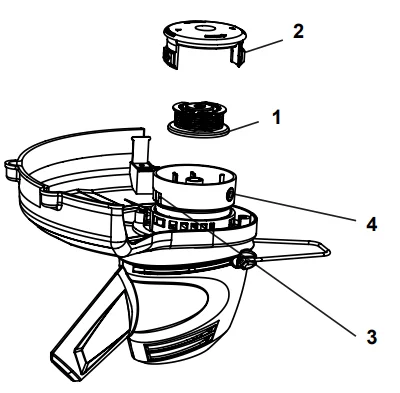
- Remove the spool cover. Press on the two tabs parallel to each other on the side of the cover (2).
- Remove the spool from the spool housing (3).
SPOOL REPLACEMENT
- Replace the spool (1) with a new prewound spool.
- Insert the end of the line through the opening (4) in the spool housing (3).
- Align the tabs on the spool cover with the slots in the spool housing on the trimmer head.
- Push down on the spool cover, locking it to the spool housing.
- To advance the line when initially installed, you must pull the line while pressing the line release button on the side of the spool housing (3).

LINE REPLACEMENT
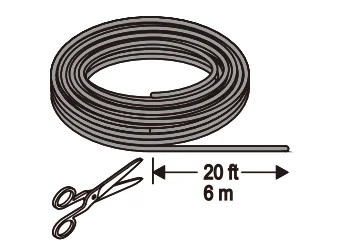
- Cut the length of the line to 20 ft (6m) total length.

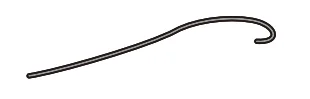
- Bend one end of the line 1/4 of an inch (6.4mm).

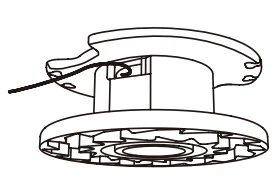
- Take the end of the line that is bent 1/4 of an inch (6.4mm) and stick it in the hole in the spool head.

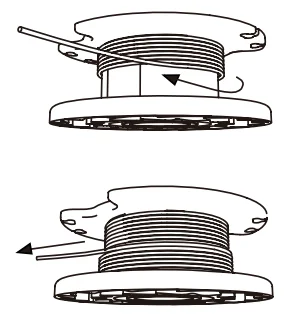
- Once the 1/4 of the line is inserted into the hole, wind the spool line clockwise evenly, overlapping the first row and continuing the process until complete.

- Once complete, the last layer of line should be evenly wound. To keep the line from unraveling, hook the line as shown below.

STORAGE
- Ensure the battery is removed from the string trimmer.
- Wipe any debris off the string trimmer.
- Store in a dry, cool place out of the reach of children.
- Position the unit so that any sharp object cannot accidentally cause injury.
TROUBLESHOOTING TABLE
WARNING: Always stop the unit and disconnect from the power source before performing all of the recommended remedies below, except remedies that require the unit to be operating.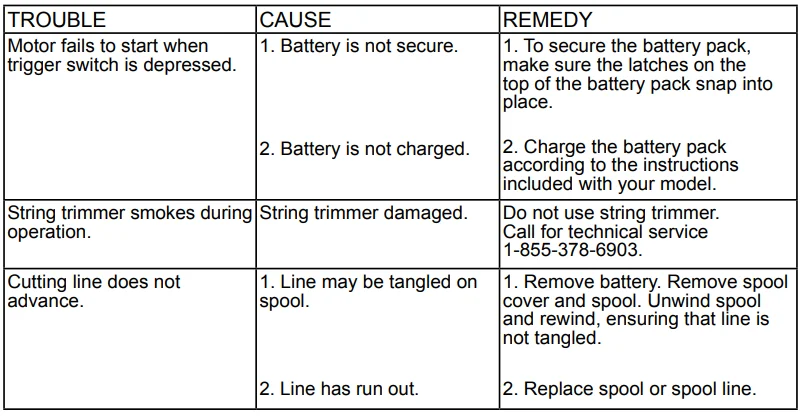
LIMITED WARRANTY
WEED EATER, a division of Husqvarna Consumer Outdoor Products N.A., Inc., hereby warrants this product to the original purchaser with proof of purchase for a period of four (4) years against defects in materials, parts, or workmanship. WEED EATER, at its own discretion, will repair or replace any parts found to be defective through normal use, free of charge to the customer. This warranty is valid only for units that have been used for personal use, that have not been hired or rented for industrial/commercial use, and that have been maintained in accordance with the instructions in the owner’s manual supplied with the product.
The battery carries a two (2) year warranty against defects in workmanship and materials. Batteries must be charged in accordance with the operator’s manual directions and regulations in order to be valid. This warranty is not transferable. This warranty does not cover damaged parts from improper handling, commercial use, abuse, neglect, accident, improper maintenance, alteration, or the use of accessories and/or attachments not specifically recommended by WEED EATER for this product.
Additionally, this warranty does not cover parts that will wear from normal use and normal deterioration of the exterior finish due to use or exposure. This warranty does not cover predelivery setup or normal adjustments explained in the instruction manual. Should you have any unanswered questions concerning this warranty, please contact: WEED EATER, a division of Husqvarna Consumer Outdoor Products N.A., Inc. 9335 Harris Corners Parkway Charlotte, NC 28269 1-855-378-6903
In Canada, contact: WEED EATER 850 Matheson Blvd. West Mississauga, Ontario L5V 0B4. Give the model number, serial number, and date of purchase of your product, and the name and address of the authorized dealer from whom it was purchased. THIS WARRANTY GIVES YOU SPECIFIC LEGAL RIGHTS, AND YOU MAY HAVE OTHER RIGHTS WHICH VARY FROM STATE TO STATE.
NO CLAIMS FOR CONSEQUENTIAL OR OTHER DAMAGES WILL BE ALLOWED, AND THERE ARE NO OTHER EXPRESS WARRANTIES EXCEPT THOSE EXPRESSLY STIPULATED HEREIN. SOME STATES DO NOT ALLOW LIMITATIONS ON HOW LONG AN IMPLIED WARRANTY LASTS OR THE EXCLUSION OR LIMITATIONS OF INCIDENTAL OR CONSEQUENTIAL DAMAGES, SO THE ABOVE LIMITATIONS OR EXCLUSIONS MAY NOT APPLY TO YOU.
This limited warranty is within the meaning of that term as defined in the Magnuson-Moss Act of 1975. The policy of WEED EATER is to continuously improve its products. Therefore, WEED EATER reserves the right to change, modify, or discontinue models, designs, specifications, and accessories of all products at any time without notice or obligation to any purchaser. Register your product online at: www.weedeater.com.
EXPLODED VIEW
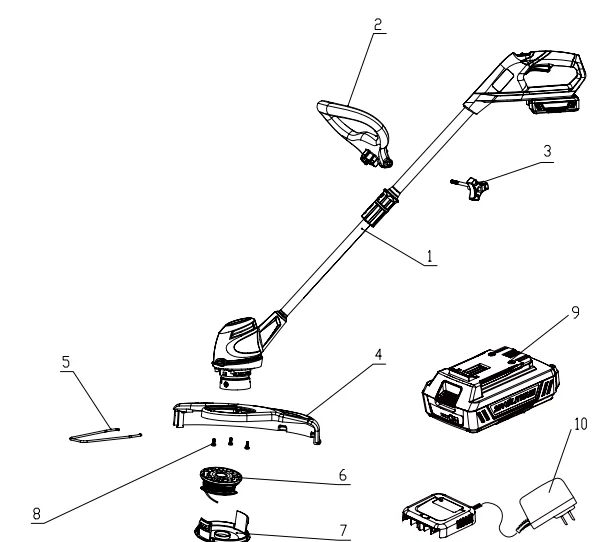
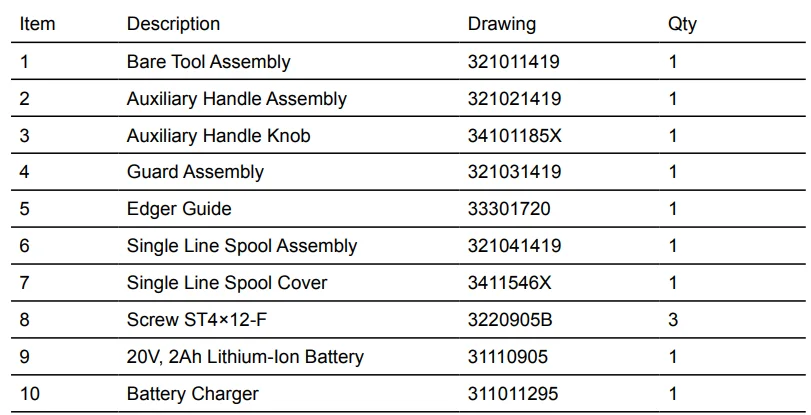
PARTS LIST
For More Manuals By Weed Eater, Visit ManualsLibraryy.
Weed Eater WE20VT String Trimmer-FAQs
Is a 2-cycle or 4-cycle string trimmer better for home use?
Generally, 2-cycle engines offer a better power-to-weight ratio because they complete a combustion cycle twice as fast as a 4-cycle engine. This makes them lighter and often more powerful for their size. However, 4-cycle engines run quieter and don’t require mixing oil with fuel. For most homeowners, a lightweight 2-cycle or a battery-powered option like the Weed Eater WE20VT is easier to maintain and more convenient for regular yard trimming.
What is the best type of string trimmer for small to medium lawns?
For small to medium lawns, a battery-powered string trimmer is usually the best choice. Cordless models like the Weed Eater WE20VT provide enough power for edging and trimming without the hassle of fuel mixing or extension cords. They are lightweight, quieter than gas models, and easier to start. If you maintain under half an acre, a 20V to 40V battery trimmer typically offers a good balance of performance and runtime.
How do you replace the string on a 20V electric weed eater?
To replace the string, first remove the battery for safety. Open the spool housing by pressing the release tabs or unscrewing the cap, depending on the design. Remove the old line and wind new trimmer line evenly onto the spool in the direction indicated by the arrows. Feed the ends through the eyelets and reassemble the head. Make sure the line is properly tensioned before reinstalling the battery.
Is there a difference between a weed eater and a weed wacker?
The terms weed eater and weed wacker are often used interchangeably, but they originated as brand names. “Weed Eater” was popularized by a brand now owned by Husqvarna, while “Weedwhacker” is associated with Stanley Black & Decker. The proper generic term is string trimmer or line trimmer. Functionally, they all refer to the same type of lawn tool designed to cut grass and weeds in tight spaces.
Is 20V strong enough for a string trimmer?
A 20V battery string trimmer is typically strong enough for light to moderate yard work, including trimming grass edges and cutting small weeds. For lawns under half an acre, 20V models provide sufficient power and manageable runtime. If you regularly deal with thick, overgrown vegetation, a 40V or higher model may deliver better torque and longer battery life under heavier loads.
Which is stronger, 20V or 40V trimmers?
In general, 40V trimmers provide more power and improved performance under heavy loads compared to 20V models. Higher voltage systems can maintain consistent cutting strength when tackling thicker weeds or larger areas. However, they are often heavier and more expensive. For basic edging and routine lawn maintenance, a 20V trimmer like the WE20VT is usually sufficient and more convenient to handle.
How long do battery-powered weed eaters last?
A quality battery-powered string trimmer generally lasts between three and seven years with proper maintenance. Battery packs may need replacement sooner, depending on usage frequency and charging habits. Keeping the trimmer clean, avoiding overloading the motor, and storing both the tool and battery in a dry place can significantly improve longevity and consistent performance over time.
Can a string trimmer cut thick weeds?
Most standard string trimmers can handle moderate weeds and tall grass. For thicker stems or woody weeds, using a heavier-duty trimmer line improves cutting performance. Some models support plastic or metal blade attachments for tougher vegetation. However, battery-powered 20V models are best suited for light to medium tasks. Extremely dense brush may require a more powerful brush cutter.
Is a blade trimmer better than a string trimmer?
String trimmers are ideal for precise edging and trimming around fences, walls, and landscaping features because the line wears down safely upon contact. Blade trimmers, especially those with plastic or metal blades, are more durable for larger areas and thicker vegetation. For typical residential lawn maintenance, a string trimmer offers greater versatility and safety, while blade systems are better for heavy-duty cutting.