

LG XD5B14PS QuadWash Dishwasher
SAFETY INSTRUCTIONS
READ ALL INSTRUCTIONS BEFORE USE
The following safety guidelines are intended to prevent unforeseen risks or damage from unsafe or incorrect operation of the appliance. The guidelines are separated into ‘WARNING’ and ‘CAUTION’ as
described below.
WARNING
To reduce the risk of explosion, fire, death, electric shock, injury or scalding to persons when using this product, follow basic precautions, including the following:
Technical Safety
This appliance is not intended for use by persons (including children) with reduced physical, sensory, or mental capabilities, or lack of experience and knowledge, unless they have been given supervision or instruction concerning use of the appliance by a person responsible for their safety. Children should be supervised to ensure that they do not play with the appliance.
- Observe the information given in the specifications regarding the maximum number of place settings to be washed of the dishwasher.
- The water pressure must be between 0.05 MPa and 1.0 MPa. Installation
- Never attempt to operate the appliance if it is damaged, malfunctioning, partially disassembled, or has missing or broken parts, including a damaged cord or plug.
- If the power cord is damaged or the hole of the socket outlet is loose, do not use the power cord and contact an authorized service centre.
- Do not modify the power cord provided with the appliance. Please contact the LG Customer Information Centre to advise of its incompatibility.
- This appliance should only be transported by two or more people holding the appliance securely.
- Do not install the appliance in a damp and dusty place. Do not install or store the appliance in any outdoor area, or any area that is subject to weathering conditions such as direct sunlight, wind, or rain or temperatures below freezing.
- Do not plug multiple socket outlets, an extension power cable, or an adapter into this appliance.
- Disconnect the power cord, house fuse, or circuit breaker before installing or servicing the appliance.
- When moving or installing the product in a different location, call qualified service personnel for installation and service.
- Fix the drain hose securely in place.
- This appliance is not designed for maritime use or for mobile installations such as in RVs, trailers, or aircraft.
- This appliance must be positioned near to an electrical power supply.
Operation
- Immediately unplug the power plug and contact an LG Electronics customer information centre if you detect a strange sound, odour, or smoke coming from the appliance.
- Do not repair or replace any part of the appliance. All repairs and servicing must be performed by qualified service personnel unless specifically recommended in this Owner’s Manual. Use only authorized factory parts.
- Do not leave the appliance door open. Children may hang on the door or crawl inside the appliance, causing damage or injury.
- Do not use flammable gas and combustible substances (benzene, gasoline, thinner, petroleum, alcohol, etc.) near the appliance.
- Do not attempt to separate any panels or disassemble the appliance. Do not apply any sharp objects to the control panel in order to operate the appliance.
- Do not bend the power cable excessively or place a heavy object on it.
- Do not put animals, such as pets, into the appliance.
- Do not touch the power plug or the appliance controls with wet hands.
- If there is a gas leakage (isobutane, propane, natural gas, etc.), do not touch the appliance or power plug and ventilate the area immediately.
- In case of a flood, disconnect the power plug and contact the LG Electronics Customer Information Centre.
- Under certain conditions, hydrogen gas may be produced in a hot water system that has not been used for two weeks or more. HYDROGEN GAS IS EXPLOSIVE. If the hot-water system has not been used for such a period, before using the appliance, turn on all hot water taps and let the water flow from each for several minutes. This will release any accumulated hydrogen gas. As the gas is flammable, do not smoke or use an open flame during this time.
- Keep the area underneath and around your appliances free of combustible materials such as lint, paper, rags, chemicals, etc.
- Some dishwasher detergents are strongly alkaline. They can be extremely dangerous if swallowed. Avoid contact with the skin and eyes and keep children away from the dishwasher when the door is open. Check that the detergent receptacle is empty after completion of the wash cycle.
INSTALLATION
Parts and Specifications
NOTE: Appearance and specifications may change without notice to improve the quality of the appliance.
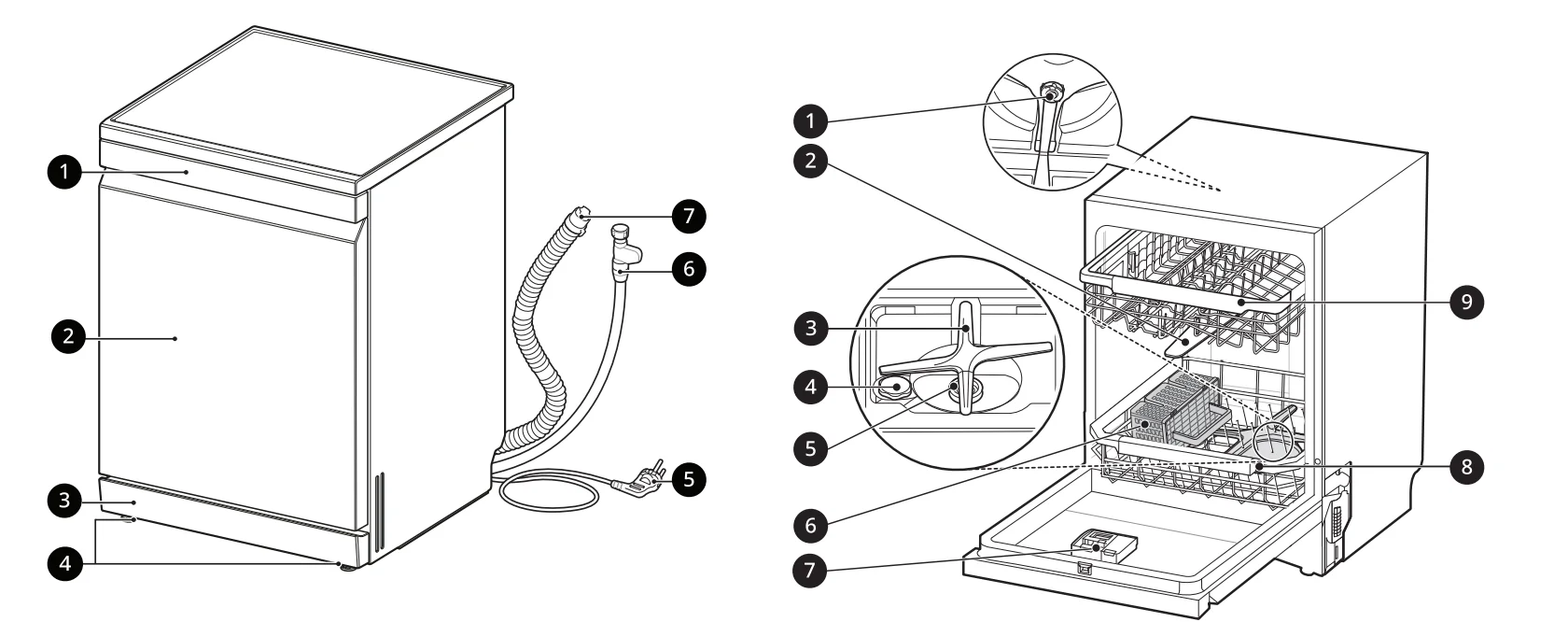
Front View
- Control Panel & Door Handle
- Front Cover
- Lower Cover
- Levelling Feet
- Power Cord
- Water Supply Hose
- Drain Hose
Interior View
- Top Wash Impeller
- Upper Spray Arm
- Lower Spray Arm
- Salt Container Cap
- Filtration System
- Cutlery Basket
- Detergent and Rinse Aid Dispenser
- Lower Rack
- Upper Rack
INSTALLATION
Accessories
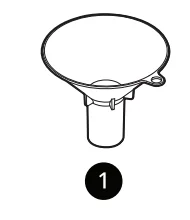
- Funnel
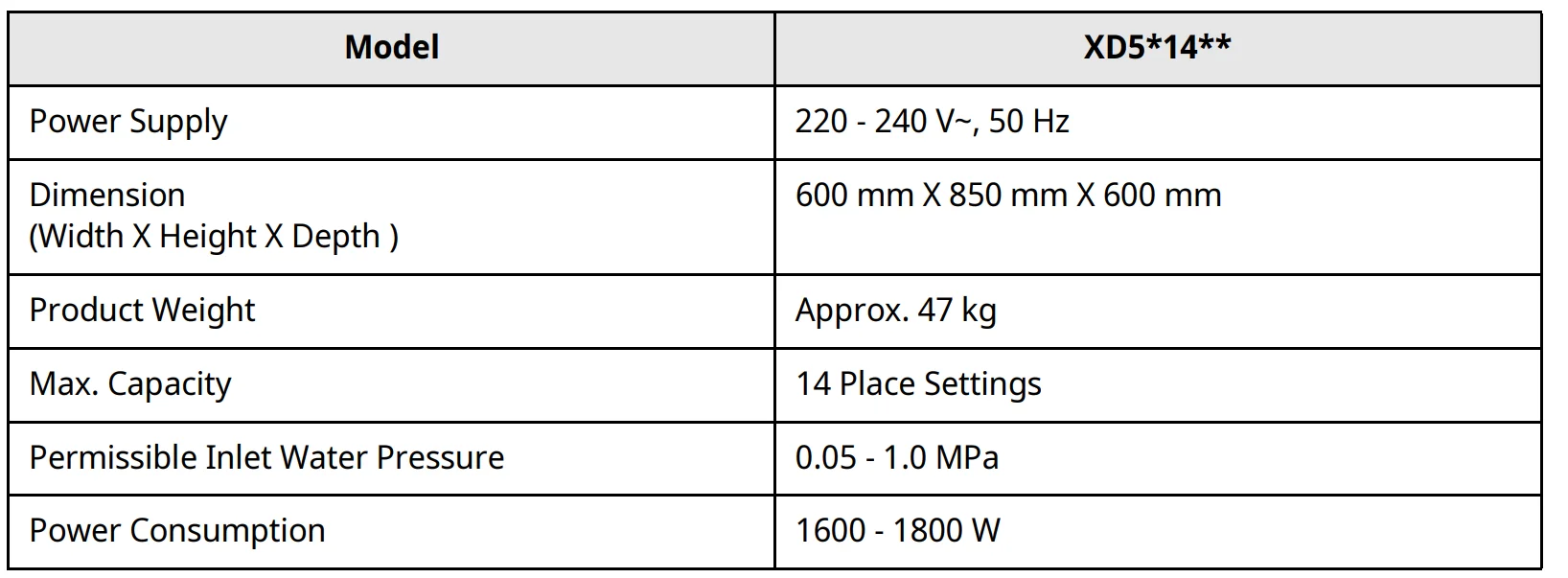
Specifications
Preparing Cabinet Opening
Choosing the Proper Location
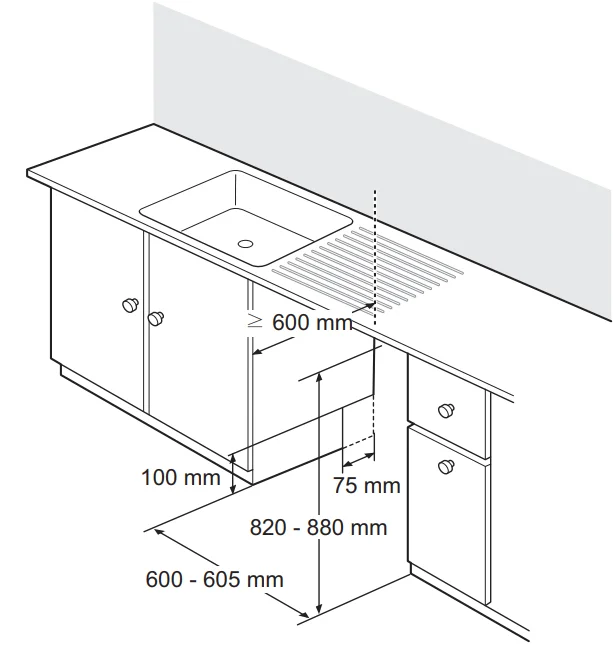
- Install the appliance on a flat and stable floor.
- Cut out for hoses and electrical cables on either side. (Approximately 100 mm X 75 mm)
- Select a location as close to the sink as possible for ease of connection to the water and drain pipes.
- To ensure drainage, the appliance should not be installed more than 1 metre away from the sink.
- If the appliance is installed in a corner, allow a minimum clearance of at least 50 mm between the appliance and an adjacent cabinet or wall.
- Before sliding the appliance into the installation opening, all necessary height adjustments should be made using a spanner.
CAUTION
- Any bare wood surrounding the appliance should be sealed with a waterproof paint or sealant to prevent it from swelling.
- Slide the dishwasher into the cabinet, opening carefully. Make sure that the drain hose behind the machine and inside the cabinet is not kinked or stretched.
- Install the appliance in a flat and stable area. Do not place any objects between the floor and the base or leg of the appliance.
NOTE
- This installation must be conducted by qualified service personnel to ensure it has been installed correctly.
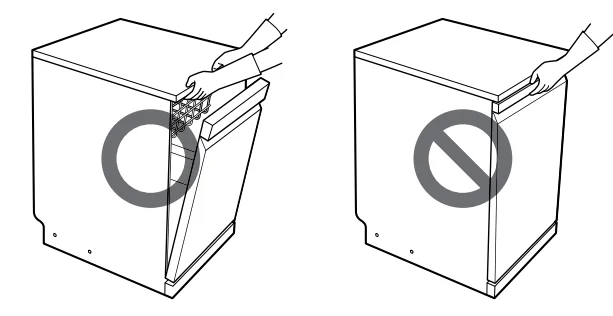
- Do not pull or lift the appliance using the handle; Doing so can damage the door and hinges. Open the door and grab the body frame and the top front opening of the tub to move or lift the appliance.

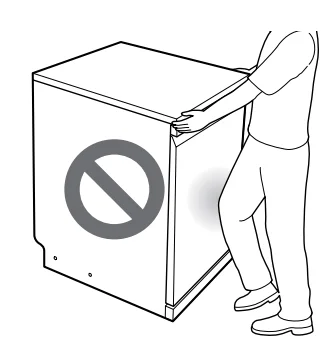
- Do not push the door of the dishwasher with your knees.

Levelling the Appliance
Checking the Level
Levelling the appliance prevents unnecessary leakage and poor washing. Check whether the appliance is perfectly level after installation.
- If the appliance rocks when pushing the top plate of the appliance diagonally, adjust the feet again.
NOTE
The appliance is not level if there is a rubbing sound or stickiness when the door is opened.
Adjusting and Levelling the Appliance
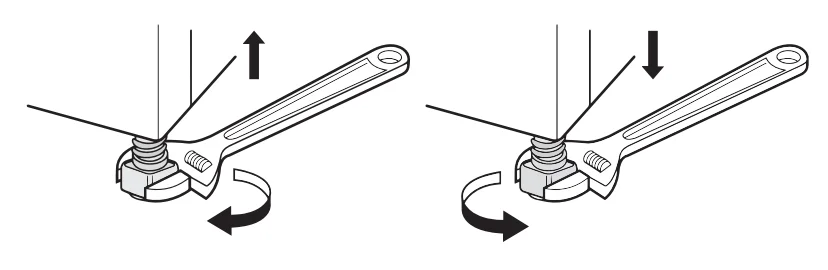
When the appliance is not perfectly level, turn the adjustable feet until the appliance no longer wobbles.
- Turn the adjustable feet clockwise to raise or turn the adjustable feet counterclockwise to lower from front-to-back, side-to-side and corner-to-corner.
NOTE
- Place the appliance on a solid, level floor.
- Do not install the appliance on an elevated surface.
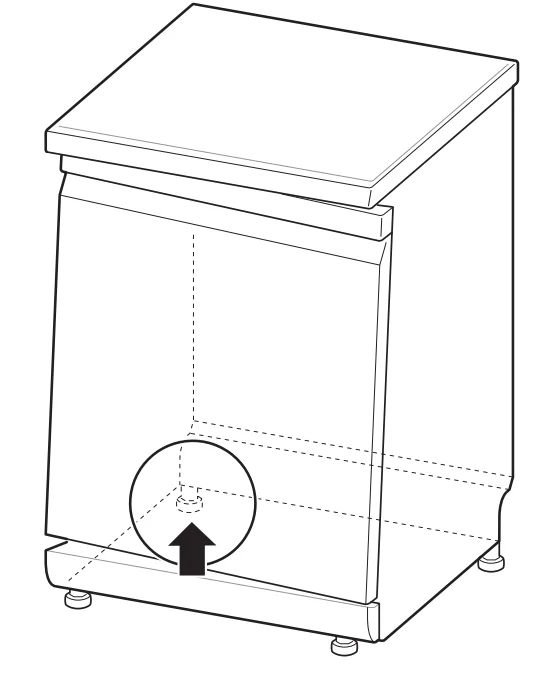
Case 1. The Door is Slanted to the Right
- Unscrew (counter-clockwise) the rear left leg and correct the level.
- Check the opening of the door and repeat if necessary until the door opens and closes properly.
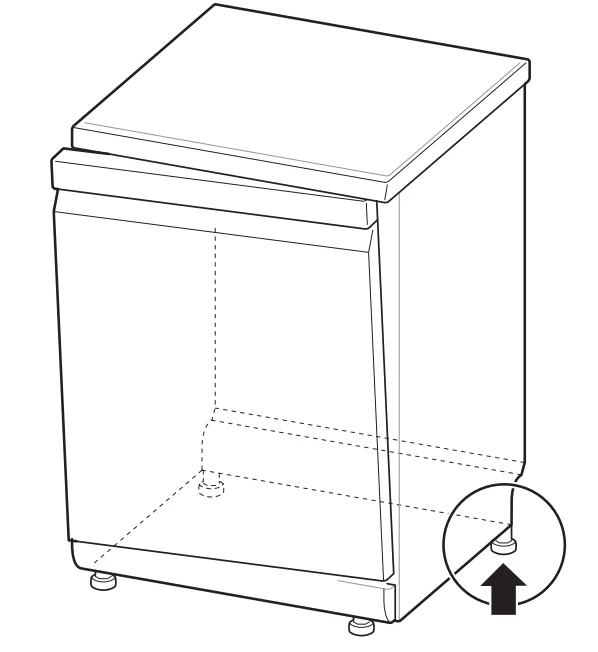
Case 2. The Door is Slanted to the Left
- Unscrew (counter-clockwise) the rear right leg and correct the level.
- Check the opening of the door and repeat if necessary until the door opens and closes properly.
Installing the Drain Hose
If the end of the drain hose does not fit the drain line, use a drain extension kit (optional) that is resistant to heat and detergent.
- This should be available from a plumbing shop or a hardware store.
Connection to the Waste Spigot
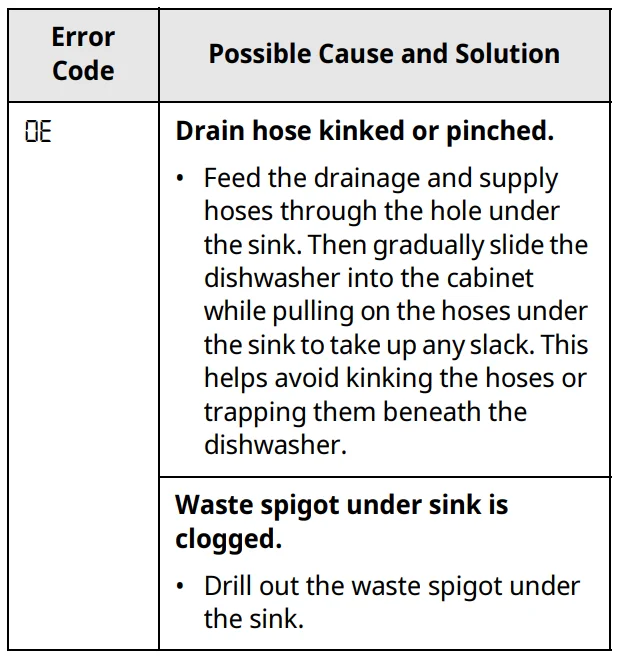
Check the waste spigot when initially installing. An OE error can occur when the waste spigot below the sink is not drilled out properly. To connect the drain hose, drill out at least a 15 mm diameter hole in the waste spigot before connecting and securing.
CAUTION
- Make sure that plastic debris is not remaining inside the spigot after it has been drilled out.
- Do not attempt to open the waste hole with a screwdriver and hammer. This will induce debris to become stuck and cause a malfunction.
- Caution should be taken when passing hoses through Cabinetry holes, as they may have sharp edges and could damage the hoses. Smooth or sand edges to avoid damaging the drain or inlet
hose.
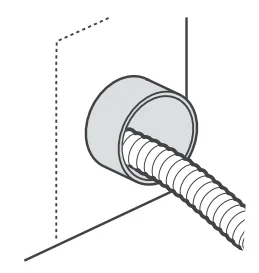
- Make sure that the line is not kinked or sharply bent.
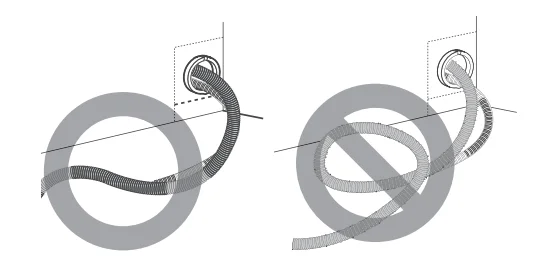
- Make sure the drain hose is straight before feeding the end of it through the hole for the water supply.
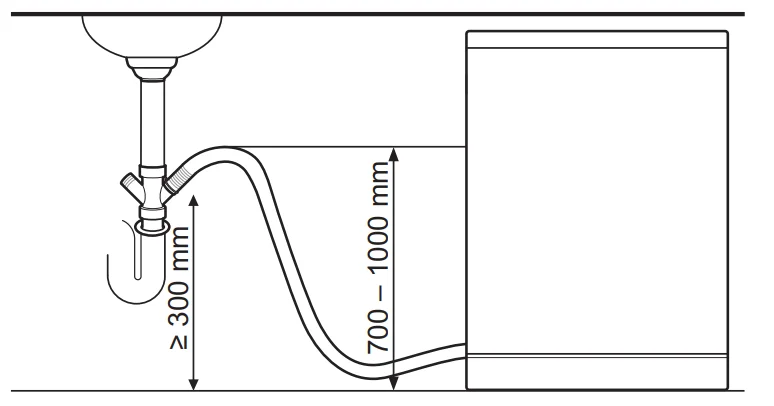
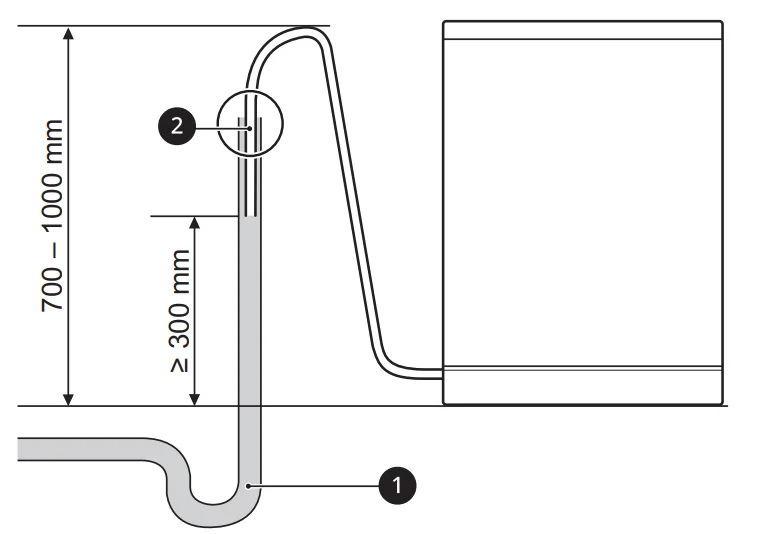
To prevent siphoning, one of the following methods must be used.
Method 1
When the drain hose is connected to a waste spigot, the hose must be looped up to the underside of the bench top and secured.
Method 2
When the drain hose is connected to a separate standpipe 1, an airtight connection 2 must be made. If not, it can induce odours.
- Standpipe diameter is at least 40 mm.
Preparing Water and Electrical Connections
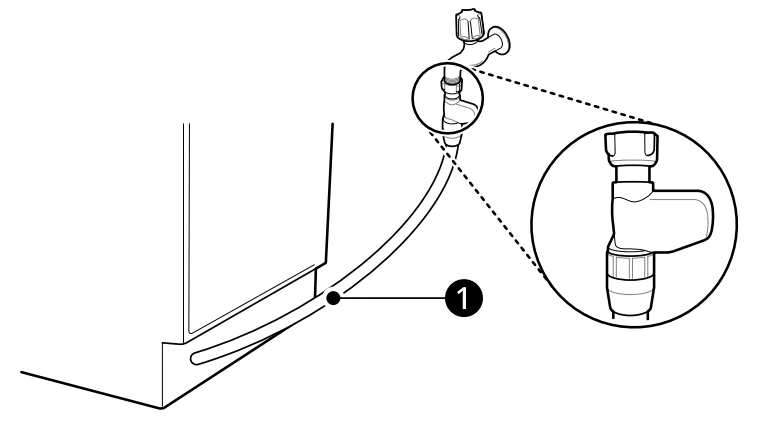
Connecting the Hose to the Water Tap
Connect the water supply hose 1 to the water tap.
WARNING
- Do not shorten or damage the water supply hose as it contains electrical wires and components. It can not be detached or removed from the appliance for installation purposes.
- It is important that the water supply hose not be tampered with, cut, disassembled, pulled, or kinked. It contains electrical wiring inside, and if damaged, it can cause an electrical hazard.
CAUTION
- Only use the threaded nut of the water supply hose to tighten it to the tap.
- Do not twist or kink the water supply hose when connecting it to the tap.
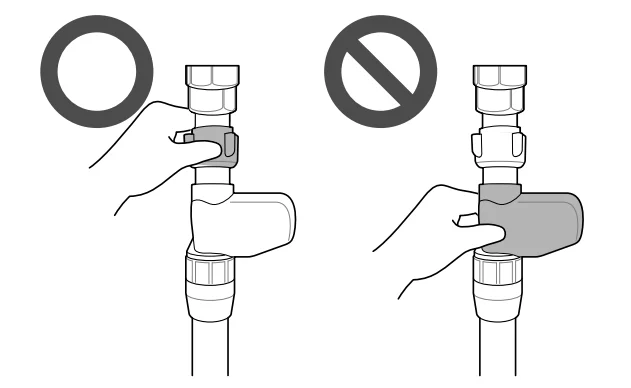
- This appliance may be fed with either hot or cold water. If the water connection can not be maintained below 65ºC, the appliance must be connected to cold water.
- Make sure that the line is not kinked or sharply bent.
- Do not use any mechanical device to tighten the inlet valve’s fitting to the tap. Hand-tighten with the aid of a soft cloth only if necessary. Overtightening the fitting to the tap can cause damage to the nut and tap and result in a water leak.
NOTE
- Before connecting the water supply hose to the tap, turn on the tap to flush out foreign substances (dirt, sand or sawdust) in the water lines. Let water drain into a bucket.
- It takes about 3 – 4 minutes for the first supply of water.
Routing Electrical Wiring
Connect the appliance to an earthed socket in accordance with the current wiring regulations, protected by a minimum 15 amp circuit breaker or time delay fuse. Wiring must be two wires with earth. The power cord should not be positioned behind the appliance but within 1.2 meters of the side so that the plug is easily accessible.
WARNING
- For personal safety, remove the house fuse, open the circuit breaker or switch off the power plug before installation.
- Do not use an extension cord or double adapter.
- The plug must be plugged into an appropriate outlet that is properly installed and grounded in accordance with all local codes and ordinances.
- Repairs to the appliance must only be carried out by qualified service personnel. Repairs carried out by inexperienced persons may cause injury or serious malfunction. Contact our local service centre.
- Connect to a properly rated, protected, and sized power circuit to avoid electrical overload.
Final Installation Check
Testing the Dishwasher
- Turn on electrical power.
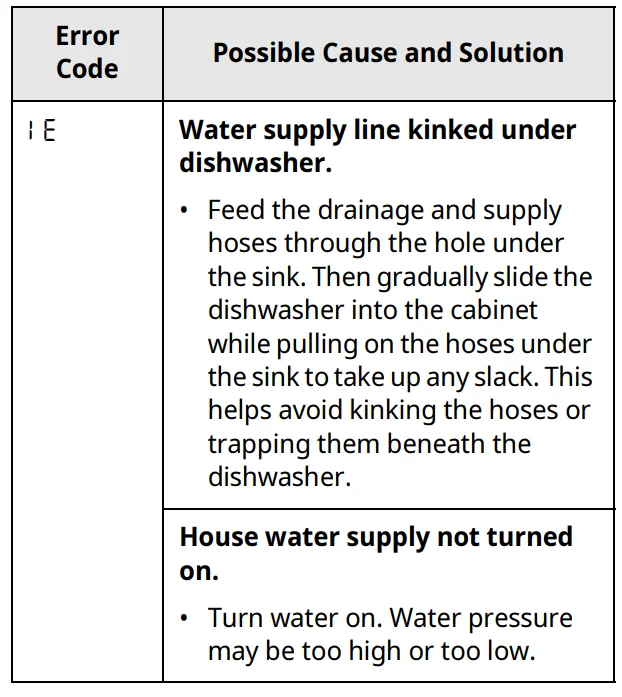
- Turn on the house water supply.
- The door should open and close smoothly and without harsh noises if the unit has been levelled correctly.
- Run the appliance on a Rinse cycle to verify proper operation and check for leaks.
Installation Check Error Codes
OPERATION
Operation Overview
Using the Appliance
- Press the Power button.
- The unit will turn on. Check the indicators.
- Check that there is rinse aid and dishwasher salt present.
- Refill the rinse aid and the salt if the corresponding icons illuminate. For more information, refer to the Refilling section.
 : Salt Refill Icon
 : Rinse Aid Refill Icon
- Open the door and check the filters.
- Always clean the filter either after a wash or before a wash so that it does not impair the washing results.

- Always clean the filter either after a wash or before a wash so that it does not impair the washing results.
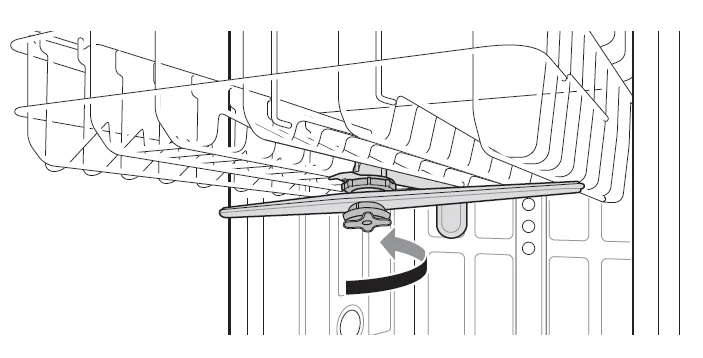
- Ensure the spray arms can unobstructedly rotate.
- Ensure that the upper spray arms and the lower spray arms rotate well. Remove the spray arm and clean it if it does not rotate.

- Ensure that the upper spray arms and the lower spray arms rotate well. Remove the spray arm and clean it if it does not rotate.
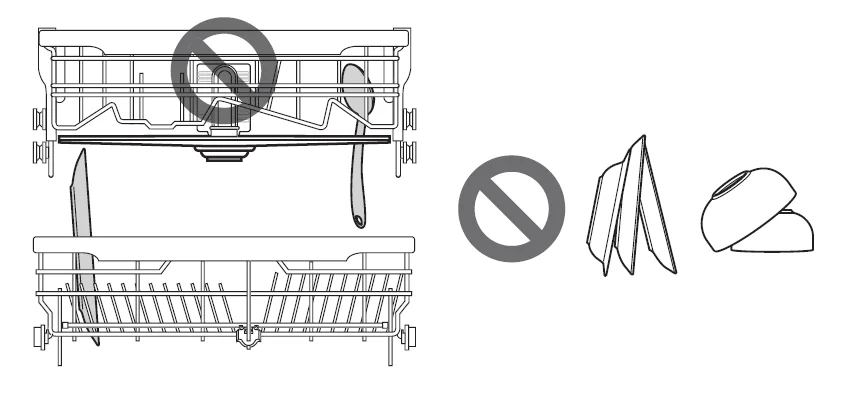
- Load the dishes in the rack.
- Make certain that no dishes or utensils are in the path of the spray arms.
- Do not place one dish on top of another.

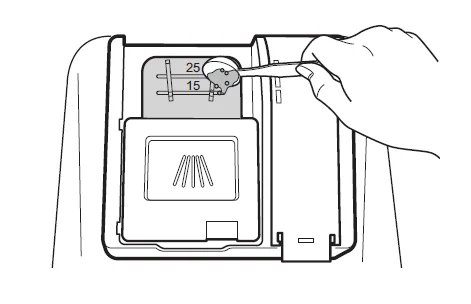
- Add the proper amount of detergent powder to the dispenser.
- If using Tablets, they can simply be placed directly on the base of the tub or on the lower part of the inner door.

- If using Tablets, they can simply be placed directly on the base of the tub or on the lower part of the inner door.
- Set and start the programme.
- The programme will start automatically in 4 seconds after any setting is selected.
 : Salt Refill Icon
 : Rinse Aid Refill Icon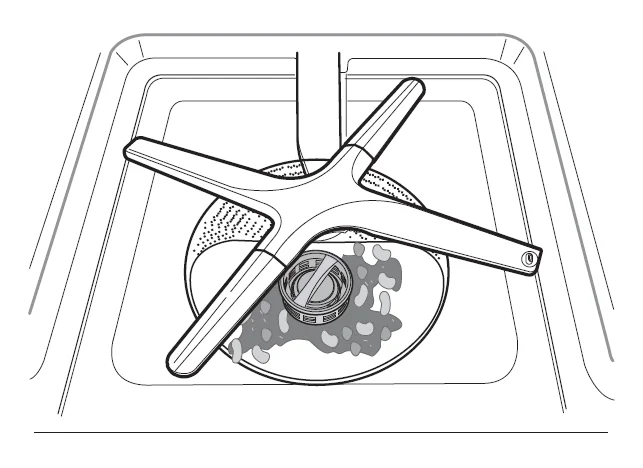
WARNING
- Do not load any items in the upper rack when the lower rack is pulled out and loaded. Failure to do so may result in injury as the appliance could become unbalanced and topple over.
- Push the upper rack in all the way.
- Empty the lower rack first and then the upper one. It will avoid water dripping from the upper rack onto the dishes below.
- Do not open the door during operation or right after it has completed the wash cycle, as the steam may cause scalding as the door is opened.
Before Using
This model has a water softener to soften hard water.
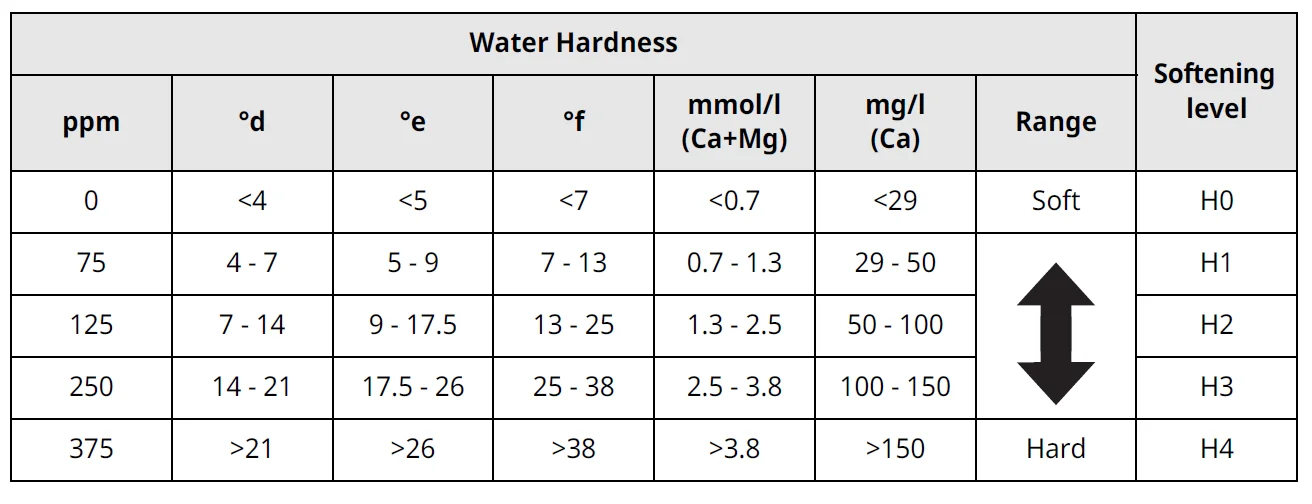
Checking Water Hardness Level
- Check the water hardness in your area. The water utility company can help you with this.
- Set the softening system level of the appliance according to the water hardness level.
Water Hardness Table
Setting the Water Softening System
For effective washing results, adjust the setting to match the hardness level of the water supply. The water softener has 5 adjustment levels, and it is factory-programmed for a water hardness level of H2. You can check the default setting value and adjust it in the following steps:
- Press the Power and Half Load buttons simultaneously.
- Current setting value indicated.
- Press the Delay Start button, and then set up the intended value.
- The scope of setting value is H0 to H4.
- Press the START button to save the setting.
- The power turns off after saving.
NOTE
- The Salt Refill icon turns on in the display if dishwasher salt is not in the softening system.
- If the hardness setting is set to H0, no icon is indicated despite no salt.
Filling with Dishwasher Salt
The salt dispenser must be filled with salt before starting the washing programme. In case of insufficient salt, the Salt Refill n icon indicates on the display, unless the hardness level has been set to H0.
CAUTION
- Once you have filled the dishwasher salt, you must run the Rinse cycle immediately to remove the salt and the salt water around the inner tub in order to prevent corrosion.
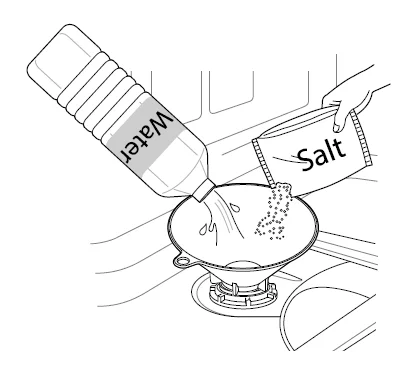
- Remove the lower rack and remove the cap of the salt dispenser located on the left side of the filters.
- Before using the appliance for the first time, it is necessary to pour 1 kg of dishwasher salt and 1 L of water at the same time if intending to use the water softener system. When refilling the salt, use a funnel. Refer to the ” Before Using section.

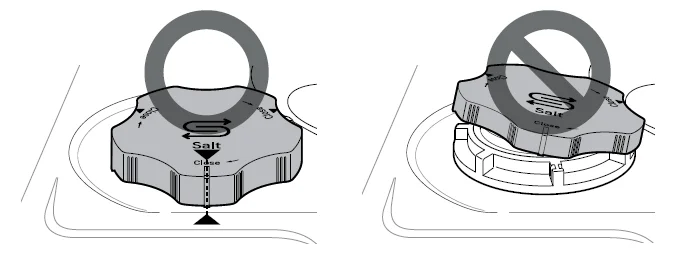
- Refit the cap tightly.
- Run the Rinse cycle without dishes.
Salt Refill Cycle (1 kg for each load)
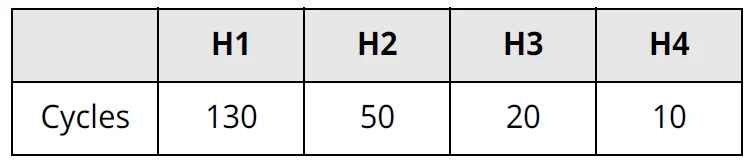
- The table describes information about the Auto programme.
- The cycle may vary depending on the salt refill amount.
CAUTION
- Do not pour any detergent in the salt dispenser. It will cause a malfunction.
- Wipe off any spilled salt around the salt dispenser cap. Saline solution that runs into the can can cause corrosion in the tub and to the dishwasher load.
- Seal the cap properly by aligning it horizontally and turning it clockwise. A loosely fitted cap may cause the saline solution to leak from the salt dispenser into the tub and cause corrosion.
- After refilling the dishwasher salt, a wash programme should be operated without dishes, as any spilled salt inside the appliance may cause rust or damage to the appliance if left unwashed.
Wash Cycles
Auto
This cycle senses the soil amount and water clarity and optimizes the wash to achieve the best cleaning. The wash time may vary depending on the soil level.
Intensive
This cycle is for heavily soiled dishes and dishes with hardened on soil. This cycle defaults to the strongest spray intensity and uses it to wash
heavily soiled dishes.
Delicate
Use this cycle to clean delicate items such as fine china and stemware.
Eco
It provides the most efficient energy and water consumption for a good washing and drying result on a normally soiled load and as it uses very little energy.
- Eco cycle and the Energy Saver option are suitable for a normally soiled load.
Turbo
This cycle will clean moderately soiled dishes using slightly more energy and water.
- Extra Dry is set to on as the default. If you do not want to dry dishes after washing, turn off the
- Extra Dry option. Not drying the dishes will result in a shorter cycle time.
Download Cycle
Use a dedicated cycle downloadable via Wi-Fi or NFC. (depending on model).
NOTE
- Only the cycle code for the currently downloaded cycle appears on the appliance. See the smartphone app for cycle codes, names, and more information about the available cycles.
- Default Cycle: P1. Pots & Pans
Machine Clean
This cycle is for cleaning the inside of the appliance. Use the cycle without dishes in the appliance. It eliminates residual soils, odour, white spots, limescale, and other dirt. Add citric acid or another
cleaning agent for more effective results.
- Press and hold Intensive for 3 seconds to activate.
Rinse
This cycle is a quick rinse only for dishes that will not be washed immediately. The cycle rinses dishes that have excess soil to soften dried-on residue. Rinsing the dishes helps prevent odours in the
appliance.
- Press and hold Eco for 3 seconds to activate.
NOTE
- Do not use detergent with this option.
- This cycle does not have drying.
Express
This cycle will quickly clean lightly soiled dishes.
- Press and hold Turbo for 3 seconds to activate.
NOTE
- This cycle does not have drying. Select the Extra Dry option or another cycle for better drying. Extra Dry will add to the overall cycle time.
- Detergent tablets are not recommended for use with the Express cycle. If the detergent tablets are used, it may cause detergent residue on dishes due to the relatively low rinse temperatures.
TROUBLESHOOTING
Before Calling for Service
Operation of the appliance can lead to errors and malfunctions. The following tables contain possible causes and notes for resolving an error message or malfunction. You can remedy most of the problems by yourself, consequently save time and money, since you do not need to call the service centre. The following table should assist you in troubleshooting.
Error Codes
The appliance is equipped with an automatic error-monitoring system to detect and diagnose problems at an early stage. If this appliance does not function properly or does not function at all, check the following before you call LG Electronics service centre.
For more manuals by LG, visit ManualsLibraryy
LG XD5B14PS QuadWash Dishwasher-FAQs
What are the most common problems with the LG XD5B14PS dishwasher?
Most common issues are usually related to clogged filters, incorrect dish loading, blocked spray arms, or skipped maintenance. Regular cleaning and proper use can help the dishwasher run efficiently and prevent washing or draining problems.
What makes QuadWash technology different from regular dishwashers?
QuadWash technology uses four rotating spray arms instead of the traditional two. This helps water reach more corners of the dishwasher, giving dishes a deeper and more even clean on every rack.
Can I use vinegar to clean my LG dishwasher?
Yes, white vinegar can help remove grease, odors, and mineral buildup. Run an empty hot-water cycle with a small amount of vinegar occasionally for maintenance cleaning.
Is the LG XD5B14PS quiet during operation?
Yes, this dishwasher is designed to operate quietly, making it suitable for open kitchens and nighttime use without causing much disturbance.
Does the LG XD5B14PS come with a warranty?
Yes, the dishwasher generally includes a manufacturer warranty covering parts and labor for a limited period, along with extended coverage for the motor components.
Why does my LG dishwasher smell bad?
Food particles, grease, and moisture buildup inside the filter or drain area can cause unpleasant odors. Cleaning the filter, door seals, and interior regularly helps keep the dishwasher fresh.
Why are dishes still dirty after a wash cycle?
Dirty dishes may result from overloaded racks, blocked spray arms, dirty filters, or dried food residue. Proper loading and regular cleaning of internal parts usually improve washing performance.
Why does my LG dishwasher take a long time to finish a cycle?
Long wash cycles are often caused by Eco mode or energy-saving settings. These cycles use lower temperatures and less energy, which can increase washing time to improve efficiency.
How long does an LG dishwasher usually last?
An LG dishwasher typically lasts around 10 years or longer when properly maintained. Cleaning the filter regularly and using the correct detergent can help extend its lifespan.
Is the LG XD5B14PS dishwasher reliable?
Yes, the LG XD5B14PS is considered a reliable dishwasher with strong cleaning performance, quiet operation, and energy-efficient features. With regular maintenance, it can provide dependable performance for many years.