
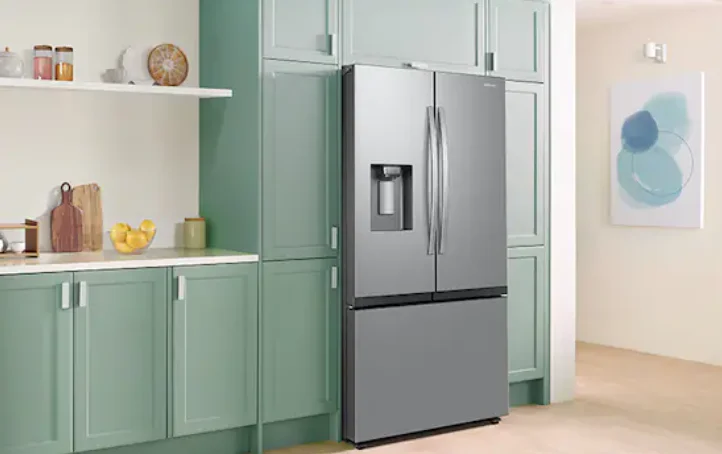

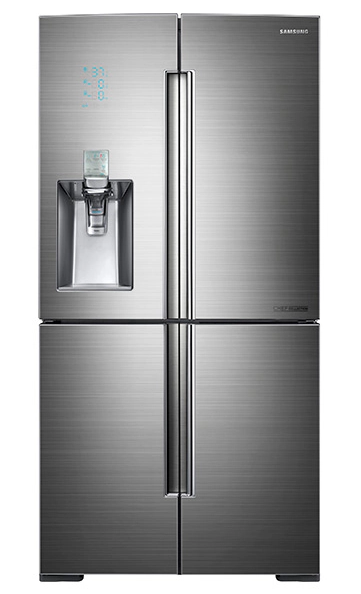
Samsung RF323TEDBSR French-Door Refrigerator
SAFETY INFORMATION
Before using your new Samsung French Door Refrigerator, please read this manual thoroughly to ensure you understand how to operate the features and functions safely and efficiently. This appliance is not intended for use by persons (including children) with reduced physical, sensory, or mental capabilities, or those who lack experience and knowledge, unless they have been given supervision or instruction concerning the use of the appliance by a person responsible for their safety.
Setting up your French Door Refrigerator
GETTING READY TO INSTALL THE REFRIGERATOR
Congratulations on your purchase of this Samsung French Door Refrigerator. We hope you enjoy the state-of-the-art features and efficiencies that this new appliance offers.
Selecting the best location for the refrigerator
Choose :
- A location with easy access to a water supply.
- A location without direct exposure to sunlight.
- A location with a level floor.
- A location with enough space for the refrigerator doors to open easily.
- A location that allows sufficient space to the right, left, back, and top for air circulation.
- A location that allows you to move the refrigerator easily if it needs maintenance or service.
- Do not install the refrigerator in locations where the temperature exceeds 110 °F (43 °C) or falls below 50 °F (10 °C).
- Do not locate the refrigerator where it may become wet.
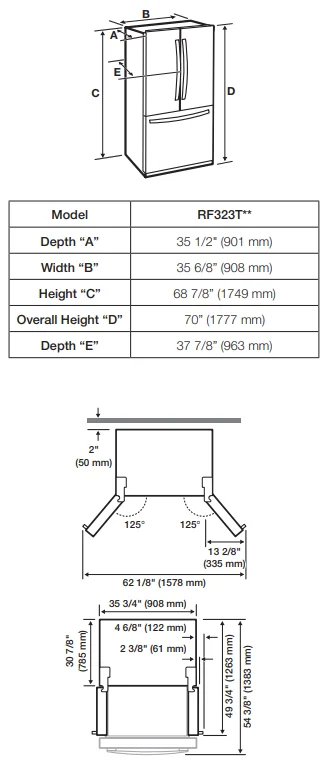
If the refrigerator does not have enough space, it can cause a bad influence on refrigeration efficiency and power consumption. If your refrigerator has an ice maker, allow extra space at the back for the water line connections. When you install the refrigerator next to a fixed wall, you need a minimum clearance of 3 ¾” (95mm) between the refrigerator and the wall to allow the door to swing open.
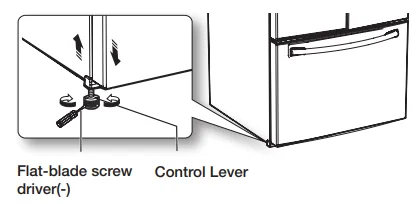
When moving your refrigerator: To prevent floor damage, be sure the front adjusting legs are in the up position (above
the floor). Refer to ‘Adjusting the Level’ in the manual (on page 9).
FLOORING
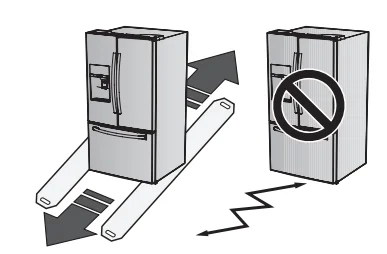
For proper installation, you must place this refrigerator on a level, hard surface that is the same height as the rest of the floor. This surface should be strong enough to support a fully loaded refrigerator. To protect the finish of the flooring, cut a large section of the cardboard carton and place it under the refrigerator where you are working. When moving the refrigerator, you need to pull and push it straight forward or back. Do not wiggle it from side to side.
REMOVING THE REFRIGERATOR DOORS
For some installations, you need to remove the fridge and freezer drawers so you can move the refrigerator to its final location. Do not remove the doors/drawer if you don’t need to. If you do not need to remove the refrigerator doors, go to Adjusting the Level on page 9. If you need to remove the doors. Continue below. Before removing the door/drawer, make sure you read the following items:
- Be careful not to drop, damage, or scratch the door/drawer while removing it.
- Use care when you remove the doors/drawer. The doors are heavy, and you could injure yourself.
- Reattach the doors/drawer properly to avoid:
- Moisture from air leakage.
- Uneven door alignment.
- Wasting energy due to an improper door seal.
Disassemble the refrigerator doors.
Be careful not to drop or scratch the doors while removing them.
Required Tools (Not provided)
You need the following tools to complete the installation of your refrigerator:
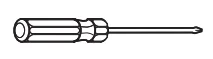
Philips screwdriver(+)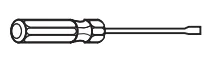
Flat-blade screw driver(-)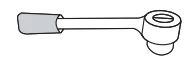
Socket wrench (10mm)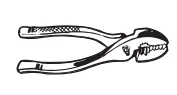
Pliers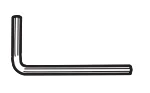
Allen wrench (3/16”) (5mm)
With the door open
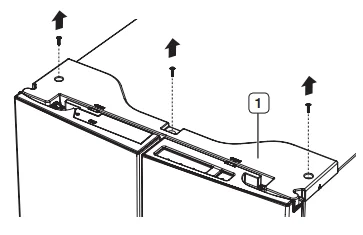
- Remove 3 screws holding down the TOP TABLE ( 1 ) and separate the wires connected.

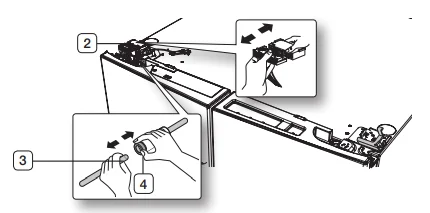
- Disconnect the two connectors ( 2 ) on the left side door. To remove the water coupler from the hinge, twist and pull it from the hinge. Remove the water line ( 3 ) while pressing the marked part ( 4 ) of the water line coupler.

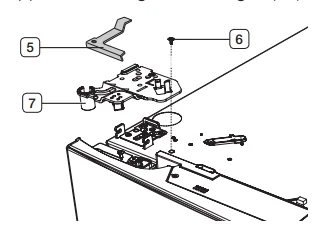
- Pull and remove the hinge lever ( 5 ). Remove the ground screw ( 6 ) attached to the upper left door hinges with a aPhillipss screwdriver (+). Remove the upper left and right door hinges ( 7 ).

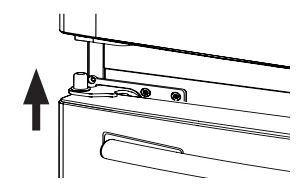
- Lift the door straight up to remove.

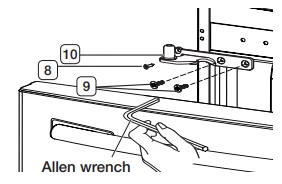
- Remove the screw ( 8 ) attached to the lower left and right door hinges with a Philips screwdriver (+). Remove the 2 hex head bolts ( 9 ) attached to the lower left and right door hinges with an allen wrench (3/16”). Remove the lower left and right door hinges ( 10 ).

REATTACHING THE REFRIGERATOR DOORS
To reattach the fridge doors after you have moved the fridge to its final location, assemble the parts in reverse order.
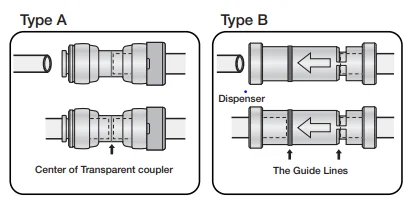
- The Water Line must be fully inserted into the center of the transparent coupler (Type A) or the Guide Lines (Type B) to prevent water leakage from the dispenser.

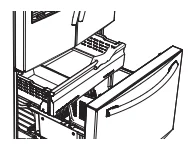
DISASSEMBLE THE FLEX DOOR
- Take out the upper drawer by lifting it.

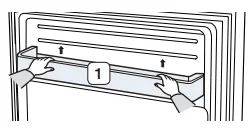
- Remove the freeze room guard ( 1 ) by lifting the guard.

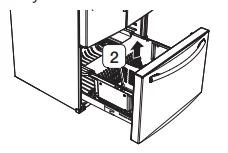
- Take out the lower basket ( 2 ) by lifting the basket from the rail system.

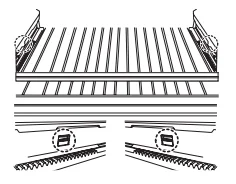
- Press the fixing hook of the rail system.

- Holding the top of the Freezer Drawer, pull it out all the way, and then remove it from the rail system.

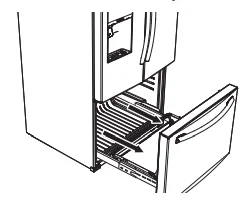
ASSEMBLE THE FREEZER DRAWER
To reattach the drawer after you have moved the fridge to its final location, assemble the parts in reverse order.
ADJUSTING THE LEVEL
Make sure the refrigerator is level so that you can make final adjustments. Use a level to test if the refrigerator is level both side to side and back to front. If the refrigerator is not level, it will not be possible to get the doors perfectly even, which
may cause moisture condensation and increased energy bills. Below is an example of how to level the refrigerator if the left side of the refrigerator is lower than the right side.
How to adjust the level
- Open the freezer drawer and remove the lower basket.
- Insert a flat-blade screwdriver (-) into a notch on the left control lever, and turn it counterclockwise to level the refrigerator. (You turn the lever clockwise to lower the refrigerator and counterclockwise to raise it.)

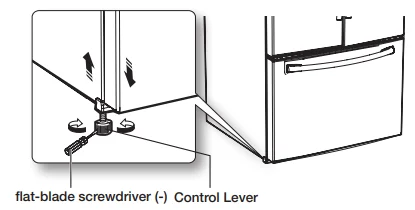
MAKING MINOR ADJUSTMENTS BETWEEN DOORS
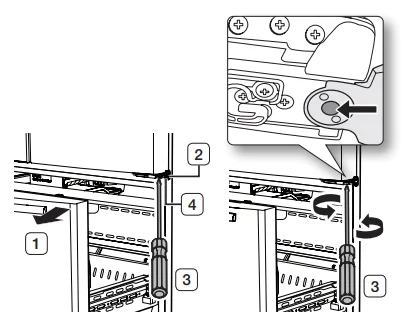
Remember, a leveled refrigerator is necessary for getting the doors perfectly even. If you need help, review the previous section on leveling the refrigerator.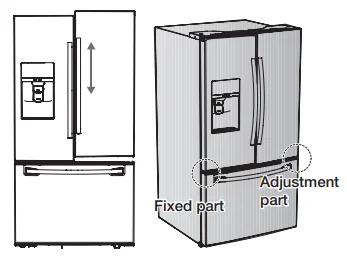
- Pull out the freezer drawer ( 1 ) to reveal the lower hinge ( 2 ).
- Insert a Philips screwdriver (+) ( 3 ) into the shaft ( 4 ) of the lower hinge.
- Adjust the height by turning a Philips screwdriver (+) ( 3 ) clockwise ( DOWN ) or counterclockwise ( UP ).

INSTALLING THE WATER DISPENSER LINE
A water dispenser with a filter is one of the helpful features on your new refrigerator. To help promote better health, the water filter removes unwanted particles from your water. However, it does not sterilize or destroy microorganisms. You may need to purchase a water purifying system to do that. The water line also connects to the ice maker. For the ice maker to operate properly, a water pressure of 20~125 psi (138~862 kPa) is required. If the refrigerator is installed in an area with low water pressure (below 20 psi), you can install a booster pump to compensate for the low pressure. After you have connected the water line, make sure the water storage tank inside the refrigerator is properly filled. To do this, press the water dispenser lever until the water runs from the water outlet.
Connecting to the water supply line
- First, shut off the main water supply.

- Locate the nearest cold water drinking line and install the pipe clamp and shut-off valve.

- Connect the water line installation kit to the shut-off valve.

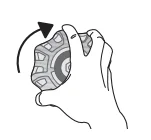
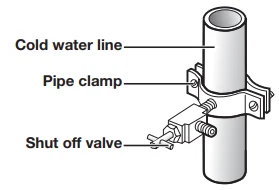
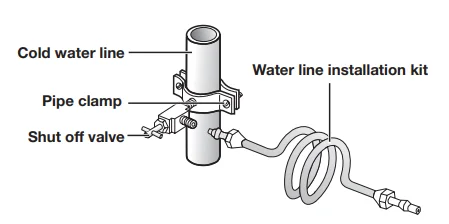
Connecting the water supply line to the refrigerator.
There are several items that you need to purchase to complete this connection. You may find these items sold as a kit at your local hardware store.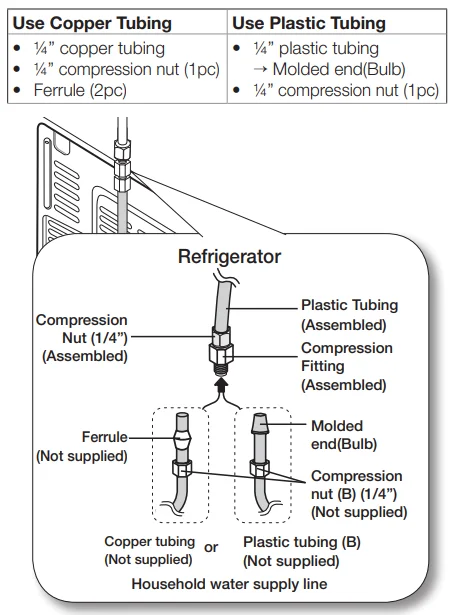
- Connect the household water line to the assembled compression fitting.
- If you are using copper tubing, slip the compression nut ( B ) (not supplied) and ferrule (not supplied) on the copper tubing (not supplied) as shown.
- If you are using plastic tubing ( B ), insert the molded end (Bulb) of the plastic tubing ( B ) into the compression fitting.
- Tighten the compression nut ( B ) onto the compression fitting.
- Turn the water on and check for any leakage. If you find water drops or leakage in the connection areas, turn off the main water supply. Check the connections and, if necessary, tighten.
- Flush 1 gallon of water through the filter before drinking or using the water from the refrigerator. (Flush approximately 6 minutes.) To flush, press a large glass or cup against the water dispenser lever. Fill the glass, empty it into the kitchen sink after it is filled, and then repeat.
- After you turn on the refrigerator, let the ice maker make ice for 1 to 2 days. Over that period of time, throw out the first 1 or 2 buckets of ice the freezer makes to ensure all impurities have been removed from the water line.
COMPLETING THE SET UP
Now that you have your new refrigerator installed in place, you are ready to set up and enjoy the features and functions of the appliance. By completing the following steps, your refrigerator should be fully operational.
- Make sure your refrigerator is in an appropriate location with reasonable clearance between it and the wall. Refer to the installation instructions in this manual.
- Once the refrigerator is plugged in, make sure the interior light comes on when you open the doors.
- Set the Temperature control to the coldest temperature and wait for an hour. The freezer will get slightly chilled, and the motor will run smoothly. Reset the refrigerator and freezer to the temperatures you want.
- After you plug the refrigerator in, it will take a few hours to reach the appropriate temperature. You can store food and drinks in the refrigerator after the temperature is sufficiently cool.
Operating your French Door Refrigerator
USING THE CONTROL PANEL RF323TE**
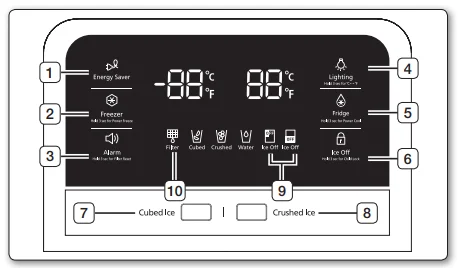
- Energy Saver: Touching this button turns Energy Saver mode on and off. When you turn Energy Saver on, the Energy Saver icon lights. Turn Energy Saver off, and the icon goes off. The Energy Saver function automatically turns on when power is supplied to the refrigerator. If condensation or water drops appear on the doors, turn the Energy Saver
mode off. - Freezer (Hold 3 sec for Power Freeze): Touch this button to set the freezer to your desired temperature. You can set the temperature between -8°F and 5°F (between -23°C and -15°C). Touch and hold this button for 3 seconds to decrease the time needed to freeze products in the Freezer. It can be helpful if you need to quickly freeze easily spoiled items or if the temperature in the freezer has warmed dramatically (For example, if the door was left open).
- Alarm/hold 3sec for Filter Reset: This button serves two purposes:
- To turn the door open alarm on and off. If the door alarm is set to On, an alarm beeps if any refrigerator door is left open for more than three minutes. The beeping stops when you close the door. The door alarm function is preset to On in the factory. You can turn it off by touching and then releasing this button. You can turn it back on in the same fashion. The icon lights up when the function is on.
- To reset the water filter life indicator. After you replace the water filter, touch and hold this button for 3 seconds to reset the water filter life indicator.r
- Lighting/Hold 3 sec for C↔F: Touching this button turns on the Dispenser LED lamp (under the display) in continuous mo, de so that it stays on continuously. The button also lights up. If you want the Dispenser lamp to come on only when someone uses the dispenser, touch this button to turn the continuous mode off. Touch and hold this button for 3 seconds to switch the temperature units between °C and °F.
USING THE COOL SELECT PANTRY™
The Cool Select Pantry™ is a full-width drawer with adjustable temperature control. This pantry can be used for large party trays, deli items, pizza, beverages, or miscellaneous items. There is a temperature control that can adjust the amount of cold air allowed into the pantry. The control is located on the right side of the pantry.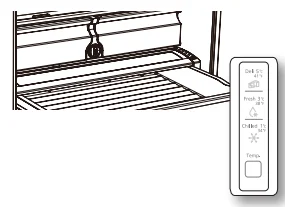
- The Pantry has three modes: The Fresh mode, the Hilled mode, and the Deli mode. Fresh mode is the default. Press the Temp button repeatedly until the mode you want is lit. Once you select a mode, the temperature will change to match the mode you selected.
- The Pantry temperature may change depending on the number of items inside and where they are located, and the ambient temperature
temperature, and how often the door is opened.
Using the doors
Ensure that the doors close all the way and are securely sealed. When the refrigerator door is only partially open, it will automatically close. But the door will stay open when opened more than the auto-close range, and you must close it manually.
CLEANING THE REFRIGERATOR
Caring for your Samsung French Door Refrigerator prolongs the life of your appliance and helps keep the refrigerator free of odor and germs.
Cleaning the Interior: Clean the inside walls and accessories with a mild detergent and then wipe dry with a soft cloth. You can remove the drawers and shelves for a more thorough cleaning. Just make sure to dry drawers and shelves before putting them back into place.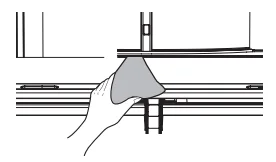
Cleaning the Exterior: Wipe the control panel and digital display with a damp, clean, soft cloth. Do not spray water
directly on the surface of the refrigerator. The doors, handles, and cabinet surfaces should be cleaned with a mild detergent and then wiped dry with a soft cloth. To keep your appliance looking its best, polish the exterior once or twice a year.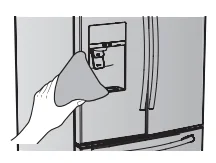
Cleaning the Ice / Water Dispenser: Push down one end of the tray dispenser and remove it. Wipe the Ice / Water Dispenser with a clean and soft cloth.
Cleaning the Rubber door seals: If the rubber door seals are dirty, the doors may not close properly, and the refrigerator will not operate efficiently. Keep the door seals free of dust or stains by cleaning the doors with a mild detergent and a damp cloth. Wipe dry with a clean, soft cloth.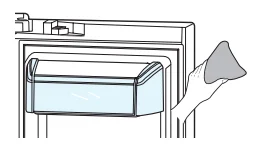
FOOD STORAGE TIPS
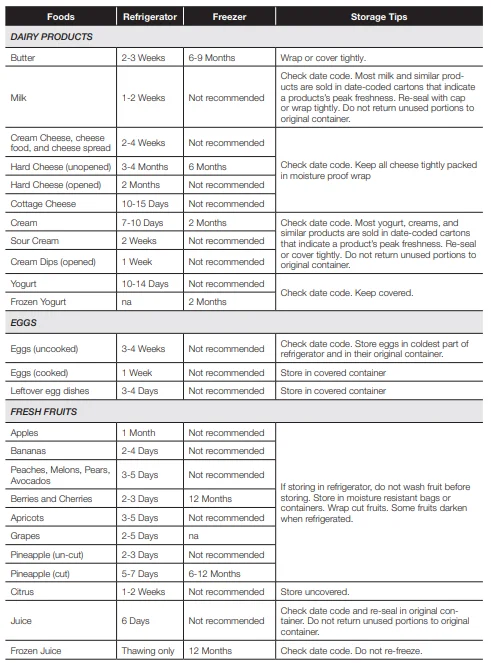
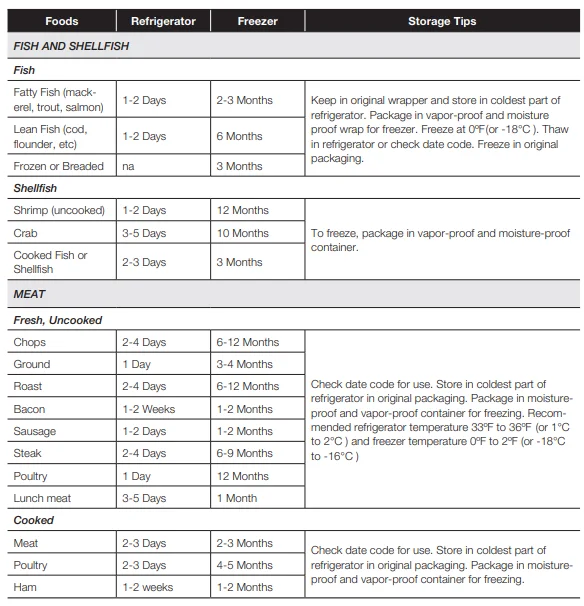
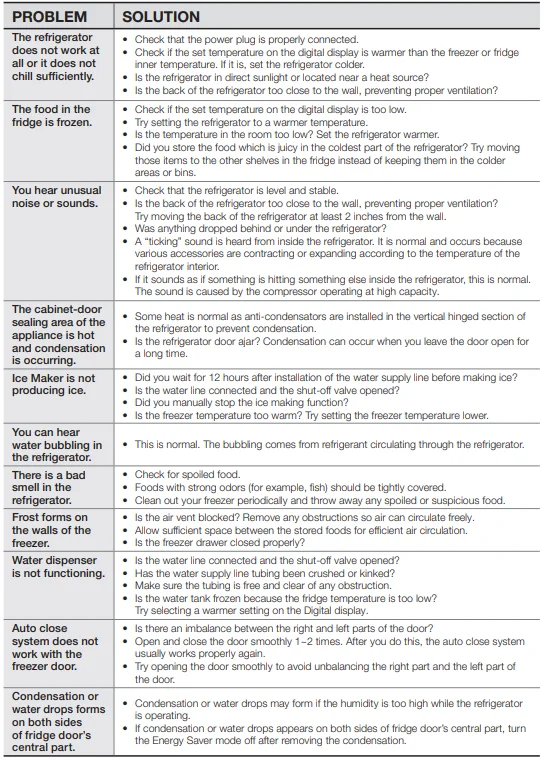
Troubleshooting
FOR MORE MANUALS BY SAMSUNG, VISIT MANUALSLIBRARYY
Samsung RF323TEDBSR French-Door Refrigerator-FAQs
What is the size and capacity of the Samsung RF323TEDBSR refrigerator?
The Samsung RF323TEDBSR is a 36-inch French-door refrigerator with a 30.5 cu. ft. capacity. It features spill-proof glass shelves, LED lighting, a filtered water and ice dispenser, and an ENERGY STAR® rating for efficiency.
What are the most common problems with Samsung refrigerators?
Common issues include cooling problems, ice maker malfunctions, and water leaks. Regular cleaning of the condenser coils and door seals can help prevent many of these problems.
Why is my Samsung French-door refrigerator not cooling properly?
Check the door seals for dirt or damage, make sure air vents are not blocked, and allow 24 hours for the temperature to stabilize after cleaning or restocking the fridge.
Why is my Samsung freezer not freezing efficiently?
Ensure that air vents are clear of food packages to maintain airflow. Blocked vents can trap warm air, causing frost buildup and uneven cooling.
What is the lifespan of a Samsung refrigerator?
Samsung refrigerators typically last 10–14 years with proper maintenance. Keeping coils clean and door seals tight can extend the lifespan.
What are the disadvantages of Samsung refrigerators?
Some users report issues like ice maker faults, temperature fluctuations, and cooling system failures. Regular servicing can reduce these risks.
How wide is a 36-inch Samsung refrigerator?
Although labeled as 36 inches, the actual width is usually around 35.75 inches, allowing a small clearance for easy installation.
How many hours should I wait before using a new Samsung refrigerator?
After installation, wait at least 2–4 hours before storing food to allow the refrigerant to settle and the internal temperature to reach optimal levels.
How do I clean the coils on my Samsung refrigerator?
Unplug the refrigerator, locate the coils at the back or bottom, and gently clean them using a soft brush or vacuum to remove dust and debris.
What signs indicate a failing refrigerator compressor?
Unusual noises, frequent cycling, and poor cooling performance can signal compressor issues. If these occur, contact a certified Samsung technician.