
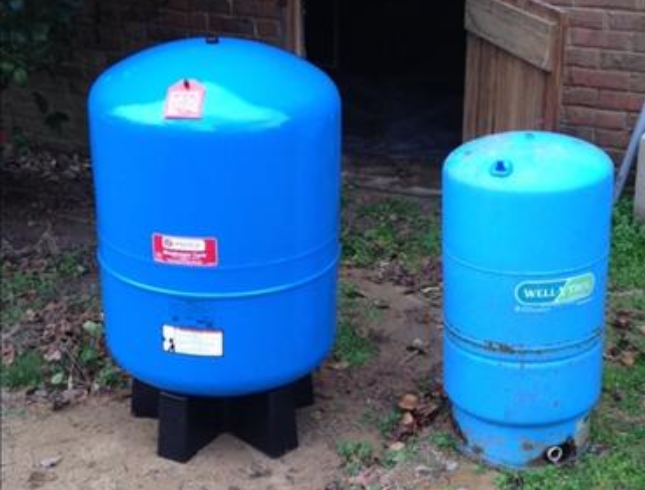

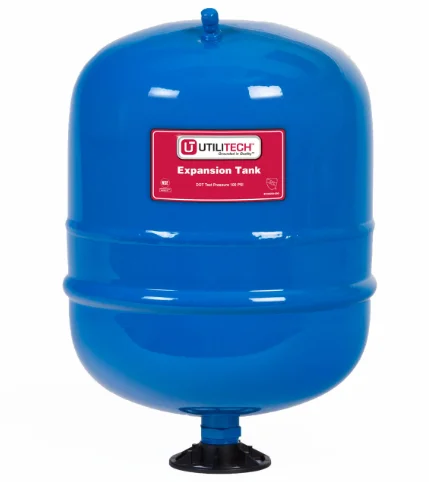
Utilitech LPT-52 52 Gallons Vertical Well Pressure Tank
IMPORTANT INSTRUCTIONS BEFORE INSTALLATION
- All piping and electrical wiring must adhere to state and local codes. If there are no state or local electrical codes, the electrical wiring must follow the National Electrical Code, NFPA 70. Check with appropriate community agencies or contact your local electrical and pump professionals.
- Install the tank as close as possible to the pump pressure switch to reduce friction loss and the elevation difference between the tank, water supply main, and switch.
- After installation, be sure the pressure switch is set low enough to shut the pump off. If all valves are closed and the pressure switch setting is too high, the pump will run continuously without water flow, causing overheating and damage to the pump.
- A pressure relief valve must be installed in the piping adjacent to the pump tank.
- The following may cause severe damage to the tank and/or piping and will void the warranty:
- Failure to protect the tank against below-freezing temperatures.
- Pumping chemicals or corrosive liquids.
- Pumping gasoline or other flammable liquids.
- Operation at pressures greater than 100 PSI with no relief valve.
- Pumping liquids hotter than 120°F.
This pump tank is designed and intended for cold (ambient temperature) water storage at a maximum pressure of 100 PSIG. Any use other than with cold water, or at a sustained or instantaneous pressure in excess of 100 PSIG, is UNSAFE. A pressure relief valve of adequate size must be incorporated into the system. The relief valve must be selected to pass the full capacity of the pump when the pressure in this tank is 100 PSIG or more.
Consult the pump manufacturer for the pump capacity at relief pressure. The manufacturer of this tank does not accept any liability or other responsibility for personal injury or property damage resulting from improper use, installation, or operation of this tank, or of the system of which it is a part.
Install a 100 P.S.I. or less pressure relief valve directly into a fitting of the plumbing. Position the valve downward and provide tubing so that any discharge will exit only within 6 inches above, or at any distance below, the structural floor. Be certain that no contact is made with any live electrical part. The discharge opening must not be blocked or reduced in size under any circumstances.
Excessive length (over 15 feet) or the use of more than two elbows can cause restriction and reduce the discharge capacity of the valve. No valve or other obstruction is to be placed between the relief valve and the tank. Do not connect tubing directly to the discharge drain unless a 6 in. air gap is provided.
To prevent bodily injury or hazard to life, the valve must be able to discharge large quantities of water should circumstances demand. If the discharge pipe is not connected to a drain or other suitable means, the water flow may cause property damage.
The Discharge Pipe:
- Must not be smaller in size than the outlet pipe size of the valve, or have any reducing couplings or other restrictions.
- Must not be plugged or blocked.
- Must be installed to allow complete drainage of both the pressure relief valve and the discharge pipe.
- Must not have any valve between the relief valve and the tank.
IMPORTANT
It will be necessary to expel all air from piping after new installations, repriming, and after pumps have been disassembled for repair. To purge the air, first open a faucet the greatest distance from the pump. With the pump allowed to run, wait until a steady stream of water is coming from the faucet. At this time, close the faucet for several short intervals. If, after this, air is still in the lines, check on the suction side of the pump for piping leaks. When standard-type tanks are replaced with this tank, all air charging devices, bleeder orifices, and air volume controls must be removed.
The pump tank has been shipped with a factory precharge as indicated on the tank label. If your pump start-up pressure is different from the factory precharge, adjust the tank pressure to your pump start-up pressure with the empty tank. This can be accomplished by simply bleeding air from the valve at the top of the tank with an accurate pressure gauge. Using the same standard air charging valve at the top of the tank, a tire pump can be used to raise the tank pressure. Raise the pressure slowly, checking it periodically with an accurate tire pressure gauge until the desired pressure is reached.
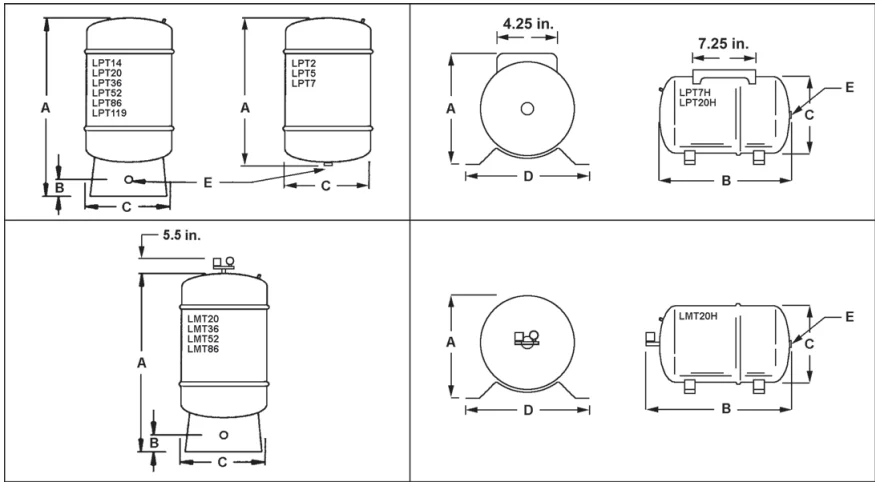
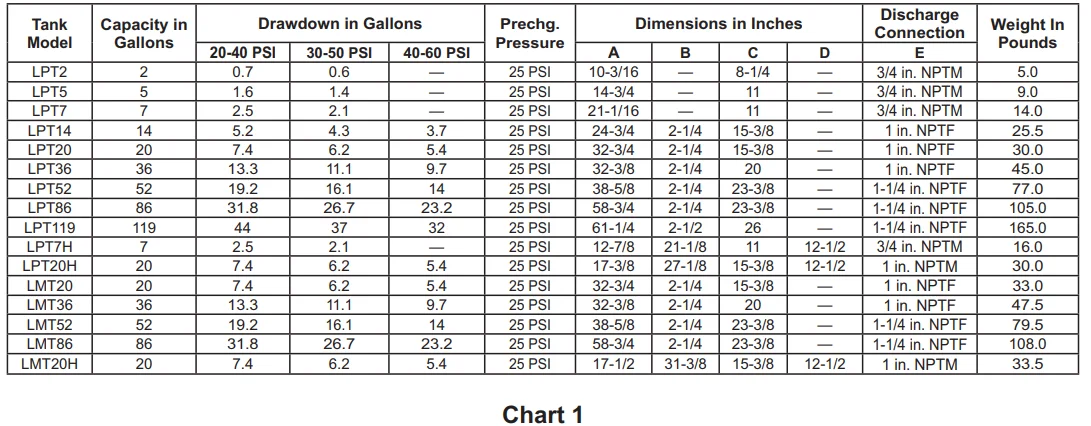
TANK SPECIFICATIONS

PIPING
PVC pipe is shown in the illustrations, but copper or galvanized steel pipe may be used if desired. All piping must be clean and free of all foreign matter. ALL JOINTS AND CONNECTIONS IN THE SYSTEM MUST BE AIRTIGHT. A pinhole leak will prevent proper operation of the system (this is the most common problem). Use thread compound on all threads unless specified otherwise.
DRAINING FOR SERVICING OR FOR WINTER
The system should be drained before it is disconnected for servicing, or if it is inoperative for an extended period of time, or if it is in danger of freezing. To Drain:
- Follow the instructions in your pump installation manual to drain the pump.
- Open the tank drain cock to drain the tank.
- Drain all piping to a point 3 feet below ground level.
DIAPHRAGM TANK INSTALLATION
Diaphragm tanks are recommended for clear water applications. Vertical tanks are the most commonly used tanks. However, horizontal tanks and in-line tanks may be used where space is more critical. See Tank Specifications for tank capacity.
General Materials
- One can use PVC cement (read instructions carefully)
- One can thread compound (read instructions carefully)
- One 1 in. gate valve
- One 1/2 in. relief valve
- Enough rigid 1 in. PVC pipe and couplings to reach from the pump to the pressure tank to the service line
- One male 1 in. PVC adapter
- One 1 in. x 11 in. tank cross or 1 1/4 in. x 13 in. depending on acceptance fitting, see Chart 1
- Two 3/8 in. plugs
- One 1/2 in. boiler drain
- One 1/2 in. street tee
REMINDER: All joints and connections must be airtight. A single pinhole leak will prevent the proper operation of the system. Use thread compound on all threaded connections unless specified otherwise.
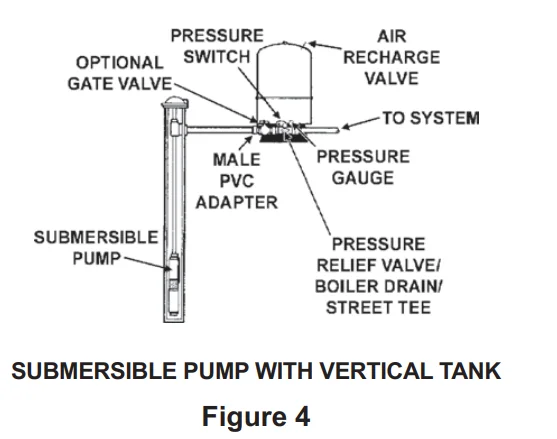
TYPICAL SUBMERSIBLE PUMP INSTALLATION
STEP 1
Complete pump assembly and electrical connections as specified in the pump installation manual. Place the tank in the desired location and level it.
STEP 2
Thread the tank tee into the pressure tank so that the two 3/8 in. holes in the tee face upward. Thread the street tee into the front of the tank tee. See Figure 1.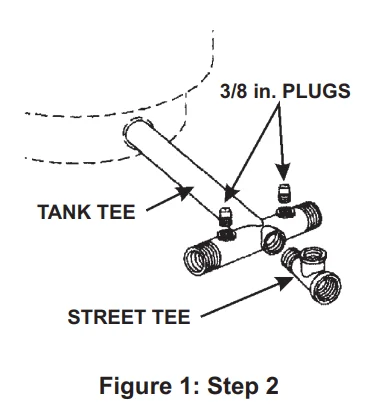
STEP 3
Thread a 3/4 in. male PVC adapter into the inlet side of the tank tee. See Figure 2.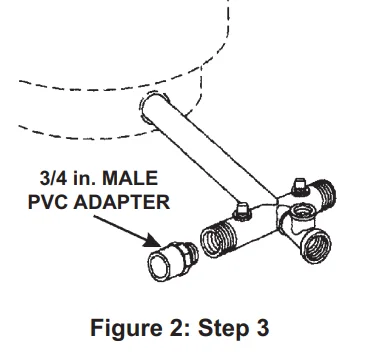
STEP 4
Thread the pressure relief valve into the top of the street tee. Thread the 1/2 in. boiler drain into the front of the street tee. Cut and cement as many sections and couplings of PVC pipe as needed to connect the 3/4 in. male PVC adapter to the pump discharge. See Figure 3.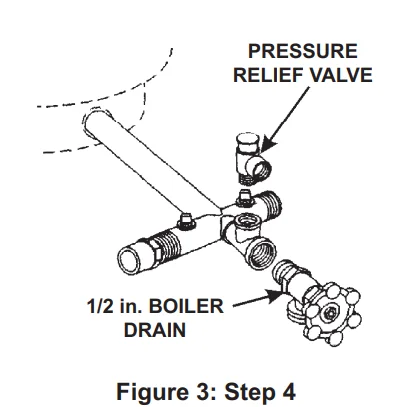
TYPICAL JET PUMP INSTALLATION
STEP 1
Thread 10 in. x 1 in. nipple into the pressure tank. Thread the tank cross into the nipple so that the two 1/4 in. holes in the tank cross face upward. Thread the street tee into the front of the tank cross. Thread the pressure relief valve into the top of the street tee and thread the 3/4 in. boiler drain into the front of the street tee.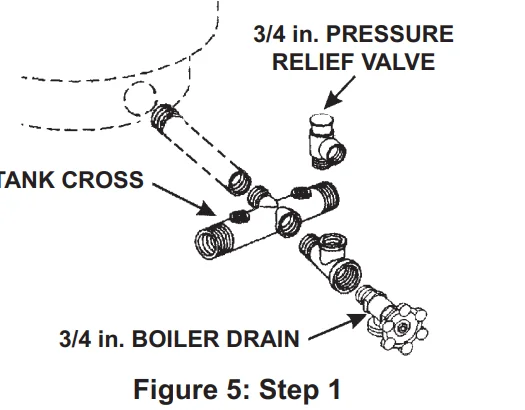
STEP 2
Thread 1 1-in male PVC adapter into the inlet side of the tank cross.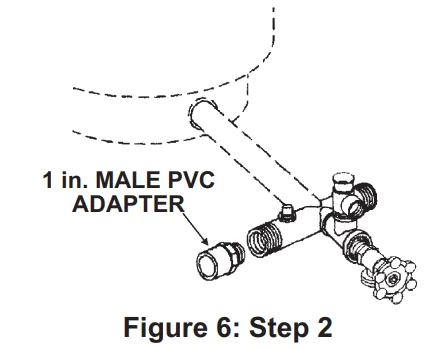
STEP 3
Thread one end of a 1/4 in. x 3 in. brass nipple into the bottom of the pressure switch. Thread the other end into the left 1/4 in. hole of the tank cross. Thread the pressure gauge into the right 1/4 in. hole of the tank cross. Cut and cement as many sections and couplings of PVC pipe as needed to connect the 1 in. male PVC adapter to the pump discharge.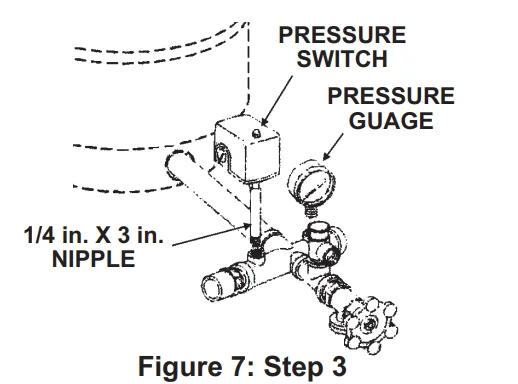
The complete installation should look like the drawing shown below. See Figure 8.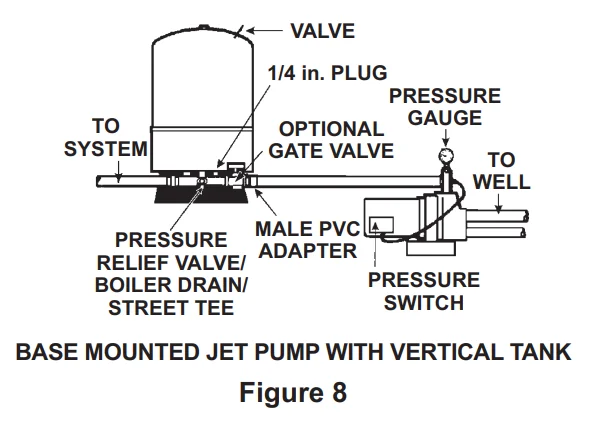
Setting the Tank Pressure
The tank pressure must be set 2 PSI lower than the pump cut-on pressure. Check tank pressure with a standard air gauge valve at the top of the tank as needed.
Other Tank Installations
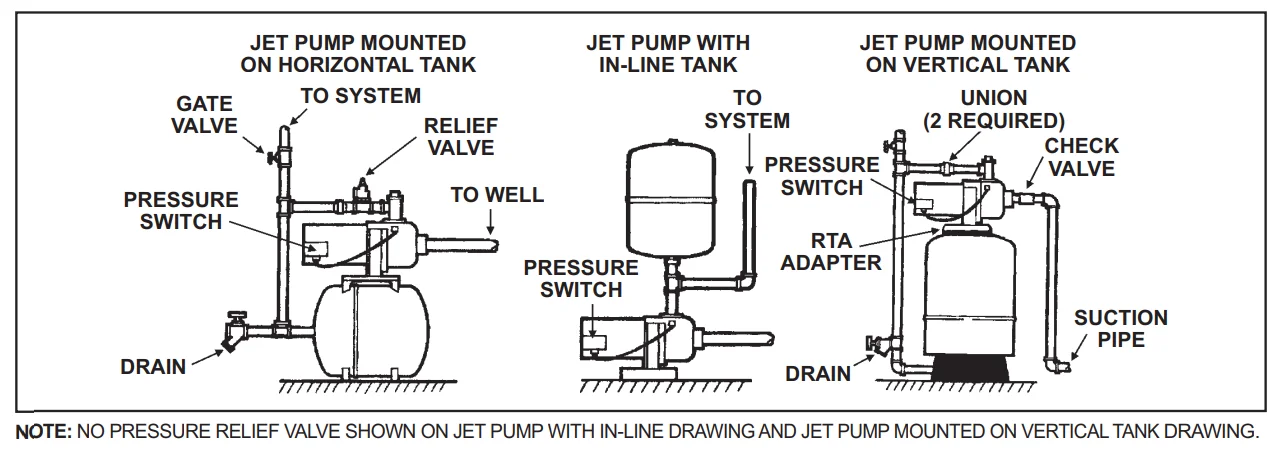
Where space is a critical factor, the in-line tank may be used, or the pump may be mounted on either the horizontal or vertical tanks. Various installations are shown below. Also, to increase tank capacity up to even industrial levels, multiple tanks may be installed on the same line, as shown to the right. Consult your local pump professional for your particular installation.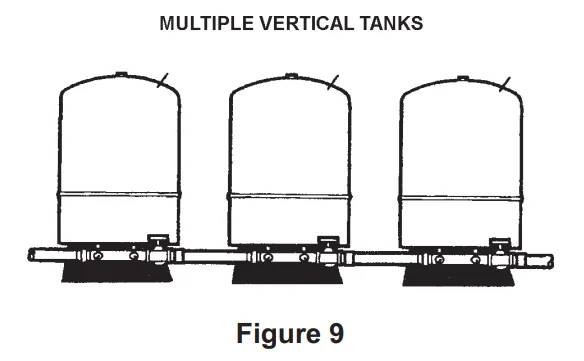
WARRANTY
5-YEAR LIMITED WARRANTY ON LPT, LMT PUMP TANKS
(“The Company”) warrants this pump tank in case of a leak within five (5) years from the date of purchase or, in the absence of a Bill of Sale verifying said date, from the date indicated on the model and rating plate affixed to this tank. In case of a defect, malfunction, or failure to conform to this warranty, the Company will repair or replace this tank. No labor, installation, or freight (if any) charges are included in this warranty. You must pay these costs.
Before the return of the pump tank or part to the manufacturer for inspection, the Company will, if requested, ship a replacement pump tank or part C.O.D. and later provide such reimbursement as subsequent inspection indicates is due under these warranties.
EXCLUSIONS AND LIMITATIONS OF THESE LIMITED WARRANTIES
- The limited warranties provided herein are instead of any warranties, expressed or implied, including, but not limited to, implied warranties of merchantability and fitness for a particular purpose; provided, however, that implied warranties are not disclaimed during the five years from the date of purchase. Some states do not allow limitations on how long an implied warranty lasts, so the above limitation may not apply to you.
- The Company shall have no liability hereunder, either direct or contingent, for incidental or consequential damages. Some states do not allow the exclusion or limitation of incidental or consequential damages, so the above limitation or exclusion may not apply to you.
- This warranty gives you specific legal rights, and you may also have other rights which vary from state to state.
- These warranties shall be void and shall have no effect:
- If the design or structure of the tank is, or is attempted to be, modified or altered in any way, including, but not limited to, by attaching non-Company-approved appliances or equipment.
- If the tank is not properly installed in accordance with all local ordinances and regulations pertinent to tanks, and the installation and instruction manual provided with this tank.
- If the pump tank is installed outdoors. This tank is intended for indoor installation only.
- If the tank is not equipped with new pressure protective equipment required by local codes, but not less than a pressure relief valve certified by a nationally recognized testing laboratory that maintains periodic inspection of production of listed equipment or materials, as meeting the requirements for Relief Valves. This valve must be marked with a maximum set pressure not to exceed the marked hydrostatic working pressure of the tank.
- If the tank is not operated within the factory-calibrated limits.
- If leaks in the tank or defects in other parts arise as a result of improper use, negligence in operation, accident, or from the inability of the tank or any of its parts to function because of repairs, adjustments, or replacements improperly made outside the Company’s factory, or because of fire, floods, or lightning.
- If the model and rating plate have been defaced or discarded, and you do not have a Bill of Sale to verify the purchase date.
- If (1) it is installed in an area where leakage of the tank or connections would result in damage to the area adjacent to the tank, or (2) where such a location is unavoidable, a suitable drain pan is not installed under the tank.
- If the tank is used for any purpose other than a pump tank for space heating and cooling systems.
- If the tank is used with pools, whirlpools, or hot tubs, or with any equipment or system that uses heavily chlorinated or otherwise nonpotable water.
- If leaks in the tank or defects in other parts occur as a result of the tank being exposed to a highly corrosive atmospheric condition.
- If leaks in the tank or defects in other parts occur as a result of the tank containing and/or being operated with desalinated (de-ionized) water.
- If leaks in the tank or defects in other parts arise as a result of sizing that does not comply with the manufacturer’s currently published sizing guides or sizing recommended by the manufacturer.
- If this pump tank or any part has been underwater.
- If a properly sized relief valve is not installed and maintained.
- Replacements and/or repairs furnished under these warranties do not carry a new warranty, only the unexpired portion of the original warranty.
- The terms of this warranty may not be varied by any person, whether or not purporting to represent or to act on behalf of the Company.
- To obtain service under these warranties, you must promptly notify the installing contractor or dealer, giving the nature of the problem and the model and serial number of the tank. If, for any reason, the installer or dealer cannot be located or fails to provide satisfactory warranty service, you should write to Water Systems, 500 Tennessee Waltz Parkway, Ashland City, TN 37015, with the above information.
For More Manuals By Utilitech, Visit ManualsLibraryy.
Utilitech LPT-52 52 Gallons Vertical Well Pressure Tank-FAQs
How tall is the 52-gallon pressure tank?
The tank measures approximately 38.6 inches in height with a diameter of 23.4 inches.
What size well pressure tank do I need?
0–10 GPM: 1 gallon of drawdown per 1 GPM. 10–20 GPM: 1.5 gallons of drawdown per 1 GPM. 20+ GPM: 2 gallons of drawdown per 1 GPM.
Is a 20-gallon pressure tank sufficient for a house?
A 20-gallon tank works for small homes but may cause frequent pump cycling. A larger tank like 52 gallons provides steadier water pressure and protects your pump.
What is the normal PSI for a well pressure tank?
Most tanks are set 2 PSI below the pump’s cut-on pressure. Typical settings are 30/50 PSI, meaning the tank pressure is about 28 PSI when the pump starts.
Should I add air to my pressure tank?
Yes. Maintaining the correct air-to-water ratio (one-third air, two-thirds water) is important. Check and adjust air pressure every 6 months for optimal performance.
Will a larger pressure tank increase water pressure?
No, a bigger tank doesn’t raise pressure, but it reduces pump cycling and extends pump life.
How long do well pressure tanks last?
With proper maintenance, they last 10–15 years, though the internal bladder or diaphragm may wear over time.
What are signs that my pressure tank is failing?
Signs include irregular or fluctuating pressure, constant pump cycling, strange noises, water spitting from faucets, a blown diaphragm, and rapid pressure swings.
What happens if water pressure is too high or too low?
Too high (>80 PSI) can damage pipes, fittings, and appliances. Too low (<30 PSI) can reduce water flow and affect appliances.