
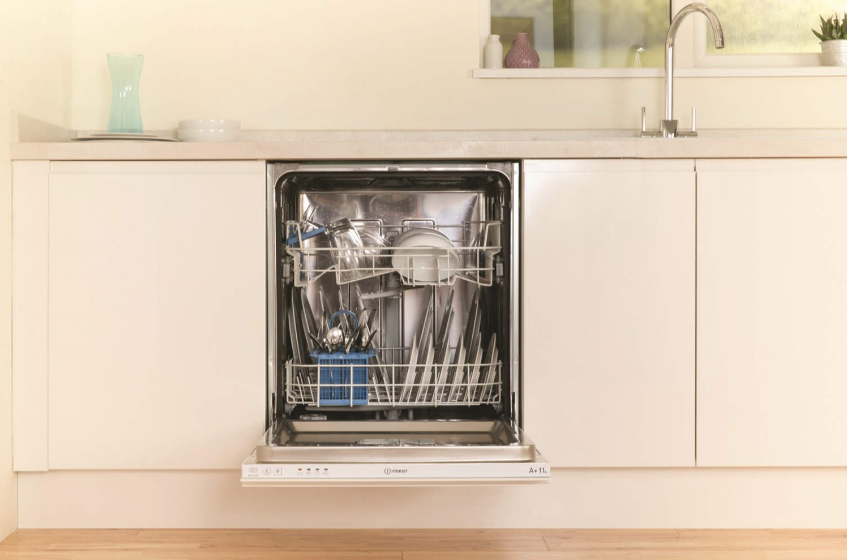

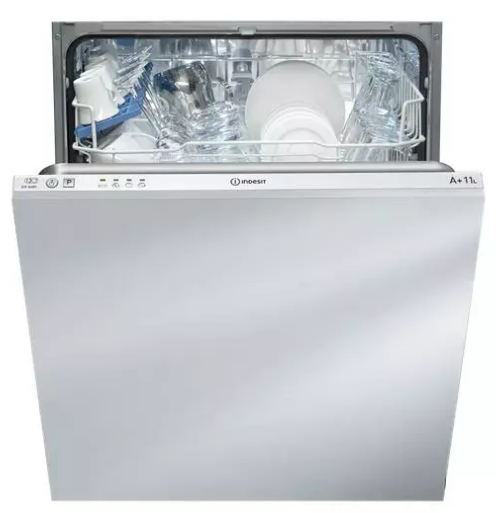
Indesit DIF 04B1 Full-Size Dishwasher
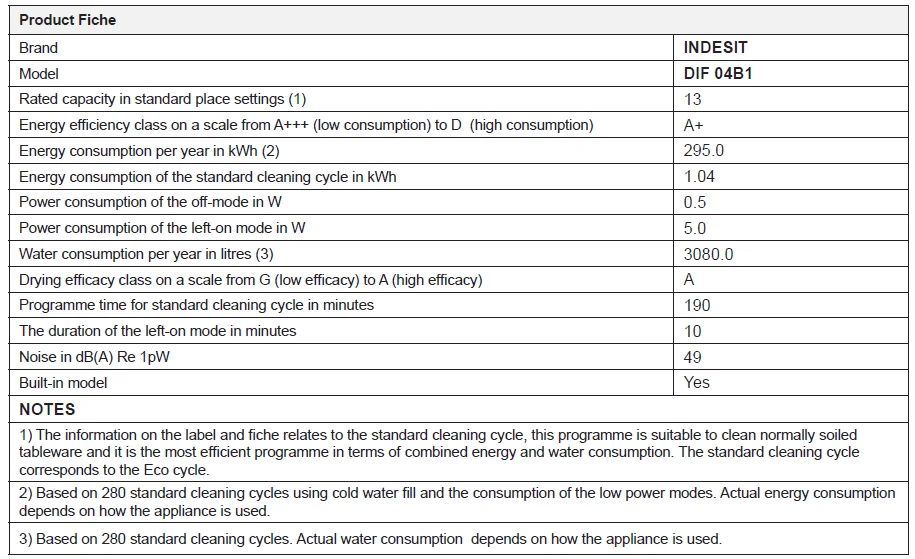
Product Data (product fiche)
Installation
If the appliance must be moved at any time, keep it in an upright position; if necessary, it may be tilted onto its back.
Connecting the water supply
Caution: Adaptation of the water supply for installation should only be performed by a qualified technician.
The water inlet and outlet hoses may be positioned towards the right or the left in order to achieve the best possible installation. Make sure the dishwasher does not bend or squash the hoses.
Connecting the water inlet hose
- To a 3/4” gas cold or hot water connection point (max. 60°C).
- Run the water until it is clear.
- Screw the inlet hose tightly into position and turn off the tap.
Caution: If the inlet hose is not long enough, contact a specialist store or an authorised technician (see Assistance). The water pressure must be within the values indicated in the Technical Data table; otherwise, the dishwasher may not function properly. Make sure the hose is not bent or compressed.
Connecting the water outlet hose
Connect the outlet hose to a drain duct with a minimum diameter of 2 cm. (A) The outlet hose connection must be at a height ranging from 40 to 80 cm from the floor or surface where the dishwasher rests. Before connecting the water outlet hose to the sink drain, remove the plastic plug (B).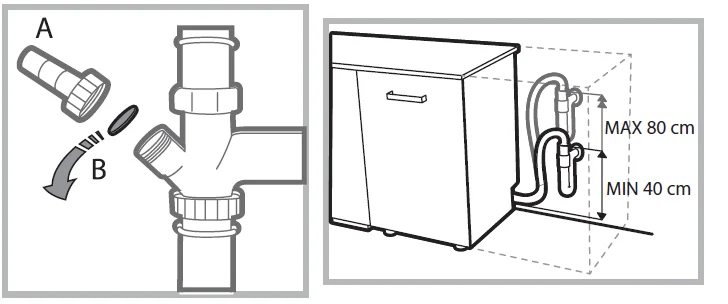
Anti-flooding protection
To ensure floods do not occur, the dishwasher is provided with a special system that blocks the water supply in the event of anomalies or leaks from inside the appliance. Some models are also equipped with the supplementary safety device New Acqua Stop*, which guarantees anti-flooding protection even in the event of a supply hose rupture.
WARNING: HAZARDOUS VOLTAGE!
Under no circumstances should the water inlet hose be cut, as it contains live electrical parts.
Electrical connection
Before inserting the plug into the electrical socket, make sure that:
- The socket is earthed and complies with current regulations.
- The socket can withstand the maximum load of the appliance, as shown on the data plate located on the inside of the door (see chapter Description of the appliance).
- The power supply voltage falls within the values indicated on the data plate on the inside of the door.
- The socket is compatible with the plug of the appliance. If this is not the case, ask an authorised technician to replace the plug (see Assistance). Do not use extension cables or multiple sockets.
Caution: Once the appliance has been installed, the power supply cable and the electrical socket should be easily accessible. The cable should not be bent or compressed. If the power supply cable is damaged, have it replaced by the manufacturer or its authorised Technical Assistance Service in order to prevent all potential hazards (see Assistance). The Company shall not be held responsible for any incidents if these regulations are not observed.
Positioning and levelling
- Position the dishwasher on a level, sturdy floor. If the floor is uneven, the front feet of the appliance may be adjusted until it reaches a horizontal position. If the appliance is levelled correctly, it will be more stable and much less likely to move or cause vibrations and noise while it is operating.
- Before recessing the dishwasher, stick the adhesive transparent strip* under the wooden shelf to protect it from any condensation that may form.
- Place the dishwasher so that its sides or back panel are in contact with the adjacent cabinets or the wall. This appliance can also be recessed under a single worktop* (see the Assembly instruction sheet).
- To adjust the height of the rear foot, turn the red hexagonal bushing on the lower central part at the front of the dishwasher using a hexagonal spanner with an opening of 8 mm. Turn the spanner in a clockwise direction to increase the height and in an anticlockwise direction to decrease it (see Bu).
Advice regarding the first wash cycle
After the installation, remove the stoppers from the racks and the retaining elastic elements from the upper rack (if any).
Water softener settings
Before starting the first wash cycle, set the hardness level of the water from the mains supply (see chapter Rinse aid and refined salt). First, load the softener tank with water, then introduce about 1 kg of salt. It is perfectly normal for water to flow out. As soon as this procedure is complete, run a wash cycle. Only use salt that has been specifically designed for dishwashers. After the salt has been poured into the machine, the LOW SALT indicator light* switches off.
Caution: If the salt container is not filled, the water softener and the heating element may be damaged as a result. The machine has a buzzer/set of tones (depending on the dishwasher model) to inform the user that a command has been implemented: power on, cycle end, etc. The symbols/indicator lights/LEDs on the control panel/display may vary in colour and may have a flashing or fixed light (depending on the dishwasher model). The display* provides useful information concerning the type of wash cycle, drying/wash-cycle phase, remaining time, temperature, etc.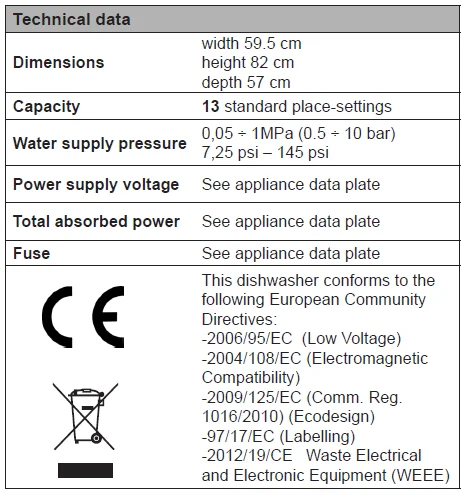
Electrical Connection
If your appliance is supplied with a 13 amp fused plug, it can be plugged into a 13 amp socket for immediate use. Before using the appliance, please read the instructions below.
WARNING: THIS APPLIANCE MUST BE EARTHED. THE FOLLOWING OPERATIONS SHOULD BE CARRIED OUT BY A QUALIFIED ELECTRICIAN.
Replacing the fuse:
When replacing a faulty fuse, a 13 amp ASTA-approved fuse to BS 1362 should always be used, and the fuse cover re-fitted. If the fuse cover is lost, the plug must not be used until a replacement is obtained.
Replacement fuse covers:
If a replacement fuse cover is fitted, it must be of the correct colours as indicated by the coloured marking or the colour that is embossed in words on the base of the plug. Replacements can be obtained directly from your nearest Service Depot.
Removing the plug:
If your appliance has a non-rewireable moulded plug and you wish to remove it to re-route the mains cable through partitions, units, etc., please ensure that either:
- The plug is replaced by a fused 13 amp re-wireable plug bearing the BSI mark of approval
- or:
- The mains cable is wired directly into a 13 amp cable outlet, controlled by a switch (in compliance with BS 5733), which is accessible without moving the appliance.
Disposing of the plug:
Ensure that before disposing of the plug itself, you make the pins unusable so that it cannot be accidentally inserted into a socket.
Instructions for connecting the cable to an alternative plug:
Important: the wires in the mains lead are coloured in accordance with the following code:
- Green & Yellow – Earth
- Blue – Neutral
- Brown – Live
CAUTION:
- Once the appliance has been installed, the electrical plug and socket should remain accessible.
- The Company shall not be held responsible for any incidents that occur if these regulations are not observed.
As the colours of the wires in the mains lead may not correspond with the coloured markings identifying the terminal in your plug, proceed as follows: connect the Green & Yellow wires to the terminal marked “E” or coloured Green or Green & Yellow. Connect the Brown wire to the terminal marked “L” or coloured Red.
Connect the Blue wire to the terminal marked “N” or coloured Black. If a 13 amp plug (BS 1363) is used, it must be fitted with a 13 amp fuse. A 15 amp plug must be protected by a 15 amp fuse, either in the plug or adaptor, or at the distribution board. If you are in any doubt about the electrical supply to your machine, consult a qualified electrician before use.
How to connect an alternative plug:
The wires in this mains lead are coloured in accordance with the following code: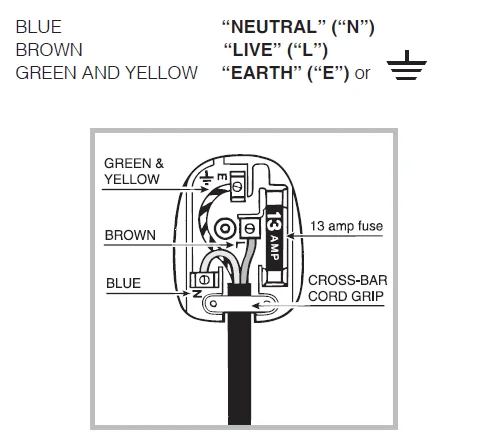
Disposing of the appliance:
When disposing of the appliance, please remove the plug by cutting the mains cable as close as possible to the plug body and disposing of it as described above.
Description of the appliance
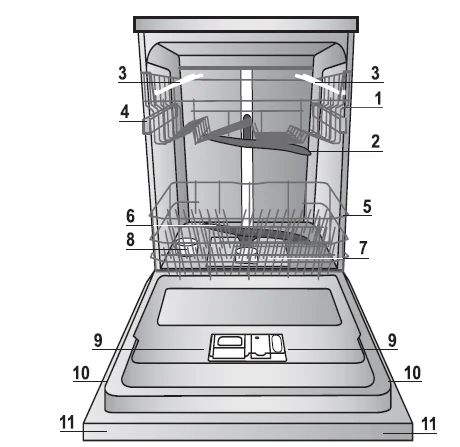
Overall view
- Upper rack
- Upper sprayer arm
- Tip-up dispensers
- Rack height adjuster
- Lower rack
- Lower sprayer arm
- Washing filter
- Salt dispenser
- Detergent dispenser and rinse-aid dispenser
- Data plate
- Control panel

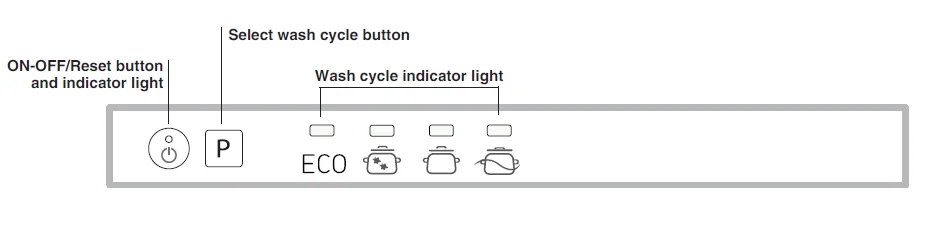
Control panel
- Only in completely built-in models.
- Only available in selected models.
- The number and type of wash cycles and options may vary depending on the dishwasher model.

Loading the racks
Tips
Before loading the racks, remove all food residues from the crockery and empty liquids from glasses and containers. No preventive rinsing is needed under running water. Arrange the crockery so that it is held in place firmly and does not tip over, and arrange the containers with the openings facing downwards and the concave/convex parts placed obliquely, thus allowing the water to reach every surface and flow freely.
Make sure that the lids, handles, trays, and frying pans do not prevent the sprayer arms from rotating. Place any small items in the cutlery basket. Since plastic dishes and non-stick frying pans usually retain more water drops, their drying will not be as good as that of ceramic or stainless-steel dishes. Lightweight items such as plastic containers should be placed in the upper rack and arranged so that they cannot move. After loading the appliance, make sure that the sprayer arms can rotate freely.
Lower rack
The lower rack can hold pans, lids, dishes, salad bowls, cutlery, etc. Large plates and lids should ideally be placed at the sides.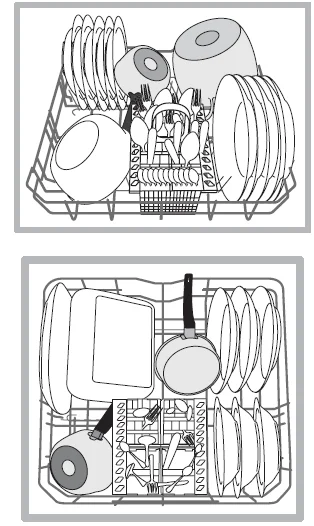
Very soiled dishes and pans should be placed in the lower rack because in this sector, the water sprays are stronger and allow a higher washing performance. *Only available in selected models with different numbers and positions. Several dishwasher models are fitted with tip-up sectors*. They can be used in a vertical position when arranging dishes or in a horizontal position (lower) to load pans and salad bowls easily.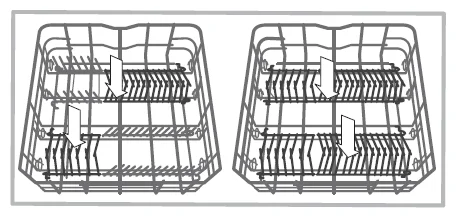
Cutlery basket
The modular basket is equipped with top grilles for improved cutlery arrangement. The cutlery basket should be positioned only at the front of the lower rack. Knives and other utensils with sharp edges must be placed in the cutlery basket with the points facing downwards, or they must be positioned horizontally in the tip-up compartments on the upper rack.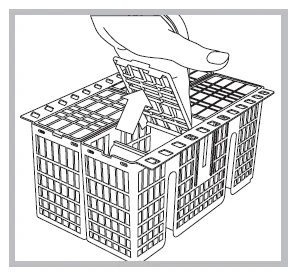
Upper rack
Load this rack with delicate and lightweight crockery such as glasses, cups, saucers, and shallow salad bowls. Several dishwasher models are fitted with tip-up sectors*. They can be used in a vertical position when arranging tea/dessert saucers or in a lower position to load bowls and food containers.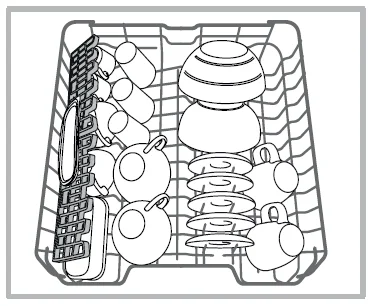
Tip-up compartments with adjustable position
The side tip-up compartments can be positioned at three different heights to optimize the arrangement of crockery inside the rack. Wine glasses can be placed safely in the tip-up compartments by inserting the stem of each glass into the corresponding slots. For optimum drying results, incline the tip-up compartments more. To change the inclination, pull up the tip-up compartment, slide it slightly, and position it as you wish.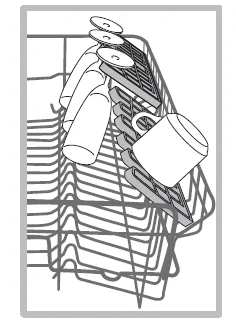
Cutlery tray
Some dishwasher models are fitted with a sliding tray that can be used to hold serving utensils or small cups. For optimum washing performance, avoid positioning bulky crockery directly below the tray. The cutlery tray can be removed (see Figure). The upper rack can be adjusted for height based on requirements: high position to place bulky crockery in the lower rack, and low position to make the most of the tip-up compartments/sectors by creating more space upwards.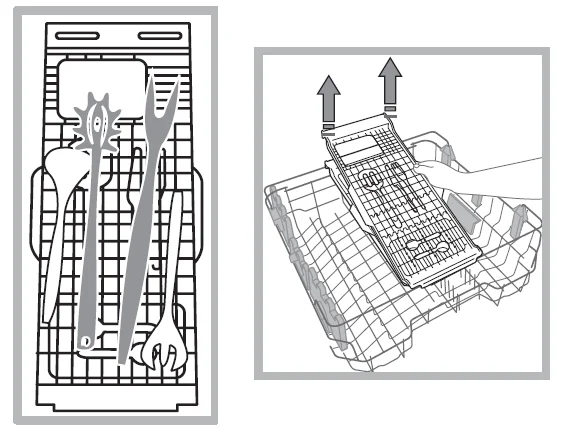
Adjusting the height of the upper rack
In order to make it easier to arrange the crockery, the upper rack may be moved to a higher or lower position. The height of the upper rack should be adjusted when the rack is empty. Never raise or lower the rack on one side only.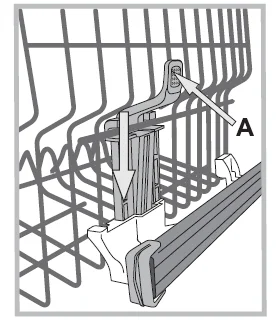
If the rack is equipped with a Lift-Up device* (see figure), lift it by holding its sides. To restore the lower position, press the levers (A) at the sides of the rack and follow the rack down.
Unsuitable crockery
- Wooden crockery and cutlery.
- Delicate decorated glasses, artistic handicrafts, and antique crockery. Their decorations are not resistant.
- Parts in synthetic material that do not withstand high temperatures.
- Copper and tin crockery.
- Crockery soiled with ash, wax, lubricating grease, or ink.
The colours of glass decorations and aluminium/silver pieces can change and fade during the washing process. Some types of glass (e.g., crystal objects) can become opaque after several wash cycles, too.
Damage to glass and crockery
Caused by:
- Type of glass and glass production process.
- Chemical composition of detergent.
- Water temperature of rinse cycle.
Tips:
- Only use glasses and porcelain guaranteed by the manufacturer as dishwasher safe.
- Use a delicate detergent suitable for crockery.
- Collect glasses and cutlery from the dishwasher as soon as the wash cycle is over.
Detergent and dishwasher use
Measuring out the detergent
A good wash result also depends on the correct amount of detergent being used. Exceeding the stated amount does not result in a more effective wash and increases environmental pollution. Based on how soiled the items are, the amount can be adjusted to individual cases using powder or liquid detergent. In the case of normally soiled items, use approximately either 35 g (powder detergent) or 35 ml (liquid detergent).
If tablets are used, one tablet will be enough. If the crockery is only lightly soiled or if it has been rinsed with water before being placed in the dishwasher, reduce the amount of detergent used accordingly. For good washing results, also follow the instructions shown on the detergent box. For further questions, please ask the detergent producers. To open the detergent dispenser, use the opening device “A”.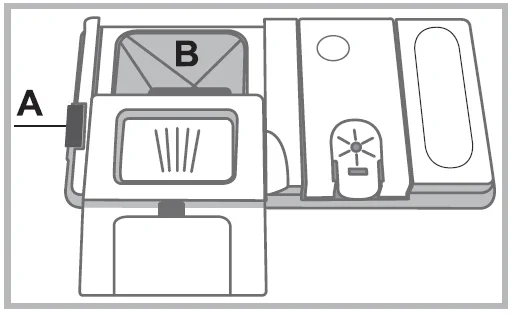
Introduce the detergent into the dry dispenser “B” only. Place the amount of detergent for pre-washing directly inside the tub.
- When measuring out the detergent, refer to the Table of wash cycles to add the proper quantity. Compartment B comprises a level showing the maximum quantity of liquid or powder detergent that can be added to each cycle.
- Remove detergent residues from the edges of the dispenser and close the cover until it clicks.
- Close the lid of the detergent dispenser by pulling it up until the closing device is secured in place. The detergent dispenser automatically opens up at the right time according to the wash cycle. If all-in-one detergents are used, we recommend using the TABS option because it adjusts the cycle so that the best washing and drying results are always achieved.
Caution: Only use a detergent that has been specifically designed for dishwashers. Do not use washing-up liquid. Using excessive detergent may result in foam residues remaining in the machine after the cycle has ended. To achieve the best washing and drying results, the combined use of detergent, rinse aid liquid, and refined salt is required.
 We recommend using detergents that do not contain phosphates or chlorine, as these products are harmful to the environment.
Starting the dishwasher
- Turn the water tap on.
- Open the door and press the ON/OFF button.
- Measure out the detergent (see adjacent information).
- Load the racks (see Loading the racks).
- Select the wash cycle in accordance with the type of crockery and its soil level (see Table of wash cycles) by pressing the P button.
- Select the wash options* (see Special wash cycles and Options).
- Start the wash cycle by shutting the door.
- The end of the wash cycle is indicated by beeps and by the flashing of the indicator light of the selected wash cycle. Open the door, switch off the appliance by pressing the ON/OFF button, shut off the water tap, and unplug the appliance from the electricity socket.
- Wait a few minutes before removing the crockery to avoid burns. Unload the racks, beginning with the lower level.
Caution: The machine will switch off automatically during long periods of inactivity to minimise electricity consumption. If the crockery is only lightly soiled or if it has been rinsed with water before being placed in the dishwasher, reduce the amount of detergent used accordingly.
Changing a wash cycle in progress
If a mistake was made in the wash cycle selection process, it is possible to change the cycle, provided that it has only just begun. Open the door, taking care to avoid the escaping steam, and press and hold the ON/OFF button; the machine will switch off. Switch the machine back on using the ON/OFF button and select the new wash cycle and any options desired; start the cycle by closing the door.
Adding extra crockery
Without switching off the machine, open the door, taking care to avoid the escaping steam, and place the crockery inside the dishwasher. Close the door: the cycle starts from the point at which it was interrupted.
Accidental interruptions
If the door is opened during the wash cycle or there is a power cut, the cycle stops. It starts again from the point at which it was interrupted once the door has been shut or the electricity supply restored.
Parts and Accessories
We supply a full range of genuine replacement parts as well as accessory products that protect and hygienically clean your appliance to keep it looking good and functioning efficiently throughout its life.
UK: 08448 225 225
Republic of Ireland: 0818 313 413
www.indesitservice.co.uk
Appliance Registration
We want to give you additional benefits of Indesit ownership. To activate your free 5-year parts guarantee, you must
Register your appliance with us.
UK: 08448 24 24 24
Republic of Ireland: 01 230 0800
www.indesitservice.co.uk
Indesit Company UK Ltd. Morley Way, Peterborough, PE2 9JB
Indesit Company Unit 49, Airways Industrial Estate, Dublin 17
Recycling and Disposal Information
As part of Indesit’s continued commitment to helping the environment, Indesit reserves the right to use quality,
recycled components to keep down customer costs and minimise material wastage. Please dispose of packaging and old appliances carefully. To minimise the risk of injury to children, remove the door, plug, and cut the mains cable off flush with the appliance. Dispose of these parts separately to ensure that the appliance can no longer be plugged into a mains socket, and the door cannot be locked shut.
For More Manuals By Indesit, Visit ManualsLibraryy.
Indesit DIF 04B1 Full-Size Dishwasher-FAQs
What does the error on my Indesit DIF 04B1 mean?
A flashing ECO light usually indicates a water supply or drainage issue. Check the inlet valve, ensure the hose isn’t kinked, and clean the filter.
How do I find the user manual for my Indesit dishwasher?
You can download manuals and safety guides from docs.indesit.eu or register your appliance at indesit.com/register.
What is the hottest cycle on an Indesit dishwasher?
The Extra Hygiene cycle heats the water to 72°C, ideal for killing bacteria and cleaning heavily soiled dishes.
How long should an Indesit dishwasher last?
Most dishwashers, including Indesit models, last around 10 years with proper care and regular cleaning.
Is Indesit a good dishwasher brand?
Indesit is known as a budget-friendly brand. Cleaning performance is good, but drying results may vary depending on the model and cycle used.
What are the most common dishwasher failures?
Typical problems include poor drainage, leaks, dirty filters, unclean dishes, and foul smells caused by blockages or worn parts.
Why is my Indesit dishwasher not starting?
Check if the door is properly closed, the Start button has been pressed, the water tap is open, and the filters are clean. Power resets can also help.
How do I reset an Indesit dishwasher?
Switch the machine off, wait a few minutes, then turn it back on. Some models reset by holding the Start/Reset button for a few seconds.
How long does an Indesit dishwasher cycle take?
A typical normal cycle takes 1.5–2.5 hours. The Fast & Clean program finishes in around 28 minutes.
Why do dishwashers take 3 hours to complete?
Eco-mode heats water slowly to save electricity, which increases cycle time. Long cycles are normal for energy-saving settings.