
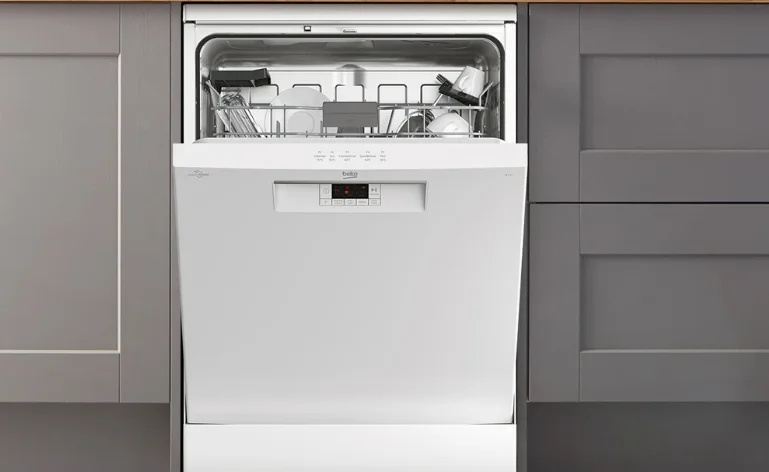

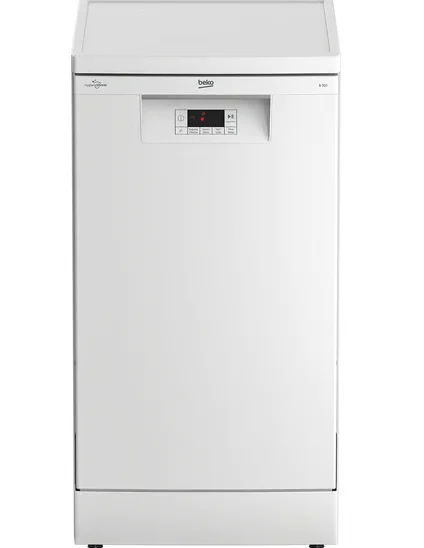
Beko BDFS16030W Freestanding Slimline Dishwasher
Technical Specifications
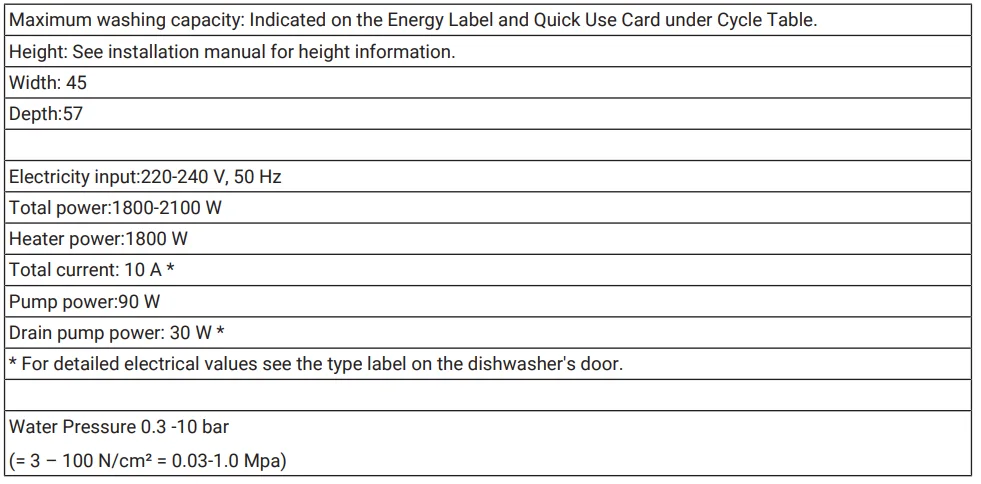
Notice: Technical specifications may be amended without prior notice to improve product quality. The figures in the manual are schematic and may not be in exact harmony with the product. The values provided with the appliance or its accompanying documents are laboratory readings in accordance with the respective standards. These values may differ depending on the use and ambient conditions.
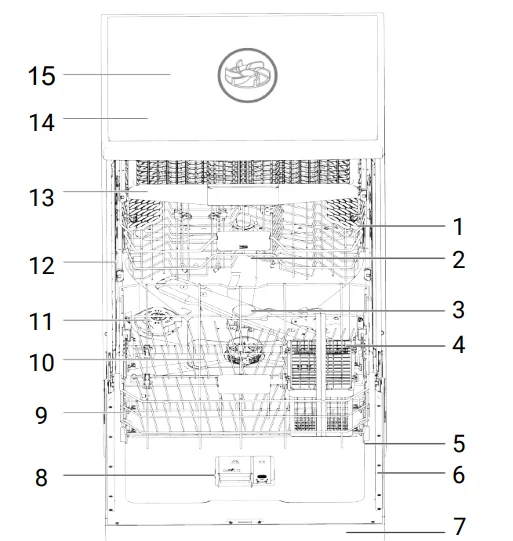
General View
- Upper Basket
- Upper Spray Arm
- Lower Spray Arm
- Cutlery Basket (depends on the model)
- Door
- Type Label
- Control Panel
- Detergent Compartment
- Lower Basket
- Filters
- Salt Compartment Cover
- Upper Basket Rail
- Ceiling Cutlery Basket (depends on the model)
- Upper Rack (depends on the model)
- Upper Impeller (depends on the model)

Installation
Warning: Read the ‘Safety Instructions’ section first!….The preparation of the electrical, clean water, and wastewater installation at the place where the product will be placed is under the responsibility of the customer. Before calling the authorised service to make the product ready for use, if the electrical installation, clean water installation, and water drainage are not suitable, call a qualified electrician and plumber to make the necessary arrangements.
Warning: Installation and electrical connections must be carried out by the authorised service. The manufacturer cannot be held responsible for any damages that may arise from the operations performed by unauthorised persons. Before installing the product, inspect it for any damage. Do not install the product if it is damaged. Damaged products pose a danger to your safety.
Notice: For free-standing and undercounter models, do not remove the kick plate of the appliance. This will void the warranty.
- When placing the product in place after installation or cleaning, make sure that the water inlet and drain hoses are not folded, pinched, or broken.
- Be careful not to damage the floor, wall, pipes, etc. when placing the product. Do not hold the door or panel to move the product.
5.1 Correct location for installation
- There must not be any lockable, sliding, or hinged doors in the place where the product is installed, which would restrict the full opening of the door.
- Place the product on a solid and level surface with sufficient load-bearing capacity. Placing the dishwasher on a level surface is essential for the door to close properly and tightly.
- Do not install the product in places where the temperature drops below 0 °C.
- Place the product on a hard floor. Do not place it on a long-pile carpet or similar surface.
- Choose a place where you can load and unload the dishes easily and quickly.
- Place the product close to the tap and drain. Choose the location of the product in such a way that you do not change it after it has been connected.
Warning: Do not place the product on the power cable. The cable may be damaged, causing a risk of electric shock or fire.
5.2 Connecting to the water supply
To prevent dirt (sand, clay, rust, etc.) from the city network or your water supply system from damaging the dishwasher and your dishes, we recommend installing a filter on the water inlet. Maximum allowable water inlet temperature:
- With the AquaSafe+ feature containing models, it is 60 °C.
- Up to 25 °C for other models.

- The dishwasher must not be connected to warm water appliances or running water heaters.
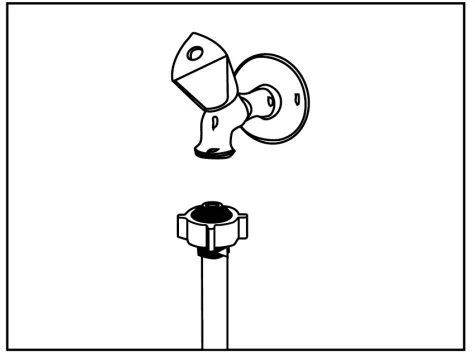
NOTICE: Do not use an old or used water inlet hose on a new product. Use the new water inlet hose supplied with the dishwasher. Do not splice the hoses.
NOTICE: Connect the water inlet hose directly to the water tap. The pressure supplied from the tap must be at least 0.3 and no more than 10 bar. If the water pressure exceeds 10 bar, a pressure-reducing valve must be installed.
NOTICE: The water supply and drain hose must be securely fastened and undamaged.
NOTE: After making the connections, open the tap fully and check for water leaks.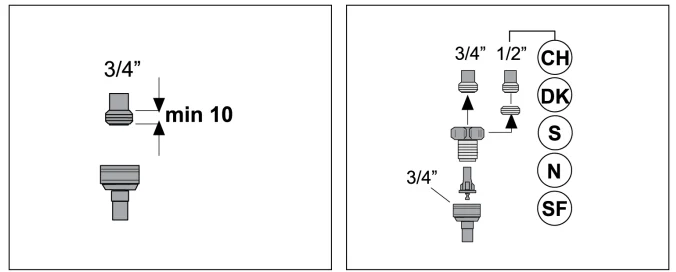
5.3 Connecting to the water drain
The water drain hose can be connected directly to the wastewater drain or to the drain of the sink. For more detailed information, refer to the installation instructions supplied with your dishwasher. The wastewater drain must be connected to the sewer and must not be connected to surface water.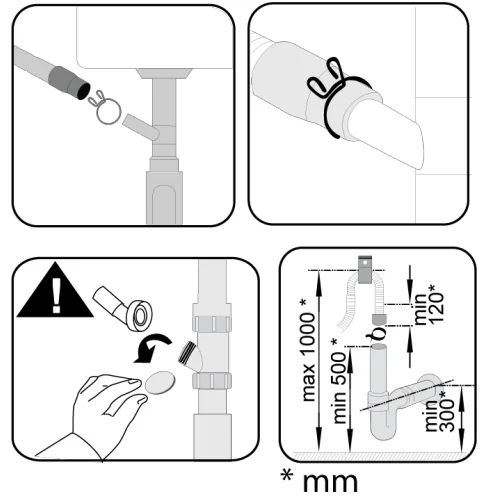
5.4 Adjusting the feet
If the door of the product does not close properly or shakes when you push it gently with your hand, this means that the feet are not adjusted. Adjust the feet of the product as shown in the installation manual supplied with the product.
Warning: Hot steam may escape if the dishwasher door is not adjusted properly. Serious burns can cause injury and damage your furniture.
5.5 Electricity connection
Warning: Connect the product to a grounded socket protected by a fuse in accordance with the values in the “Technical specifications” table. Our company shall not be responsible for any damages that may occur if the product is used without grounding in accordance with local regulations.
- The connection must comply with national regulations.
- The plug of the power cord must be easily accessible following the installation.
- Connect the product to a grounded socket protected by a 16-ampere fuse.
- The specified voltage must be equivalent to your mains voltage.
Warning: Do not connect with extension cords or multiple sockets. A damaged power cord must be replaced by an authorised service.
5.6 Fitting a Different Plug
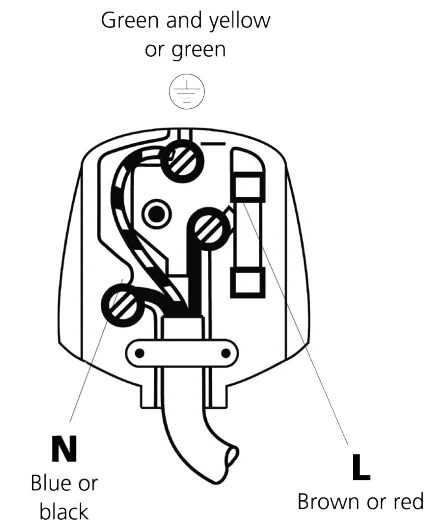
As the colours of the wires in the mains lead of this appliance may not correspond with the coloured markings identifying the terminals on your plug, proceed as follows:
- Connect the green-yellow or green (earth) wire to the terminal in the plug marked ‘E’ or with the symbol, or coloured green and yellow or green.
- Connect the blue (neutral) wire to the terminal in the plug marked ‘N’ or coloured black.
- Connect the brown (live) wire to the terminal in the plug marked ‘L’ or coloured red. With the alternative plugs, a 13A fuse must be fitted either in the plug or adaptor or in the main fuse box. If in doubt, contact a qualified electrician.

6 Preparation
Warning: Read the ‘Safety Instructions’ section first!
6.1 Considerations for energy saving
The following information will help you to use the product in an ecological and energy-saving way. Remove all coarse waste before placing the dishes in the dishwasher.
Notice: It is not recommended to pre-clean the dishes before loading them into the dishwasher, as this will consume energy and water. Washing the dishes in the dishwasher consumes less energy and water than washing them by hand.
Start the dishwasher after it is fully loaded. Pay attention to the “Cycle Information and Average Consumption Table” when selecting a cycle. Do not use more detergent than recommended on the detergent packaging.
6.2 Water softening system
The dishwasher is equipped with a special water softening system that reduces the hardness of the mains water. This system softens the water to the level required for washing dishes to the desired quality.
Notice: Mains water must be softened if its hardness is above 7°dH. Otherwise, hard ions will accumulate on the washing utensils and may affect the washing, rinsing, and drying performance of the dishwasher.
Setting the water softening system
Washing efficiency will be improved when the water softening system is set correctly. Read the section on adjusting the water softening system first. Regeneration of the water softening system can take place in all cycles during the drying step. When regeneration is performed, the duration of the cycle, energy, and water consumption are increased. For the regeneration process, the table below shows the frequency of the regeneration process, maximum additional time, water, and energy consumption depending on the water consumption for the Eco 50 °C cycle when the dishwasher is operated under standard conditions with a water supply of 14 dH.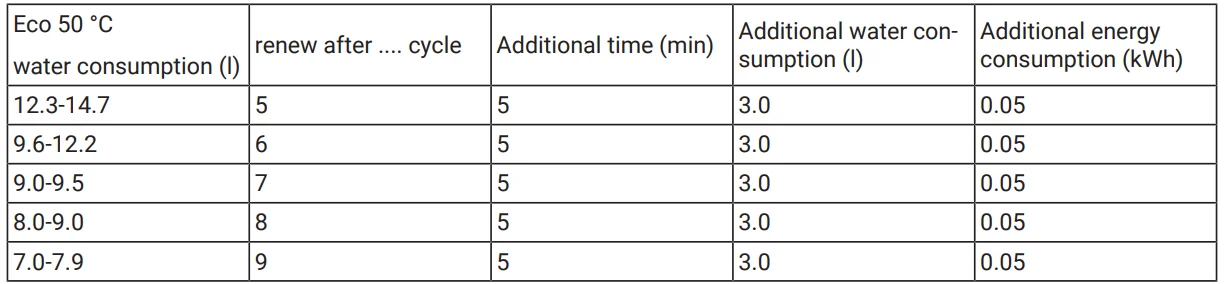
For water consumption in the Eco 50 °C cycle of your dishwasher, refer to the Cycle Information and Average Consumption Values Table given in the Cycle Table.
6.3 Setting the Water Softening System
Setting the water softening system correctly will improve your dishwasher’s washing, rinsing, and drying performance.
NOTICE: To set the system, first find out your water hardness level from the authorised service in your region and set it as follows. After determining the water hardness:
- Press the Delay and Program keys simultaneously for 3 seconds to enter the settings menu after turning your dishwasher on.
- Keep the program knob pressed until the low salt warning indicator starts to flash. The current regeneration level is indicated on the program indicator.
- Set the water hardness to a proper level for the hardness of your mains water with the Delay key. For the correct setting, refer to the “Water hardness level setting table”.
- Save by pressing the On / Off key.


- If the hardness of the water you use is above 50°dH (French hardness) or if you use well water, you should use filters and water purifiers.
- If the hardness of the water you use is below 7°dH, you do not need to use salt in your dishwasher. In this case, the “Low Salt Indicator Light” on your dishwasher control panel will be on continuously.
- If your water hardness setting is at level 1, the “Low Salt Indicator Light” will remain on continuously even though you do not need to use salt. If you do add salt in this position, the salt will not be consumed, and the lamp will not come on.
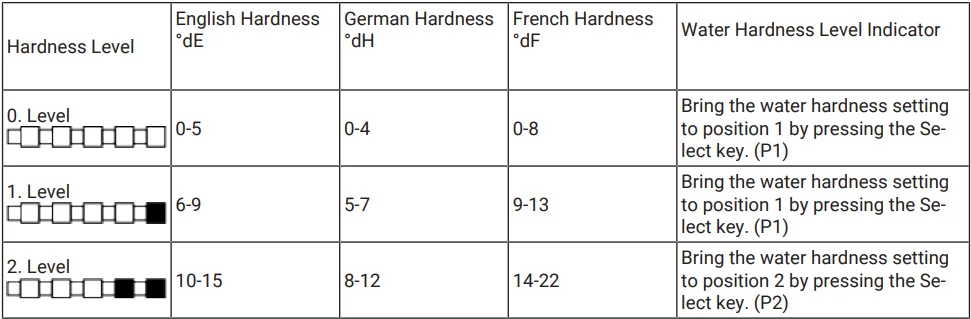
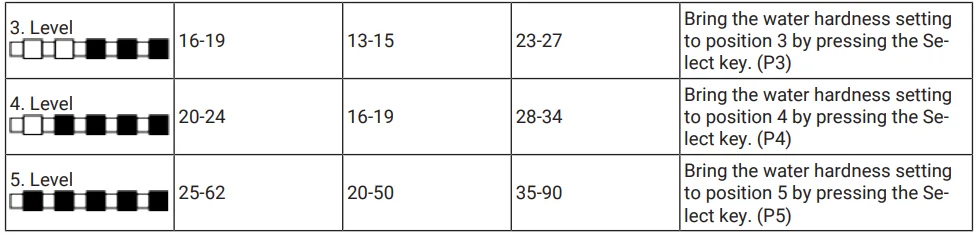
NOTICE: If you move house, you may need to adjust the water hardness setting of your dishwasher again according to the water hardness of the place you move to, taking into account the information given above. If the water hardness setting of your dishwasher has been adjusted before, the last water hardness setting will be displayed on your dishwasher’s display panel.
6.4 Filling the salt
The water softening system must be renewed for the dishwasher to operate at the same performance at all times. Dishwasher salt is used for this purpose.
Notice: Only use special softening salt for use in dishwashers. It is recommended to use granulated or powdered softening salts in the water softening system. Do not use salts such as table salt and rock salt that do not dissolve completely in water. Otherwise, the performance of the system may deteriorate over time. The salt compartment fills with water when you switch on the dishwasher. Therefore, fill the salt compartment before starting the dishwasher.
- Initially, remove the lower basket to load softening salt.
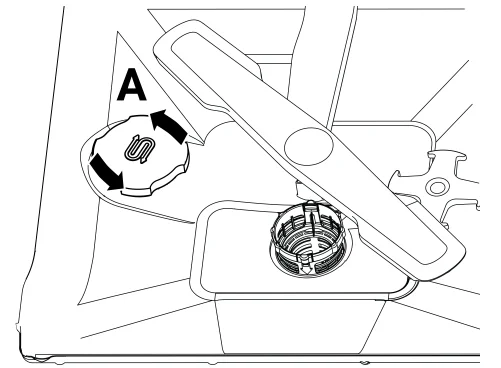
- Open the salt compartment lid by turning it anti-clockwise (A).

- Only add 1 litre of water to the salt compartment when using your dishwasher for the first time.
- Fill the salt compartment with salt (D). Stir with a spoon to speed up the dissolution of the salt in the water. Notice: You can put approx. 2 kg of softening salt in the salt compartment.

- When the compartment is full, replace the lid and close it by turning.
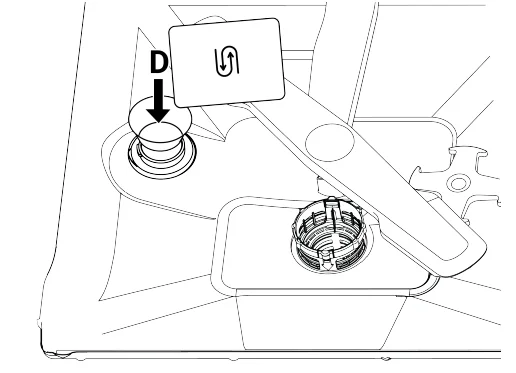
Notice: Adding salt should be performed just before starting the dishwasher. In this way, the overflowing brine is cleaned immediately, and the risk of corrosion inside the dishwasher is prevented. If you are not going to wash immediately, run the dishwasher empty and without detergent in the shortest cycle. Depending on the different salt particle sizes of different brands on the market and the water hardness, it may take several hours for the salt to dissolve in the water. For this reason, the “Salt Shortage Warning Indicator” will remain on for a certain period of time after the salt is filled into the dishwasher.
6.5 Detergent
You can use powder, liquid/gel, and tablet detergent in the dishwasher.
Warning: Use only detergents intended for use in dishwashers. We recommend that you do not use detergents containing chlorine and phosphates, as these are harmful to the environment.
Filling the detergent
For good washing and drying results, observe the instructions on the detergent packaging. Contact the detergent manufacturer for further questions. Warning: Do not put solvents in the detergent compartment. There is a risk of explosion. Put the detergent in the detergent compartment as follows immediately before starting the dishwasher.
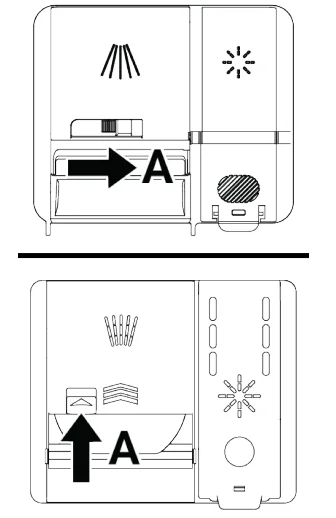
- Open the detergent compartment door by pushing the latch to the right (A) (depends on the model).

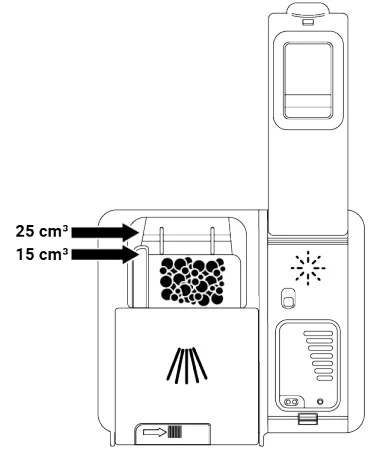
- Put the specified amount of powder, liquid/gel, or tablet detergent into the compartment. Notice: There are level lines on the inside of the detergent compartment to help you use the correct amount of powdered detergent. The detergent compartment holds 45 cm³ of detergent when fully loaded. Fill the detergent compartment up to the level lines of 15 cm³ or 25 cm³ of detergent, depending on how full the dishwasher is and/or how dirty your dishes are. If tablet detergent is used, one tablet is sufficient.

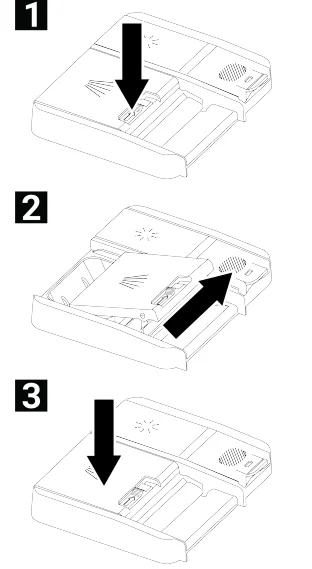
- Close the lid of the detergent compartment by pushing it in the direction of the arrow. A “click” sound is heard when the lid is closed.

Notice: Since the solubility of tablet detergents varies depending on temperature and time, always use powder or liquid/gel detergent in short cycles without pre-wash.
Tablet detergents
In addition to conventional tablet detergents, there are also tablet detergents on the market that contain water softening salt and/or rinse aid. Some of them also contain special components such as glass preservatives and stainless steel preservatives. These tablets work up to a certain water hardness level (21°dH). Water softening salt and rinse aid should be used together with the tablet detergent above this level. The best washing performance in dishwashers is achieved by using detergent, rinse aid, and water softening salt separately.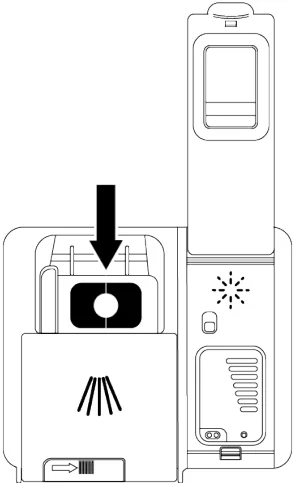
When using tablet detergents, follow the manufacturer’s instructions on the detergent packaging. When using tablet detergent, contact the detergent manufacturer if your dishes are wet when the wash cycle has finished and/or if you notice limescale stains, especially on glasses.
When you change from tablet detergent to powder detergent:
- Make sure the salt and rinse aid compartment is full.
- Set the water hardness setting to the highest position and run a wash cycle with the dishwasher empty.
- After the empty wash cycle, read the instruction manual and adjust the water hardness setting again according to your mains water.
- Set the appropriate rinse aid setting.
6.6 Rinse aid
The rinse aid used in dishwashers is a special compound to improve drying efficiency and to prevent traces of water or limescale from remaining on the washed items. For this reason, make sure that there is rinse aid in the rinse aid compartment and use only rinse aid that is intended for use in dishwashers.
Filling the rinse aid
- Open the rinse aid cap with the latch.

- Fill the compartment to the MAX level.

- Close the compartment lid by pressing it lightly against point (B).

- Increase the setting if water marks appear on the crockery after washing, or decrease it if a blue mark remains when wiped by hand. This setting is set to position 3 at the factory.
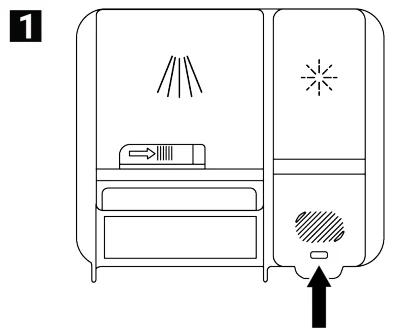
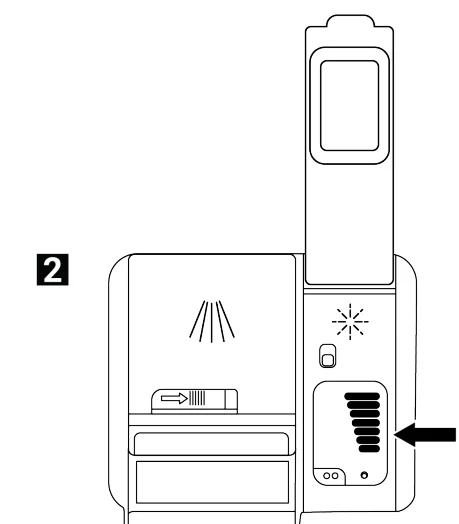
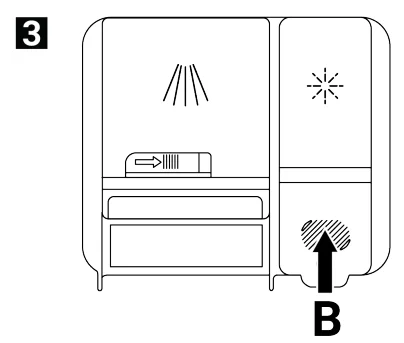
Notice: The rinse aid setting is described under the heading “Adjusting the rinse aid quantity” in the operation of the dishwasher section. Wipe off any rinse aid spilled outside the chamber. Accidental spillage of rinse aid will cause foaming and reduce washing performance.
6.7 Parts not suitable for washing in the dishwasher
- Do not wash dishes contaminated with cigarette ash, wax residue, varnish, paint, chemicals, etc., in the dishwasher.
- Do not wash forks, spoons, and knives with wooden or bone handles, glued parts, non-heat-resistant plastic parts, copper, or pewter utensils in the dishwasher.
Notice: As with hand washing, the dishwasher may discolour and tarnish decorative prints on porcelain, aluminium, and silver. Some types of delicate glass and crystals may lose their transparency over time. We recommend that you pay particular attention to the fact that the new tableware you buy is appropriate for washing in the dishwasher.
6.8 Placing the dishes in the dishwasher
If you place the dishes correctly in accordance with the washing capacity of your dishwasher, you will make the best use of the dishwasher in terms of energy consumption, washing, and drying performance.
- Remove any food residues (bones, fruit pits, etc.) from the dishes before placing them in the dishwasher.
- If possible, place thin, narrow-bodied items in the centre compartments of the baskets.
- Place very dirty and large items in the lower basket and small, delicate, and light items in the upper basket.
- Place deep containers such as bowls, glasses, and pots with their mouths downwards. This prevents water from accumulating in them.
Notice: To avoid possible injury, always place long and pointed dishes such as serving forks, bread knives, etc., in the cutlery basket with the pointed end downwards or horizontally on the dishwashing baskets. Empty the dishes in the lower basket first, then the dishes in the upper basket.
9 Troubleshooting
9.1 Error Codes, Causes, and Solutions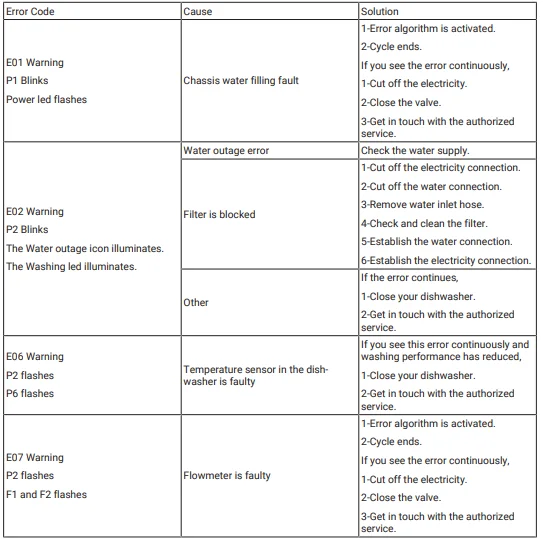
12 DISCLAIMER / WARNING
Some (simple) faults can be repaired by end users without causing any safety problems or unsafe use, provided that they are carried out in accordance with the following instructions (see the section “I Want To Repair Myself”). Therefore, except for the parts specified in the “I Want to Repair Myself” section that can be repaired by end users, repair by an authorised service station is strongly recommended to prevent safety problems and is mandatory for the continuation of the Beko product warranty.
I WANT TO REPAIR MYSELF
Repairs to be carried out by end users can be performed for the following spare parts: External Power Supplies, Remote Control. (Current spare parts list is available at https://www.beko.com.tr/destek address as of 1 March 2021)
In addition, to ensure product safety and to avoid the risk of serious injury, repairs must be carried out according to the instructions in the instruction manual or at https://www.beko.com.tr/destek address. For your safety, unplug the product before carrying out any repair work.
Cannot be held responsible for any safety problems that may arise due to repair operations or attempts by end users to repair parts other than those specified in the user manuals or in accordance with the instructions in the https://www.beko.com.tr/destek address and parts in the current parts list available at the Beko address. In such a case, the Beko product warranty will be invalid.
Therefore, end users are strongly recommended to refrain from performing repair operations for parts other than the spare parts mentioned above by themselves and to contact an authorised service station if necessary. Such repair attempts by end users may cause safety issues, damage the product, and subsequently result in fire, flooding, electric shock, and serious personal injury. Repair processes of the following parts, but not limited to those listed, should be performed by authorised service stations: Internal Power Supply, Capacitors, Battery and Accumulators, etc. The manufacturer/seller cannot be held responsible for any failure of end users to comply with the above.
For More Manuals By Beko, Visit ManualsLibraryy.
Beko BDFS16030 Freestanding Slimline Dishwasher-FAQs
What is the most common problem with a Beko dishwasher?
The most common issues include sensor and valve errors, such as turbidity sensor faults or diverter valve position errors, which can affect water flow and cleaning performance.
Where should I place the dishwasher tablet?
Always place the tablet inside the main detergent dispenser. Remove any outer wrapping before inserting it, then close the dispenser firmly before starting the cycle.
Can I put a dishwasher pod in the bottom of the machine?
No, dishwasher tablets should not be placed at the bottom. This prevents proper dissolving and can reduce cleaning efficiency.
What is the Mini or Quick wash function on a Beko dishwasher?
The Mini 30 program washes lightly soiled dishes in about 30 minutes, while Quick & Shine cleans and dries a full load in under an hour.
Why does my dishwasher take nearly 3 hours to finish?
This usually happens when Eco mode is selected. Eco programs use lower water temperatures and longer cycles to reduce energy consumption.
How do I reset my Beko dishwasher?
Press and hold the Start/Stop button for 10–15 seconds. This resets the control panel and allows you to select a new program.
Can a dishwasher clean heavy utensils like kadai or pots?
Yes, most stainless steel cookware, including large pots and kadai, can be cleaned safely as long as they are dishwasher-safe and properly placed.
Is Eco mode cheaper than quick wash?
Yes, Eco mode is generally more energy-efficient because it heats water less, even though the cycle takes longer.
Why are my dishes still dirty after a wash cycle?
Common causes include clogged filters, blocked spray arms, or improper loading. Regular cleaning of filters helps maintain performance.
Is it safe to clean the dishwasher with vinegar?
Yes, running an empty hot cycle with a bowl of white vinegar on the top rack helps remove odors and grease without damaging the interior.