
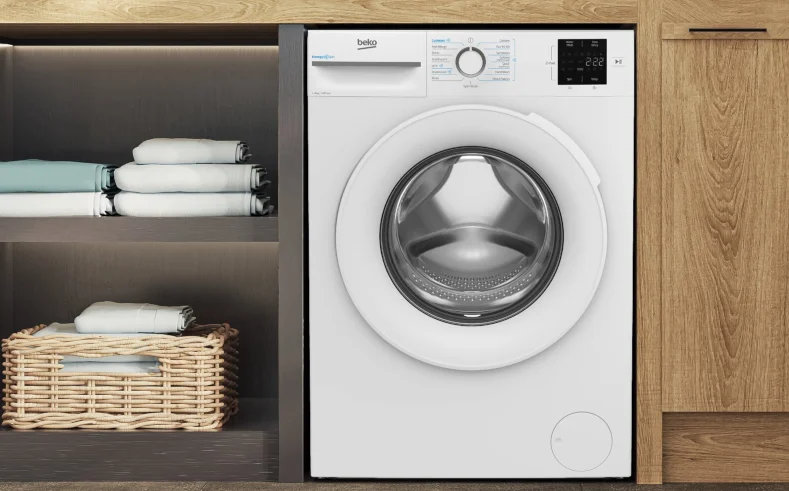

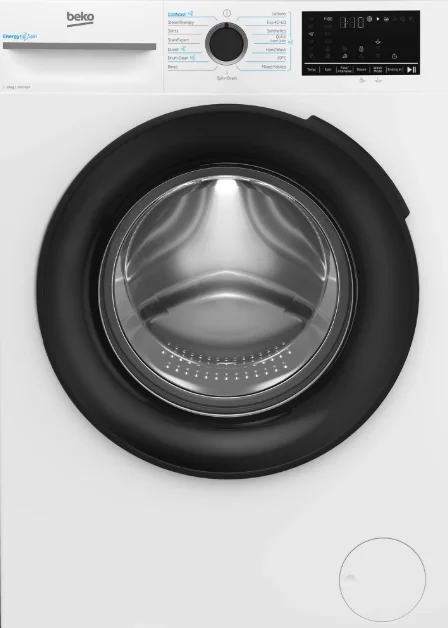
Beko BM3WT12411 Washing Machine
Maintenance and Cleaning Safety
- Before cleaning or servicing the washing machine, unplug it or cut the power at the fuse.
- If you need to move the product for cleaning, do not pull on the cover. The cover can break and cause injury!
- Do not put hands, feet, or metal objects under or behind your product. This can cause jams, and any sharp edge can cause personal injury.
- Use a clean, dry cloth to wipe foreign material or dust from the plug ends. When cleaning the plug, avoid using a wet cloth. Otherwise, there is a risk of fire or electric shock.
- Do not wash the product with pressure washers, by spraying vapour, water, or pouring water. There is a risk of electrocution.
- Do not use sharp or abrasive tools to clean the product. Do not use household cleaners, soap, detergent, gas, gasoline, thinner, alcohol, varnish, etc. while cleaning.
- Cleaning agents containing solvents might release poisonous fumes (for ex. cleaning solvent). Do not use cleaning products containing solvents.
- There may be detergent residues in the detergent drawer when you open it for cleaning.
- Do not dismantle the filter of the discharge pump while the product is running.
- The temperature in the machine may rise to 90ºC. Clean the filter after the water in the machine cools down in order to avoid the risk of getting burnt.
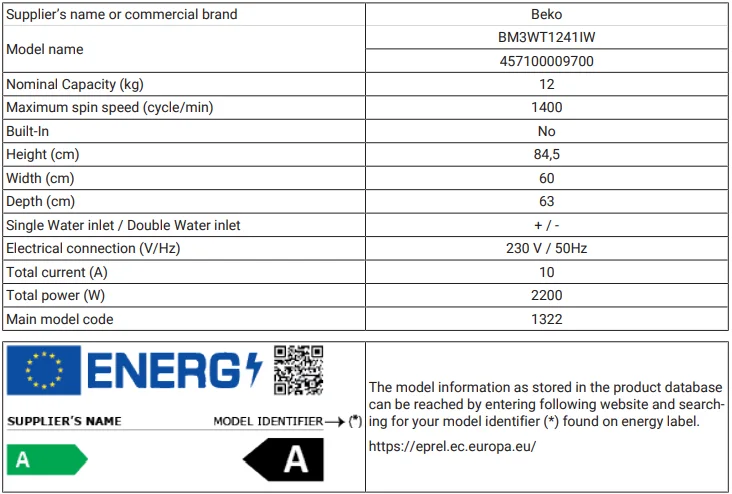
Technical Specifications
Installation
 Please read the “Safety Instructions” section first!
 Your washing machine automatically detects the amount of laundry placed inside when selecting a program. While installing the product, before the first use, calibration should be done to ensure that the laundry amount is detected in the most accurate way. To do this, select the Drum Cleaning* program and cancel the spin function. Start the program without laundry. Wait for the program to finish, which will take about 15 minutes. The program name may vary depending on the model. For the appropriate program selection, review the program descriptions section.
- Preparation of the location and electrical, tap water, and wastewater installations at the place of installation is under the customer’s responsibility.
- Make sure that the water inlet and discharge hoses, as well as the power cable, are not folded, pinched, or crushed while pushing the product into its place after installation or cleaning procedures.
- Before installation, visually check if the product has any defects on it. Do not have the product installed if it is damaged. Damaged products cause risks to your safety.
4.1 Appropriate Installation Location
- Place the product on a hard and level floor. Do not place it on a carpet with a high pile or other similar surfaces. Placing on an improper floor shall cause noise and vibration problems.
- Total weight of the washing machine and the dryer -with full load- when they are placed on top of each other, reaches approx. 180 kilograms. Place the product on a solid and flat floor that has sufficient load-carrying capacity.
- Do not place the product on the power cable.
- Do not install the product in places where the temperature may fall below 0 ºC. Freezing might damage your product.
- Leave a minimum space of 1 cm between the product and the furniture.
- If you will install the product on a surface with steps, never place it close to the edge.
- Do not place the product on any platform.
- Do not place heat sources such as cookers, irons, ovens, heater etc. on the appliance and do not use them on the product.
4.2 Assembly of Bottom Panel Covers
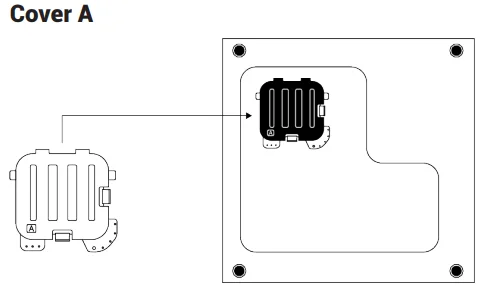
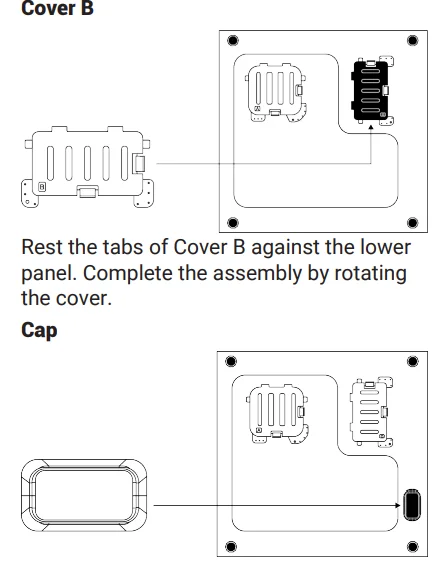
- In order to increase the sound comfort of the product, attach cover A after removing the package foam. Tilt the machine back slightly. Rest the tabs of Cover A against the lower panel. Complete the assembly by rotating the cover.

- Cover B and the Cap are optional. If available, attach cover B and the Cap.

4.3 Removing Transportation Safety Bolts
- Loosen all transportation safety bolts with an appropriate wrench until they turn freely.
- Bend the inner part by pressing it at the grip areas and pulling the part out.
- Attach the plastic covers supplied in the User Manual bag to the holes on the rear panel.

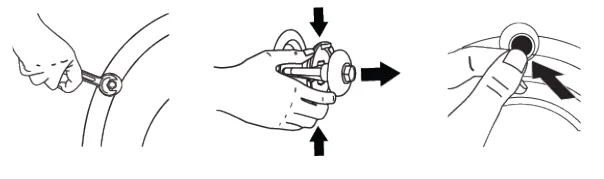
NOTICE: Keep the transportation safety bolts in a safe place to reuse when the product needs to be moved again in the future. Install the transportation safety bolts in reverse order of the disassembly procedure. Never move the product without the transportation safety bolts properly fixed in place.
4.4 Connecting to Water Supply
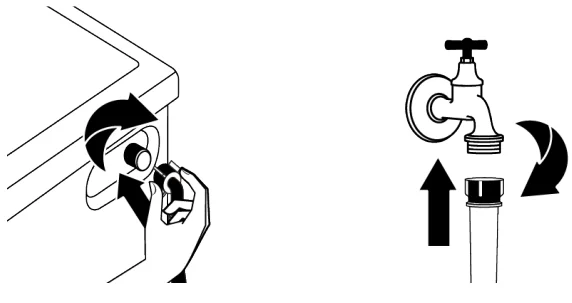
NOTICE: Models with a single water inlet shall not be connected to the hot water tap. In such a case, the laundry will get damaged, or the product will switch to protection mode and will not operate. Do not use old or used water inlet hoses on a new product. It may cause water leakage from your machine and stain your laundry.
- Tighten all hose nuts by hand. Never use a tool when tightening the nuts.
- Open the taps completely after making the hose connection to check for water leaks at the connection points. If any leak occurs, turn off the tap and remove the nut. Check the gasket and tighten the nut carefully again. In order to prevent water leaks and resultant damage, keep the taps closed when you do not use the product.

4.5 Connecting the Drain Hose to the Drain
- Attach the end of the drain hose directly to waste water drain, washbasin, or bathtub.
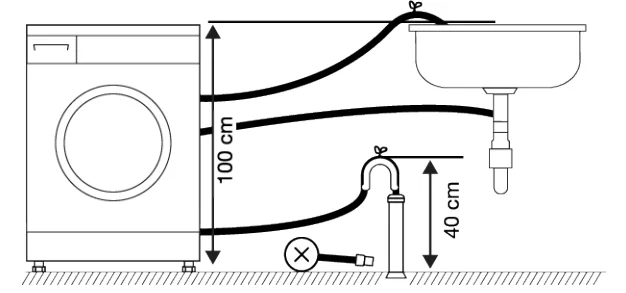
Your house will be flooded if the water drainage hose is disconnected during water draining. There is also a risk of burning due to the high washing temperatures. In order to prevent such situations and make sure that the product performs water intake and drain processes without any problem, fix the drain hose securely. - Connect the drain hose to a minimum height of 40 cm and a maximum height of 100 cm.
- Installing the water draining hose at ground level or close to the floor (40 cm below) and then raising it makes water discharge difficult, and the laundry may come out extremely wet. Thus, follow the heights provided in the figure.

- To prevent the wastewater from going back into the product again and to ensure easy drainage, do not immerse the end of the hose into the wastewater or do not insert it into the drain for more than 15 cm. If it is too long, cut it short.
- The end of the hose should not be bent, it should not be stepped on, and the hose must not be pinched between the drain and the product. Otherwise, water discharge issues may emerge.
- If the length of the hose is too short, use it by adding an original extension hose. The overall length of the hose shall not be longer than 3.2 m. To prevent water leaks, always secure the connection between the extension hose and the draining hose of the product with a suitable clamp so that it does not come off and cause leaks.
4.6 Adjusting the Stands
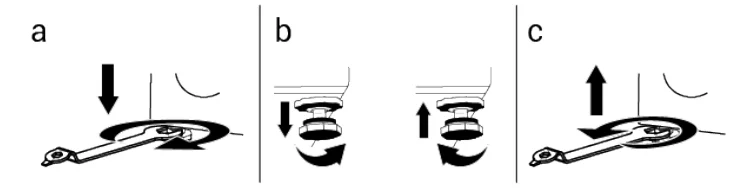
WARNING: In order to ensure that the product operates more silently and vibration-free, it must stand level and balanced on its feet. Ensure that the product is balanced by adjusting the feet. Otherwise, the product may move from its place and cause crushing, noise, and vibration problems.
- Loosen the nuts on the feet in the direction of the arrow with the tool in the user manual bag.
- Adjust the feet until the product stands level and balanced. You can move the feet up by turning them counter-clockwise and down by turning them clockwise.
- Re-tighten all lock nuts with the tool in the direction of the arrow. You can move the nuts down by turning them counter-clockwise and up by turning them clockwise.

4.7 Electrical Connection
Connect the product to a grounded outlet protected by a 13 A fuse. Our company shall not be responsible for the damages that shall be incurred due to using the product without grounding according to local regulations.
- Connection must comply with national regulations.
- The electrical connection cable infrastructure of the product must be adequate and suitable for product requirements. It is recommended to use a Ground Fault Circuit Breaker (GFCI).
- The power cable plug must be within easy reach after installation.
- If the current supply to the fuse or breaker in the house is less than 13 Amps, have a qualified electrician install a 13-amp supply.
- The voltage specified in the “Technical specifications” section must be equal to your mains voltage.
- Do not make connections via extension cables or multi-plugs. Overheating and burning may occur due to the connecting cable.
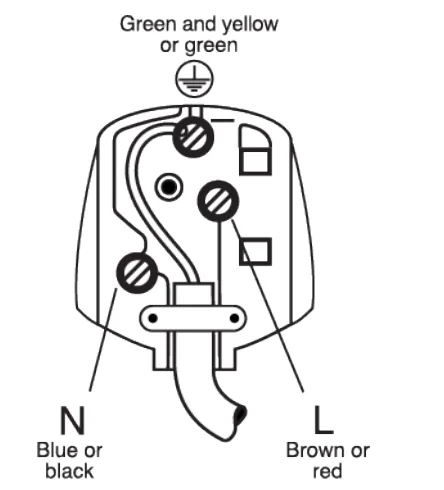
Fitting a different plug:
As the colours of the wires in the mains lead of this appliance may not correspond with the coloured markings identifying the terminals on your plug, proceed as follows:
- Connect the green-yellow or green (earth) wire to the terminal in the plug marked ‘E’ or with the symbol f for coloured green and yellow or green.
- Connect the blue (neutral) wire to the terminal in the plug marked ‘N’ or coloured black.
- Connect the brown (live) wire to the terminal in the plug marked ‘L’ or coloured red. With the alternative plugs, a 13 A fuse must be fitted either in the plug, adaptor, or in the main fuse box. If in doubt, contact a qualified electrician.

4.8 Start Up
Before starting to use the product, make sure that the preparations described in section “Environmental instructions” and “Installation” are followed. To prepare the product for washing laundry, perform the first operation in the Drum Cleaning programme. If this programme is not available in your product, apply the method which is described in the section “Cleaning the loading door and the drum”.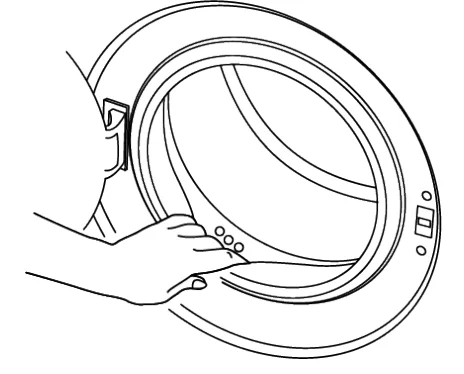
5 Preliminary Preparation
5.1 Sorting the Laundry
- Sort laundry according to type of fabric, colour, degree of soiling, and allowable water temperature.
- Always observe the instructions given on the garment care labels.
5.2 Preparing Laundry for Washing
- Laundry items with metal attachments, such as underwiring, belt buckles, or metal buttons, will damage the product. Remove the metal pieces or wash such clothes by putting them in a laundry bag or pillow case.
- Take out all substances in the pockets, such as coins, pens, and paper clips, and turn the pockets inside out and brush. Such objects may damage the product or cause a noise problem.
- Put small-sized clothes such as infant’s socks and nylon stockings in a laundry bag or pillow case.
- Place curtains in without compressing them. Remove curtain attachment items. Curtain attachment items may cause pulling and tearing on the curtain.
- Fasten zippers, sew loose buttons, and mend rips and tears.
- Wash “Machine washable” or “Hand washable” labelled products only with an appropriate programme.
- Do not wash colours and whites together. New, dark coloured cottons release a lot of dye. Wash them separately.
- Tough stains must be treated properly before washing.
- Wash trousers and delicate laundry turned inside out.
- Laundry that is subjected to materials such as flour, lime dust, milk powder, etc., intensely must be shaken off before placing it into the product. Such dust and powders on the laundry may build up on the inner parts of the product over time and can cause damage.
5.3 Tips for Energy and Water Saving
The following information will help you use the product in an ecological and energy/water-efficient manner.
- Operate the product in the highest load capacity allowed for the programme you have selected, but do not overload. See “Programme and consumption table”.
- Observe the temperature instructions on the detergent packaging.
- Wash slightly soiled laundry at low temperatures.
- Use faster programmes for small quantities of lightly soiled laundry.
- Do not use prewash and high temperatures for laundry that is not heavily soiled or stained.
- If you plan to dry your laundry in a dryer, select the highest spin speed recommended during the washing process.
- Do not use more detergent than the recommended amount on the detergent packaging.
5.4 Loading the Laundry
- Open the loading door.
- Put the laundry items into the product in a loose manner.
- Push the loading door to close until you hear a locking sound. Ensure that no items are caught in the door. The loading door is locked while a programme is running. The door lock will open once the programme is completed. Then you can open the loading door. If the door does not open, apply the solutions provided for the “Loading door cannot be opened” error in the Troubleshooting section.
5.5 Correct Load Capacity
The maximum load capacity depends on the type of laundry, the degree of soiling, and the desired washing programme. The product automatically adjusts the water amount according to the weight of the laundry put inside it.
5.8 Displayed Programme Duration
You can view the programme duration on the display of your machine while selecting a programme. Depending on the amount of laundry you have loaded into your machine, foaming, unbalanced load conditions, fluctuations in power supply, water pressure, and programme settings, the programme duration is automatically adjusted while the programme is running.
SPECIAL CASE: At the start of Cottons and Cotton Eco programmes, the display shows the duration of half load. It is the most common use case. After the programme starts, in 20–25 minutes actual load is detected by the machine. And if the detected load is higher than half load; washing programme will be adjusted accordingly, and the programme duration will be increased automatically. You can follow this change on the display.
6 Operating the Product
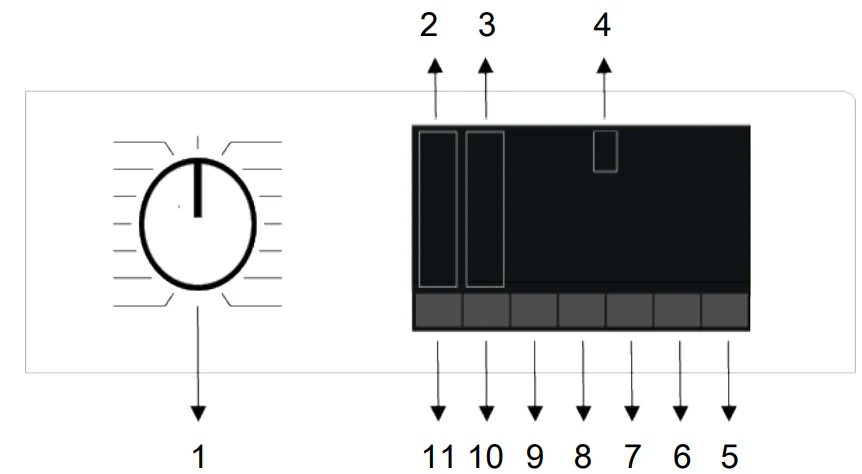
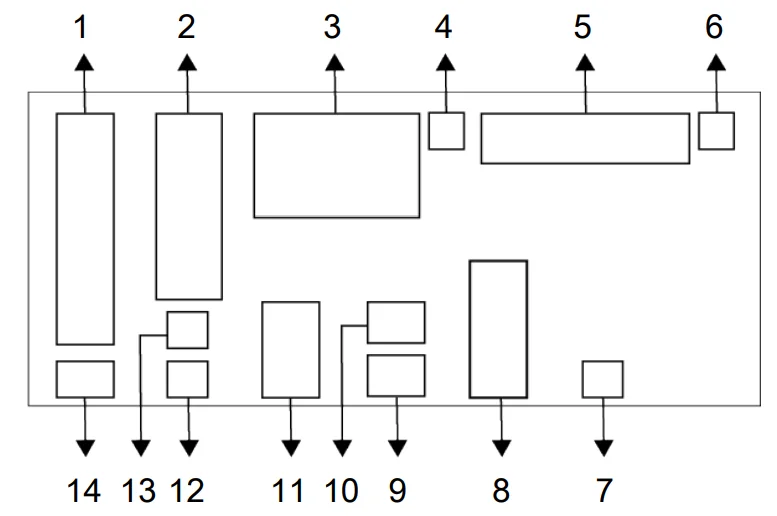
6.1 Control Panel
- Programme Selection Button
- Temperature Level Indicator Lights
- Spin Level Indicator Lights
- Display
- Start/Pause Button
- End Time Setting Button
- Auxiliary Function Button 3
- Auxiliary Function Button 2
- Auxiliary Function Button 1
- Spin Speed Adjustment Button
- Temperature Setting Button

6.2 Symbols on the Display
- Temperature Indicator
- Spin Speed Indicator
- Duration Information
- Door Lock Is Engaged Symbol
- Programme Follow-up Indicator
- No Water Indicator
- Delayed Start Enabled Indicator
- Auxiliary Function Indicators 3
- Auxiliary Function Indicators 2
- Child Lock Enabled Symbol
- Auxiliary Function Indicators 1
- No Spin Indicator
- Rinse Hold Indicator
- Cold Water Indicator

Programme Selection
- Determine the programme suitable for the type, quantity, and soiling level of the laundry in accordance with “Programme and consumption table”. Programmes are limited with the highest spin speed appropriate for that particular type of fabric. When selecting a programme, always consider the type of fabric, colour, degree of soiling, and permissible water temperature.
- Select the desired programme with the Programme Selection knob.
9 DISCLAIMER / WARNING
Some (simple) failures can be adequately handled by the end-user without any safety issue or unsafe use arising, provided that they are carried out within the limits and in accordance with the following instructions (see the “Self-Repair” section). Therefore, unless otherwise authorized in the “Self-Repair” section below, repairs shall be addressed to registered professional repairers to avoid safety issues. A registered professional repairer is a professional repairer who has been granted access to the instructions and spare parts list of this product by the manufacturer according to the methods described in legislative acts pursuant to Directive 2009/125/EC.
However, only the service agent (i.e., authorized professional repairers) that you can reach through the phone number given in the user manual/warranty card or through your authorized dealer may provide service under the guarantee terms. Therefore, please be advised that repairs by professional repairers (who are not authorized by Beko) shall void the guarantee.
Self-Repair
Self-repair can be done by the end-user with regard to the following spare parts: door, door hinge and seals, other seals, door locking assembly, and plastic peripherals such as detergent dispensers (an updated list is also available in support.beko.com as of 1st of March 2021).
Moreover, to ensure product safety and to prevent risk of serious injury, the mentioned self-repair shall be done following the instructions in the user manual for self-repair, or which are available at support.beko.com. For your safety, unplug the product before attempting any self-repair.
Repair and repair attempts by end-users for parts not included in such a list and/or not following the instructions in the user manuals for self-repair or which are available in support.beko.com might give rise to safety issues not attributable to support.beko.com, and will void the warranty of the product.
Therefore, it is highly recommended that end-users refrain from attempting to carry out repairs falling outside the mentioned list of spare parts, contacting in such cases authorized professional repairers or registered professional repairers. On the contrary, such attempts by end-users may cause safety issues and damage the product and subsequently cause fire, flood, electrocution, and serious personal injury to occur.
By way of example, but not limited to, the following repairs must be addressed to authorized professional repairers or registered professional repairers: motor, pump assembly, main board, motor board, display board, heaters, etc. The manufacturer/seller cannot be held liable in any case where end-users do not comply with the above. The spare part availability of the washing machine or washer-dryer that you purchased is 10 years. During this period, original spare parts will be available to operate the washing machine or washer-dryer properly.
For More Manuals By Beko, Visit ManualsLibraryy.
Beko BM3WT12411 Washing Machine-FAQs
What are the most common problems with Beko washing machines?
Common issues include the machine not draining water, not filling properly, making unusual noise, leaking, cycles not starting, or the door failing to open. Most problems are caused by blocked filters, overloading, or incorrect detergent use.
What is the average lifespan of a Beko washing machine?
A Beko washing machine typically lasts 7 to 13 years, depending on how often it is used, maintenance habits, and water quality.
Which wash setting is best for towels on a Beko washer?
The Cotton cycle is ideal for towels. It uses stronger agitation and higher spin speeds, helping remove dirt effectively and extract more water.
How long does the Eco 40-60 wash cycle take?
The Eco 40-60 programme usually takes around 3 hours to 3 hours 30 minutes, depending on load size and selected options.
Why do Beko washing machine cycles take so long?
Cycles may run longer when eco modes, extra rinse, or pre-wash options are selected. Eco programmes also use lower temperatures, which increases wash time to save energy.
How much water does a Beko washing machine use per wash?
Modern Beko machines typically use 40–60 litres per wash, while eco programmes may use even less water.
Why are my clothes still wet after the spin cycle?
This often happens due to overloading, unbalanced loads, or a blocked drain filter, which reduces spinning efficiency.
How many towels fit in a 7kg Beko washing machine?
A 7kg machine can usually hold 9–10 standard bath towels, making it suitable for small to medium households.