
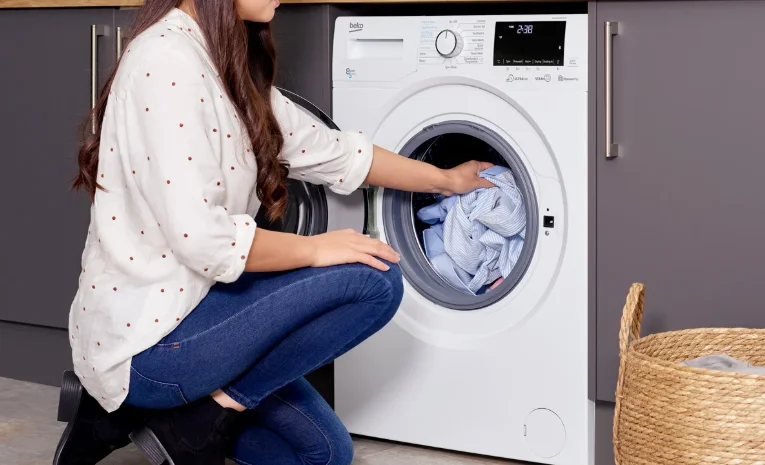

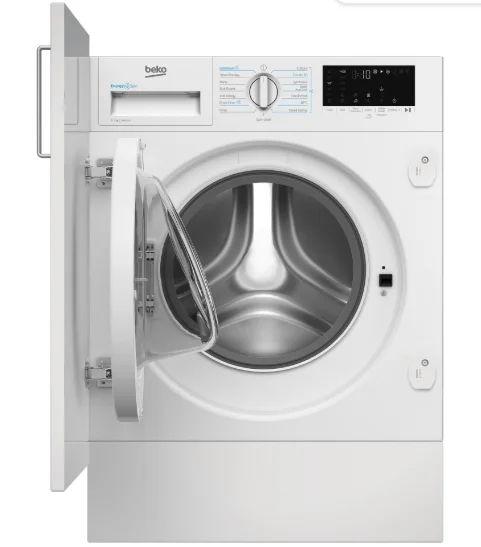
Beko WTIK741511 Washing Machine
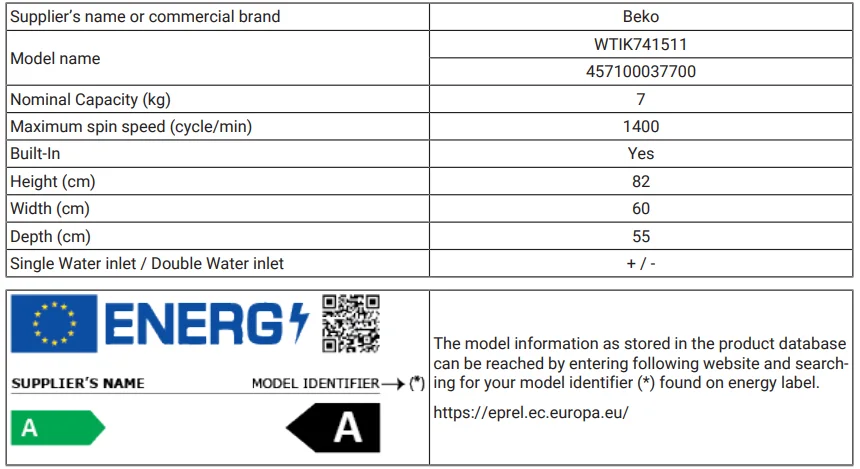
3 Technical Specifications
4 Installation
Note: Please read the “Safety Instructions” section first! Notice: Your product automatically detects the amount of laundry placed inside when selecting a programme. While installing the product, before the first use, calibration should be done to ensure that the laundry amount is detected in the most accurate way. To do this, select the Drum Cleaning* programme and cancel the spin function. Start the programme without laundry. Wait for the programme to finish, which will take about 15 minutes. The programme name may vary depending on the model. For the appropriate programme selection, review the programme descriptions section.
- Please contact the nearest Authorised Service for the installation of the product.
- Make sure that the installation and electrical connections of the product are performed by an authorised service agent. The manufacturer shall not be held responsible for damages caused by operations performed by unauthorised persons.
- Preparation of the location and electrical, tap water, and wastewater installations at the place of installation is under the customer’s responsibility.
- Make sure that the water inlet and discharge hoses, as well as the power cable, are not folded, pinched, or crushed while pushing the product into its place after installation or cleaning procedures.
- Before installation, visually check if the product has any defects on it. Do not have the product installed if it is damaged. Damaged products cause risks to your safety.
4.1 Unpacking and Transporting the Product
Unpacking the Product
- Remove the cardboard box or Styrofoam packaging.
- To remove the cardboard or Styrofoam packaging underneath the product, lift the product carefully. If this is not possible, remove it by tilting it slightly to the side or by laying it on its side without damaging the product.
- Open the door and remove the inlet hose and any other accessories inside the drum.
- Detach the power cable and drain hose from their fixed positions.
- Remove the transportation safety bolts. (see “Removing the Transportation Safety Bolts”)
Transporting the Product
Note: Read the “Transportation Safety” section first!
- Ensure the door and detergent drawer are closed.
- Install the transportation safety bolts carefully without damaging the product’s drum. (see “Removing the Transportation Safety Bolts”)
- Pack the product with protective packaging to prevent damage during transport.
4.2 Appropriate Installation Location
- Place the product on a hard, rigid, and level floor. Do not place the product on surfaces such as long-pile carpets or non-slip carpets, or on excessively springy flooring such as acoustic floor coverings. Improper surfaces may cause noise and vibration problems.
- When the washing machine and the dryer are placed on top of each other, their total weight -when full- is approximately 180 kilograms. Place the product on a solid and level surface with sufficient load-carrying capacity.
- Do not place the product on the power cord.
- Do not install the product in places where the temperature drops below 0ºC. This may cause damage to your product due to freezing.
- Leave a minimum space of 1 cm between the product and the furniture.
- When installing the appliance on a stepped surface, keep it away from the edges.
- Do not place the product on any platform.
- Do not place or use heat sources such as cooktops, irons, ovens, heaters, etc. on the product.
4.3 Assembly of Bottom Panel Covers
Notice: With some models, the base parts of the products are completely closed. These products do not have plugs and covers.
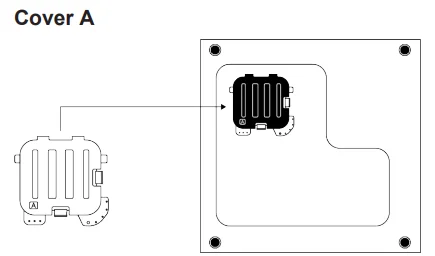
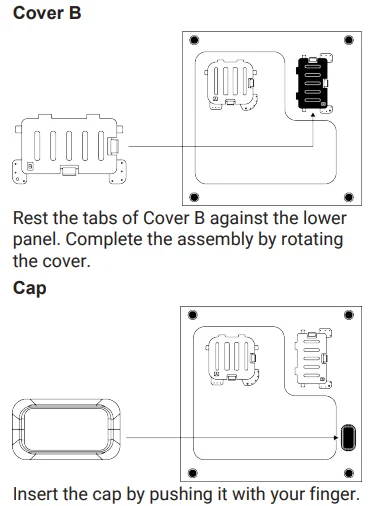
- To increase the sound comfort of the product, attach cover A after removing the package foam. Tilt the product back slightly. Rest the tabs of Cover A against the lower panel. Complete the assembly by rotating the cover.

- Cover B and the Cap are optional. If available, attach cover B and the Cap.

4.4 Removing Transportation Safety Bolts
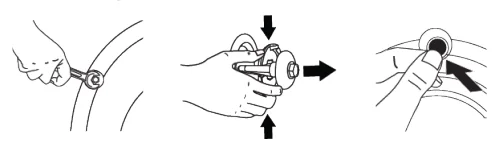
- Loosen all transportation safety bolts with an appropriate wrench until they turn freely.
- Bend the inner part by pressing it at the grip areas and pulling the part out.
- Attach the plastic covers supplied in the User Manual bag to the holes on the rear panel.

NOTICE
- Keep the transportation safety bolts in a safe place to reuse when the product needs to be moved again in the future.
- Install the transportation safety bolts in reverse order of the disassembly procedure.
- Never move the product without the transportation safety bolts properly fixed in place.
4.5 Connecting to Water Supply
NOTICE
- Models with a single water inlet should not be connected to the hot water tap. Laundry may be damaged, or the product may go into protection mode and not work.
- Do not use old or used water inlet hoses on your new product. This may cause water leakage in your product and stains on your laundry.
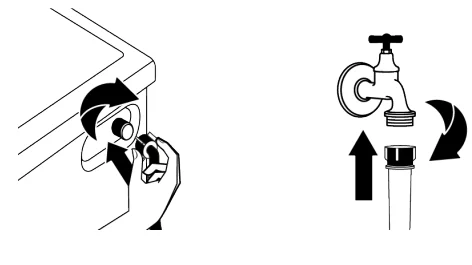
- Tighten all hose nuts by hand. Make sure to tighten all hose connections completely. Never use a tool when tightening nuts.
- After completing the hose connection, open the taps all the way and check if there is any water leakage from the connection points. In case of a leakage, turn off the tap and unscrew the nut. Check the seal and tighten the nut carefully again. To prevent possible water leaks and damage that may occur, keep the taps closed when the product is not in use.

4.6 Connecting the Drain Hose to the Drain
- Attach the end of the drain hose directly to the wastewater drain, washbasin, or bathtub. Warning: Your house will be flooded if the water drainage hose is disconnected during water draining. There is also a risk of burning due to the high washing temperatures. In order to prevent such situations and make sure that the product performs water intake and drain processes without any problem, fix the drain hose securely.
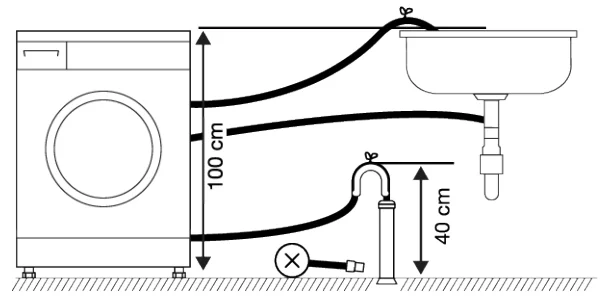
- Connect the drain hose to a minimum height of 40 cm and a maximum height of 100 cm.
- Installing the water draining hose at ground level or close to the floor (40 cm below) and then raising it makes water discharge difficult, and the laundry may come out extremely wet. Thus, follow the heights provided in the figure.

- To prevent the wastewater from going back into the product again and to ensure easy drainage, do not immerse the end of the hose in the wastewater or do not insert it into the drain for more than 15 cm. If it is too long, cut it short.
- The end of the hose should not be bent, it should not be stepped on, and the hose must not be pinched between the drain and the product. Otherwise, water discharge issues may emerge.
- If the length of the hose is too short, use it by adding an original extension hose. The overall length of the hose shall not be longer than 3.2 m. To prevent water leaks, always secure the connection between the extension hose and the draining hose of the product with a suitable clamp so that it does not come off and cause leaks.
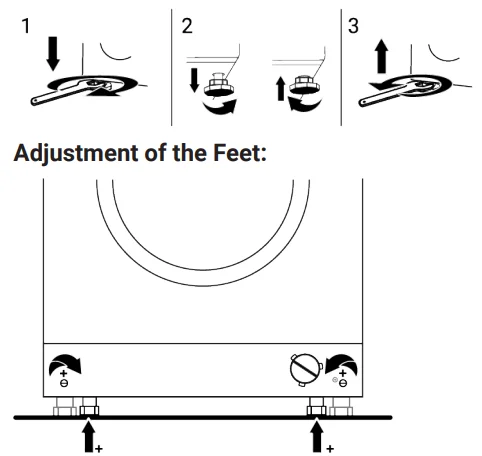
4.7 Adjusting the Feet
NOTICE: In order to ensure that the product operates more silently and vibration-free, it must stand level and balanced on its feet. Adjust the feet to ensure balance. Otherwise, the product may move from its place and cause bumping, noise, and vibration problems.
- To loosen the nuts on the feet, rotate the nuts clockwise using the hand tool.
- Adjust the feet until the product stands level and stable. To lower the feet, rotate them counterclockwise. To raise the feet, rotate them clockwise.
- To retighten the nuts, rotate them counterclockwise using the hand tool.

- When you turn the rotary knob shown inside the circle in the direction of the arrow, the machine will raise 0.3 mm. If you turn it in the opposite direction of the arrow, the machine will lower by 0.3 mm.
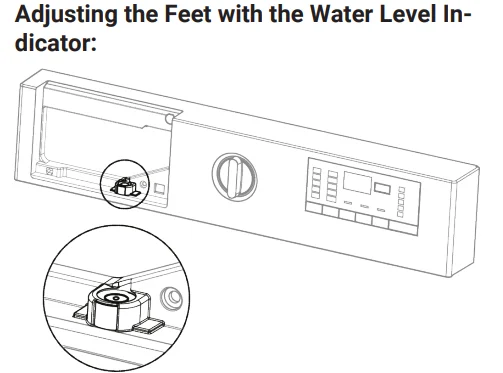
- You can use the water meter to check the rear and front feet of the machine for the proper setting.
- Do not adjust the rear feet using rechargeable devices. Use a screwdriver instead.

- To adjust the Water Level Indicator, you must remove the Detergent Drawer.
- The bubble inside the Water Level Indicator must be in the middle for the system to work correctly.
- If the bubble inside the Water Level Indicator is on the left, the right preset foot of the Washing Machine must be adjusted.
- If the bubble inside the Water Level Indicator is on the right, the left preset foot of the Washing Machine must be adjusted.
- If the bubble inside the Water Level Indicator is on the rear, the front preset foot of the Washing Machine should be turned left (clockwise).
- If the bubble inside the Water Level Indicator is on the front, the front preset foot of the Washing Machine should be turned right (counterclockwise).
4.8 Electrical Connection
Connect the product to a grounded outlet protected by a 13-amp fuse. Our company shall not be responsible for the damages that shall be incurred due to using the product without grounding according to local regulations.
- Connection must comply with national regulations.
- The electrical connection cable infrastructure of the product must be adequate and suitable for product requirements. It is recommended to use a Ground Fault Circuit Breaker (GFCI).
- The power cable plug must be within easy reach after installation.
- If the current supply to the fuse or breaker in the house is less than 13 amps, have a qualified electrician install a 13-amp supply.
- Your mains voltage must comply with the voltage specified in the “technical specifications” section.
- Do not make connections via extension cables or multi-plugs. Overheating and burning may occur due to the connecting cable.
Warning: Damaged power cables should be replaced by the authorised service in order to prevent possible danger.
4.9 Start Up
Before starting to use the product, make sure that the preparations described in section “Environmental instructions” and “Installation” are completed. To prepare the product for washing laundry, perform the first operation in the Drum Cleaning programme. If this programme is not available in your product, apply the method which is described in the section “Cleaning the loading door and the drum”.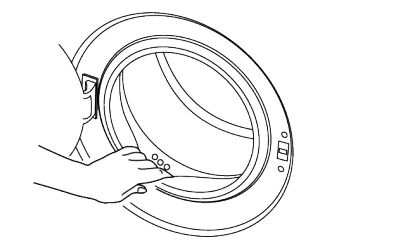
Notice: Some water has remained in the product due to the quality control processes in the production. It is not harmful to the product.
5 Preliminary Preparation
Note: Please read the “Safety Instructions” section first!
5.1 Sorting the Laundry
- Sort laundry according to type of fabric, colour, degree of soiling, and allowable water temperature.
- Always observe the instructions given on the garment care labels.
5.2 Preparing Laundry for Washing
- Laundry items with metal attachments, such as underwiring, belt buckles, or metal buttons, will damage the product. Remove the metal pieces or wash such clothes by putting them in a laundry bag or pillow case.
- Take out all items in the pockets, such as coins, pens, and paper clips, and turn the pockets inside out and brush. Such objects may damage the product or cause a noise problem.
- Put small-sized clothes such as infant’s socks and nylon stockings in a laundry bag or pillow case.
- Place curtains in without compressing them. Remove all curtain accessories such as rings, hooks, and clips to prevent damage to the curtains.
- Fasten zippers, sew loose buttons on securely, and mend rips and tears.
- Wash “Machine washable” or “Hand washable” labelled products only with an appropriate programme.
- Do not wash colours and whites together. New, dark coloured cottons release a lot of dye. Wash them separately.
- Tough stains must be treated properly before washing.
- Wash trousers and delicate laundry turned inside out.
- Laundry that is subjected to materials such as flour, lime dust, milk powder, etc., intensely must be shaken off before placing it into the product. Such dust and powders on the laundry may build up on the inner parts of the product over time and can cause damage.
5.3 Tips for Energy and Water Saving
The following information will help you use the product in an ecological and energy/water-saving way.
- Operate the product at the maximum load capacity for the programme selected, but do not overload it. See “Programme and consumption table”.
- Follow the temperature recommendations on the detergent packaging.
- Wash your lightly soiled laundry at low temperatures.
- Choose quick programmes for lightly soiled and small amounts of laundry.
- Do not use prewash or high temperatures for laundry that is not heavily dirty or stained.
- If you are going to dry your laundry in the dryer, select the highest spin speed recommended for your washing programme.
- Do not use more detergent than recommended on the detergent packaging.
5.4 Loading the Laundry
- Open the loading door.
- Put the laundry items into the product in a loose manner.
- Push the loading door to close until you hear a locking sound. Ensure that no items are caught in the door. The loading door is locked while a programme is running. The door lock will open once the programme is completed. Then you can open the loading door. If the door does not open, apply the solutions provided for the “Loading door cannot be opened” error in the Troubleshooting section.
5.5 Correct Load Capacity
The maximum load capacity depends on the type of laundry, the degree of soiling, and the desired washing programme. The product automatically adjusts the water amount according to the weight of the laundry put inside it.
Notice: Follow the instructions in the “Programme and consumption table”. When the product is overloaded, its washing performance will drop. Moreover, noise and vibration problems may occur.
5.6 Using Detergent and Softener
WARNING: Read the manufacturer’s instructions on the packaging when using detergents, softeners, starch, bleach, and decolourants, anti-lime scale, and follow the dosage information provided. Use a measuring cup, if any.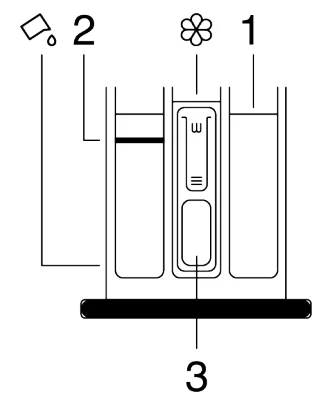
The detergent drawer comprises three compartments:
- (1) for prewash – if your model has a prewash function available,
- (2) for main washing,
- (3) for softener,
 a syphon piece in the softener compartment,
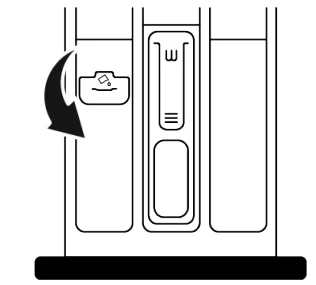
 There is a liquid detergent flap for liquid detergent use in the main washing compartment.
 a syphon piece in the softener compartment,
 There is a liquid detergent flap for liquid detergent use in the main washing compartment.
Detergent, Softener, and Other Cleaning Agents
- Add detergent and softener before starting the washing programme.
- Do not leave the detergent drawer open when the washing programme is on.
- If you are using a programme without prewashing, do not put detergent in the prewash compartment (compartment 1).
- If your model has a prewash function available – If you are using a program with prewash, start the product after adding powder detergent to the prewash and main wash compartments (compartments 1 and 2).
- If your model has a prewash function available, do not select a programme with pre-washing if you are using a detergent pod or dispensing ball. Place the detergent pod or the dispensing ball directly in the laundry product.
- If you are using a liquid detergent, follow the directions under “Liquid detergent use” and hinge down the liquid detergent flap.
Choosing the Detergent Type
The detergent type to be used depends on the washing programme, fabric type, and colour.
- Use different detergents for coloured and white laundry.
- Wash your delicate clothes only with special detergents (liquid detergent, wool shampoo, etc.) intended solely for delicate clothes and on suggested programmes.
- When washing dark coloured clothes and quilts, it is recommended to use liquid detergent.
- Wash woollens on the suggested programme with special detergent made specifically for woollens.
- Please review the programme descriptions part for the suggested programme for different textiles.
- All recommendations about detergents are valid for the selectable temperature range of programmes
Warning: Only detergents, softeners, and additives suitable for washing machines should be used. Do not use soap powder.
Adjusting the Detergent Amount
The amount of detergent depends on the amount of laundry, how soiled it is, and the water hardness.
- Do not exceed the recommended dosage values on the detergent packaging to eliminate excessive foam and poor rinsing problems, to save money, and protect the environment.
- Use less detergent for lightly soiled or a small amount of laundry.
Using Softeners
Put the softener in the softener compartment of the detergent drawer.
- Do not exceed the (>max<) level sign in the softener compartment.
- If the softener is thick, dilute it with water before placing it in the softener compartment.
WARNING: Do not use liquid detergents or other materials with cleaning properties unless they are intended for use in washing machines for softening the laundry.
Using Liquid Detergents
If the Product Has a Liquid Detergent Flap
- Hinge down the liquid detergent flap when you want to use liquid detergents. The flap will serve as a barrier for liquid detergent.
- Clean with water at its place or by removing it from its place when it is necessary. Do not forget to place the flap in the main washing compartment (compartment 2) after cleaning.
- The flap should be up if you will use a powder detergent.

6.1 Control Panel
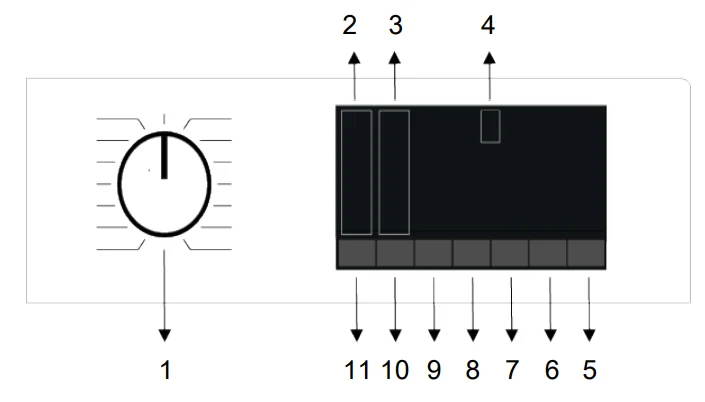
- Programme Selection Button
- Temperature Level Indicator Lights
- Spin Level Indicator Lights
- Display
- Start/Pause Button
- End Time Setting Button
- Auxiliary Function Button 3
- Auxiliary Function Button 2
- Auxiliary Function Button 1
- Spin Speed Adjustment Button
- Temperature Setting Button

6.2 Symbols on the Display
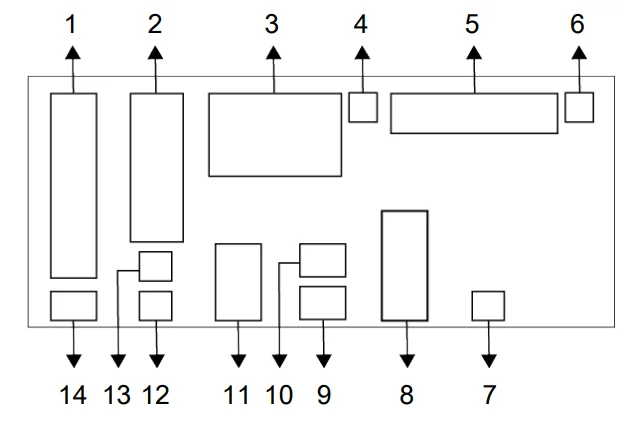
- Temperature Indicator
- Spin Speed Indicator
- Duration Information
- Door Lock Is Engaged Symbol
- Programme Follow-up Indicator
- No Water Indicator
- Delayed Start Enabled Indicator
- Auxiliary Function Indicators 3
- Auxiliary Function Indicators 2
- Child Lock Enabled Symbol
- Auxiliary Function Indicators 1
- No Spin Indicator
- Rinse Hold Indicator
- Cold Water Indicator

Product registrations
For UK registrations please visit beko.co.uk/register and for the Republic of Ireland visit beko.ie/register.
For More Manuals By Beko, Visit ManualsLibraryy.
Beko WTIK741511 Washing Machine-FAQs
How long does a wash cycle take on the Beko WTIK741511?
A standard wash cycle usually takes around 50 minutes, but the exact time depends on the selected programme, load size, and how dirty the clothes are.
Why do some wash cycles take longer than expected?
Cycles may run longer if options like extra rinse, pre-wash, or eco mode are selected. Using too much detergent can also extend the cycle time.
What wash programmes are available on this Beko washing machine?
The machine offers core programmes such as Cottons, Synthetics, and Wool, with adjustable temperatures and spin speeds to suit different fabrics.
Is a 45-minute wash cycle enough for daily laundry?
Yes, a 45–60 minute cycle is suitable for regular, lightly to moderately soiled clothes. Heavily soiled items may need a longer programme.
What is the Drum Clean or self-clean feature used for?
The Drum Clean function cleans the inside of the machine at high temperature (around 70°C) to remove bacteria, detergent residue, and odors. It’s best run with a washing machine cleaner and no laundry inside.
How do I reset my Beko WTIK741511 washing machine?
Press and hold the Start/Pause button for about 3 seconds, then turn the machine off and back on. This often resets the control system.
How much water does a typical wash cycle use?
Modern Beko washing machines usually use 40–60 litres of water per cycle, depending on the selected programme and load size.
What is the most common problem with Beko washing machines?
A blocked or dirty filter is one of the most common issues. Cleaning the filter regularly helps prevent drainage problems and bad smells.
Why are my clothes still wet after the spin cycle?
This can happen due to overloading, an unbalanced load, or a low spin setting. Redistribute the laundry and try a higher spin speed.