
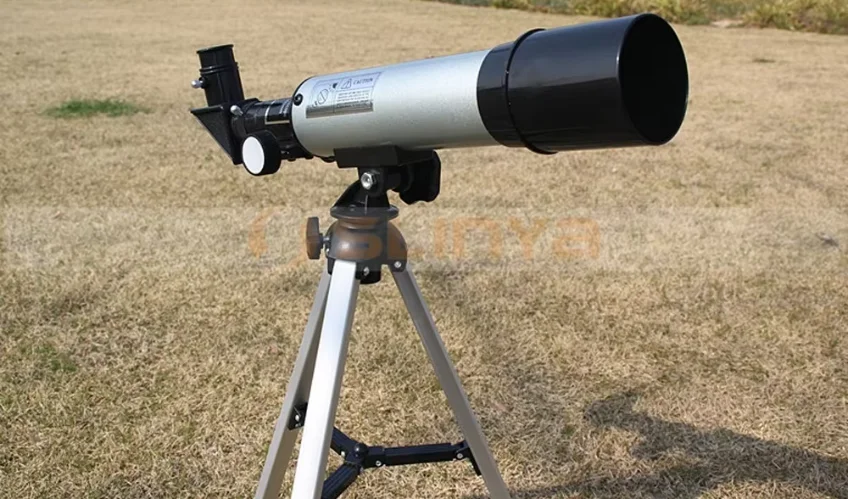

Dartwood Astronomical Telescope

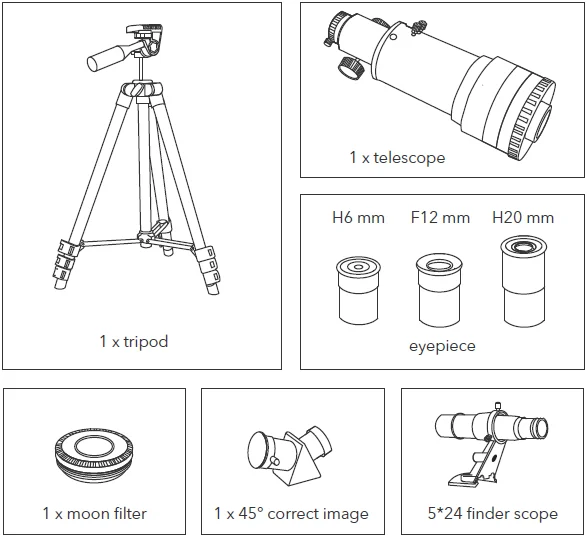
In the Box
Introduction to Parts
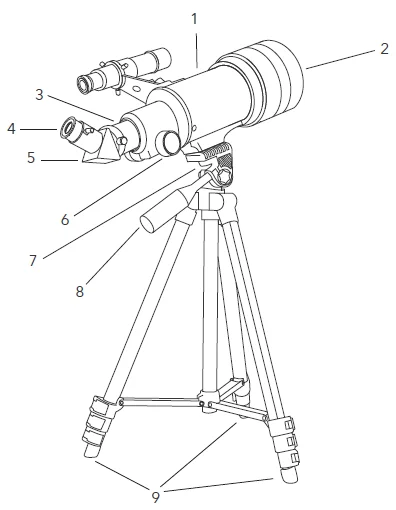
- Telescope tube
- Protective screen against condensation
- Focus tube
- Eyepiece
- Diagonal mirror
- Focus knob
- Mounting the lock button
- Control arm
- Tripod legs
How to Set Up
- Gently pull the tripod legs apart until the center leg braces sit flat.
- Place the tab on the bottom of the telescope into the slot at the top of the tripod.
- Firmly tighten the knob at the top of the tripod head.
- Screw the aiming control arm into the hole at the rear of the mount.
- Insert the H20 mm eyepiece into the diagonal mirror.
- Remove the dust cap from the large end of the telescope before using.
Using Your Telescope
Warning:
Never point the telescope at the sun, an eclipse, or any bright lights for any length of time.
Children should always be supervised when using the telescope, especially in the daytime.
- Windows, skylights, and other glass structures can cause reflections in the telescope. Using the telescope outdoors is recommended.
- The telescope is sensitive to temperature changes. Allow the telescope and its internal parts to adjust to the outdoor temperature before using (about 30 mins).
- The telescope works best when the surrounding area is dark. The glare from city lights will limit visibility.
Care and Cleaning of Optics
Note: Improper cleaning of optical components may void the warranty.
- Always keep the dust cap on during transport and storage.
- After the telescope is brought back indoors, remove the dust cap and allow any moisture to evaporate. Point the telescope downwards to minimize dust buildup.
- Clean any dust off the lenses by lightly spraying a can of compressed air.
- Place the dust cap back onto the telescope.
Astronomical Use
- Always start viewing with your H20 mm eyepiece (the least powerful). The wide viewing angle makes it easier to locate objects.
- Once you have located an object, switch to a more powerful eyepiece (F12 mm, H6 mm) for a better view.
Terrestrial Use
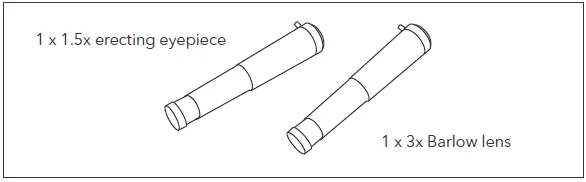
To orient the telescope for terrestrial use, use the 1.5x erecting eyepiece that comes with the telescope.
- Remove the diagonal mirror from your telescope.
- Insert the 1.5x erecting eyepiece into the focus tube. Then insert the H20 mm eyepiece. Look through the telescope to check that the image you see is right-side up and properly oriented.
- For a stronger view, remove the H20 mm eyepiece and replace it with a high-power one.
Specifications
- Eyepiece: H6 mm, F12 mm, H20 mm
- Packing: color box + master carton
- Box size: 23.4 x 18.5 x 18.5 in
- Weight: 41.9 lb
Get More Support
Scan the QR code below or email us at [email protected]
For more Manuals by Dartwood, visit ManualsLibraryy
Dartwood Astronomical Telescope-FAQs
What is the Dartwood Astronomical Telescope used for?
The Dartwood Astronomical Telescope is designed to observe distant celestial objects like the Moon, planets, and stars. It gathers and focuses light using mirrors or lenses, giving you a magnified view of the night sky.
Is the F30070M telescope suitable for beginners?
Yes. The F30070M model is an excellent choice for beginners, students, and astronomy enthusiasts. It includes essential accessories and a detailed manual, making it easy to start exploring space.
How do I use my phone with the telescope?
Attach the included smartphone adapter to the eyepiece, secure your phone, and adjust the focus until the image appears clear. This lets you capture photos or videos of celestial objects directly through the telescope.
What kind of image does an astronomical telescope produce?
An astronomical telescope forms a virtual, inverted, and magnified image of distant celestial bodies, allowing detailed observation of planets, stars, and the Moon’s surface.
What are the main types of astronomical telescopes?
There are three main types:
Refractor telescopes (use lenses),
Reflector telescopes (use mirrors), and
Catadioptric telescopes (combine lenses and mirrors).
Each design offers unique viewing advantages.
What is the magnification power of the F30070M telescope?
The F30070M comes with H20mm and H6mm eyepieces and a 3X Barlow lens, offering magnification from 15X up to 150X, ideal for observing the Moon and planets.
Can I see planets or galaxies with this telescope?
Yes, you can view planets like Jupiter, Saturn, and Mars with clear detail. Under dark skies, you may also observe star clusters and some bright galaxies.
How should I maintain my telescope?
Keep the lens and mirrors clean, store the telescope in a dry place, and avoid touching optical surfaces. Regular gentle cleaning and proper storage will ensure long-lasting performance.