


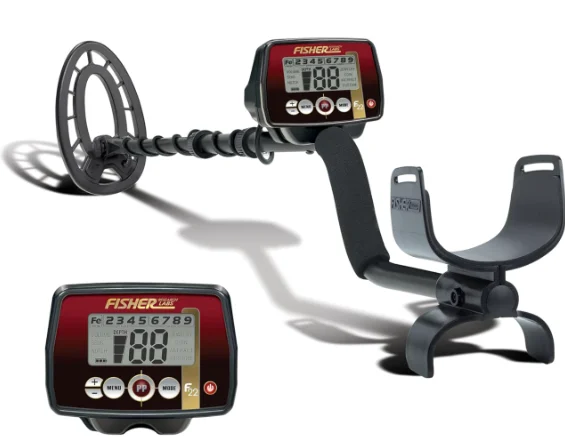
Fisher F22 Weatherproof Metal Detector
ACCESSORIES
FOR COMPLETE DETAILS VISIT WWW.FISHERLAB.COM, 1-800-685-5050
TERMINOLOGY
The following terms are used throughout the manual and are standard terminology among detectorists.
RELIC
A relic is an object of interest by reason of its age or its association with the past. Many relics are made of iron, but can also be made of bronze or precious metals.
IRON
Iron is a common, low-grade metal that is an undesirable target in certain metal detecting applications. Examples of undesirable iron objects are old cans, pipes, bolts, and nails. Sometimes the desired target is made of iron. Property markers, for instance, contain iron. Valuable relics can also be composed of iron; cannon balls, old armaments, and parts of old structures and vehicles can also be composed of iron.
FERROUS
Metals that are made of, or contain, iron.
ELIMINATION
Reference to a metal being “eliminated” means the detector will not emit a tone, nor display a Target-ID, when a metal object passes through the searchcoil’s detection field.
DISCRIMINATION
When the detector emits different tones for different types of metals, and when the detector “eliminates” certain metals, we refer to this as the detector “discriminating” among different types of metals. Discrimination is an important feature of professional metal detectors. Discrimination allows the user to ignore trash and other undesirable objects.
PINPOINTING
Pinpointing is the process of finding the exact location of a buried object. Long-buried metals can appear exactly like the surrounding soil and can therefore be very hard to isolate from the soil.
GROUND CANCELATION
Ground Cancelation is the ability of the detector to ignore, or “see through,” the earth’s naturally occurring minerals, and only sound a tone when a metal object is detected. This detector incorporates proprietary circuitry to eliminate false signals from many mineralized soils.
CONTENTS OF BOX
The following detector components are in the box: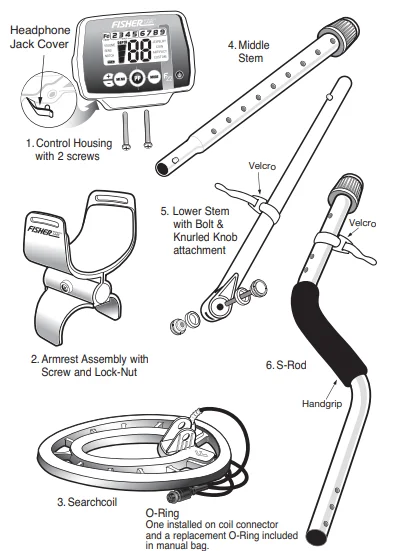
ASSEMBLY
Tool Required: #1 Phillips Screwdriver
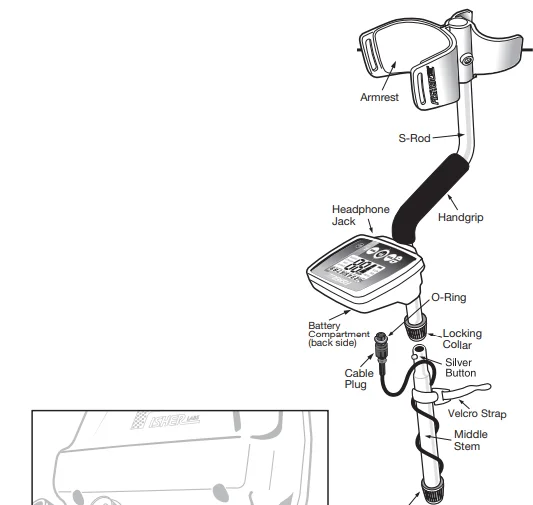
- Remove the Screw from the Armrest.
- Slide the Armrest over the end of the S-Rod.
- Attach with Screw and Lock-Nut.
- Attach the Control Housing with Screws; install the back screw first.
- NOTE: The Handgrip fits under the Control Housing. The handgrip may partially cover one mounting hole. Peel back the Handgrip to expose the front hole.
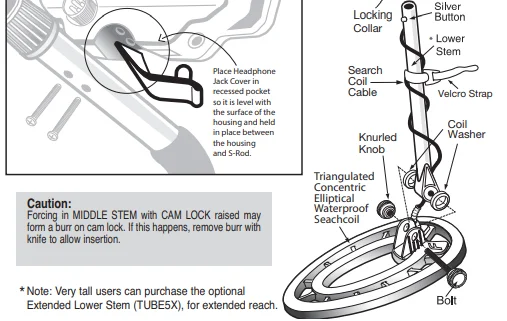
- Ensure the headphone jack cover is properly seated before attaching the control housing.


- Position S-Rod upright.
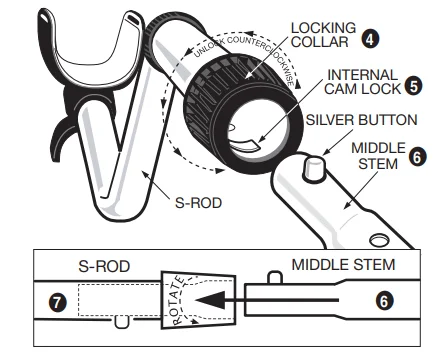
- Rotate the LOCKING COLLAR fully in the counterclockwise direction.
- Insert your finger inside the tube and make sure the INTERNAL CAM LOCK is flush with the inside of the tube.
- Insert the MIDDLE STEM into the S-ROD, with the SILVER BUTTON pointed upward.
- Rotate the MIDDLE STEM until the SILVER BUTTON locates in the hole.
- Twist the LOCKING COLLAR fully in the clockwise direction until it locks.
- Repeat this process on the LOWER STEM.
- Using the BOLT and KNURLED KNOB, attach the SEARCHCOIL to the LOWER STEM.
- Adjust the LOWER STEM to a length that lets you maintain a comfortable upright posture with your arm relaxed at your side, and the SEARCHCOIL parallel to the ground in front of you.
- Wind the CABLE securely around the STEMS, leaving slack at the bottom.
- Connect the CABLE PLUG to the housing. Do not twist the Cable or Plug. Turn the Locking Ring only. Use minimal finger pressure to start the threads. Do not cross-thread. When the Locking Ring is fully engaged over the threaded connector, give it a firm turn to make sure it is very tight. When the Locking Ring is fully engaged over the threaded connector, it may not cover all of the threads.

CHARACTERISTICS & LIMITATIONS
- This detector comes with a waterproof searchcoil. The searchcoil can be completely submerged in water. The control housing is weatherproof but cannot be submerged in water.
- BURIED UTILITY LINES. This hobby metal detector is not designed to locate buried pipes or cables. First Texas Products manufactures a complete line of pipe and cable locators for this application. These are sophisticated instruments with functionality different from your hobby metal detector.
- SEVERE SOIL CONDITIONS. While this detector has proprietary circuitry to cancel out minerals naturally occurring in most soil types, it cannot penetrate the most severe soils, and it is not intended for use on wet sand or saltwater beaches. However, it is well-suited for detecting on dry sand. Saltwater is highly conductive and requires a more sophisticated type of detector. First Texas Products offers such types of detectors. Other highly mineralized soils, such as those found in some gold prospecting sites, may also limit this detector’s capability. If the detector tends to overload, it could indicate you are in an area containing such severe soils.
- TARGET-ID. The detector’s Target-ID system calculates and displays the most probable identification. Target-ID is affected by soil conditions, the searchcoil’s distance from the target, the length of time the target has been buried, and the target’s proximity to other dissimilar targets. Very large metal objects can overload the detector and may be classified inaccurately.
- REDUCE SENSITIVITY. The primary purpose of the Sensitivity control is to allow the operator to reduce the sensitivity of the detector. All detectorists desire to find objects at maximum depth. However, in today’s environment, there is a never-ending variety of devices emitting EMI (Electromagnetic Interference) that can interfere with this detector. There will be environments where the detector cannot operate at maximum sensitivity. This is not a defect. If you find yourself in such an environment, reduce the sensitivity of the detector. Some environments may have so much EMI that it is impossible to detect it there. Both overhead power lines and buried power lines can interfere with this detector. Power line capacity may be quite different during certain times of the day. For instance, peak hours of electrical use that can occur around 6 p.m. can lead to a lot of EMI. If you experience power line interference, try returning to a given area at a different time of day.
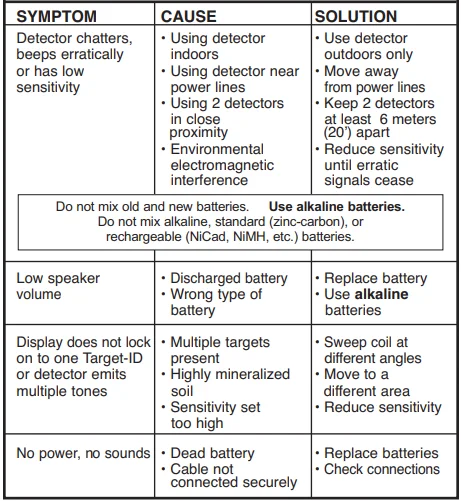
TROUBLESHOOTING GUIDE
Note: This equipment has been tested and found to comply with the limits for a Class B digital device, pursuant to part 15 of the FCC Rules. These limits are designed to provide reasonable protection against harmful interference in a residential installation. This equipment generates, uses, and can radiate radio frequency energy and, if not installed and used in accordance with the instructions, may cause harmful interference to radio communications.
However, there is no guarantee that interference will not occur in a particular installation. If this equipment does cause harmful interference to radio or television reception, which can be determined by turning the equipment off and on, the user is encouraged to try to correct the interference by one or more of the following measures:
- Reorient or relocate the receiving antenna.
- Increase the separation between the equipment and receiver.
- Consult the dealer or an experienced radio/TV technician for help.
CE The manufacturer declares that the minimum ESD performance criteria are 1) the unit shall not be permanently damaged, and 2) operator intervention is allowed. This product is RoHS compliant. This product meets the requirements of Industry Canada: CAN ICES-3 B/NMB-3 B.
HEADPHONE JACK
This detector has a 1/4” headphone jack. It works with any stereo headphone that has a 1/4” plug. When the headphone jack is connected, speaker volume is disabled. Using headphones extends battery life and prevents the sounds from bothering bystanders. Headphone use also facilitates the detection of the weakest signals.
For safety reasons, do not use headphones near traffic or where other dangers are present. This device is to be used with interconnecting cables shorter than three meters. The headphone jack has a rubber plug that will help keep foreign material from entering the control box. To ensure it remains weatherproof, do not use headphones during rain or very wet conditions.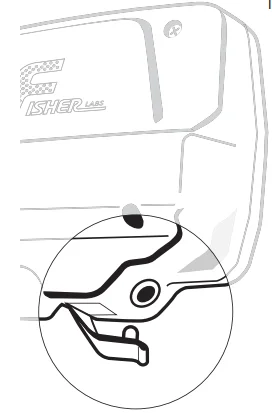
THE BASICS OF METAL DETECTING
This metal detector is intended for locating buried metal objects. When searching for metals, underground or on the surface, you have the following challenges and objectives:
- Ignoring signals caused by ground minerals.
- Ignoring signals caused by metal objects that you do not want to find, like nails.
- Identifying a buried metal object before you dig it up.
- Estimating the size and depth of objects to facilitate digging them up.
- Eliminating the effects of electromagnetic interference from other electronic devices.
Your metal detector is designed with these things in mind.
1. Ground Minerals
All soils contain minerals. Signals from ground minerals can interfere with the signals from metal objects you want to find. All soils differ and can differ greatly in the type and amount of ground minerals present. This detector has proprietary circuitry to automatically eliminate interfering signals from minerals that occur naturally in the ground.
NOTE: This detector will not eliminate interference from all types of minerals. For example, the detector IS NOT designed for use on wet sand saltwater beaches. Another example of soil this detector will not eliminate is any soil containing large concentrations of iron oxides, which are usually red in color.
2. Trash
If searching for coins, you want to ignore items like aluminum foil and nails. You can see the Target-ID of the buried objects, listen to the sounds, and then decide what you want to dig up. Or, you can eliminate unwanted metals from detection by using the different Modes or NOTCH feature, or use the Custom mode to create your own discrimination settings.
3. Identifying Buried Objects
Metal objects are identified along the 9-segment Conductivity graphic symbols and with a large 2-digit target ID number in the center of the screen. Both are indicators of the relative electrical conductivity of different objects. Segments to the right indicate more conductive targets. Iron objects will be illuminated with the Fe symbol. The Fe (iron) category will display target ID numbers from 1 to 19. Gold, nickel, and brass objects will be illuminated in the “Gold” group . Silver and copper objects will be illuminated in the “Silver” group
4. Size and Depth of Buried Objects
The 3-segment graphic indicates the relative depth of a buried metal object. This graphic can indicate the relative size of different objects or their distance from the searchcoil. For a given object, the greater the distance between it and the searchcoil, the more segment lines illuminated.
5. EMI (Electromagnetic Interference)
The searchcoil produces a magnetic field and then detects changes in that magnetic field caused by the presence of metal objects. This magnetic field, which the detector creates, is also susceptible to the electromagnetic energy produced by other electronic devices. Electric fences, cell phones, cell phone towers, power lines, microwave ovens, lighting fixtures, TVs, computers, motors, etc., all produce EMI, which can interfere with the detector and cause it to beep erratically. The SENSITIVITY control lets you reduce the strength of this magnetic field and therefore lessen its susceptibility to EMI. You may want to operate at maximum strength, but the presence of EMI may make this impossible, so if you experience erratic behavior or “false” signals, reduce the sensitivity.
USING THE DETECTOR
Sweep Method
Sweep the detector side-to-side over the ground. Keep the searchcoil parallel to the ground as you sweep; do not lift the searchcoil at the ends of your sweeps. Searchcoil motion is required for target detection.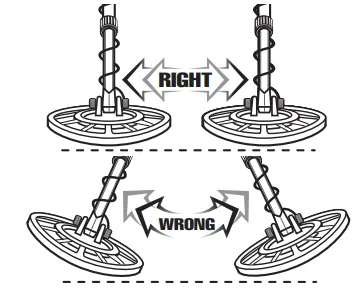
9” WATERPROOF SEARCHCOIL
This detector is equipped with a 9” triangulated elliptical concentric waterproof searchcoil. This lightweight, ruggedly constructed searchcoil can be fully submerged in water. The bottom portion of the pole assembly can also be submerged, but the control housing and the searchcoil cable plug connection into the housing must not be submerged. The weatherproofing on the F22 was designed to allow hunting in inclement weather, but it was not designed to withstand submersion in water.
Accessory searchcoils are also available for purchase; see the back cover or visit www.fisherlab.com. A smaller searchcoil offers more precision and fits into tight spaces. Larger search coils provide more ground coverage on each sweep and penetrate deeper into the ground. Biaxial searchcoils provide better penetration in mineralized soils.
OPERATION and CONTROLS
HOW TO WORK THE CONTROLS
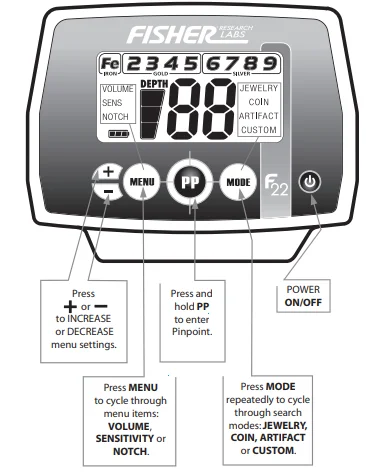
THE DISPLAY
Target Category Icons
Icons will turn from outlined to solid, indicating a detected target. A “blank” position indicates a Notched-out target category.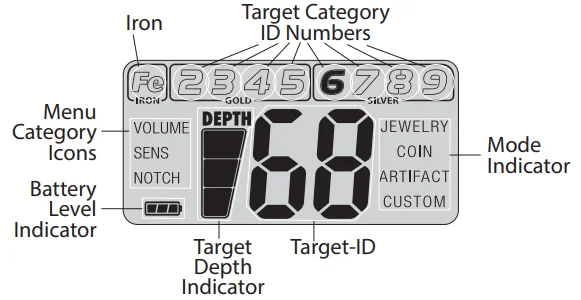
DEPTH INDICATOR
Coin-sized objects will be detected up to 9” deep. The 3-segment graphic indicator is calibrated to coin-sized objects. Objects other than coins will still register on the 3-segment depth scale, but the depth indication will be relative. For example, all 3 segments illuminated could indicate a coin buried 9” deep, but could also be a very large object several feet deep. Use the Depth Indicator in conjunction with the Target Category Icons to gain more information.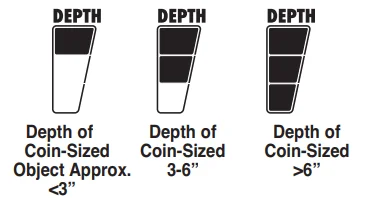
OVERLOAD WARNING
If a metal object or highly magnetic soil is too close to the search coil, the detector will overload, and a “–” will appear on the screen. The detector will make a rapid, repeating mid-tone warning sound. Overload will not harm the detector, but the detector will not function under these conditions. If overload occurs, raise the searchcoil to detect the target from a greater distance or move to a different location.
TREASURE HUNTER’S CODE OF ETHICS:
- Always check Federal, State, County, and local laws before searching.
- Respect private property and do not enter private property without the owner’s permission.
- Take care to refill all holes and leave no damage.
- Remove and dispose of any trash and litter found.
- Appreciate and protect our inheritance of natural resources, wildlife, and private property.
- Act as an ambassador for all treasure hunters; use thoughtfulness, consideration, and courtesy at all times.
- Never destroy historical or archaeological treasures.
- All treasure hunters may be judged by the example you set; always conduct yourself with courtesy and consideration for others.
5-YEAR LIMITED WARRANTY
Register your warranty online for a chance to win a FREE DETECTOR. For details, visit www.fisherlab.com. The F22 metal detector is warranted against defects in materials and workmanship under normal use for five years from the date of purchase to the original owner. Damage due to neglect, accidental damage, or misuse of this product is not covered under this warranty. Decisions regarding abuse or misuse of the F22 metal detector are made solely at the discretion of the manufacturer.
Proof of Purchase is required to make a claim under this warranty. Liability under this Warranty is limited to replacing or repairing, at our option, the metal detector returned, shipping cost prepaid, to First Texas Products. Shipping cost to First Texas Products is the responsibility of the consumer. To return your detector for service, please first contact First Texas Products for a Return Authorization (RA) Number. Reference the RA number on your package and return the detector within 15 days of calling to:
Fisher Research Labs
1465 Henry Brennan Dr.
El Paso, TX 79936
Phone: 915-225-0333 ext. 118
NOTICE TO CUSTOMERS OUTSIDE THE U.S.A.
This warranty may vary in other countries; check with your distributor for details. Warranty does not cover shipping costs to and from the U.S.A. According to FCC Part 15.21, changes or modifications made to this device not expressly approved by the party responsible for compliance could void the user’s authority to operate this equipment. This device complies with FCC Part 15 Subpart B Section 15.109 Class B.
Copyright © 2015
All rights reserved, including the right to reproduce this book, or parts thereof, in any form. Fisher® is a registered trademark of Fisher Research Labs. www.fisherlab.com.
For More Manuals By Fisher Labs, Visit ManualsLibraryy.
Fisher F22 Weatherproof Metal Detector-FAQs
What is the frequency of the Fisher F22 metal detector?
The Fisher F22 operates at a frequency of 7.69 kHz, making it well-suited for detecting coins, relics, and jewelry. This mid-range frequency offers a good balance between sensitivity to small targets and depth performance on larger objects. It performs well in parks, fields, and light mineralized soil. The F22 also comes equipped with a 9-inch triangulated concentric elliptical search coil, which enhances target separation and accuracy.
Is the Fisher F22 a good metal detector for beginners?
Yes, the Fisher F22 is widely considered a great beginner-friendly metal detector. It features simple controls, preset search modes, numeric target ID, and lightweight construction. Its weatherproof design allows hunting in rain and wet grass without worry. While easy to use, it still offers enough performance for intermediate hobbyists, making it a strong long-term investment for entry-level detectorists.
What is the difference between the Fisher F22 and F44?
The Fisher F44 is a step up from the F22 in terms of features and adjustability. While both operate at 7.69 kHz, the F44 includes manual ground balance, adjustable threshold, and more advanced tuning options, making it better for mineralized soil conditions. The F22 is simpler and preset for ease of use, while the F44 offers greater control and slightly improved performance for experienced users.
How deep can the Fisher F22 detect metal?
The Fisher F22 can typically detect coin-sized objects at depths of 8–10 inches, depending on soil conditions and target size. Larger objects may be detected deeper. Depth performance varies based on ground mineralization, sensitivity settings, and target composition. While it’s not a deep treasure machine for extreme depths, it performs very well for coins, jewelry, and common relic hunting scenarios.
Can the Fisher F22 detect gold, including 24k gold?
Yes, the Fisher F22 can detect gold because gold is a conductive metal. However, detection depends on the gold item’s size and shape. Small flakes or thin chains can be more difficult to detect, while solid rings and heavier jewelry are much easier to locate. The 7.69 kHz frequency is suitable for general gold jewelry hunting but is not specialized for tiny gold prospecting like high-frequency gold detectors.
What metals cannot be detected by the Fisher F22?
All conductive metals can technically be detected, but the F22 may struggle with extremely small, thin, or deeply buried objects. Very low-conductivity or microscopic pieces may produce weak signals. Additionally, items heavily masked by iron trash can be harder to identify. The detector’s discrimination feature allows users to filter out unwanted metals, but no metal detector can detect 100% of targets under all conditions.
Is the Fisher F22 weatherproof?
Yes, the Fisher F22 control housing is weatherproof, meaning it can be used in rain, wet grass, and damp conditions. However, it is not fully waterproof, so the control box should not be submerged in water. The search coil is waterproof and can be submerged in shallow water, making it suitable for creek edges and shoreline detecting.
How much should I pay for a metal detector like the Fisher F22?
Metal detectors range widely in price, but beginner-to-mid-level machines like the Fisher F22 typically fall within the $200–$400 range, depending on bundles and accessories. In general, most hobbyists find strong performance between $350 and $800 for mid-range detectors. The F22 offers solid value for its price, especially for coin and jewelry hunters who want reliable performance without advanced complexity.
What are the top metal detector brands besides Fisher?
Some of the most respected metal detector brands include Garrett, Minelab, XP, Nokta Makro, and Fisher Research Labs. These companies produce detectors ranging from beginner models to professional-grade machines for gold prospecting and deep treasure hunting. Fisher is known for reliable, lightweight, and user-friendly detectors, while brands like Minelab often specialize in advanced multi-frequency technology.
Does the Fisher F22 have target ID and discrimination features?
Yes, the Fisher F22 includes a numeric Target ID system (0–99) that helps identify probable metal types before digging. It also features adjustable discrimination, allowing users to filter out unwanted metals like iron trash. The visual ID is paired with tone alerts, making it easier to distinguish coins, jewelry, and relics. This combination improves digging accuracy and saves time, especially in trash-heavy areas like parks and old home sites.