
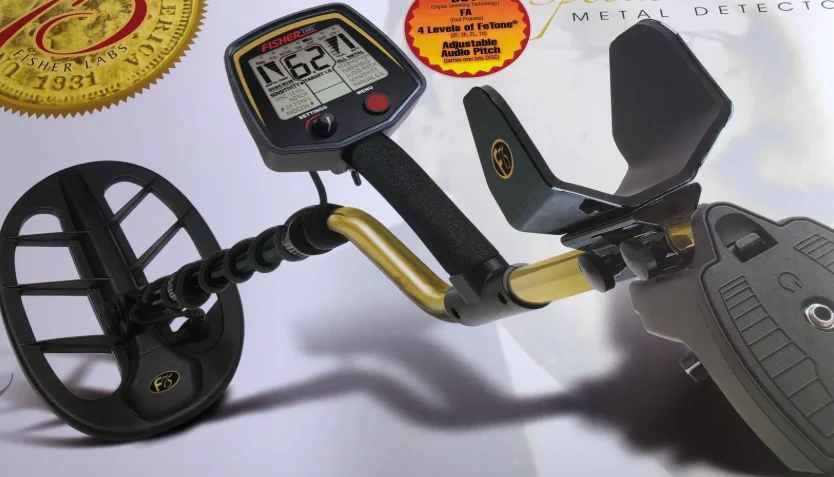

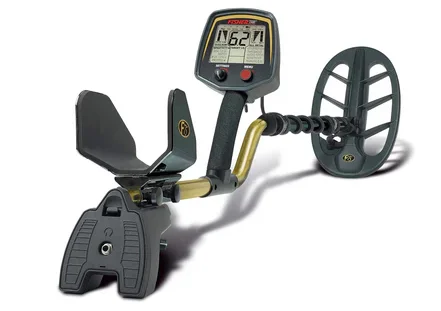
Fisher F75 Multi-Purpose Metal Detector
ACCESSORIES
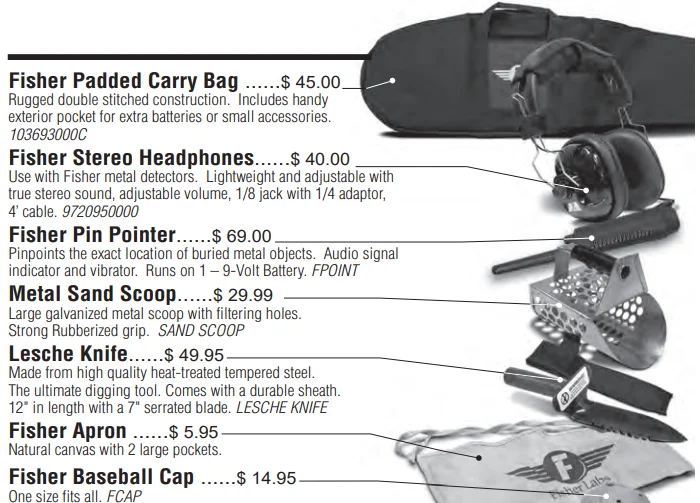
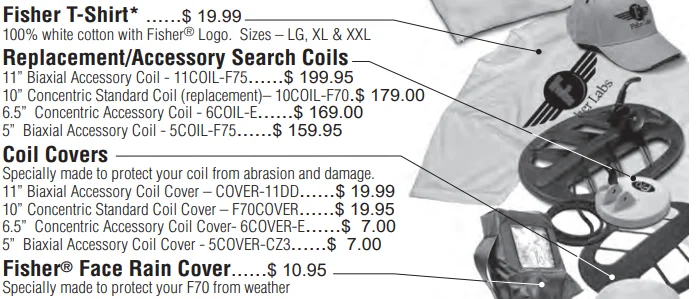
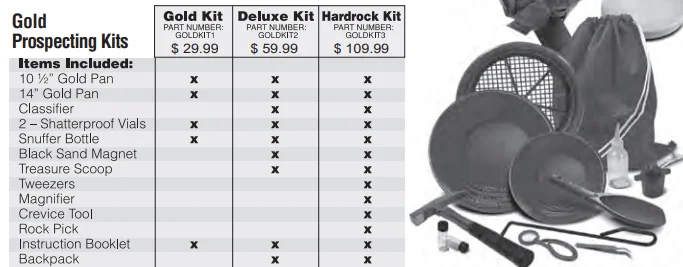
FOR COMPLETE DETAILS VISIT WWW.FISHERLAB.COM ,1-800-685-5050
PRODUCT FEATURES
- Lightweight and well-balanced: best ergonomically engineered detector in the industry.
- Intuitive menu-driven user interface
- Large LCD screen
- Visual indicators of important values such as:
- Target Identification
- Target Confidence
- Target Depth (both running-depth and pinpoint-depth)
- Ground Mineralization
- Multiple Search Modes:
- Discrimination
- Static All-Metal
- Motion All-Metal
- Trigger-actuated FASTGRAB™ ground balancing with manual override
- Waterproof 11-inch open-frame BiAxial™ searchcoil
- Housing constructed of a carbon fiber-polycarbonate blend
- Trigger-actuated target pinpointing with variable audio pitch
- Fully adjustable armrest
- Display backlight for night and low-light conditions
- Notch and discrimination controls
- Covers provided for both the control housing and battery box.
- Made in the USA
If you have any questions or need assistance with your metal detector, call 1-915-225-0333 and ask for Fisher Hobby Technical Service.
5-Year Limited Warranty
The F75 metal detector is warranted against defects in materials and workmanship under normal use for five years from the date of purchase to the original owner. Damage due to neglect, accidental damage, or misuse of this product is not covered under this warranty. Decisions regarding abuse or misuse of the detector are made solely at the discretion of the manufacturer.
Proof of purchase is required to make a claim under this warranty. Liability under this warranty is limited to replacing or repairing, at our option, the metal detector returned, shipping cost prepaid, to Fisher Labs. Shipping cost to Fisher Labs is the responsibility of the consumer. To return your detector for service, please first contact Fisher Labs for a Return Authorization (RA) number. Reference the RA number on your package and return the detector within 15 days of calling to:
Fisher Research Labs, Inc.
1465-H Henry Brennan Dr.
El Paso, TX 79936
Phone: 915-225-0333 ext. 118
Fax: 915-225-0336
Warranty coverage does not include the cost of transporting the detector back to an owner who is located outside of the United States of America.
NOTE TO CUSTOMERS OUTSIDE THE U.S.A.
This warranty may vary in other countries; check with your distributor for details. Warranty does not cover shipping costs. According to FCC Part 15.21, changes or modifications made to this device not expressly approved by the party responsible for compliance could void the user’s authority to operate this equipment.
How Metal Detectors Work
Most hobby metal detectors use VLF Induction Balance technology. Here’s how they work. The searchcoil (also called search head or loop) contains two electrical induction coils, which are like antennas. One coil transmits a rapidly alternating magnetic field, illuminating the region surrounding the searchcoil. If metal is present, its electrical conductivity distorts the magnetic field. If iron metal is present, its magnetism also distorts the magnetic field, but differently, allowing the metal detector to distinguish between ferrous and nonferrous metals.
The other coil is a receiving antenna that detects changes in the magnetic field caused by the presence of metal. Electronic circuits amplify this weak signal, analyze it to determine the changes which occur as the searchcoil sweeps over the target, and then convey the information to the user in the form of a visual display or audio tones.
Most modern metal detectors perform many of these tasks in software running on an internal microcomputer. The iron minerals, which are present in most soils, also distort the magnetic field, obscuring the weak signals of small or deep objects. This can cause the object to go undetected or to be misidentified when it is detected. Much of the technology that goes into modern metal detectors is devoted to the task of eliminating the unwanted signals from iron minerals in the soil, while not losing the signals from metal objects.
This device has been designed to operate with the antennas listed below, with a maximum gain of 3 dB. Antennas not included in this list or having a gain greater than 3 dB are strictly prohibited for use with this device. The required antenna impedance is 53 ohms. 10COIL-F70, 11COIL-F75, 5COIL-F75, 6COIL-E.
The following statement is not relevant to metal detectors but is printed here to satisfy legal notification requirements: “To reduce potential radio interference to other users, the antenna type and its gain should be so chosen that the equivalent isotropically radiated power (e.i.r.p.) is not more than that permitted for successful communication.” The following countries allow free movement of this product within the European Community: FIN, LVA, SVN, SUI, BIH.
Specifications
- Mechanical: S-rod with electronics housing mounted on handgrip, 3-piece breakdown, batteries under elbow, 2-way armrest adjustment — forward/backward & around forearm.
- Searchcoil: 11” (28 cm) open-frame elliptical double-D, waterproof.
- Batteries: 4 AA, alkaline (not included).
- Weight: 3.5 pounds (1.6 kg) with alkaline batteries installed.
- Static Balance: force in vertical plane normal to elbow 0.47 pounds (0.22 kg). Varies with adjustment and the user’s stance and arm/hand physiology.
- Dynamic Balance: axial moment, 0.29 foot-pounds (0.39 newton-meters). Varies with adjustment and the user’s stance and arm/hand physiology.
- Sweep Effort: lateral moment 5.2 foot-pounds (7.1 newton-meters).
- Operating Principle: VLF induction balance
- Operating Frequency: nominal 13 kHz, quartz crystal timing reference 13158Hz, 13100Hz, 13043Hz, 12987Hz, 12931Hz, 12876Hz, 12821Hz
- Basic Sensitivity: 6 x 10 9 root Hertz (detectivity)
- Lag Coefficient: 78 milliseconds
- Reactive Overload: approximately 10,000 micro-cgs units (volume susceptibility), 40,000 micro-cgs units with sensitivity < 30.
- Resistive Overload: approximately 1,200 micro-cgs units (volume susceptibility), 4,800 micro-cgs units with sensitivity < 30.
- Ground Balancing Range: from ferrite to salt, inclusive
- Discrimination Ground Suppression: a combination of the second- and third-order methods
- ID Ground Suppression: third order
- Battery Life: typically 40 hours with high-quality alkaline batteries; estimated 80 hours with nickel oxyhydroxide batteries; estimated 65 hours with lithium iron disulfide batteries
- Operating Temp Range: 4 to +122 degrees F (-20 to +50 degrees C)
- Operating Humidity Range: 0-90% non-condensing
Introduction to the Fisher F75
HIGH PERFORMANCE
The F75 is a multi-purpose, high-performance computerized metal detector. It has the high sensitivity and ground balancing control needed for professional gold prospecting, the discrimination responsiveness needed for serious relic hunting under difficult conditions, and visual target ID considered essential in searching for coins. The F75 operates at 13 kHz for good sensitivity to gold nuggets and jewelry as well as to coins. The F75 comes with an 11-inch elliptical Bi-Axial searchcoil for maximum detection depth in mineralized soils.
USER COMFORT
The F75 is among the lightest and best-balanced of all high-performance metal detectors, so you can hold and swing it almost effortlessly. The armrest position is adjustable to fit your arm. The grip is durable, high-friction foam elastomer, and comfortable in any kind of weather. The controls are conveniently located and easy to learn how to use. Locking collars on the tubes eliminate rattling.
EASY-TO-USE & INFORMATIVE INTERFACE
The entire menu is always visible on the LCD. The LCD indicates the electrical signature (target I.D.) of the detected metal object. The display provides continuous information on battery condition and on ground mineralization, which affects detection depth. Help messages are automatically displayed at the bottom of the display when necessary.
LOW OPERATING COST
The F75 is powered by four AA alkaline batteries, which will typically last for more than 40 hours of use before needing replacement.
DESIGNED BY MANY OF THE INDUSTRY’S MOST TALENTED ENGINEERS
The lead engineers on the F75 design team were John Gardiner and David Johnson. David Johnson’s previous Fisher design credits include the CZ-platform, the Gold Bug series, most of the 1200-series, Impulse Underwater Detector, CZ-20 Underwater Detector, FX3 magnetometer, the Gemini 2-box locator, the XLT-16 Acoustical Leak Detector, and the XLG-80 Ultrasonic Leak Detector. John and David were supported by fellow electrical engineers Jorge Corral and Mark Krieger. The mechanical design was a collaboration among David Johnson, Brad Fulghum, John Griffin, and Tom Walsh.
MECHANICAL ENGINEERING
While the F75 is robustly engineered for outdoor use, it is not indestructible, and it is not waterproof.
RESET function
The F75’s microprocessor saves all settings that you input, even after the power is turned off. If you wish to reset the settings to the factory preset, follow this process:
- Turn the detector off.
- Press and hold the red MENU button and push forward and hold the TOGGLE SWITCH.
- Turn the detector on while you are still holding the controls.
- Release the MENU button and TOGGLE SWITCH.
- See the F symbol. When the F disappears, the detector is reset.
Controls
Detecting Activities
Coinshooting
Coinshooting is searching for coins, usually in places like parks, schoolyards, church lawns, and people’s yards. In most places where coins are likely to be found, there is also a lot of aluminum trash like pull-tabs and bottle caps, as well as steel bottle caps, and often nails. Sometimes there is jewelry present. You will usually search using discrimination to get rid of the iron and the aluminum trash, even though this mode will cause you to miss some of the jewelry.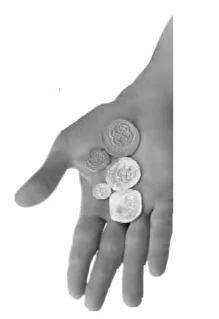
Much coinshooting is done in lawn areas, where digging holes would cause damage to the grass. We recommend the use of an accessory hand-held pinpointer in such cases. Recovering targets is usually done by first accurately pinpointing the target, then carefully cutting a slit in the turf with a knife and tamping it firmly when you are finished. In these situations, you cannot recover deep targets for fear of damaging the turf, so you can cut down on nuisance signals by reducing the sensitivity.
When searching on private property, first get the permission of the property owner. Most of the public places where one is likely to do coinshooting are city, county, or school district property. There is usually no ordinance prohibiting the use of a metal detector as long as you are not causing damage. Sometimes such ordinances do exist.
Administrators and security personnel often have the legal authority to prohibit any activity they do not like, even if there is no ordinance against it. If there is a metal detecting club in your area, someone will usually know what areas can and cannot be searched. If you are ever in doubt about hunting an area, then ask before hunting.
Be prepared to always put your best foot forward when using a metal detector in a public place. Pick up any trash you recover; put it in a pouch or pocketed apron. This way, you can explain that you are performing a public service by helping keep the place free of trash, especially pieces of metal or glass that could endanger a child at play.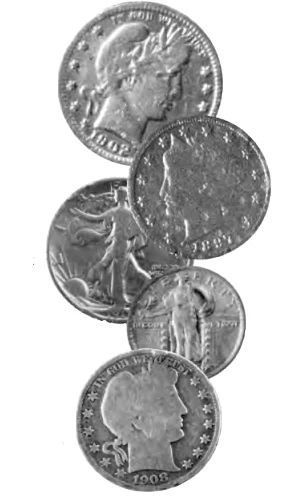
Be proficient at recovering targets without causing damage to the lawn. Explain that whenever you find jewelry that has personal identification marks, such as a class ring, you make an attempt to determine the owner and to return it. When someone who questions what you are doing understands that you are causing no damage and are actually performing a public service, you will usually be welcome.
Relic Hunting
Relic hunting is searching for historical artifacts. The most common desired objects are battlefield debris, coins, jewelry, harness hardware, metal buttons, trade tokens, metal toys, household items, and tools used by workmen and tradespeople. The most common unwanted metal is iron (nails, fence wire, rusted cans, etc.), but some iron and steel objects, such as weapons, may be valuable. If you are at a site where you may encounter unexploded ordnance, use caution.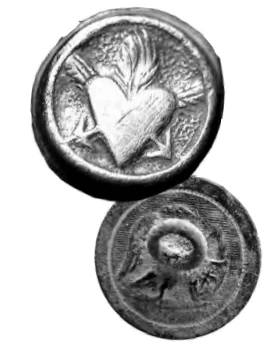
Most relic hunting locations are in fields, forested areas, and vacant lots where digging holes will not damage turf grass, so having a detector with good depth sensitivity is important. Some places are so littered with iron that it is necessary to discriminate against iron in order to be able to search, even though you may miss some potentially valuable artifacts.
Before you go relic hunting, obtain permission from the property owner. If you intend to hunt on public land, check first with the administrator to make sure it’s not illegal. Certain kinds of sites, on both public and private land, are protected by law from relic hunting. If there is a metal detecting club in your area, some of the members will probably know what the laws are in that area and which sites are, and are not, off limits.
Relic hunting is most rewarding if you have an avid interest in history. In many cases, the value of a relic is not the object itself, but the story it’s a part of — what historians call context and archeologists call provenance. A few pieces of rusty metal can tell the story of life in a specific place, or that of a specific family or person from hundreds of years ago. They can capture our imagination and help to give context to our lives today.
The value and context of a find can be readily lost without proper documentation and storage. Add finds to your collection with care. Take the trouble to understand the site you are searching and keep track of where you find things. Describe exactly how and where items were found. Consider including a sketch of the site with your finds.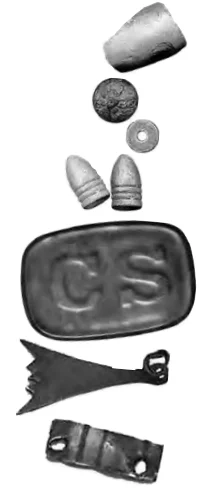
Organization techniques might include storing together all finds from the same site. Alternatively, if you have an interest in specific items, like buttons, make a button collection, and within that collection, document the circumstances surrounding each button found. If your finds are mixed without categorization or documentation, their context will be lost.
The ground balancing and Fe3O4 bar graph features of the F75 can be used to map the soils of a site. In this way, you might determine which areas have been dug, backfilled, or subjected to fire. This information, in turn, helps to reveal the history of the site.
To find promising sites to hunt, conduct research at your local library, look for clues in old newspapers, and seek information on the internet. Where did buildings used to be? Which have since been torn down? Where did people gather for public events like dances and county fairs? Where did train and stage lines run? Where were the swimming holes? In almost every town, there is a historical society and a museum of local history.
Most museums are grateful for anything they can put on display, and when you dig something you cannot identify, the curator can often identify it for you. If you work closely with the local historical society or museum, landowners will be more willing to permit you to search their property.
Some of the most promising sites for relic hunting are places being cleared for development. After the site is built on, whatever is in the ground will become inaccessible. The property owner can often be persuaded that the site should be searched immediately while it is still searchable.
Gold Prospecting
In the United States, gold is found in many places in the western states, Alaska, and in a few localities in the Appalachians. The old saying “Gold is where you find it” means that to find gold, you should look in areas where the yellow metal is known to be present. Hillsides are the best areas for gold prospecting using a metal detector, because hillsides cannot be cleaned out by panning and dredging the way streams can. Also, gold on hillsides, not far from its source vein, tends to be larger and hence more readily detected than alluvial (placer) gold, which tends to get pounded to pieces and worn away as it rolls along the streambed with gravel during floods.
Gold is valuable because it is a scarce commodity. Even in a good gold-producing area, you will often spend an entire day without finding any gold. Meanwhile, you will dig bits and pieces of other metal — birdshot, shells and bullets from hunting and target practice, bits of rusted barbed wire, chips off shovels and other mining tools, rusted tin cans, etc. Hot rocks — rocks containing concentrations of iron oxides that sound like metal when you pass over them — are also a nuisance in many gold areas.
Discrimination is usually ineffective because the loss of sensitivity resulting from discrimination is enough to cause those little nuggets to vanish. If you have gone many hours without finding gold and are wondering if there is something wrong with your metal detector or how you are using it, the most important clue is this: if you are digging tiny pieces of trash metal, then if gold were present, you would have found small gold pieces too!
Assembly
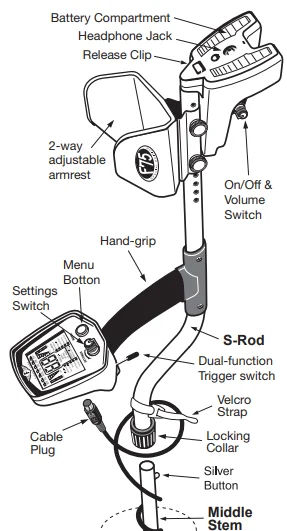
Is easy and requires no tools.
- Position the detector upright.
- Rotate the LOCKING COLLAR fully counterclockwise.
- Insert your finger inside the tube and make sure the INTERNAL CAM LOCK is flush with the inside of the tube.
- Insert the MIDDLE STEM into the S-ROD.
- Rotate the MIDDLE STEM until the SILVER BUTTON is located in the hole.
- Twist the LOCKING COLLAR fully in the clockwise direction until it locks.
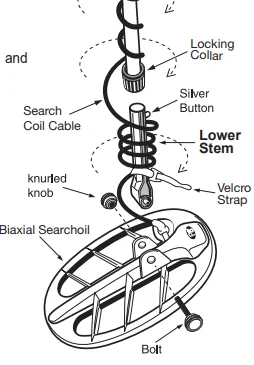
- If your detector has 3 tubes and 2 Locking Collars, repeat this process on the Lower Stem.
- Position the Lower Stem with the Silver Button toward the back. Using the Bolt, Single Rubber Washer, and Knurled Knob, attach the Searchcoil to the Lower Stem.
- Adjust the Lower Stem to a length that lets you maintain a comfortable upright posture, with your arm relaxed at your side and the Searchcoil parallel to the ground in front of you.
- Wind the Cable securely around the Stems. A loose or moving Cable can cause false signals.


For More Manuals By Fisher Labs, Visit ManualsLibraryy.
Fisher F75 Multi-Purpose Metal Detector-FAQs
Is the Fisher F75 metal detector any good?
Yes, the Fisher F75 is widely regarded as a high-performance metal detector suitable for serious hobbyists and professionals. It’s known for its fast target recovery speed, excellent depth, and strong performance in mineralized soil. The detector is lightweight, well-balanced, and highly sensitive, making it effective for coin shooting, relic hunting, and general treasure detection. Its reputation comes from consistent real-world performance rather than gimmicks.
What is the Fisher F75 metal detector used for?
The Fisher F75 is a multi-purpose metal detector designed for coin hunting, relic hunting, jewelry detection, and general treasure searching. It performs well in parks, fields, forests, and moderately mineralized ground. Thanks to advanced discrimination and ground balance controls, it can identify valuable targets while reducing trash signals, making it suitable for both beginners who want to grow and experienced detectorists.
What is the difference between Fisher F75 and F75+?
The main difference is that the F75+ includes an extra 5-inch search coil in addition to the standard 11-inch DD coil. This smaller coil improves target separation in trashy or iron-heavy areas, making it easier to isolate valuable finds. Performance, electronics, and core detection capabilities remain the same between the two models.
What’s the difference between the F75, F75+, and F75 Limited?
All models share the same core platform, but features vary. The F75 is the standard model. The F75+ adds a 5-inch coil for better separation. The F75 Limited (F75 LTD) includes additional Boost Mode for increased detection depth and Cache Locating Mode for large, deeply buried objects. These extra modes make the LTD version more suitable for advanced relic and deep-target hunters.
Is the Fisher F75 waterproof?
The search coil is waterproof, allowing use in wet grass, shallow water, and muddy conditions. However, the control box is not waterproof, so it should not be submerged or exposed to heavy rain without protection. This makes the F75 suitable for damp environments but not for full underwater detecting.
How deep can the Fisher F75 detect objects?
Depth depends on target size, soil conditions, and settings, but the Fisher F75 can typically detect coin-sized objects up to 10–15 inches deep under favorable conditions. Larger objects can be detected at even greater depths. The F75 LTD’s Boost Mode can provide additional depth in low-trash environments.
Can the Fisher F75 detect gold?
Yes, the Fisher F75 can detect gold, including gold jewelry and larger natural gold pieces. While it is not a dedicated gold-only detector, its high sensitivity and adjustable discrimination allow it to respond well to small, low-conductive targets. Performance is best in mild to moderately mineralized ground.
Does rain or wet ground affect the Fisher F75?
Wet ground generally improves detection depth, and light rain will not affect performance as long as the control box is protected. Many detectorists prefer searching after rainfall because moisture enhances conductivity. However, prolonged exposure to rain without a cover can damage the electronics.
Is the Fisher F75 suitable for beach detecting?
The Fisher F75 can be used on dry sand and lightly wet sand, but it is not optimized for saltwater beaches. Salt mineralization can cause instability unless carefully tuned. For frequent saltwater beach detecting, a dedicated multi-frequency or fully waterproof detector may perform better.
Who should buy the Fisher F75 metal detector?
The Fisher F75 is ideal for serious hobbyists, relic hunters, and experienced detectorists who want speed, depth, and customization. Beginners can also use it, but the advanced settings may require a learning curve. It’s best suited for users who want long-term performance rather than entry-level simplicity.