
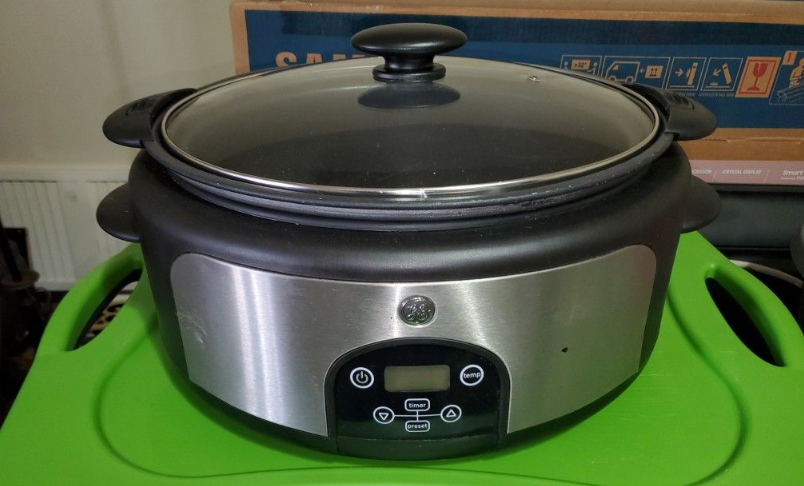

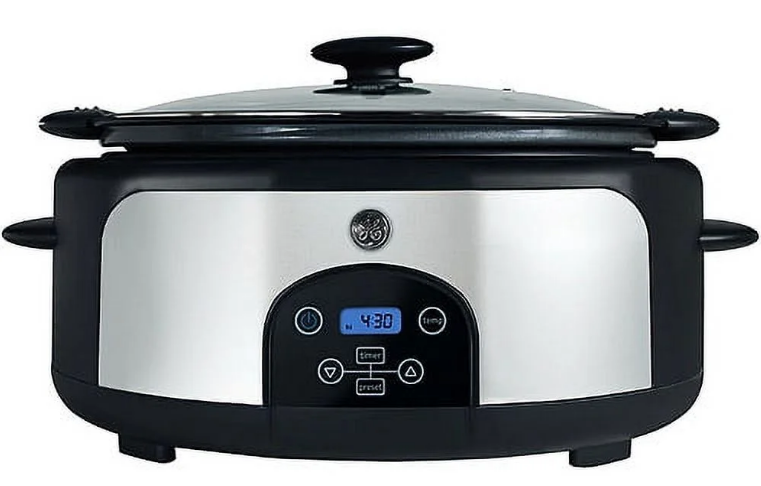
GE 169143 Digital Slow Cooker
IMPORTANT SAFEGUARDS
When using electrical appliances, basic safety precautions should always be followed to prevent the risk of fire, electric shock, burns, or other injuries or damages.
- Read all instructions before use.
- Do not touch hot surfaces. Use handles or knobs. Always use pot holders when removing the glass lid, ceramic pot or moving the base unit.
- To protect against electrical shock, do not immerse the cord, plugs, or the base unit in water or other liquids.
- Close supervision is necessary when any appliance is used by or near children.
- Unplug from the outlet when not in use and before cleaning. Allow it to cool before putting on or taking off parts.
- Do not operate the appliance with a damaged cord or plug, or after the appliance malfunctions or has been dropped or damaged in any manner. Call our toll-free customer assistance number for information on examination, repair, or adjustment.
- The use of accessory attachments not recommended by the appliance manufacturer may cause injuries.
- Do not use outdoors or in a damp area.
- Do not let the cord hang over the edge of the table or counter, or touch hot surfaces.
- Do not place on or near a hot gas or electric burner, or in a heated oven.
- Extreme caution must be used when moving an appliance containing hot oil or other hot liquids. Do not move during the operation.
- To disconnect, turn every control to “off”, then remove the plug from the wall outlet.
- Do not use this appliance for anything other than its intended use.
- Always leave the glass lid on the slow cooker when cooking.
- To avoid damage or electrical shock, do not fill any liquids into the base unit. Never use the appliance without the ceramic pot.
- The supplied ceramic pot is only suitable for use with the base unit. Do not set the hot ceramic pot on a non-heat-resistant surface. The surface may be damaged.
- This appliance has a non-metallic pot. Avoid sudden temperature changes, such as adding refrigerated foods into a heated pot.
- This product is for household use only.
SAVE THESE INSTRUCTIONS!
PARTS
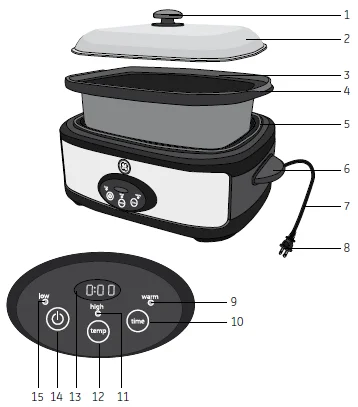
- Knob
- Glass lid
- Ceramic pot
- Ceramic pot handle
- Base unit
- Base unit handle
- Power cord
- Polarized plug
- Warm indicator
- Time button
- High indicator
- Temp button
- Display
- Power button
- Low indicator
ILLUSTRATIONS
OPERATION
Before first use
- Unpack the slow cooker and remove all packaging material. Carefully unpack the ceramic pot (3).
- Clean the glass lid (2), ceramic pot (3) and base unit (5) ( Cleaning).
NOTE: For the first use, fill the ceramic pot (3) with 3 cups of water and run the slow cooker for 30 minutes. Due to the manufacturing process, the slow cooker may emit a slight odour during first use.
Assembly
- Place the base unit (5) on a stable and dry surface.
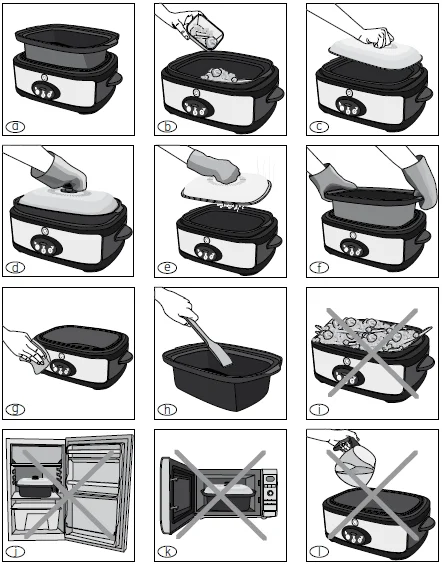
- Put the ceramic pot (3) into the base unit (5) (ill. a ).
- Fill food into the ceramic pot (3) (ill. b ) and cover with the glass lid (2) (ill. c ).
Operating instructions
The slow cooker is intended for cooking food at low temperatures for a long time. If the temperature is set too high, the slow cooker works like a pot on a burner. Do not leave the slow cooker unattended while heating.
- Prepare a recipe suitable for slow cooking.
- Place the prepared food in the ceramic pot (3) (ill. b ) ( Tips & Tricks).
- Do not fill the ceramic pot (3) to the brim (ill. i ).
- Connect the power plug (8) to an energised wall outlet. The display (13) flashes —-.
- Setting the temperature: Press temp (12) repeatedly to choose the desired cook setting.

- Setting the cooking time: Press time (10) repeatedly to increase the cooking time in 30-minute steps. The cooking time can be set from 30 minutes to 8 hours.
- Press the power button (14) to start cooking. The display (13) shows a countdown of the programmed cooking time. The indicator light for the selected setting (low (15) or high (11)) lights up.
- Do not lift the glass lid (2) during the cooking process. If steam escapes, the cooking time increases. Always grasp the glass lid with pot holders using the knob (1) (ill. d ).
- After the programmed cooking time is finished, the slow cooker will automatically switch to standby mode for 10 minutes. The display (13) shows the countdown timer starting with 10 minutes, and the indicator light (9) flashes.
- When the countdown timer reaches 0:00, the slow cooker will switch to warm mode. The initial warming time of 8 hours is shown on the display (13). The indicator light warm (9) is continuously displayed.
- Press the power button (14) to stop the cooking process at any time. The slow cooker will switch to standby mode. The display (13) flashes —-.
- Disconnect the slow cooker from the wall outlet.
- After the cooking process is finished, use pot holders to grasp the ceramic pot handles (4) to remove the ceramic pot (3) from the base unit (5) (ill. f ).
- Wait for the slow cooker to cool down before grasping the base unit handles (6) with pot holders.
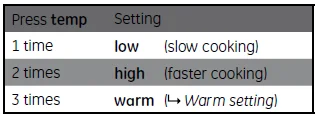
NOTE: Cooking time may differ due to factors like room temperature or the amount of food in the ceramic pot. The cooking time can be adjusted at any time.
CAUTION: When lifting the glass lid (2), hot steam may cause serious injuries. Always lift the glass lid in a way that the steam is diverted away from you. Let the condensed hot water drip into the pot (ill. e ).
WARNING: Do not fill liquids or food into the base unit (5) (ill. l ).
Warm setting
Use the warm setting to keep food warm for up to 8 hours.
- Press temp (12) to select the warm mode. The indicator light (9) lights up. Press time (10) to set the desired time the food should be kept warm.
- Put cooked food into the ceramic pot (3). Place the ceramic pot into the base unit.
- Press the power button (14) to start warm mode. The slow cooker will keep the food warm for the selected time.
- Press the power button (14) to stop warm mode.
Notes on the ceramic pot
- Only fill the warm food into the ceramic pot (3) when it is at room temperature. The ceramic pot (3) may be damaged if the temperature changes rapidly.
- Ceramic is a material sensitive to temperature changes. Never let the temperature in the pot rise or fall rapidly. This will result in the pot being damaged or destroyed.
- Do not put the pot in a refrigerator to store food. Reheating a cold pot may damage or destroy your appliance (ill. j ).
- Do not place hot food in the pot when it is cold or cold food when the pot is hot.
- Do not put the pot under cold water if still hot.
- Do not hit the pot against hard surfaces or faucets.
- Do not use the pot if it is chipped, cracked or otherwise damaged.
- Do not put the pot or lid into a microwave oven (ill. k ).
TIPS & TRICKS
- During slow cooking, liquids do not boil away. Begin with a small amount of liquid and add more during the cooking process when needed. If there is too much liquid at the end of the cooking process, set the slow cooker to high. Cook on this setting to reduce the liquid.
- For better flavour, do not crush or grind herbs and spices.
- If cooking on a low setting, some recipes may require 8 hours.
- Meats with a high percentage of fat can influence the flavour of the dish. Browning or pre-cooking can reduce the fat.
- Cut food into smaller pieces. They will cook faster than food left whole.
- Some vegetables require a longer cooking time. Place vegetables like potatoes, carrots or beets on the bottom of the ceramic pot. Cover with liquid.
- Add pre-cooked rice or pasta only at the end of the cooking process.
CLEANING
Clean the slow cooker after every use. This appliance contains no user-serviceable parts and requires little maintenance. Leave any servicing or repairs to qualified personnel.
- Always let the base unit (5), ceramic pot (3) and glass lid (2) cool down completely before cleaning.
- The ceramic pot (3) and the glass lid (2) can be hand-washed with warm and soapy water or cleaned in a dishwasher.
- Should food stick to the surface of the ceramic pot (3), fill the pot with warm soapy water and let it soak before cleaning. Use a sponge or rubber scraper to remove sticky food remains (ill. h ).
- Do not use scouring pads or abrasive cleaners. As they might damage the surface of the ceramic pot (3) or scratch the surface of the glass lid (2).
- Use a soft, damp cloth to wipe the inside and outer parts of the base unit (5) (ill. g ).
DANGER: Do not immerse the base unit (5), power cord (7) or power plug (8) in water or other liquids.
TROUBLESHOOTING
Slow cooker not working.
Check the power connection. The power plug (8) should be inserted properly in the outlet.
Slow cooker not heating.
Check if the slow cooker is in standby mode. Press the power button (14) to activate the slow cooker.
If additional assistance is needed, please contact our Customer Assistance at 1.877.207.0923 (U.S.) or 1.877.556.0973 (Canada).
TECHNICAL DATA
- Rated voltage: 120V ~60Hz
- Rated current: 3A
- Rated power input: 260W
For more Manuals by General Electric, visit ManualsLibraryy
GE 169143 Digital Slow Cooker-FAQs
What is the GE 169143 Digital Slow Cooker?
The GE 169143 Digital Slow Cooker is a programmable slow cooker designed for convenient, hands-off cooking with digital controls, multiple heat settings, and a removable cooking pot.
Is a 6.5-litre slow cooker large enough for families?
Yes. A 6.5-litre capacity comfortably serves 6–8 people, making it ideal for stews, soups, roasts, and batch cooking.
What is the difference between a slow cooker and a crockpot?
A crockpot usually has a ceramic insert with heat around the sides, while many slow cookers heat mainly from the base. Both cook food slowly at low temperatures.
How do you use a digital slow cooker?
Add ingredients, choose Low or High heat, set the cooking time on the digital panel, and let the cooker automatically manage the process.
What size slow cooker is best for two people?
For 1–2 people, a 3–4.5 quart (about 3–4 litres) slow cooker is ideal. Larger sizes are better if you want leftovers.
Can you put raw meat in the GE slow cooker?
Yes. Raw meat can be cooked safely. Browning it first is optional but helps improve flavor and texture.
Can you put frozen food in a slow cooker?
It’s best to thaw frozen meat first. Frozen food takes longer to reach safe temperatures and may affect food safety.
Is 4 hours on High the same as 8 hours on Low?
They reach similar temperatures, but Low cooks more gently over time, while High reaches heat faster.