
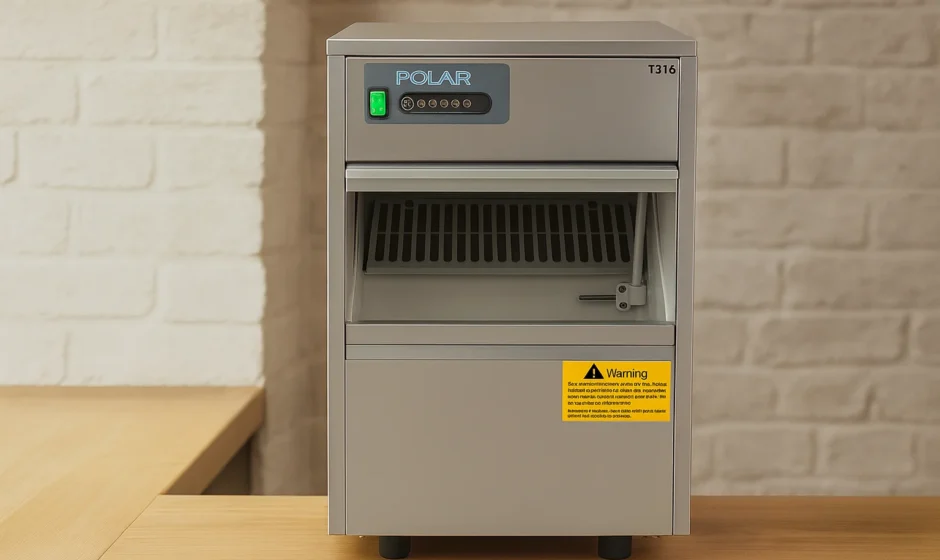

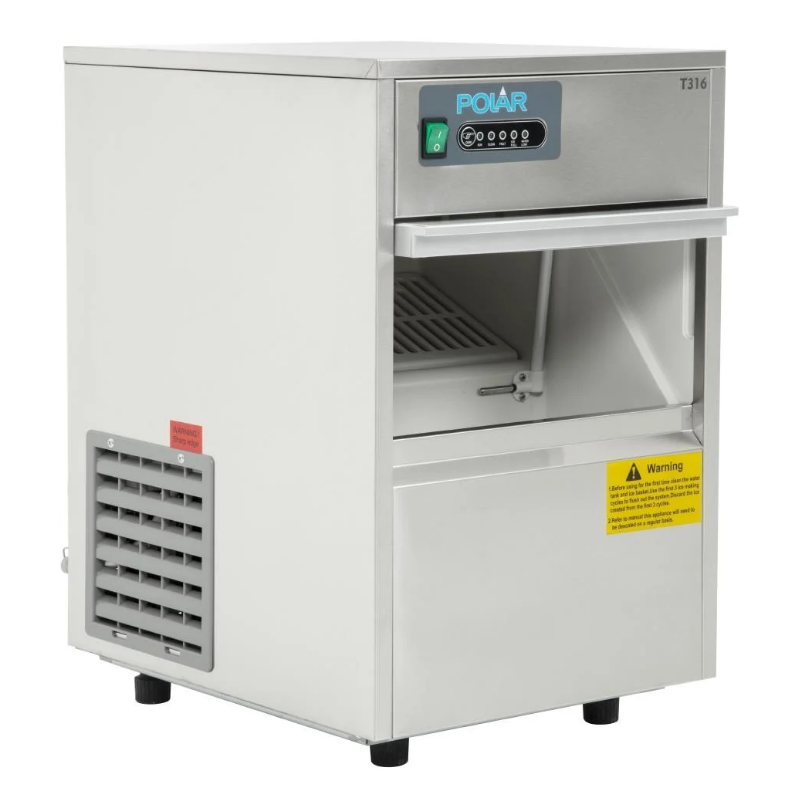
Polar T316 G-Series Countertop Ice Machine
Safety Instructions
When using electrical appliances, basic safety precautions should be followed to reduce the risk of fire, electric shock, and injury to persons or property. Read all instructions before using the appliance.
- Position on a flat, stable surface.
- A service agent/qualified technician should carry out installation and any repairs if required. Do not remove any components or service panels on this product.
- Consult Local and National Standards to comply with the following:
- Health and Safety at Work Legislation
- BS EN Codes of Practice
- Fire Precautions
- IEE Wiring Regulations
- Building Regulations
- DO NOT immerse in water or use steam/jet washers to clean the unit.
- DO NOT cover the appliance when it is operating.
- Always carry, store, and handle the appliance in a vertical position.
- Never tilt the appliance more than 45° from the vertical.
- ONLY use drinking or potable water when making ice cubes.
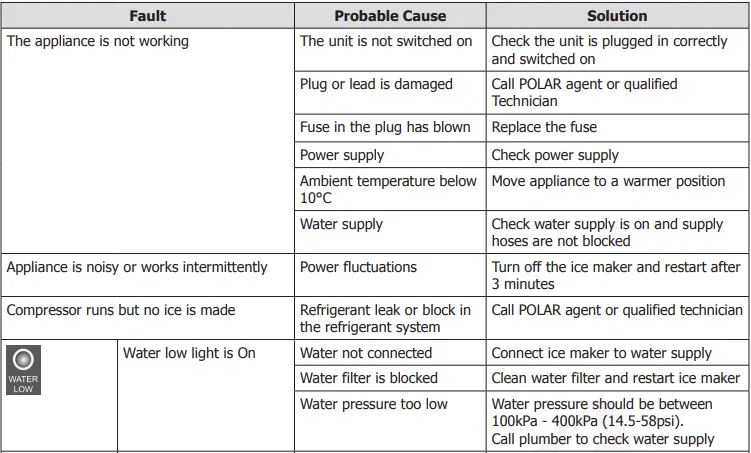
- Ensure the water pressure of the connected water supply is between 100kPa – 400kPa (14.5-58psi).
- For indoor use only.
- Replace any unused water in the tank at least once every 24 hours.
- Keep all packaging away from children. Dispose of the packaging in accordance with the regulations of local authorities.
- This appliance can be used by children aged 8 years and above and persons with reduced physical, sensory, or mental capabilities or lack of experience and knowledge if they have been given supervision or instruction concerning the use of the appliance in a safe way and understand the hazards involved.
- Children shall not play with the appliance.
- Cleaning and user maintenance shall not be made by children without supervision.
- If the power cord is damaged, it must be replaced by a POLAR agent or a recommended qualified technician to avoid a hazard.
- POLAR recommends that this appliance should be periodically tested (at least annually) by a Competent Person. Testing should include, but not be limited to: Visual Inspection, Polarity Test, Earth Continuity, Insulation Continuity, and Functional Testing.
- This appliance is intended to be used in household and similar applications such as:
- staff kitchen areas in shops, offices, and other working environments;
- farm houses;
- by clients in hotels, motels, and other residential-type environments;
- bed and breakfast type environments;
- catering and similar non-retail applications.
- Children aged from 3 to 8 years are allowed to load and unload refrigerating appliances.
- When positioning the appliance, ensure the supply cord is not trapped or damaged.
- WARNING: Do not locate multiple portable socket-outlets or portable power supplies at the rear of the appliance.
- Do not run the power cord under carpeting or other heat insulators. Do not cover the cord. Keep the cord away from traffic areas, and do not submerge it in water.
- Do not clean your ice maker with flammable fluids. The fumes can create a fire hazard or explosion.
- We do not recommend the use of an extension cord, as it may overheat and lead to a risk of fire. Unplug the ice maker before cleaning, making any repairs, or servicing.
- POLAR recommends that this product be connected to a circuit protected by an appropriate RCD (Residual Current Device).
Introduction
Please take a few moments to carefully read through this manual. Correct maintenance and operation of this machine will provide the best possible performance from your POLAR product. The ice maker is designed to make ice cubes and should not be used as a storage unit to preserve foods, drinks, etc.
Pack Contents
The following is included:
- Ice Maker
- Ice scoop
- Inlet/Outlet hoses
- Sealing washers
- Instruction manual
POLAR prides itself on quality and service, ensuring that at the time of packaging, the contents are supplied fully functional and free of damage. Should you find any damage as a result of transit, please contact your POLAR dealer immediately.
Note: Only use the hoses supplied with the appliance. Other hoses are not suitable and should not be used.
Installation
Note: If the unit has not been stored or moved in an upright position, let it stand upright for approximately 12 hours before operation. If in doubt, allow to stand.
- Remove the appliance from the packaging and remove the protective film from all surfaces.
- Remove the scoop, inlet/outlet hoses, and sealing washers from the ice bin.
- To optimize performance and longevity, ensure a minimum clearance of 2.5cm is maintained between the unit and walls and other objects, with a minimum 5cm clearance on the top. NEVER LOCATE NEXT TO A HEAT SOURCE.
- If necessary, adjust the screw legs of the ice maker to make it level. The efficiency of the ice maker can be reduced if the appliance is unevenly located.
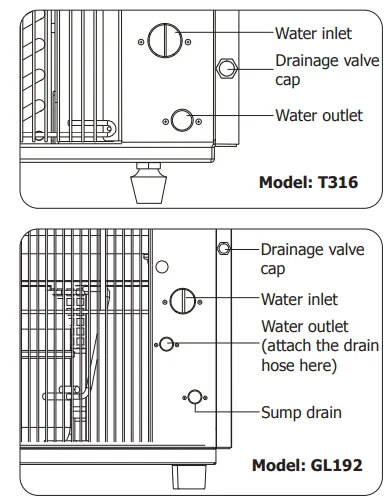
- Connect one end of the corrugated outlet hose to the water outlet on the rear of the ice maker.
- Attach the other end of the hose to a plumbed-in stand, waste pipe, or container suitable for collecting wastewater.
Installing the Drain
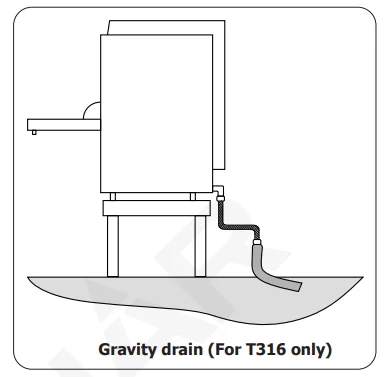
For T316 only:
- Please note: this model drains via gravity – no drain pump supplied. An optional drain pump is required if installing this unit lower than the drain standpipe.
- Ensure the end of the drainage pipe is situated lower than the water outlet valve for efficient drainage.

Installing the Cold Water Feed
Note: The highest temperature for the water to be used: 38°C
- Place the sealing washers on the water inlet at the back of the ice maker and attach one end of the inlet hose.
- Connect the other end of the inlet hose to the water supply.

Operation
Making Ice
Note: Before using for the first time (or after a period of inactivity), clean the water tank, ice basket, and ice basket shelf. Use the first ice-making cycle to flush out the system. Discard the water and ice created from the first cycle.
- Ensure the door is closed fully before use.
- Press the power switch to the On position [I]. The RUN light illuminates, and the appliance begins the ice-making process. Each ice-making cycle takes approximately 25 minutes.
- When the cubes reach the ice sensor, ice production stops. Production resumes once ice has been removed from the bin.
- Press the power switch to the Off position [O] at any time to halt the ice-making process.
Note: Ensure the metal rack is pushed as far forward as possible against the plastic ice curtain to allow ice to fall.
To avoid contamination of ice, please respect the following instructions:
- Opening the door for long periods can cause a significant increase in the temperature in the compartments of the appliance.
- Clean regularly the surfaces that can come in contact with ice and accessible drainage systems.
- Clean water tanks if they have not been used for 48h; flush the water system connected to a water supply if water has not been drawn for 5 days.
- If the refrigerating appliance is left empty for long periods, switch off, defrost, clean, dry, and leave the door open to prevent mould developing within the appliance.
Cleaning, Care & Maintenance
- Always switch off and disconnect the power supply before cleaning.
- Warm, soapy water is recommended for cleaning. Cleaning agents may leave harmful residues. DO NOT wash the base unit; instead, wipe the exterior with a damp cloth.
- A POLAR agent or qualified technician should carry out repairs if required.
- Clean the water filter regularly with a small brush, particularly in hard water areas. The water filter is located just inside the water inlet at the back of the appliance.
- If the ice maker is to be left unused for longer than 24 hours, loosen the drain valve cap and drain the water from the tank.
- The inner removable parts and water tank should be cleaned regularly.
Automatic Cleaning Function
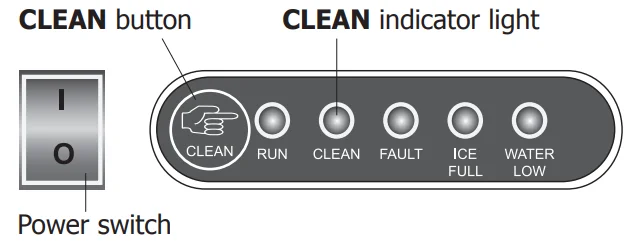
This ice maker features an automatic cleaning function. When the appliance has completed up to 1500 ice-making cycles (roughly after 3 months of routine use), the “CLEAN” indicator light will flash with an audible alarm, indicating the unit needs to be cleaned. It will keep flashing and alarming until auto-cleaning is started, during which ice can still be made.
- Press and hold the “CLEAN” button for 3 seconds. The water box at the top will turn down and up. When it returns to horizontal position, press the power switch to O (OFF position) and unplug the machine. Make sure no water remains in the water box.

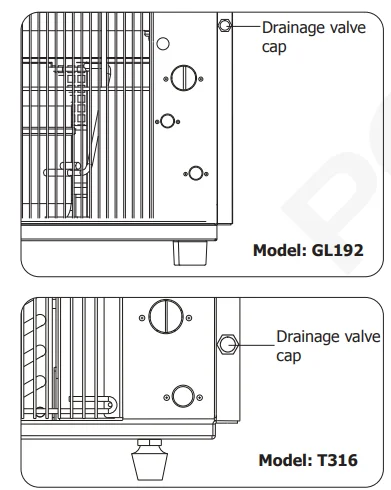
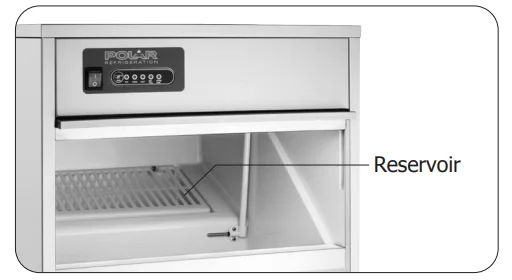
- Unscrew the drainage valve cap at the right lower part of the rear. Let the water drain from the water reservoir thoroughly. Afterwards, relocate the drainage cap and screw it tight.

- Add around 3L of dilute cleaner into the reservoir. Note: Choose an ice maker-specific cleaner and follow the manufacturer’s instructions.

- Plug the unit and press the power switch to I (ON position).
- Press and hold the “CLEAN” button for 3 seconds. The “CLEAN” indicator light turns on. The cleaner in the water reservoir will be pumped into the water box to start cleaning. After about 10 minutes, the water box turns vertical to drop the cleaner. The appliance will repeat the above procedures twice. Then, the “CLEAN” indicator light goes out, indicating auto-cleaning is completed. Note: A cycle takes about 30 minutes.
- Turn the unit off and unplug. Remove the drainage valve cap to empty the water.
Note: After auto-cleaning, use the first 3 ice-making cycles to flush out the system. Discard the water and ice created from these initial cycles.
Notes for Descaling:
In hard water areas, lime scale can build up within the appliance after prolonged use. We suggest installing a water softener before the inlet of water in case the supplied water is hard. The softener could be a mechanical filter. To descale, always choose a suitable descaler and follow the manufacturer’s instructions. POLAR recommends that this appliance be descaled every 3 months or more frequently in hard water areas.
Troubleshooting
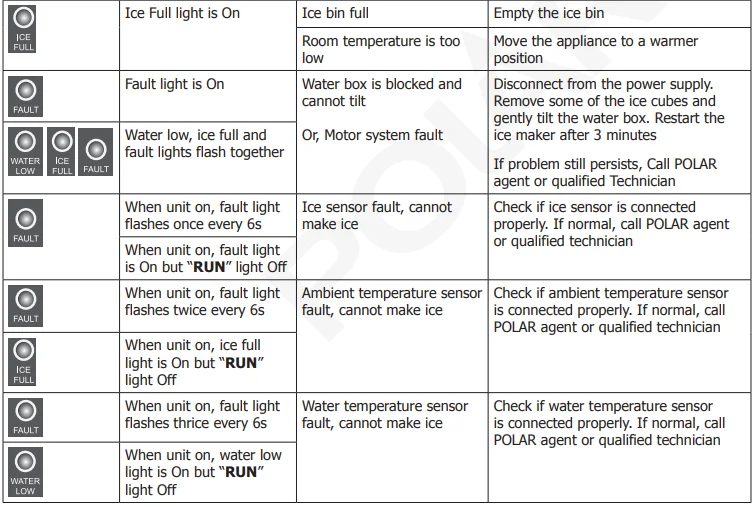
Technical Specifications

Electrical Wiring
POLAR appliances are supplied with a 3-pin BS1363 plug and lead. The plug is to be connected to a suitable mains socket. POLAR appliances are wired as follows:
- Live wire (coloured brown) to the terminal marked L
- Neutral wire (coloured blue) to the terminal marked N
- Earth wire (coloured green/yellow) to the terminal marked E
- This appliance must be earthed.

- If in doubt, consult a qualified electrician. Electrical isolation points must be kept clear of any obstructions. In the event of any emergency disconnection being required, they must be readily accessible.

Disposal
EU regulations require refrigeration products to be disposed of by specialist companies that remove or recycle all gases, metal, and plastic components. Consult your local waste collection authority regarding the disposal of your appliance. Local authorities are not obliged to dispose of commercial refrigeration equipment, but may be able to offer advice on how to dispose of the equipment locally. Alternatively, call the POLAR helpline for details of national disposal companies within the EU.
Compliance
 The WEEE logo on this product or its documentation indicates that the product must not be disposed of as household waste. To help prevent possible harm to human health and/or the environment, the product must be disposed of in an approved and environmentally safe recycling process. For further information on how to dispose of this product correctly, contact the product supplier or the local authority responsible for waste disposal in your area.
 POLAR parts have undergone strict product testing in order to comply with regulatory standards and specifications set by international, independent, and federal authorities. POLAR products have been approved to carry the following symbol:
For More Manuals By Polar Refrigeration, Visit ManualsLibraryy.
Polar T316 G-Series Countertop Ice Machine-FAQs
How do I clean the Polar T316 ice machine?
Empty the unit, then pour about 3 liters of diluted ice-machine cleaner into the reservoir. Switch the machine ON, hold the CLEAN button for 3 seconds, and let the cycle run. Rinse thoroughly afterward.
How do I fill the Polar T316 with water?
Lift the lid, pour water directly into the reservoir, and wait for ice to collect in the internal removable basket.
How do I use the Polar T316 ice machine?
Fill the reservoir, close the lid, switch the unit on, select the desired ice size (if applicable), and let the machine begin its automatic ice-making cycle.
How do I manually reset a countertop ice maker?
Turn the machine OFF for 5–10 seconds, turn it back ON, and hold the RESET button (if present) for about 5 seconds. Some models also require cycling the feeler arm up and down.
Does the Polar T316 have a reset button?
Most countertop units, including the T316, rely on power cycling or a Clean/Reset function instead of a dedicated reset button.
Why is my ice maker not making ice?
Common causes include low water level, clogged filter, blocked water inlet tube, incorrect temperature, or a stuck control arm. Cleaning and refilling the reservoir usually resolves minor issues.
Why is my countertop ice maker not pumping water?
This may happen due to a frozen water line, blocked pump filter, low water level, or a faulty inlet valve. Defrost and clean the unit, then try restarting.
Can I clean the Polar T316 with vinegar or lemon juice?
Yes, mild vinegar or lemon juice can be used for deep cleaning, but ice-machine-specific cleaners are recommended for the best results.