
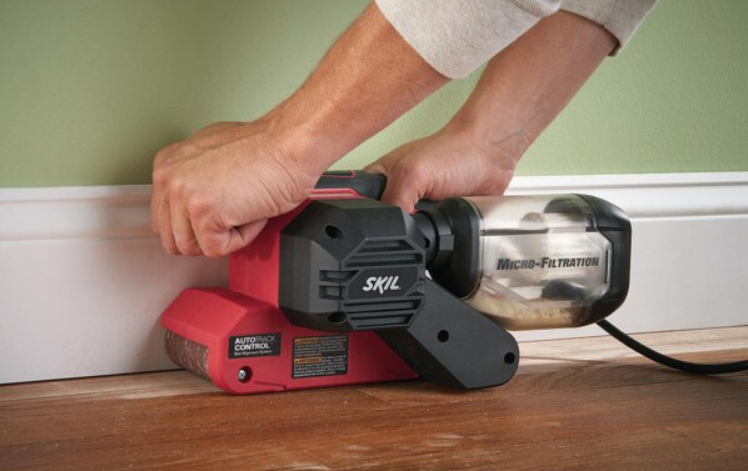

SKIL 7313 Corded Belt Sander

Power Tool Safety Rules
Work Area
- Keep your work area clean and well-lit. Cluttered benches and dark areas invite accidents.
- Do not operate power tools in explosive atmospheres, such as in the presence of flammable liquids, gases, or dust. Power tools create sparks, which may ignite the dust or fumes.
- Keep bystanders, children, and visitors away while operating a power tool. Distractions can cause you to lose control.
Electrical Safety
- Double-insulated tools are equipped with a polarized plug (one blade is wider than the other). This plug will fit in a polarized outlet only one way. If the plug does not fit fully in the outlet, reverse the plug. If it still does not fit, contact a qualified electrician to install a polarized outlet. Do not change the plug in any way. Double Insulation
 eliminates the need for the three-wire grounded power cord and grounded power supply system.
 - Before plugging in the tool, be certain the outlet voltage supplied is within the voltage marked on the nameplate. Do not use “AC only” rated tools with a DC power supply.
- Avoid body contact with grounded surfaces such as pipes, radiators, ranges, and refrigerators. There is an increased risk of electric shock if your body is grounded. If operating the power tool in damp locations is unavoidable, a Ground Fault Circuit Interrupter must be used to supply the power to your tool. Electrician’s rubber gloves and footwear will further enhance your personal safety.
- Do not expose power tools to rain or wet conditions. Water entering a power tool will increase the risk of electric shock.
- Do not abuse the cord. Never use the cord to carry the tools or pull the plug from an outlet. Keep the cord away from heat, oil, sharp edges, or moving parts. Replace damaged cords immediately. Damaged cords increase the risk of electric shock.
- When operating a power tool outside, use an outdoor extension cord marked “W-A” or “W.” These cords are rated for outdoor use and reduce the risk of electric shock. Refer to “Recommended sizes of Extension Cords” in the Accessory section of this manual.
 eliminates the need for the three-wire grounded power cord and grounded power supply system.
Personal Safety
- Stay alert, watch what you are doing, and use common sense when operating a power tool. Do not use the tool while tired or under the influence of drugs, alcohol, or medication. A moment of inattention while operating power tools may result in serious personal injury.
- Dress properly. Do not wear loose clothing or jewelry. Contain long hair. Keep your hair, clothing, and gloves away from moving parts. Loose clothes, jewelry, or long hair can be caught in moving parts. Keep handles dry, clean, and free from oil and grease.
- Avoid accidental starting. Be sure the switch is “OFF” before plugging in. Carrying tools with your finger on the switch or plugging in tools that have the switch “ON” invites accidents.
- Remove adjusting keys or wrenches before turning the tool “ON”. A wrench or a key that is left attached to a rotating part of the tool may result in personal injury.
- Do not overreach. Keep proper footing and balance at all times. Proper footing and balance enable better control of the tool in unexpected situations.
- Use safety equipment. Always wear eye protection. Dust masks, non-skid safety shoes, hard hats, or hearing protection must be used for appropriate conditions.
Tool Use and Care
- Use clamps or other practical ways to secure and support the workpiece on a stable platform. Holding the work by hand or against your body is unstable and may lead to loss of control.
- Do not force the tool. Use the correct tool for your application. The correct tool will do the job better and safer at the rate for which it is designed.
- Do not use the tool if the switch does not turn it “ON” or “OFF”. Any tool that cannot be controlled with the switch is dangerous and must be repaired.
- Disconnect the plug from the power source before making any adjustments, changing accessories, or storing the tool. Such preventive safety measures reduce the risk of starting the tool accidentally.
- Store idle tools out of reach of children and other untrained persons. Tools are dangerous in the hands of untrained users.
- Maintain tools with care. Keep cutting tools sharp and clean. Properly maintained tools, with sharp cutting edges, are less likely to bind and are easier to control. Any alteration or modification is a misuse and may result in a dangerous condition.
- Check for misalignment or binding of moving parts, breakage of parts, and any other condition that may affect the tool’s operation. If damaged, have the tool serviced before using. Many accidents are caused by poorly maintained tools. Develop a periodic maintenance schedule for your tool.
- Use only accessories that are recommended by the manufacturer for your model. Accessories that may be suitable for one tool may become hazardous when used on another tool.
Service
- Tool service must be performed only by qualified repair personnel. Service or maintenance performed by unqualified personnel could result in a risk of injury. For example, internal wires may be misplaced or pinched, and safety guard return springs may be improperly mounted.
- When servicing a tool, use only identical replacement parts. Follow instructions in the Maintenance section of this manual. Use of unauthorized parts or failure to follow Maintenance Instructions may create a risk of electric shock or injury. Certain cleaning agents, such as gasoline, carbon tetrachloride, ammonia, etc., may damage plastic parts.
Belt Sander Safety Rules
- Hold the tool by its insulated gripping surfaces when performing an operation where the cutting tool may contact hidden wiring or its own cord. Contact with a “live” wire will make exposed metal parts of the tool “live” and shock the operator.
- Never leave the trigger locked “ON”. Before plugging the tool in, check that the trigger lock is “OFF”. Accidental start-ups could cause injury.
- Unplug the sander before changing accessories. Accidental start-ups may occur if the sander is plugged in while changing an accessory.
- Keep your fingers and clothing away from the belt. They could get cut or wedged between the pulley, belt, and motor housing.
- Properly adjust the tracking of the belt to avoid it overhanging the housing. A running belt overhanging its housing can cause severe lacerations.
- Be aware of the location and setting of the Switch “Lock-ON” Button. If the switch is locked “ON”, be ready for emergencies to switch it “OFF” by first pulling the trigger, then immediately releasing it without pressing the “Lock-ON” button.
- Keep the cord to the side, away from pulleys. The cord can be dragged into the belt housing and become entangled with the pulleys.
- Clamp or secure the workpiece when sanding. Clamping the workpiece prevents it from being ejected from under the sander and leaves both hands to control the tool.
- Clamp or secure the sander if it is inverted and bench-mounted for use as a table sander. Always use an edge stop or guide when sanding short or small workpieces. Fingers or clothing can be dragged into the pulley and housing area.
- Do not wet sand with this sander. Liquids entering the motor housing are an electrical shock hazard.
- If your tool is equipped with a dust bag, empty it frequently after the completion of sanding. Be extremely careful with dust disposal. Materials in fine particle form may be explosive. Do not throw sanding dust on an open fire. Spontaneous combustion may, in time, result from a mixture of oil or water with dust particles.
- Portable belt sanders are not intended to be permanently mounted as a bench or table sander. There are accessories available that can convert certain portable belt sanders for occasional stationary use. If such accessories are used, always clamp or secure the sander when inverted and bench-mounted for use as a table sander. Be aware of the switch location and know how to shut off the tool in emergencies. Always follow directions included with the accessory. Use a sanding fence, stop, or guide when sanding short or small workpieces.
- Warning: Some dust created by power sanding, sawing, grinding, drilling, and other construction activities contains chemicals known to cause cancer, birth defects, or other reproductive harm. Some examples of these chemicals are:
- Lead from lead-based paints,
- Crystalline silica from bricks, cement, and other masonry products, and
- Arsenic and chromium from chemically treated lumber.
- Your risk from these exposures varies, depending on how often you do this type of work. To reduce your exposure to these chemicals, work in a well-ventilated area and work with approved safety equipment, such as dust masks that are specially designed to filter out microscopic particles.
Functional Description and Specifications
Warning: Disconnect the plug from the power source before making any assembly, adjustments, or changing accessories. Such preventive safety measures reduce the risk of starting the tool accidentally.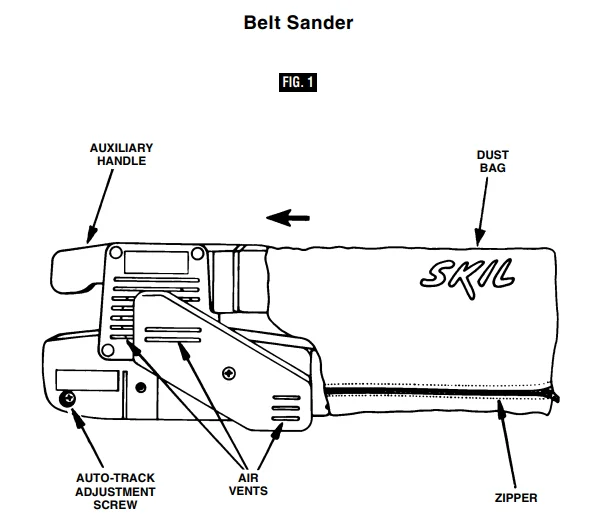
- Model number 7313
- Voltage rating 120 V 50–60 Hz
- Amperage rating 4.5 A
- No load speed 0 700/min
- Belt size 3″ x 18″
Assembly
REMOVING AND INSTALLING SANDING BELTS
WARNING: To prevent personal injury, always disconnect the plug from the power source before removing or installing the belt.
TO REMOVE BELT
- Place the sander upside down and move the lever in the direction of the arrow to retract the front pulley and release belt tension (Fig. 2).

- With the sander upside down and the open side facing you, you can easily remove the belt.

TO INSTALL BELT
- While the sander is still upside down with the front pulley retracted and locked, insert the new belt around both pulleys and over the metal plate. If the belt has directional marks, be sure the arrow on the inside of the belt is pointing in the direction of rotation as indicated on the housing.
- Then push the lever back to its original position to return tension to the belt.
ATTACHING AND REMOVING DUST BAG
Your tool is equipped with a dust bag (Fig. 1). To install, slide the dust bag in the direction of the arrow. The dust bag can be emptied by removing the bag from the tool and opening the zipper on the lower side of the bag. For the most efficient pick-up, empty the bag frequently.
Operating Instructions
TRIGGER SWITCH AND “LOCK-ON” BUTTON
Your tool can be turned “ON” or “OFF” by squeezing or releasing the trigger. Your tool is also equipped with a “Lock-ON” button located just above the trigger that allows continuous operation without holding the trigger (Fig. 3). TO LOCK SWITCH “ON”: Squeeze trigger, depress button, and release trigger. TO UNLOCK THE SWITCH: Squeeze the trigger and release it without depressing the “Lock-ON” button. WARNING: If the “Lock-ON” button is continuously being depressed, the trigger cannot be released.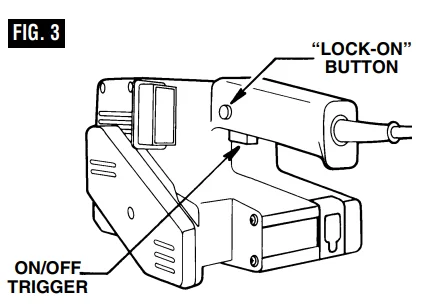
AUTO-TRACK SYSTEM
Your sander features the automatic belt control system, which keeps the belt running in the center of the pulleys after initial adjustment. The system has been preset at the factory but may require adjustment when belts are changed or an older belt stretches.
ADJUSTING THE AUTO-TRACK SYSTEM
- Plug in the cord with the tool OFF.
- Hold the handle of the sander with one hand and tilt back until the belt is off the work and the sander is resting on the bottom heel of the housing.
- Turn the tool ON by pressing the trigger.
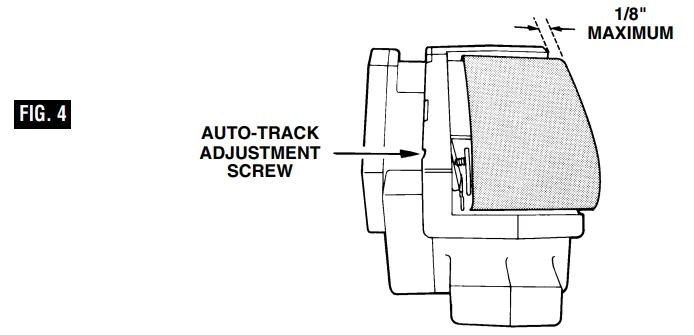
- For best performance, the belt should be in line with the outer edge of the rear pulley. If the belt deviates more than 1/8 inch from the outside of the sander, adjust the belt position by turning the auto-track adjustment screw (Fig. 4) until the belt returns to the proper position.

SELECTING THE SANDING BELT
It is very important that you select the proper belt for each particular application. To do this, you should understand the method of marking or coding on the back of most belts. “CLOSED COAT” means the surface is densely covered with as much grit as the adhesive will hold. “OPEN COAT” means the grit has been applied evenly but openly to the surface. An “open coat” will not clog or fill as readily as a “closed coat”. In general, aluminum oxide abrasive belts are best for woodworking because they are tougher and last longer. Sanding belts should be stored in a cool, dry place. Do not store near heat or near a window where the sun can reach them.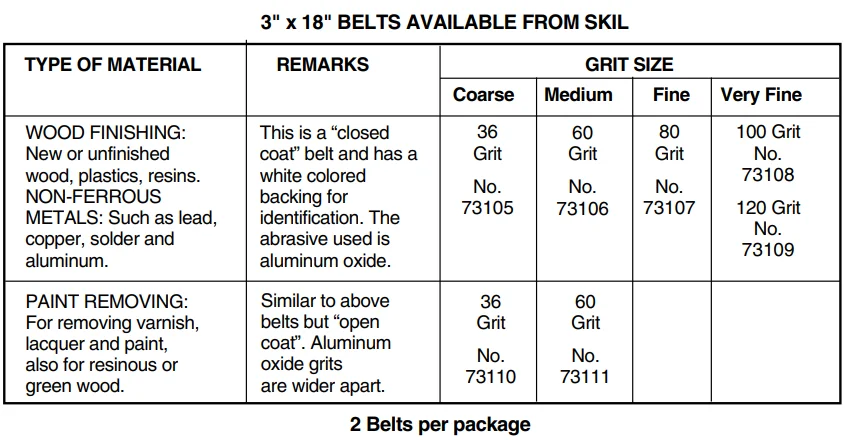
FLUSH SANDING
Your sander has been designed to allow convenient flush sanding on the right side of the sander.
Sanding Tips
TECHNIQUE
Grasp the handles firmly. Start the sander with the belt off the work (NOTE: never start or stop the tool with the belt in contact with the work surface). Place the heel of the sander on the work first. Then, with a forward motion, begin the sanding stroke as the machine is lowered onto the work surface. This will prevent gouging. Keep the sander moving so that your work will be smooth and even.
The stroke is simply a back-and-forth movement with most of the sanding done on the pull movement. Use a light touch. The weight of the belt sander is the only pressure required. Too much pressure will slow the work by overloading the motor and reducing belt speed. The result will be decreased sanding efficiency. Sand slowly and systematically. When you stop, lift the sander from the surface before stopping the tool.
WOOD FINISHING
Take care to select belts wisely. For initial smoothing of rough lumber, use coarse or very coarse grit and sand with the grain. On very uneven or hard wood, sand diagonally (across the grain). Be careful to avoid gouging. Now switch to a medium grit belt and sand with the grain. This will provide a relatively level and smooth finish. Now insert a fine-grit belt for final finishing. Always sand with the grain to remove scratches left by coarser belts. Keep the sander moving in long, light strokes during finishing operations. As a final touch, experienced sanders will often insert a “used” fine belt to provide a smooth surface for filling, sealing, brushing, or spraying.
REFINISHING COATED WOOD
Your belt sander will also help remove old paint, varnish, or lacquer; however, if the coating consists of several layers, remove as much as possible with a paint solvent or varnish remover before using the belt sander. Use a hand scraper to remove the residue left by the solvent and allow the surface to dry completely before sanding.
GUIDE FOR WOOD SANDING OPERATION
For fast removal, start with a coarse grit, open-coat belt. Change to closed coat belts, using medium grits as the material shows through the coating. When the covering is thin, use medium grit to avoid scratching the material. Use short, light strokes, moving the sander rapidly. Excessive pressure or steady sanding in one place will burn the coating and load the belt.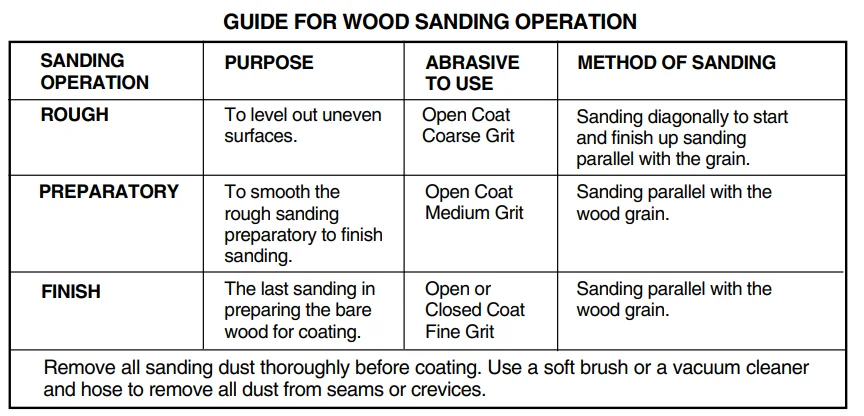
METAL FINISHING
For ferrous metals such as steel, stainless steel, iron, etc., use coarse grit open coat belts or coarse to fine grit closed coat belts, depending on the finish desired. Non-ferrous metals such as aluminum, solder, brass, bronze, etc., can also be sanded. Beeswax or tallow is recommended as a lubricant for metal sanding, polishing, or satin finishing to minimize belt loading and to lengthen belt life. To use, simply rub the lubricant on the belt from time to time. SAE No. 10 or 20 lubricating oil can also be used to assure a smooth, scratch-free surface. Just wipe the oil on the surface before sanding.
Maintenance
Service
Preventive maintenance
WARNING: Service performed by unauthorized personnel may result in misplacement of internal wires and components, which could cause a serious hazard. We recommend that all tool service be performed by a Skil Factory Service Center or Authorized Skil Service Station.
TOOL LUBRICATION
Your Skil tool has been properly lubricated and is ready to use. It is recommended that tools with gears be regreased with a special gear lubricant at every brush change.
CARBON BRUSHES
The brushes and commutator in your tool have been engineered for many hours of dependable service. To maintain peak efficiency of the motor, we recommend every two to six months the brushes be examined. Only genuine Skil replacement brushes specially designed for your tool should be used.
BEARINGS
After about 300–400 hours of operation, or at every second brush change, the bearings should be replaced at a Skil Factory Service Center or Authorized Skil Service Station. Bearings that become noisy (due to heavy load or very abrasive material cutting) should be replaced at once to avoid overheating or motor failure.
Cleaning
WARNING: To avoid accidents, always disconnect the tool from the power supply before cleaning or performing any maintenance. The tool may be cleaned most effectively with compressed dry air. Always wear safety goggles when cleaning tools with compressed air. Ventilation openings and switch levers must be kept clean and free of foreign matter. Do not attempt to clean by inserting pointed objects through openings.
CAUTION: Certain cleaning agents and solvents damage plastic parts. Some of these are gasoline, carbon tetrachloride, chlorinated cleaning solvents, ammonia, and household detergents that contain ammonia.
Accessories
WARNING: If an extension cord is necessary, a cord with adequately sized conductors that is capable of carrying the current necessary for your tool must be used. This will prevent excessive voltage drop, loss of power, or overheating. Grounded tools must use 3-wire extension cords that have 3-prong plugs and receptacles. NOTE: The smaller the gauge number, the heavier the cord. For More Details Visit: www.skil.com.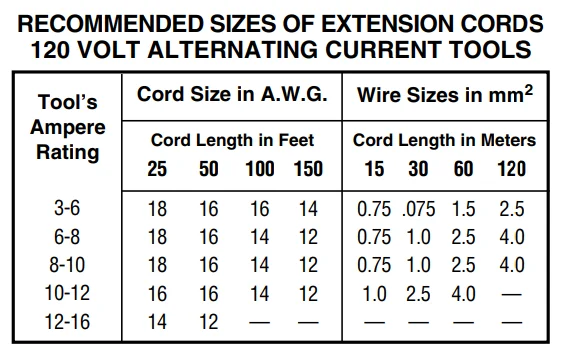
For More Manuals By SKIL Tools, Visit ManualsLibraryy.
SKIL 7313 Corded Belt Sander-FAQs
How do I use a belt sander correctly?
Always move the sander in the direction of the wood grain and let the weight of the tool do the work. Avoid pressing down too hard, as it can leave burn marks or uneven surfaces.
How do I change the sanding belt on the SKIL 7313?
Turn off and unplug the sander, release the tension lever, remove the old belt, slide the new belt onto the rollers, and then reapply tension. Make sure it is centered before use.
How do I adjust the sanding belt?
Use the tracking knob to keep the belt centered on the rollers while running. Adjust gradually until the belt runs smoothly without slipping off.
Why does my sanding belt keep coming off?
Low tension or misaligned rollers is usually the cause. Check the belt tension and adjust the tracking knob to center the belt.
What is the main reason for belt failure?
Most failures are caused by improper tension, misalignment, pressing too hard, or sanding against the grain.
Can I reuse sandpaper belts?
Belts can be reused if they are not worn out or frayed. Check for cracks or excessive wear before reusing.
What is the “golden rule” of sanding?
Never skip more than one grit when sanding. This prevents deep scratches and ensures a smooth, professional finish.
How do I clean or maintain the SKIL 7313 belt sander?
Remove dust and debris after each use, clean the rollers, check belt tension, and occasionally wipe the body with a dry cloth. Avoid spraying oils like WD-40 on the belt or motor.
Why is my wood not smooth after sanding?
This usually happens if you skip grits or sand unevenly. Always progress gradually through grits and maintain consistent pressure.