
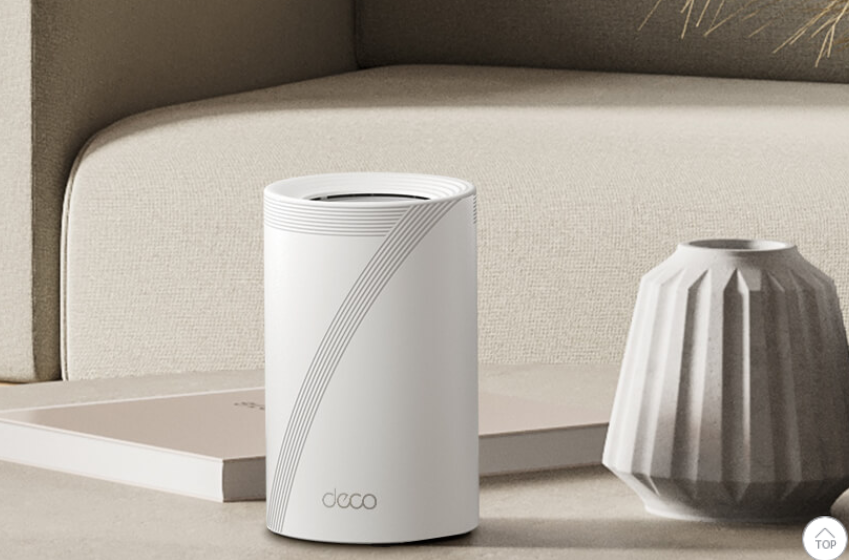

TP Link Deco BE11000 WiFi Router
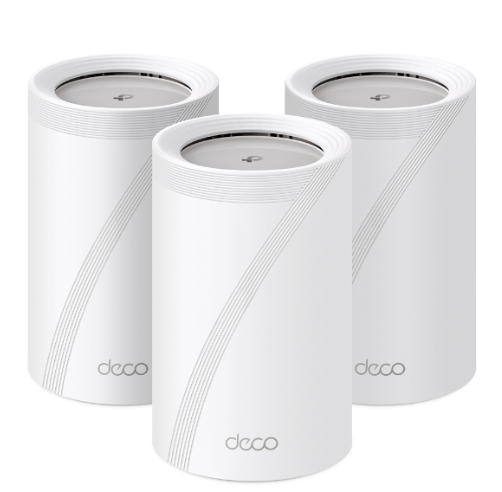
About This Guide
This guide provides a brief introduction to the BE11000 Whole Home Mesh Wi-Fi 7 System and regulatory information. Features available in Deco may vary by model and software version. Deco availability may also vary by region or ISP. All images, steps, and descriptions in this guide are only examples and may not reflect your actual Deco experience.
Conventions
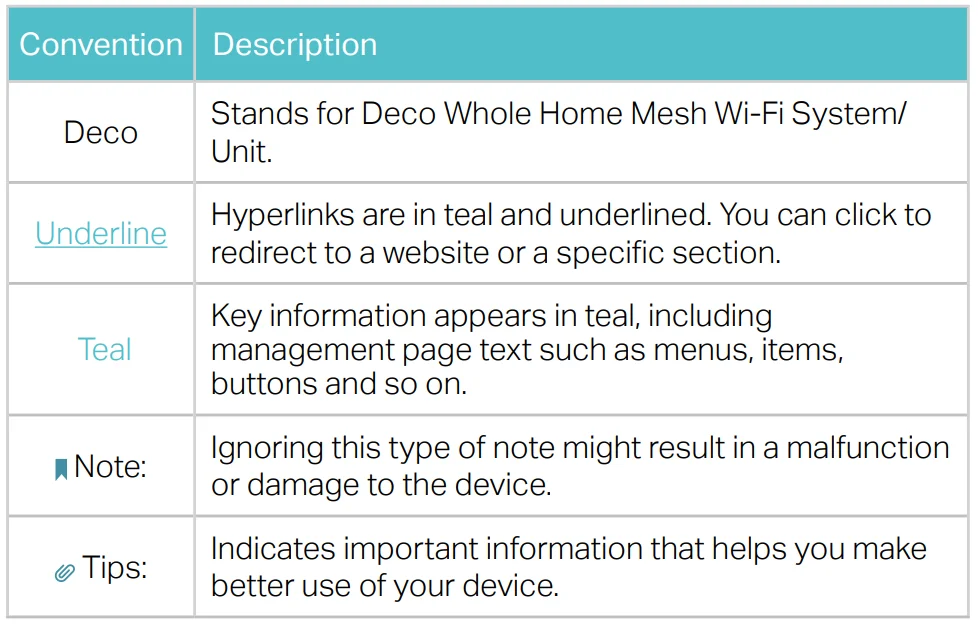
In this guide, the following conventions are used:
More Info
- Specific product information can be found on the product page at https://www.tp-link.com.
- A Technical Community is provided for you to discuss our products at https://community.tp-link.com.
- Our Technical Support contact information can be found at the Help center of the Deco app and the Contact Technical Support page at https://www.tp-link.com/support.
Speed/Coverage/Device Quantity Disclaimer
Maximum wireless signal rates are the physical rates defined in the IEEE 802.11 specifications. Actual wireless data throughput, wireless coverage, and the number of connected devices are not guaranteed and will vary as a result of network conditions, client limitations, and environmental factors, including building materials, obstacles, traffic volume and density, and client location.
MU-MIMO Disclaimer
MU-MIMO requires clients to also support it.
IoT Compatibility Disclaimer
IoT compatibility refers only to smart devices that can be controlled via the Deco app. Other wireless devices can still connect to Deco for normal Wi-Fi use.
Seamless Roaming Disclaimer
Clients need to support 802.11k/v/r and may require additional setup. Performance may vary depending on the client device.
Appearance
Each Deco has an LED that changes color according to its status, a WPS button, four 2.5 Gbps WAN/LAN ports, a USB port, a power slot, and a Reset button. See the explanation below:
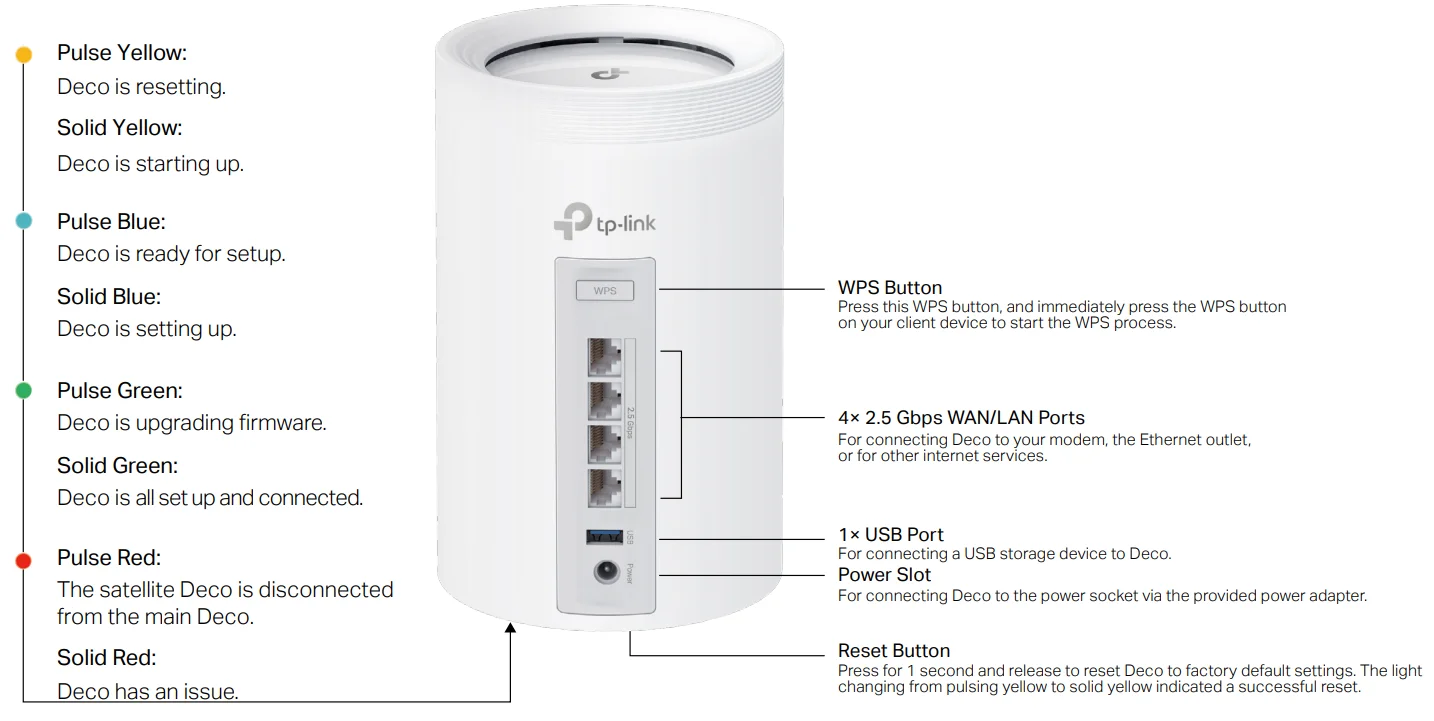
Tip: The product label can be found at the bottom of the product.
Set Up Your Deco
First, let’s start by setting up the Deco network. Get the TP-Link Deco app for iOS or Android, then follow the app to walk through the setup.
- Get the Deco app
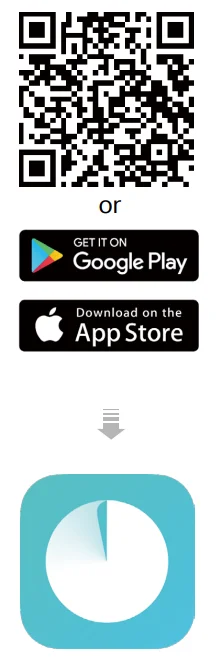
Scan the QR code below or go to Google Play or the App Store to download the Deco app. Install the app on your Android or iOS smartphone or tablet.
- Log in or sign up with TP-Link ID
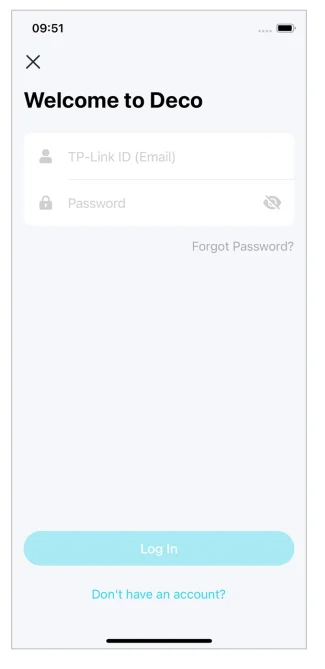
Open the app and log in with your TP-Link ID. If you don’t have a TP-Link ID, create one first.
Note: If you forgot your login password, tap Forgot Password?. The app will help you reset your password.
- Select your Deco model
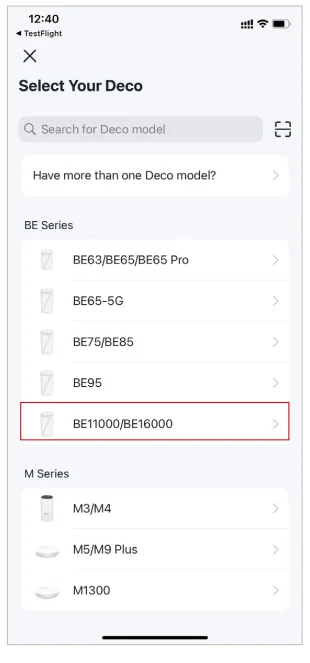
Search for and select your Deco model. If you have more than one Deco model, tap the question below the search box to check how to maximize the overall network.
- Plug in your Deco
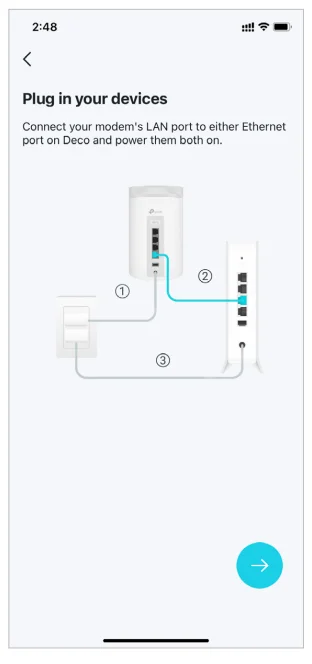
Power off your modem. Connect your Deco to the modem and power them both on. If you don’t have a modem, connect your Deco directly to the Ethernet outlet.
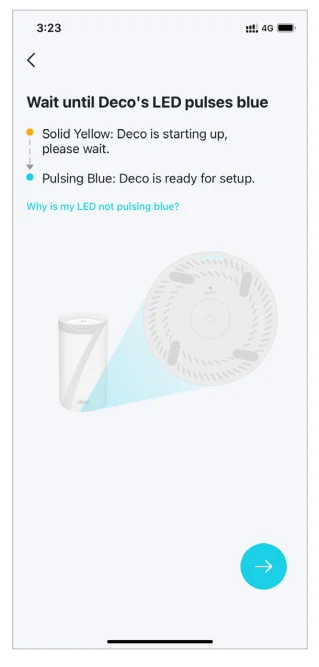
- Wait until Deco’s LED pulses blue
Wait until your Deco’s LED pulses blue, then your phone/tablet will automatically connect to the Deco’s default Wi-Fi.
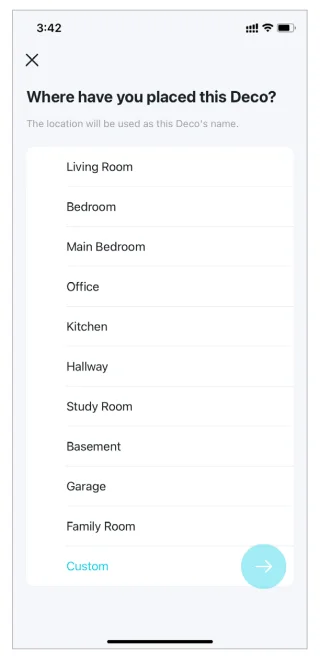
- Specify your Deco’s location
Select or customize a location for your Deco. The location will be used as the name of your Deco.
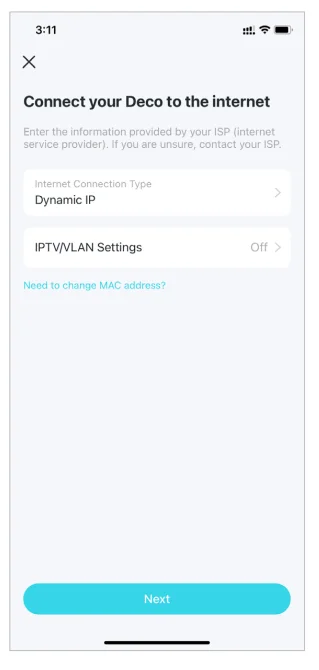
- Connect your Deco to the internet
Select the internet connection type and enter the information. If you are not sure, contact your internet service provider.
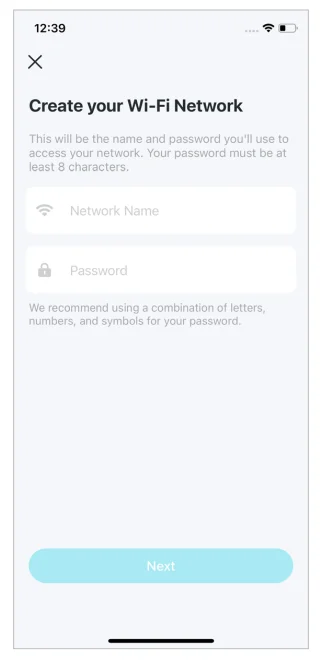
- Create your Wi-Fi network
Set a network name and a password. These will be the name and password you use to connect your devices to Wi-Fi.
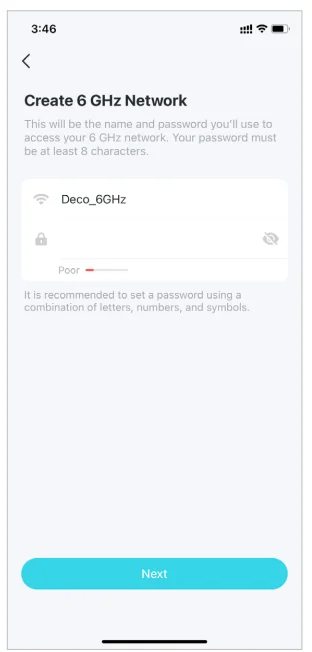
- Create your 6GHz Wi-Fi network
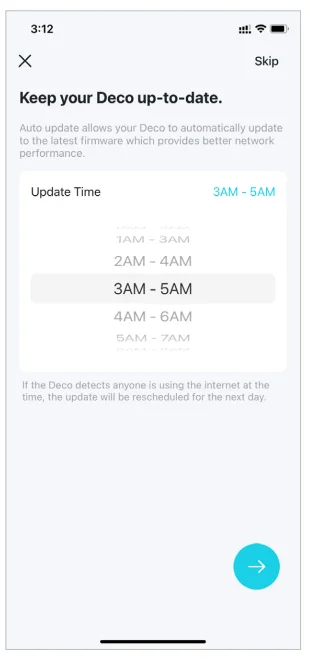
Set a network name and a password. These will be the name and password you use to connect your devices to the 6GHz Wi-Fi. - Keep your Deco up-to-date
Set auto update time. This allows your Deco to automatically update to the latest firmware, which provides a better network experience.
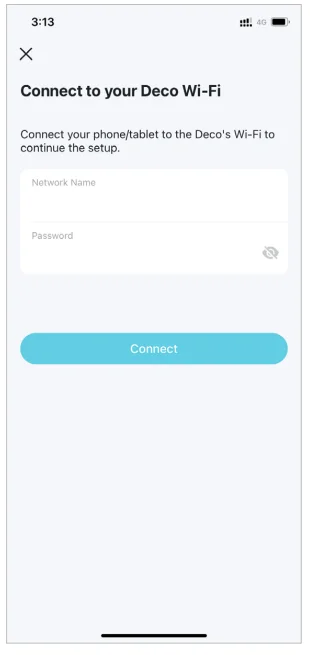
- Connect to your Wi-Fi network
Connect your phone/tablet to the Deco’s Wi-Fi to continue the setup.
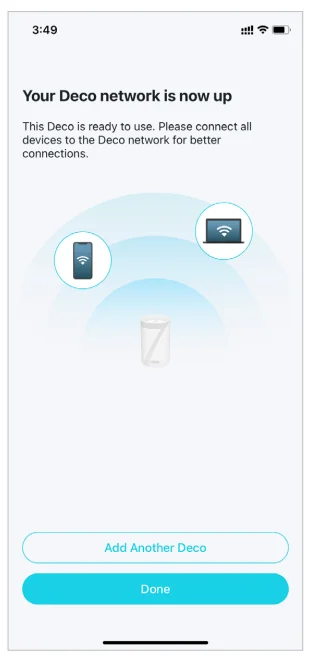
- Setup complete
Your Deco network is now up. You can connect your devices to the Deco network. Plug in the other included Decos, and they will automatically join the network within 2 minutes.
Troubleshooting
Solutions to common problems during setup or use are provided here for reference. Follow the steps and the provided link below to diagnose and solve problems you might experience with your Deco. If problems still exist, contact us: https://www.tp-link.com/support
- Q1. What should I do if I fail to configure the main Deco and get stuck on “We couldn’t find Deco”?
Refer to the guide https://www.tp-link.com/support/faq/2239/ or follow the video https://youtu.be/2HYuEYS9XJM - Q2. What should I do if I fail to configure the satellite Deco and get stuck on “We couldn’t find another Deco”?
Refer to the guide https://www.tp-link.com/support/faq/1447/ or follow the video https://youtu.be/iVgDzoo16T4 - Q3. What should I do if I fail to configure the main Deco and get stuck on “Testing Internet Connection”?
Refer to the guide https://www.tp-link.com/support/faq/2239/. Refer to the video https://youtu.be/OSUrGdWH-i0 - Q4. What should I do if my wireless devices cannot connect to Deco?
Refer to the guide https://www.tp-link.com/support/faq/2718/ - Q5. What should I do if Deco suddenly loses internet access?
Refer to the guide https://www.tp-link.com/support/faq/2428/ - Q6. How can I find a suitable spot for my Deco?
Refer to the guide https://www.tp-link.com//support/faq/1446/ - Q7. What can I do if the Deco app isn’t working properly?
Refer to the guide https://www.tp-link.com/support/faq/1456/
Authentication
FCC Compliance Information Statement
- Product Name: BE11000 Whole Home Mesh Wi-Fi 7 System
- Model Number: Deco BE11000

Responsible party:
TP-Link USA Corporation
- Address: 10 Mauchly, Irvine, CA 92618
- Website: http://www.tp-link.com/us/
Tel: +1 626 333 0234 - Fax: +1 909 527 6804
- E-mail: [email protected]
This equipment has been tested and found to comply with the limits for a Class B digital device, pursuant to part 15 of the FCC Rules. These limits are designed to provide reasonable protection against harmful interference in a residential installation. This equipment generates, uses and can radiate radio frequency energy and, if not installed and used in accordance with the instructions, may cause harmful interference to radio communications. However, there is no guarantee that interference will not occur in a particular installation. If this equipment does cause harmful interference to radio or television reception, which can be determined by turning the equipment off and on, the user is encouraged to try to correct the interference by one or more of the following measures:
- Reorient or relocate the receiving antenna.
- Increase the separation between the equipment and receiver.
- Connect the equipment into an outlet on a circuit different from that to which the receiver is connected.
- Consult the dealer or an experienced radio/ TV technician for help.
This device complies with part 15 of the FCC Rules. Operation is subject to the following two conditions:
- This device may not cause harmful interference.
- This device must accept any interference received, including interference that may cause undesired operation.
Any changes or modifications not expressly approved by the party responsible for compliance could void the user’s authority to operate the equipment.
Note: The manufacturer is not responsible for any radio or TV interference caused by unauthorized modifications to this equipment. Such modifications could void the user’s authority to operate the equipment.
FCC RF Radiation Exposure Statement
This equipment complies with FCC RF radiation exposure limits set forth for an uncontrolled environment. This device and its antenna must not be co-located or operating in conjunction with any other antenna or transmitter. To comply with FCC RF exposure compliance requirements, this grant is applicable to only to Mobile Configurations. The antennas used for this transmitter must be installed to provide a separation distance of at least 55 cm from all persons. They must not be co-located or operating in conjunction with any other antenna or transmitter.FCC regulations restrict the operation of this device to indoor use only. The operation of this device is prohibited on oil platforms, cars, trains, boats, and aircraft, except that the operation of this device is permitted in large aircraft while flying above 10000 feet. Operation of transmitters in the 5.925-6.425 GHz band is prohibited for control of or communications with unmanned aircraft systems. We, TP-Link USA Corporation, have determined that the equipment shown as above has been shown to comply with the applicable technical standards, FCC part 15. No unauthorized change is made in the equipment, and the equipment is properly maintained and operated.
FCC Compliance Information Statement
- Product Name: I.T.E POWER SUPPLY
- Model Number: T120250-2B4
Responsible party:
TP-Link USA Corporation
- Address: 10 Mauchly, Irvine, CA 92618
- Website: http://www.tp-link.com/us/
- Tel: +1 626 333 0234
- Fax: +1 909 527 6804
- E-mail: [email protected]
This equipment has been tested and found to comply with the limits for a Class B digital device, pursuant to part 15 of the FCC Rules. These limits are designed to provide reasonable protection against harmful interference in a residential installation. This equipment generates, uses, and can radiate radio frequency energy and, if not installed and used in accordance with the instructions, may cause harmful interference to radio communications. However, there is no guarantee that interference will not occur in a particular installation. If this equipment does cause harmful interference to radio or television reception, which can be determined by turning the equipment off and on, the user is encouraged to try to correct the interference by one or more of the following measures:
- Reorient or relocate the receiving antenna.
- Increase the separation between the equipment and receiver.
- Connect the equipment into an outlet on a circuit different from that to which the receiver is connected.
- Consult the dealer or an experienced radio/ TV technician for help.
This device complies with part 15 of the FCC Rules. Operation is subject to the following two conditions:
- This device may not cause harmful interference.
- This device must accept any interference received, including interference that may cause undesired operation.
Any changes or modifications not expressly approved by the party responsible for compliance could void the user’s authority to operate the equipment. We, TP-Link USA Corporation, have determined that the equipment shown above complies with the applicable technical standards, including FCC Part 15. No unauthorized change is made in the equipment, and the equipment is properly maintained and operated.
Canadian Compliance Statement
This device complies with Industry Canada license-exempt RSS standard(s). Operation is subject to the following two conditions:
- This device may not cause interference.
- This device must accept any interference, including interference that may cause undesired operation of the device.
Caution:
The device for operation in the band 5150–5250 MHz is only for indoor use to reduce the potential for harmful interference to co-channel mobile satellite systems; DFS (Dynamic Frequency Selection) products that operate in the bands 5250- 5350 MHz, 5470-5600MHz, and 5650-5725MHz. ISED regulations restrict the operation of this device to indoor use only. The operation of this device is prohibited on oil platforms, cars, trains, boats, and aircraft, except that the operation of this device is permitted in large aircraft while flying above 10000 feet. Operation of transmitters in the 5.925-7.125 GHz band is prohibited for control of or communications with unmanned aircraft systems.
Radiation Exposure Statement: This equipment complies with IC radiation exposure limits set forth for an uncontrolled environment. This equipment should be installed and operated with a minimum distance of 45cm between the radiator & your body.
Safety Information
- Keep the device away from water, fire, humidity, or hot environments.
- Do not attempt to disassemble, repair, or modify the device. If you need service, please get in touch with us.
- Do not use a damaged charger or USB cable to charge the device.
- Do not use any other chargers than those recommended.
- Do not use the device where wireless devices are not allowed.
- The adapter shall be installed near the equipment and shall be easily accessible.
- Use only power supplies provided by the manufacturer and in the product’s original packaging. If you have any questions, please don’t hesitate to contact us.
- Operating Temperature: 0°C~40°C (32°F~104°F)
- This product uses radios and other components that emit electromagnetic fields. Electromagnetic fields and magnets may interfere with pacemakers and other implanted medical devices. Always keep the product and its power adapter more than 15 cm (6 inches) away from any pacemakers or other implanted medical devices. If you suspect your product is interfering with your pacemaker or any other implanted medical device, turn off your product and consult your physician for information specific to your medical device.
Please read and follow the above safety information when operating the device. We cannot guarantee that no accidents or damage will occur due to improper use of the device. Please use this product with care and operate at your own risk.
Explanation of the symbols on the product label
Symbols may vary by product.
Note: The product label can be found at the bottom of the product and its I.T.E. power supply.
For more manuals by TP-Link, visit ManualsLibraryy
TP Link Deco BE11000 WiFi Router-FAQs
How do I set up the TP-Link Deco BE11000 WiFi Router?
Setting up the Deco BE11000 is straightforward using the Deco mobile app. First, install the app and create or log in to your TP-Link account. Connect the main Deco unit to your modem via Ethernet and power it on. The app will guide you through naming your network and setting a password. Once complete, you can add additional Deco units to extend coverage across your home.
Can the Deco BE11000 work as a standalone router?
Yes, the Deco BE11000 can fully replace your existing router. The main Deco unit connects directly to your modem and acts as the primary router. All additional Deco units then connect wirelessly or via Ethernet to create a seamless mesh network. This setup ensures consistent coverage and eliminates dead zones throughout your space.
Is the TP-Link Deco BE11000 easy to install for beginners?
The Deco BE11000 is designed for user-friendly installation, even for beginners. The mobile app provides step-by-step instructions with visuals, making the process simple and quick. Most users can complete the setup within minutes without needing advanced networking knowledge. The guided setup minimizes errors and ensures your network is configured correctly from the start.
How do I configure my WiFi network after setup?
After installation, you can manage and customize your network through the Deco app. You can change the WiFi name, update the password, create guest networks, and monitor connected devices. Advanced options like parental controls, device prioritization, and firmware updates are also available, giving you full control over your home network performance and security.
Does the Deco BE11000 support both 2.4 GHz and 5 GHz bands?
Yes, the Deco BE11000 supports multiple bands, including 2.4 GHz and 5 GHz (and newer bands depending on WiFi generation). By default, the system uses a single network name (SSID) and automatically assigns devices to the best band. This ensures optimal speed and stability without requiring manual switching between frequencies.
Can I connect the Deco BE11000 to an existing router?
Yes, you can use the Deco BE11000 alongside an existing router by enabling Access Point mode. In this setup, your current router handles internet routing, while the Deco system extends WiFi coverage. This is useful if you want to keep your existing network setup while improving signal strength and coverage with mesh technology.
How do I set up a mesh network using multiple Deco units?
After configuring the main unit, you can easily add more Deco devices through the app. Simply power on the additional units and follow the in-app instructions to pair them. Place them in different areas of your home to expand coverage. The system automatically creates a unified mesh network, allowing seamless roaming without signal drops.
What internet connection types does the Deco BE11000 support?
The Deco BE11000 supports common connection types such as Dynamic IP (DHCP), Static IP, and PPPoE. If your internet service requires a username and password, you can enter those details during setup. The app simplifies this process, ensuring compatibility with most broadband connections without complex manual configuration.
How can I improve WiFi speed and performance on Deco BE11000?
To maximize performance, place the main Deco unit in a central location and keep it away from obstacles or interference. Adding additional nodes helps eliminate weak signal areas. You can also use the app to prioritize devices, update firmware, and reduce network congestion. Proper placement and regular updates significantly improve speed and reliability.
Can Deco BE11000 signals pass through walls effectively?
Yes, the mesh design helps WiFi signals cover areas more effectively than traditional routers. Instead of relying on a single strong signal, multiple Deco units distribute connectivity throughout your home. While thick walls can still reduce signal strength, placing nodes strategically allows the network to route signals around obstacles for better overall coverage.