


TSI 9515 VelociCalc Air Velocity Meter
Unpacking and Parts Identification
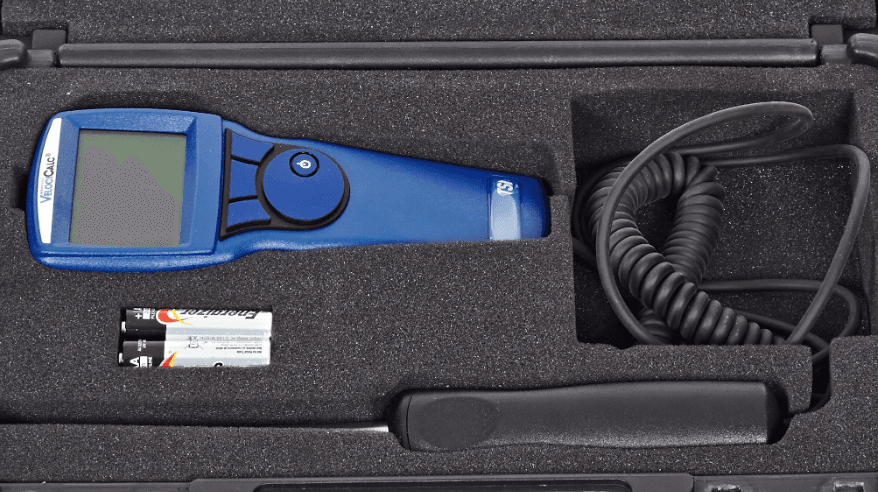
Carefully unpack the instrument and accessories from the shipping container. Check the individual parts against the list of components below. If anything is missing or damaged, notify TSI® Incorporated immediately.
- Carrying case
- Instrument
Setting-up
Supplying Power to the Model 9515 VelociCalc™ Air Velocity Meter
The Model 9515 is powered by four AA batteries
Installing the Batteries
Insert four AA batteries as indicated by the diagram located on the inside of the battery compartment. The Model 9515 is designed to operate with either alkaline or NiMH rechargeable batteries, although it will not recharge NiMH batteries. Battery life will be shorter if NiMH batteries are used. Carbon-zinc batteries are not recommended because of the danger of battery acid leakage.
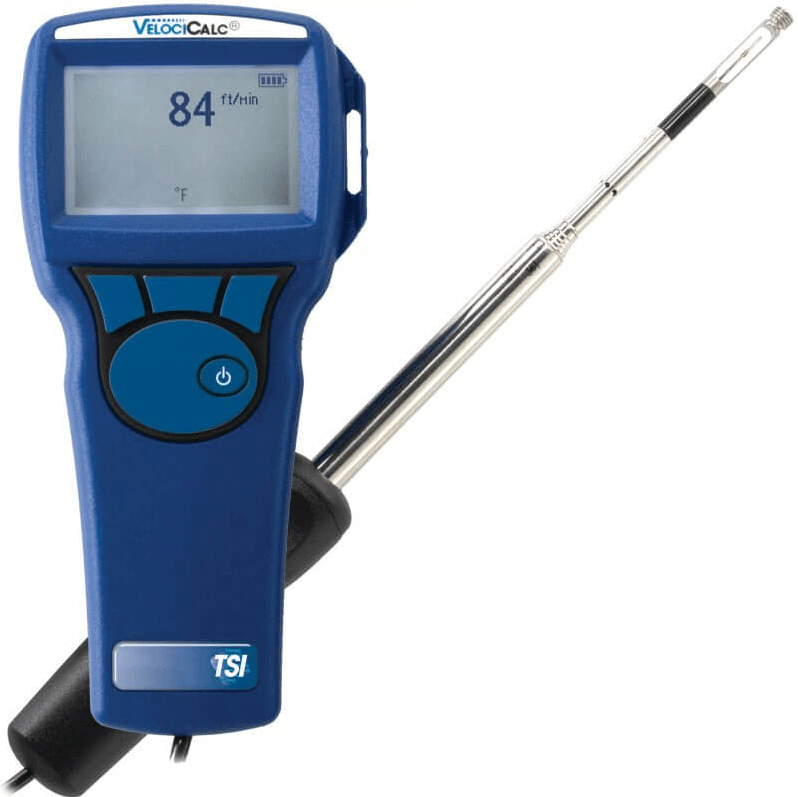
Using the Telescoping Probe
The telescoping probe contains the velocity and temperature sensors.
When using the probe, make sure the sensor window is fully exposed
and the orientation dimple is facing upstream.
Extending the Probe
To extend the probe, hold the handle in one hand while pulling on
the probe tip with the other hand. DO NOT hold the cable while
extending the probe, as this prevents the probe from extending.
Retracting the Probe
To retract the probe, hold the handle in one hand while pulling
gently on the probe cable with the other hand.
Operation
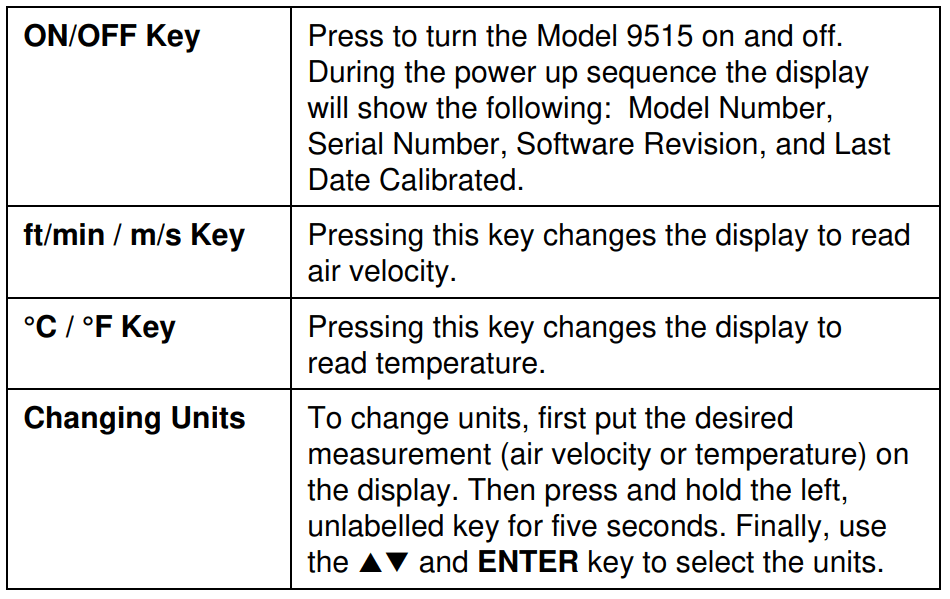
Keypad Functions
Maintenance
The Model 9515 requires very little maintenance to keep it performing well.
Recalibration
To maintain a high degree of accuracy in your measurements, TSI®
recommends that you return your Model 9515 to TSI® Incorporated
for annual recalibration. Please contact one of TSI’s offices or your
local distributor to make service arrangements and to receive a
“Service Request” number. To fill out an online “Service Request”
form, visit TSI’s website at tsi.com/service.
Cases
If the instrument case or storage case needs cleaning, wipe it off with a soft cloth and isopropyl alcohol or a mild detergent. Never immerse in the Model 9515. If the enclosure of the Model 9515 becomes broken, it must be replaced immediately to prevent access to hazardous voltage.
Storage
Remove the batteries when storing the unit for more than one month
to prevent damage due to battery leakage.
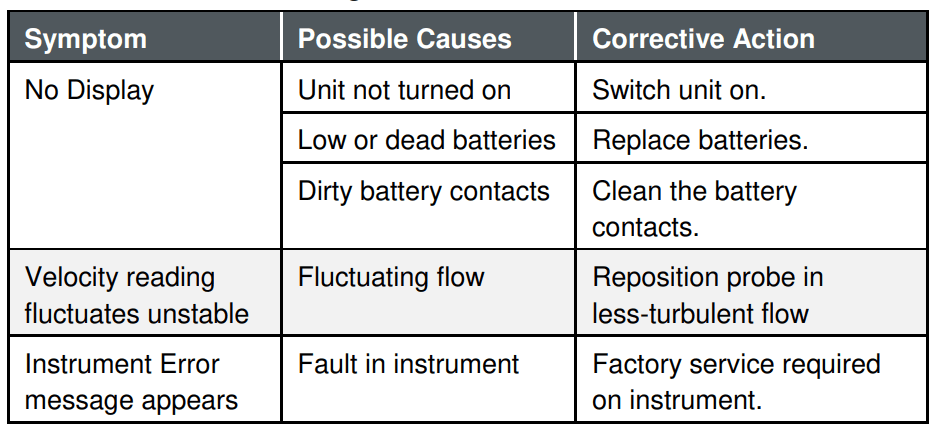
Troubleshooting
Table 5-1 lists the symptoms, possible causes, and recommended
solutions for common problems encountered with Model 9515. If
your symptom is not listed, or if none of the solutions solves your
problem, please contact TSI® Incorporated.
Specifications
Specifications are subject to change without notice.
Velocity:
- Range: 0 to 4000 ft/min (0 to 20 m/s)
- Accuracy1&2: ±5% of reading or ±5 ft/min (±0.025 m/s), whichever is greater
- Resolution: 1 ft/min (0.01 m/s)
Temperature:
- Range: 0 to 200°F (-18 to 93°C)
- Accuracy3: ±0.5°F (±0.3°C)
- Resolution: 0.1°F (0.1°C)
Instrument Temperature Range:
- Operating (Electronics): 40 to 113°F (5 to 45°C)
- Operating (Probe): 0 to 200°F (-18 to 93°C)
- Storage: -4 to 140°F (-20 to 60°C)
External Meter Dimensions:
- 3.3 in. 7.0 in. 1.8 in. (8.4 cm, 17.8 cm, 4.4 cm)
Meter Weight:
- Weight with batteries: 0.6 lbs (0.27 kg)
Power Requirements:
- Four AA-size batteries (included)
- Temperature compensated over an air temperature range of 40 to 150°F (5 to 65°C).
- The accuracy statement of ±5.0% of reading or ±5 ft/min (±0.025 m/s), whichever is greater, begins at 30 ft/min through 4000 ft/min (0.15 m/s through 20 m/s).
- Accuracy with instrument case at 77°F (25°C), add uncertainty of 0.05°F/°F (0.03°C/°C) for change in instrument temperature.
FOR MORE MANUALS BY TSI, VISIT MANUALSLIBRARYY
TSI 9515 VelociCalc Air Velocity Meter-FAQs
What is the function of the TSI 9515 VelociCalc?
The TSI 9515 VelociCalc is a hot-wire anemometer that measures air velocity (speed of airflow) in applications like HVAC, cleanrooms, and industrial ventilation. It provides precise readings between 0.3 to 30.0 m/s (0.98 to 98.4 ft/min).
What is an anemometer used for?
An anemometer measures air velocity (wind or airflow speed). Common uses include:
HVAC system testing
Industrial airflow monitoring
Laboratory & cleanroom validation
Wind speed measurement
How does a hot-wire anemometer work?
It uses a heated wire that cools as air passes over it. The cooling rate is converted into velocity readings for accurate airflow measurement.
How do you calculate air velocity?
Air velocity (in m/s or ft/min) can be calculated by:
Measuring airflow (CFM or m³/s) ÷ Duct cross-sectional area (m² or ft²)
Using an anemometer (like the TSI 9515) for direct readings.
What is the difference between air velocity and airflow?
Air Velocity = Speed of air (e.g., m/s, ft/min).
Airflow (CFM or m³/s) = Volume of air moving per minute.
Formula: Airflow = Velocity × Duct Area
What are the applications of air velocity meters?
HVAC balancing & diagnostics
Fume hood testing
Cleanroom validation
Industrial process control
How do you measure airflow in a duct?
Measure air velocity with an anemometer.
Calculate duct area (π × radius² for round ducts).
Multiply velocity × area to get airflow (CFM or m³/s).
What is the relationship between air pressure and velocity?
According to Bernoulli’s Principle:
Higher air velocity = Lower pressure (and vice versa).
Used in ventilation design & aerodynamics.
What is a normal air velocity range for HVAC systems?
Duct trunks: 700–900 FPM (feet per minute).
Branch ducts: 500–700 FPM.
Too high → Noise & pressure loss
Too low → Poor airflow distribution