

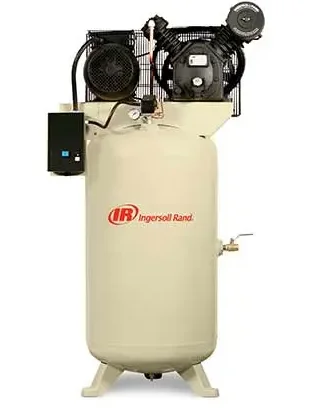
Ingersoll-Rand TS4 Electric Driven Reciprocating Compressor
RECEIPT & INSPECTION
Ensure adequate lifting equipment is available for unloading and moving the compressor to the installation site. Use suitable lifting equipment (i.e., forklift) to lift and transport the compressor to the installation site. Ensure the lifting equipment, straps, etc., are capable of supporting the weight of the unit.
Lifting Equipment and Straps
Before signing the delivery receipt, inspect for damage and missing parts. If damage or missing parts are apparent, make the appropriate notation on the delivery receipt, then sign the receipt. Immediately contact the carrier for an inspection. All material must be held in the receiving location for the carrier’s inspection. Delivery receipts that have been signed without a notation of damage or missing parts are considered to be delivered “clear.” Subsequent claims are then considered to be concealed damage claims.
Settle damage claims directly with the transportation company. If you discover damage after receiving the compressor (concealed damage), the carrier must be notified within 15 days of receipt, and an inspection must be requested by telephone with confirmation in writing. On concealed damage claims, the burden of establishing that the compressor was damaged in transit reverts to the claimant. Read the unit nameplate to verify it is the model ordered, and read the motor nameplate to verify it is compatible with your electrical conditions. Make sure electrical enclosures and components are appropriate for the installation environment.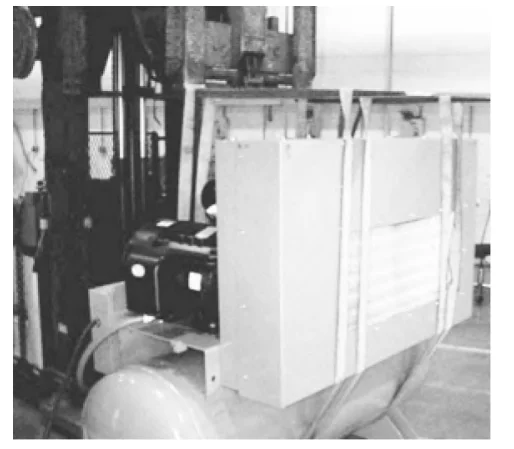
INSTALLATION
SELECTING A LOCATION
For most electric motor units, select a relatively clean and dry, well-lighted indoor area with plenty of space for proper ventilation, cooling airflow, and accessibility. Provide 1,000 cubic feet of fresh air per 5 horsepower. Locate the unit at least 15 inches (38 cm) from walls, and make sure the main power supply is clearly identified and accessible. Unless the electrical components of the unit are specially protected for outdoor use, do not install an electric motor unit outdoors or in an area that will expose the electrical components to rain, snow, or sources of appreciable moisture.
WARNING: The electric drain valve incorporates arcing or sparking parts, such as snap switches, receptacles, and the like, that tend to produce arcs or sparks and, therefore, when located in a garage, the compressor should be in a room or enclosure provided for the purpose, or the electric drain valve should be 18 inches (457 mm) or more above the floor.
AMBIENT TEMPERATURE CONSIDERATIONS
Ideal operating temperatures are between 32°F and 100°F (0°C and 37.8°C). If temperatures consistently drop below 32°F (0°C), install the compressor in a heated area. If this is not possible, you must protect safety/relief valves and drain valves from freezing. If temperatures are consistently below 40°F (4.4°C), consider installing an external crankcase heater kit, especially if the compressor has difficulty starting. CAUTION: Never operate the compressor in temperatures below 20°F (-6.6°C) or above 104°F (40°C).
HUMID AREAS
In frequently humid areas, moisture may form in the pump and produce sludge in the lubricant, causing running parts to wear out prematurely. Excessive moisture is especially likely to occur if the unit is located in an unheated area that is subject to large temperature changes. Two signs of excessive humidity are external condensation on the pump when it cools down and a “milky” appearance in petroleum lubricant. You may be able to prevent moisture from forming in the pump by increasing ventilation, operating for longer intervals, or installing an external crankcase heater kit.
NOISE CONSIDERATIONS
Consult local officials for information regarding acceptable noise levels in your area. To reduce excessive noise, use vibration isolator pads or intake silencers, relocate the unit, or construct total enclosures or baffle walls.
MOUNTING
To mount the compressor to a concrete surface, use the following procedure:
- Mark the location of the mounting holes.
- Drill holes to the proper depth based on the concrete stud. Using a concrete stud sized per the following table, follow the concrete stud instructions to determine the proper drill bit size (Note: It may be helpful to use a piece of tape on the drill bit to mark the proper depth).
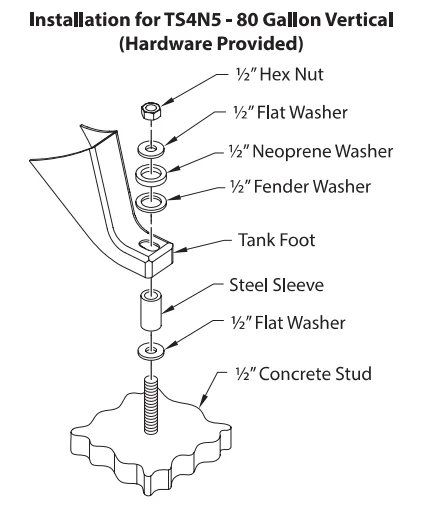
- Add a backing plate as depicted in the illustration, while maintaining a level mounting surface.
- Position the compressor feet holes over the studs and slowly lower the compressor feet onto the studs.
- Install the first standard nut and torque each in a criss-cross pattern to 10 ft.lb*. After all mounting nuts are installed, check for receiver stress by loosening each nut individually to check for upward movement of the foot. Upward movement indicates the requirement for an appropriately sized metal shim to fill in the open elevation under the foot.
- After all required shims have been inserted, re-tighten the nuts to 10 ft.lb*.
- Add a backup nut to keep the primary nut from backing off. Backup nut may be a locknut or a second standard nut. Ensure not to tighten the primary nut.
Do not secure uneven feet tightly, as this will cause excessive stress on the receiver tank. For gas or diesel engine compressors, use the torque specification indicated in the mounting hardware kit installation instructions.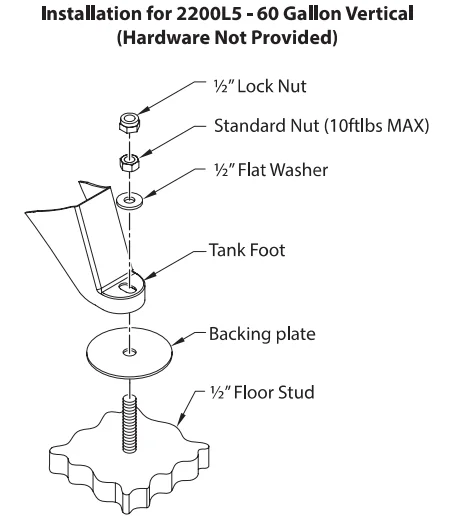
INSTALLING REMOTE AIR INLET PIPING
CAUTION: Do not operate the unit without air inlet filtration.
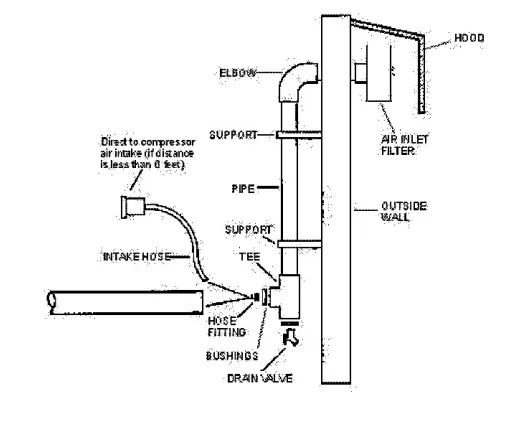
If the air around the unit is relatively free of dirt, install the air inlet filter at the inlet connection at the pump. If the air is dirty, pipe the filter to a source of clean air. Use PVC plastic tubes for remote inlet piping. Do not use black pipe or galvanized pipe, as these promote sweating and rust. Consider installing an in-line type filter for ease of cleaning and replacement. Make the line as short and direct as possible and as large, or larger, than the diameter of the inlet connection on the pump.
Do not install piping with a diameter lower than that of the pump intake. Increase the pipe diameter one size for every 10 feet (3 m) of length or every 90° bend. Make sure the piping is adequately braced. If you pipe the filter outdoors, cover it with a hood to prevent the entrance of rain or snow. Heavy-duty filter elements and filtration equipment are available for fine airborne dust, such as cement and rock dust.
TYPICAL REMOTE AIR INLET PIPING
INSTALLING DISCHARGE PIPING
CAUTION: If you will be using synthetic compressor lubricant, all downstream piping material and system components must be compatible. Refer to the following material compatibility list. If there are incompatible materials present in your system, or if there are materials not included in the list, contact Ingersoll Rand for recommendations.
SYNTHETIC COMPRESSOR LUBRICANT MATERIAL COMPATIBILITY LIST
SUITABLE: FKM (Fluoroelastomer), PTFE, Epoxy (Glass Filled), Oil Resistant Alkyd, Fluorosilicone, Fluorocarbon, Polysulfide, 2-Component Urethane, Nylon, POM (Polyoxymethylene/Polyacetal), High Nitrile Rubber (Buna N, NBR more than 36% Acrylonitrile), Polyurethane, Polyethylene, Epichlorohydrin, Polyacrylate, Melamine, Polypropylene, Baked Phenolics, Epoxy, Modified Alkyds (® indicates trademark of DuPont Corporation).
NOT RECOMMENDED: Neoprene, Natural Rubber, SBR Rubber, Acrylic Paint, Lacquer, Varnish, Polystyrene, PVC, ABS, Polycarbonate, Cellulose Acetate, Low Nitrile Rubber (Buna N, NBR less than 36% Acrylonitrile), EPDM, Ethylene Vinyl Acetate, Latex, EPR, Acrylics, Phenoxy, Polysulfones, Styrene Acrylonitrile (SAN), Butyl.
GENERAL REQUIREMENTS
The piping, fittings, air receiver tank, etc., must be certified safe for at least the maximum working pressure of the unit. Use hard-welded or threaded steel or copper pipes and cast iron fittings that are certified safe for the unit’s discharge pressure and temperature. DO NOT USE PVC PLASTIC IN THE COMPRESSED AIR DISCHARGE LINE. Use pipe thread sealant on all threads, and make up joints tightly to prevent air leaks.
CONDENSATE DISCHARGE PIPING
If installing a condensate discharge line, the piping must be at least one size larger than the connection, as short and direct as possible, secured tightly, and routed to a suitable drain point or waste container. Condensate must be disposed of in accordance with local, state, and federal laws and regulations.
ELECTRICAL CONNECTIONS
WARNING: Electrical installation and service must be performed by a qualified electrician who is familiar with all applicable electrical codes.
GENERAL
The motor rating, as shown on the motor nameplate, and the power supply must have compatible voltage, phase, and hertz characteristics.
WIRE SIZE
Refer to the applicable electric codes in your area for information on selecting the proper wire size and securing electrical connections. Install adequately sized power leads to protect against excessive voltage drop during start-up. For distances exceeding 50 ft, it may be necessary to use a larger wire to avoid any voltage drop.
NOTICE: DO NOT USE UNDERSIZED WIRE
If wire size information is not available, the wire sizes shown in the following wire selection chart can be used as a safe guide if the distance does not exceed 50 feet (15.3 m). For longer distances, consult an electrical contractor or the local electric company for recommendations.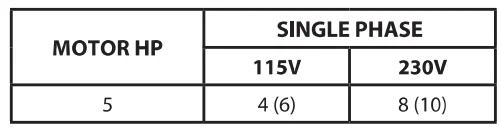
Wire sizes shown in AWG (SWG):
- AWG = American Wire Gauge
- SWG = British Imperial Standard Wire Gauge
FUSES
Refer to applicable local codes to determine the proper fuse or circuit breaker rating required. When selecting fuses, remember that the momentary starting current of an electric motor is greater than its full load current. Time delay or “slow-blow” fuses are recommended.
GROUNDING INSTRUCTIONS
The ground terminal is located within the pressure switch. Ground must be established with a grounding wire sized according to the voltage and minimum branch circuit requirements printed on the compressor specifications decal. Ensure good bare metal contact at all grounding connection points, and ensure all connections are clean and tight.
PRESSURE SWITCH ELECTRICAL CONNECTIONS
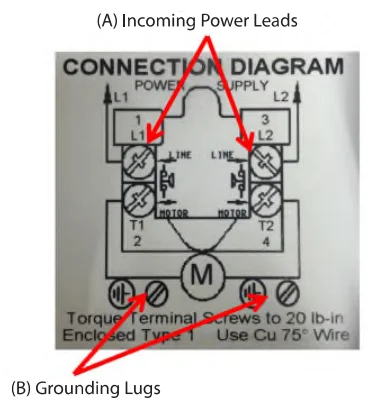
Ground wires not shown for clarity. Equipment must be properly grounded.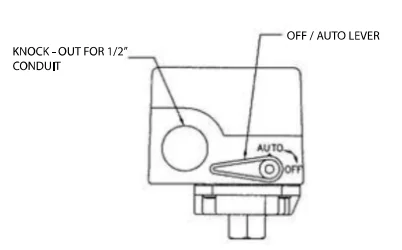
- A = Incoming power leads (see notes 3 & 4)
- B = Incoming grounding lug (see note 2)
- Confirm that the supply voltage matches the voltage rating of the pressure switch (label can be found inside the cover of the pressure switch).
- Connect the power supply to a properly grounded electrical circuit with specified voltage and fuse protection.
- When connecting the incoming power wires to the pressure switch, ensure that the existing control circuit wires remain under the terminal pressure plates and are secure after tightening the screw terminals. Utilize the split ring terminal type of connector for the incoming power leads.
- Refer to the torque values listed on the side of the pressure switch when tightening the wire terminal screws.
COMPRESSOR LUBRICATION
CAUTION: Do not operate without lubricant or with inadequate lubricant. Ingersoll Rand is not responsible for compressor failure caused by inadequate lubrication.
SYNTHETIC COMPRESSOR LUBRICANT
Ingersoll Rand recommends All-Season Select synthetic lubricant from the start-up. See the WARRANTY for extended warranty information.
ALTERNATE LUBRICANTS
You may use XL-300 or a comparable petroleum-based lubricant that is premium quality, does not contain detergents, contains only anti-rust, anti-oxidation, and anti-foam agents as additives, has a flashpoint of 440°F (227°C) or higher, and has an auto-ignition point of 650°F (343°C) or higher. See the petroleum lubricant viscosity table below. The table is intended as a general guide only. Heavy-duty operating conditions require heavier viscosities. Refer specific operating conditions to Ingersoll Rand for recommendations.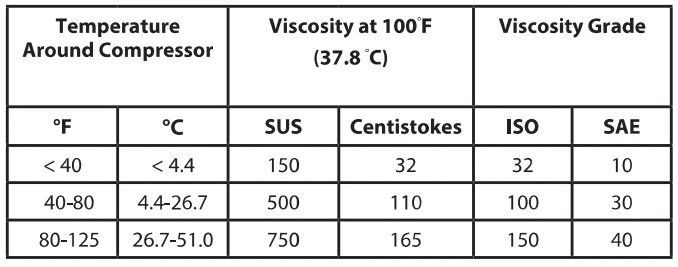
If you use a petroleum-based compressor lubricant at start-up and decide to convert to All-Season Select later on, the pump must be decarbonized and flushed before conversion. Contact Ingersoll Rand for more information.
FILLING PROCEDURES:
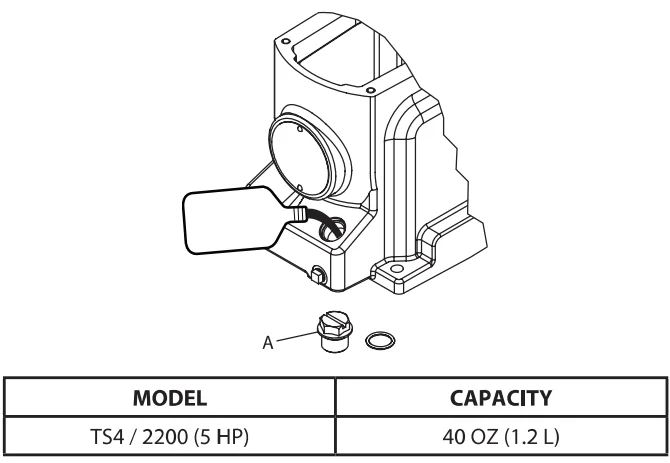
- Unscrew and remove the oil fill plug.
- Fill the crankcase with lubricant.
- Replace the oil fill plug, hand-tight only.

Use one of the following methods illustrated to determine when the crankcase is full.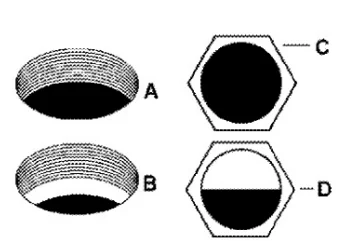
- A = FULL level at the bottom thread of the oil fill opening on units without a sight glass.
- B = ADD level below the bottom thread of the oil fill opening on units without a sight glass.
- C = FULL level on units with a sight glass.
- D = ADD level on units with the sight glass.
OPERATION
START-UP
The pressure switch is preset at the required pressure. The range and differential settings are not adjustable. The pressure switch should not be tampered with in any way, and no attempt should be made to adjust the pressure settings, as this could damage the switch to the point of failure and/or void any warranty for the pressure switch.
- Close the service valve.
- Release any remaining tank pressure by slowly opening the manual drain valve.
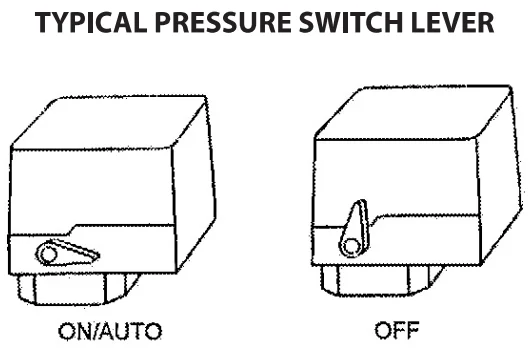
- Close the manual drain valve and apply power to the compressor. The pressure switch is equipped with an “ON/AUTO-OFF” lever; flip the switch to the “ON/AUTO” position.

- Slowly open the service valve.
OIL CONSUMPTION CHECK
A rule of thumb in determining a “passing grade” for oil consumption is to consider consumption at or above 50 horsepower-hours per ounce to be acceptable. The formula is as follows:
- Horsepower × Hours of Operation = Horsepower Hours
- Ounces of Oil Used per Ounce
To apply this formula, consider the size of the machine. In the following example, a 5-horsepower compressor uses 2 ounces of oil every 20 hours of operation.
- 5 Horsepower × 20 Hours of Operation = 50 Horsepower Hours
- 2 Ounces of Oil Used per Ounce
The compressor in the example passes the oil consumption test.
MAINTENANCE
FILTER INSPECTION & CLEANING
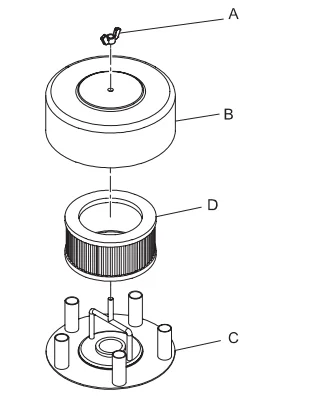
- Unscrew and remove the wing nut (A) securing the filter housing (B) to its base (C).
- Remove the filter housing and withdraw the old filter element (D). Clean the element with a jet of air or vacuum.
- Replace the filter element and housing, securing it in place with the wing nut previously removed.

OIL CHANGE
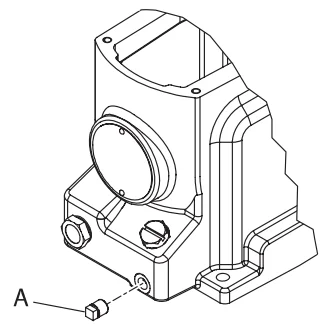
- Remove the oil drain plug (A) and allow the lubricant to drain into a suitable container.

- Replace the oil drain plug.
- Follow the filling procedures in the OPERATION section.
BELT ADJUSTMENT
CHECKING BELT TENSION
Check belt tension occasionally, especially if looseness is suspected. New belts must also be properly tensioned upon installation.
TENSIONING BELTS
Belt tensioning can be achieved by loosening the motor anchor screws, pushing the motor away from the pump, and retightening the motor anchor screws. The motor can be easily moved by placing a prying tool beneath it. A commercially available spreader or other belt tensioning device can also be helpful.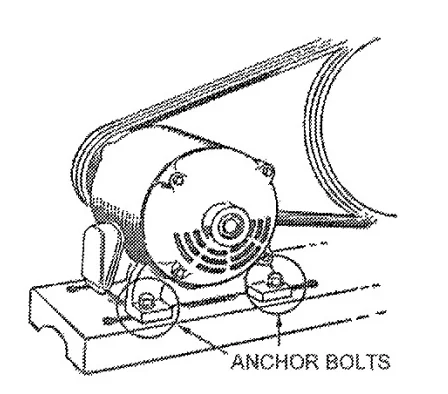
Follow the procedures outlined below to correctly set and measure belt tension. Refer to the following illustration for a visual representation.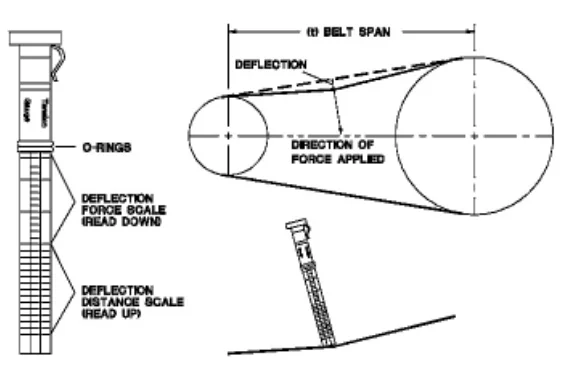
- Lay a straight edge across the top outer surface of the belt drive from pulley to sheave.
- At the center of the span, perpendicular to the belt, apply pressure to the outer surface of the belt with a tension gauge. Force the belt to the deflection indicated in the BELT TENSION TABLE in the DIAGRAMS & TABLES section. Compare the reading on the tension gauge to the table.
Ensure the pulley and sheave are properly aligned, and the motor anchor screws are adequately retightened before restarting the compressor. To prevent these problems from occurring, ensure the pulley and sheave are aligned, and the belt tension is satisfactory after installing new belts or tensioning existing belts.
TANK INSPECTION
The life of an air receiver tank is dependent upon several factors, including, but not limited to, operating conditions, ambient environments, and the level of maintenance. The exact effect of these factors on tank life is difficult to predict; therefore, Ingersoll Rand recommends that you schedule a certified tank inspection within the first five years of compressor service. To arrange a tank inspection, contact Ingersoll Rand. If the tank has not been inspected within the first 10 years of compressor service, the receiver must be taken out of service until it has passed inspection. Tanks that fail to meet requirements must be replaced.
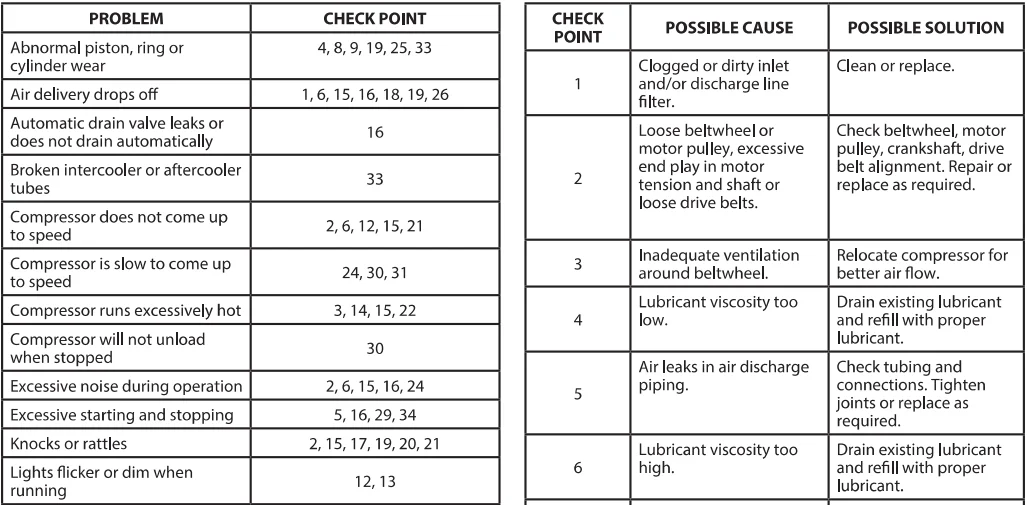
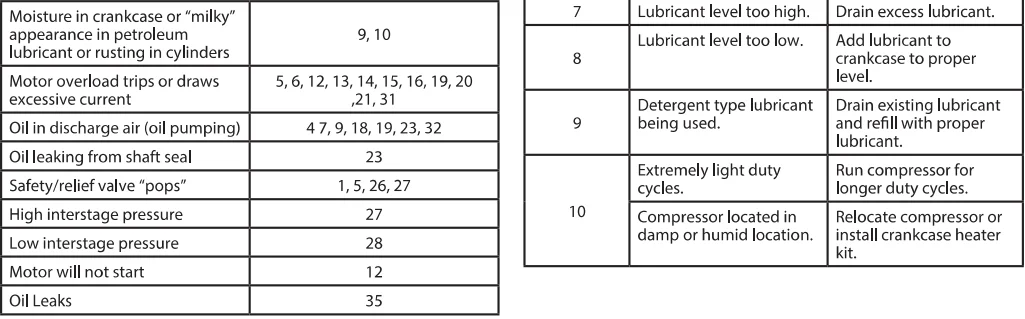
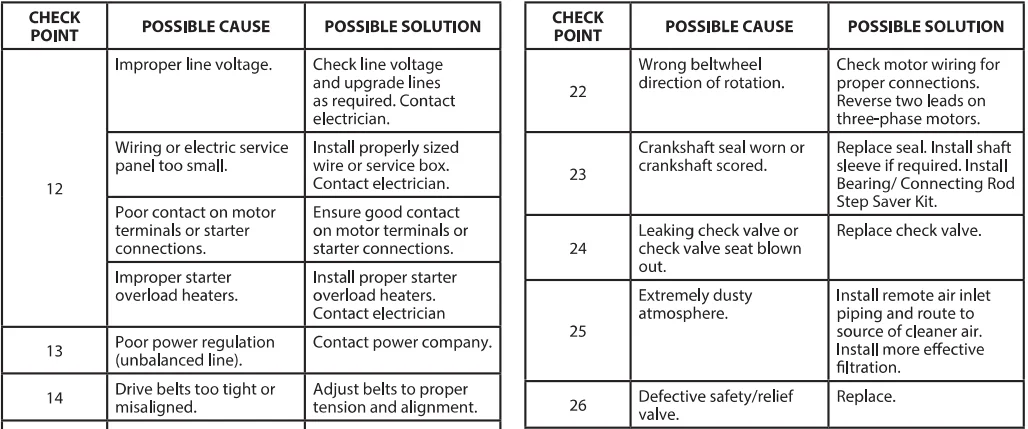
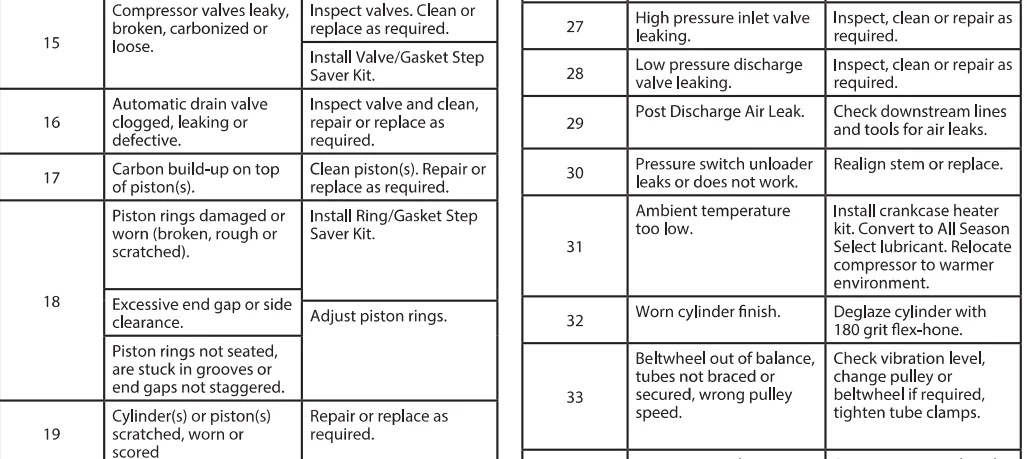
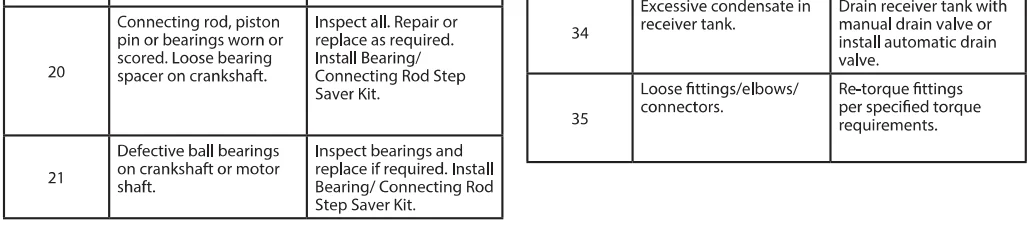
TROUBLESHOOTING
Visit ingersollrandproducts.com for more details.
For More Manuals By Ingersoll-Rand, Visit ManualsLibraryy.
Ingersoll-Rand TS4 Electric Driven Reciprocating Compressor -FAQS
What is the Ingersoll-Rand TS4 reciprocating compressor?
The Ingersoll-Rand TS4 is an electric-driven reciprocating air compressor designed for high-pressure industrial and workshop applications requiring reliable compressed air delivery.
What is the working principle of a reciprocating compressor?
Air enters the cylinder through a suction valve, is compressed by a piston driven by a crankshaft, and exits through a discharge valve at higher pressure.
What applications are reciprocating compressors best suited for?
They are ideal for high-pressure tasks such as spray painting, industrial processes, pneumatic tools, and intermittent-duty operations.
How do you troubleshoot a reciprocating compressor?
Start by checking the power supply, circuit breaker, wiring size, oil level, belts, and the condition of the check valve.
vWhat is the maximum safe discharge temperature for a compressor?
Discharge line temperature should not exceed 225°F (107°C) to prevent oil breakdown and carbon buildup.
How can you tell if a compressor is weak or inefficient?
Signs include reduced airflow, slower pressure buildup, abnormal noise, overheating, or frequent shutdowns.
What are common problems with reciprocating compressors?
Typical faults include gas leakage, mechanical wear, lubrication problems, irregular exhaust, and overheating.
What is the most common cause of reciprocating compressor failure?
Lubrication failure is the leading cause, often due to overheating, dirty coolers, low oil levels, or extended service intervals.