
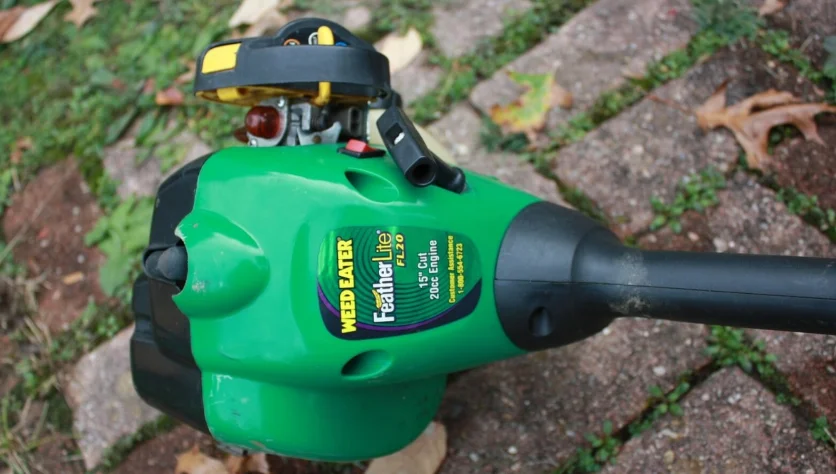

Weed Eater FL20 Grass Trimmer
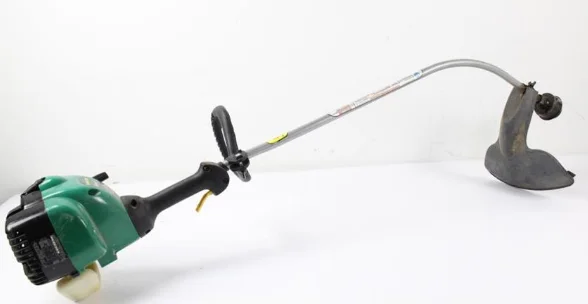
ASSEMBLY
WARNING: If received assembled, repeat all steps to ensure your unit is properly assembled and all fasteners are secure. Examine parts for damage. Do not use damaged parts.
NOTE: If you need assistance or find parts missing or damaged, call 1-800-554-6723. It is normal for the fuel filter to rattle in the empty fuel tank. Finding fuel or oil residue on the muffler is normal due to carburetor adjustments and testing done by the manufacturer.
ADJUSTING THE HANDLE
WARNING: When adjusting the assist handle, be sure it remains above the safety label and below the mark or arrow on the shaft.
- Loosen the wing nut on the handle.
- Rotate the handle on the shaft to an upright position; retighten the wing nut.
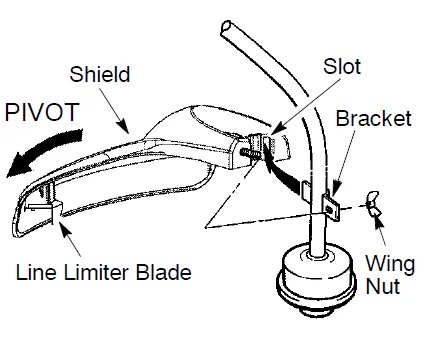
ATTACHING SHIELD
WARNING: The shield must be properly installed. The shield provides partial protection from the risk of thrown objects to the operator and others and is equipped with a line limiter blade, which cuts excess line to the proper length. The line limiter blade (on the underside of the shield) is sharp and can cut you. For proper orientation of the shield, see KNOW YOUR TRIMMER illustration in the OPERATION section.
- Remove the wing nut from the shield.
- Insert the bracket into the slot as shown.
- Pivot shield until the bolt passes through the hole in the bracket.
- Securely tighten the wing nut onto the bolt.

OPERATION
KNOW YOUR TRIMMER
READ THIS INSTRUCTION MANUAL AND SAFETY RULES BEFORE OPERATING YOUR UNIT. Compare the illustrations with your unit to familiarize yourself with the location of the various controls and adjustments. Save this manual for future reference.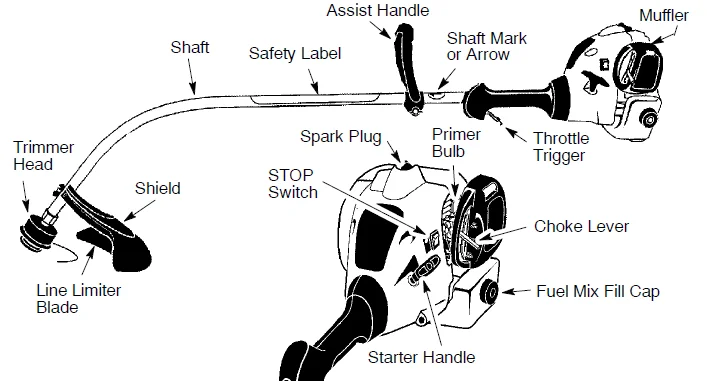
STOP SWITCH
The STOP switch is used to stop the engine. To stop the engine, push and hold the switch in the STOP position until the engine stops.
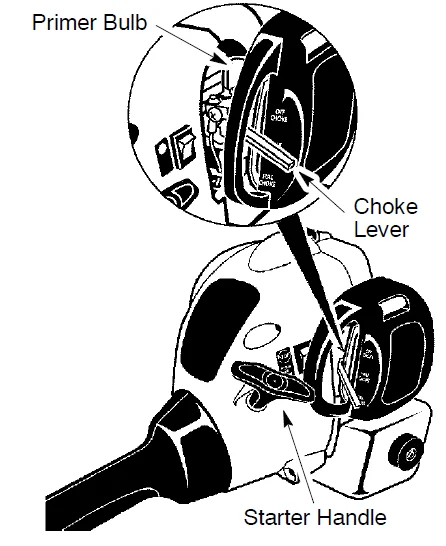
PRIMER BULB
The PRIMER BULB removes air from the carburetor and fuel lines and fills them with fuel. This allows you to start the engine with fewer pulls on the starter rope. Activate the primer bulb by pressing it and allowing it to return to its original form.
CHOKE
The CHOKE helps to supply fuel to the engine to aid in cold starting. Activate the choke by moving the choke lever to the FULL CHOKE position. After the engine attempts to start, move the choke lever to the HALF CHOKE position. Once the engine has started, move the choke lever to the RUN position.
BEFORE STARTING THE ENGINE
WARNING: Be sure to read the fuel information in the safety rules before you begin. If you do not understand the safety rules, do not attempt to fuel your unit. Call 1-800-554-6723.
FUELING ENGINE
WARNING: Remove fuel cap slowly when refueling. This engine is certified to operate on unleaded gasoline. Before operation, gasoline must be mixed with a good quality synthetic 2-cycle air-cooled engine oil designed to be mixed at a ratio of 40:1. Poulan/WEED EATER brand synthetic oil is recommended. Mix gasoline and oil at a ratio of 40:1. A 40:1 ratio is obtained by mixing 3.2 fluid ounces (95 ml) of oil with 1 gallon (4 liters) of unleaded gasoline.
DO NOT USE automotive oil or marine oil. These oils will cause engine damage. When mixing fuel, follow the instructions printed on the container. Once oil is added to gasoline, shake the container momentarily to ensure that the fuel is thoroughly mixed. Always read and follow the safety rules relating to fuel before fueling your unit.
CAUTION: Never use straight gasoline in your unit. This will cause permanent engine damage and void the limited warranty.
FUEL REQUIREMENTS
This engine requires the use of a minimum of 87 octane [R+M]/2 clean gasoline.
IMPORTANT
Use of alcohol blended fuels (called gasohol, ethanol, or methanol) can cause major engine performance and durability problems. Alternative fuels (not gasoline) such as E-15 (15% alcohol), E-20 (20% alcohol), E-85 (85% alcohol) are NOT classified as gasoline and are NOT approved for use in 2-stroke gasoline engines.
Use of alternative fuels will cause problems such as improper clutch engagements, overheating, vapor lock, power loss, lubrication deficiency, deterioration of fuel lines, gaskets, and internal carburetor components, etc. Alternative fuels cause high moisture absorption into the fuel/oil mixture, leading to oil and fuel separation.
HOW TO STOP YOUR UNIT
- To stop the engine, push and hold the STOP switch in the STOP position until the engine stops.
- If the engine does not stop, move the choke to the FULL CHOKE position.
HOW TO START YOUR UNIT
WARNING: The trimmer head will turn while starting the engine. Avoid any contact with the muffler. A hot muffler can cause serious burns.
STARTING A COLD ENGINE (or a warm engine after running out of fuel)
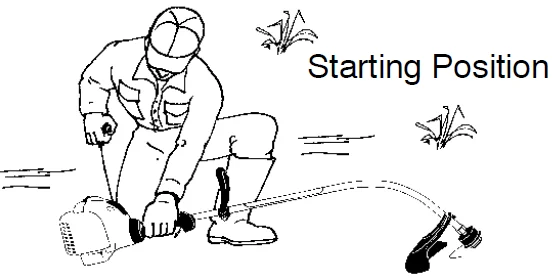
- Set the unit on a flat surface.
- Slowly press the primer bulb 6 times.
- Move the choke lever to the FULL CHOKE position.
- Squeeze the throttle trigger fully and hold through all remaining steps.

- Pull the starter rope handle sharply until the engine sounds as if it is trying to start, but do not pull the rope more than 6 times.
- As soon as the engine sounds as if it is trying to start, move the choke lever to the HALF CHOKE position.
- Pull the starter rope sharply until the engine runs, but no more than 6 pulls. NOTE: If the engine doesn’t start after 6 pulls (at the HALF CHOKE position), move the choke lever to the FULL CHOKE position and press the primer bulb 6 times. Squeeze and hold the throttle trigger and pull the starter rope 2 more times. Move the choke lever to the HALF CHOKE position and pull the starter rope until the engine runs, but no more than 6 pulls. If the engine still doesn’t start, it is probably flooded. Proceed to STARTING A FLOODED ENGINE.
- Once the engine starts, allow it to run 10 seconds, then move the choke lever to the RUN position. Allow the unit to run for 30 more seconds at RUN before releasing the throttle trigger. NOTE: If the engine dies with the choke lever in the RUN position, move the choke lever to the HALF CHOKE position and pull the rope until the engine runs, but no more than 6 pulls.
STARTING A WARM ENGINE
- Move the choke lever to the HALF CHOKE position.
- Squeeze and hold the throttle trigger. Keep the throttle trigger fully squeezed until the engine runs smoothly.
- Pull the starter rope sharply until the engine runs, but no more than 6 pulls.
- Allow the engine to run 15 seconds, then move the choke lever to RUN.
NOTE: If the engine has not started, pull the starter rope 5 more times. If the engine still does not run, it is probably flooded.
STARTING A FLOODED ENGINE
Flooded engines can be started by placing the choke lever in the RUN position; then, pull the rope to clear the engine of excess fuel. This could require pulling the starter handle many times, depending on how badly the unit is flooded. If the unit still doesn’t start, refer to the TROUBLESHOOTING TABLE or call 1-800-554-6723.
OPERATING INSTRUCTIONS
It is recommended that the engine not be operated for longer than 1 minute at full throttle.
OPERATING POSITION
WARNING: Always wear eye protection. Never lean over the trimmer head. Rocks or debris can ricochet or be thrown into the eyes and face and cause blindness or other serious injury.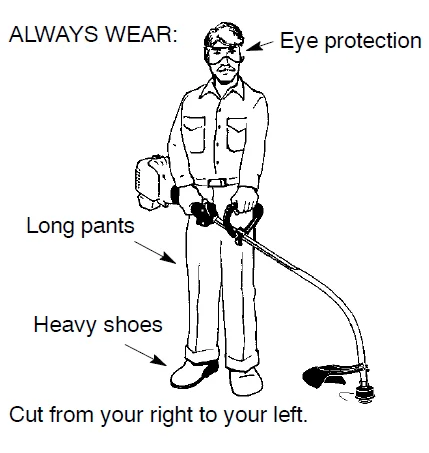
Do not run the engine at a higher speed than necessary. The cutting line will cut efficiently when the engine is run at less than full throttle. At lower speeds, there is less engine noise and vibration. The cutting line will last longer and will be less likely to “weld” onto the spool. Always release the throttle trigger and allow the engine to return to idle speed when not cutting.
To stop the engine:
- Release the throttle trigger.
- Push and hold the STOP switch in the STOP position until the engine stops.
TRIMMER LINE ADVANCE
The trimmer line will advance approximately 2 inches (5 cm) each time the bottom of the trimmer head is tapped on the ground with the engine running at full throttle. The most efficient line length is the maximum length allowed by the line limiter. Always keep the shield in place when the tool is being operated.
To advance line:
- Operate the engine at full throttle.
- Hold the trimmer head parallel to and above the grassy area.
- Tap the bottom of the trimmer head lightly on the ground one time. Approximately 2 inches (5 cm) of line will be advanced with each tap.
Always tap the trimmer head on a grassy area. Tapping on surfaces such as concrete or asphalt can cause excessive wear to the trimmer head. If the line is worn down to 2 inches (5 cm) or less, more than one tap will be required to obtain the most efficient line length.
WARNING: Use only 0.065″ (1.65 mm) diameter line. Other sizes of line will not advance properly and will result in improper cutting head function, or can cause serious injury. Do not use other materials such as wire, string, rope, etc. A wire can break off during cutting and become a dangerous missile that can cause serious injury.
CUTTING METHODS
WARNING: Use minimum speed and do not crowd the line when cutting around hard objects (rock, gravel, fence posts, etc.), which can damage the trimmer head, become entangled in the line, or be thrown, causing a serious hazard.
- The tip of the line does the cutting. You will achieve the best performance and minimum line wear by not crowding the line into the cutting area. The right and wrong ways are shown below.

- The line will easily remove grass and weeds from around walls, fences, trees, and flower beds, but it also can cut the tender bark of trees or shrubs and scar fences. To help avoid damage, especially to delicate vegetation or trees with tender bark, shorten the line to 4-5 inches (10-13 cm) and use at less than full throttle.
- For trimming or scalping, use less than full throttle to increase line life and decrease head wear, especially:
- During light-duty cutting.
- Near objects around which the line can wrap, such as small posts, trees, or fence wire.
- For mowing or sweeping, use full throttle for a good clean job.
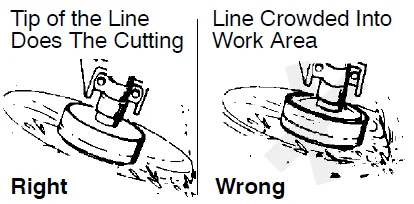
TRIMMING — Hold the bottom of the trimmer head about 3 inches (8 cm) above the ground and at an angle. Allow only the tip of the line to make contact. Do not force the trimmer line into the work area.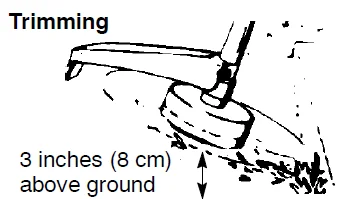
SCALPING — The scalping technique removes unwanted vegetation down to the ground. Hold the bottom of the trimmer head about 3 inches (8 cm) above the ground and at an angle. Allow the tip of the line to strike the ground around trees, posts, monuments, etc. This technique increases line wear.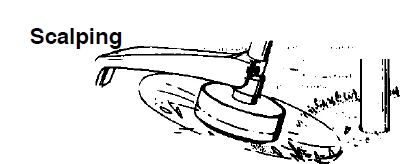
MOWING — Your trimmer is ideal for mowing in places conventional lawn mowers cannot reach. In the mowing position, keep the line parallel to the ground. Avoid pressing the head into the ground as this can scalp the ground and damage the tool.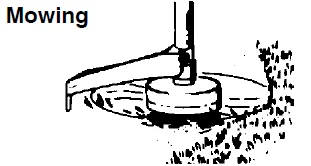
SWEEPING — The fanning action of the rotating line can be used for a quick and easy cleanup. Keep the line parallel to and above the surfaces being swept and move the tool from side to side.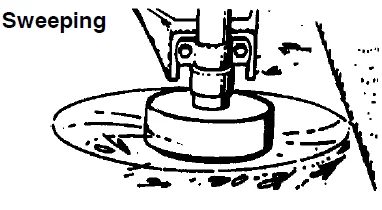
MAINTENANCE
CHECK FOR LOOSE FASTENERS AND PARTS
- Spark Plug Boot
- Air Filter
- Housing Screws
- Assist Handle Screws
- Debris Shield
CHECK FOR DAMAGED OR WORN PARTS
Contact an authorized service dealer for the replacement of damaged or worn parts.
- STOP Switch — Ensure the STOP switch functions properly by pushing and holding the switch in the STOP position. Make sure the engine stops. Restart the engine and continue.
- Fuel Tank — Discontinue use of the unit if the fuel tank shows signs of damage or leaks.
- Debris Shield — Discontinue use of the unit if the debris shield is damaged.
INSPECT AND CLEAN THE UNIT AND LABELS
- After each use, inspect the complete unit for loose or damaged parts. Clean the unit and labels using a damp cloth with a mild detergent.
- Swipe off the unit with a clean, dry cloth.
CLEAN AIR FILTER
A dirty air filter decreases engine performance and increases fuel consumption and harmful emissions. Always clean after every 5 hours of operation.
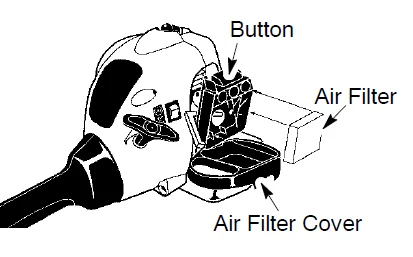
- Clean the air filter cover and the area around it to keep dirt from falling into the carburetor chamber when the cover is opened.
- Open the air filter cover by pushing the button (see illustration). Remove the air filter. NOTE: To avoid creating a fire hazard or producing harmful evaporative emissions, do not clean the filter in gasoline or other flammable solvents.
- Wash the filter in soap and water.
- Allow the filter to dry.
- Replace the air filter and close the cover.

WARNING: The muffler on this product contains chemicals known to the State of California to cause cancer. As your unit is used, carbon deposits build up on the muffler and spark-arresting screen. For normal homeowner use, however, the muffler and spark-arresting screen will not require any service. After 50 hours of use, we recommend that your muffler be serviced or replaced by your authorized service dealer.
SERVICE AND ADJUSTMENTS
LINE REPLACEMENT
- Remove the spool by firmly pulling on the tap button.
- Clean the entire surface of the hub and spool.
- Replace with a pre-wound spool, or cut a length of 18 feet of 0.065″ (1.65 mm) diameter WEED EATER brand line. WARNING: Never use wire, rope, string, etc., which can break off and become a dangerous missile.
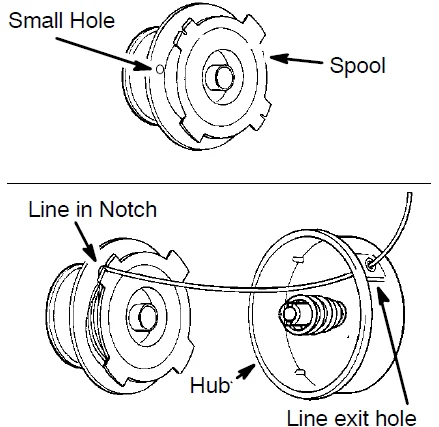
- Insert one end of the line about 1/2 inch (1 cm) into the small hole on the inside of the spool.

- Wind the line evenly and tightly onto the spool. Wind in the direction of the arrow found on the spool.
- Push the line into the notches, leaving 3 to 5 inches (7-12 cm) unwound.
- Insert the lines into the exit holes in the hub as shown in the illustration.
- Align the notch with the line exit hole.
- Push the spool into the hub until it snaps into place.
- Pull the line extending outside of the hub to release it from the notch.
REPLACING THE TRIMMER HEAD
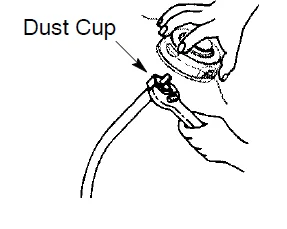
- Hold the dust cup with a wrench to keep the shaft from turning while removing and installing the trimmer head.

- Remove the trimmer head by turning counterclockwise (looking from the bottom of the unit).
- Thread the replacement trimmer head onto the shaft by turning clockwise. Only tighten your hand tight!
CARBURETOR IDLE SPEED ADJUSTMENT
WARNING: Keep others away when making idle speed adjustments. The trimmer head will be spinning during this procedure. Wear your protective equipment and observe all safety precautions.
- The carburetor has been carefully set at the factory. Adjustments may be necessary if you notice any of the following conditions:
- The engine will not idle when the throttle is released.
- Make adjustments with the unit supported so that the cutting attachment is off the ground and will not make contact with any object. Hold the unit by hand while running and making adjustments. Keep all parts of your body away from the cutting attachment and muffler.
To adjust idle speed:
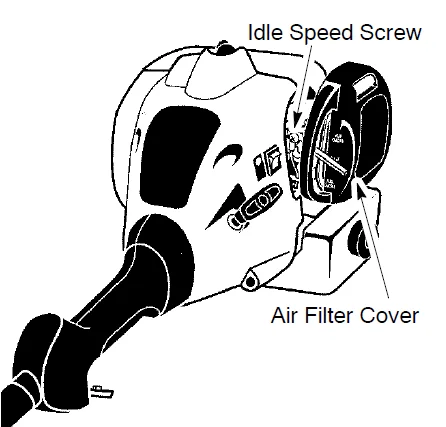
- Allow the engine to idle. Adjust speed until engine runs without stalling (idle speed too slow).
- Turn the idle speed screw clockwise to increase engine speed if the engine stalls or dies.

- Turn the idle speed screw counterclockwise to decrease engine speed.
If you require further assistance or are unsure about performing this procedure, contact an authorized service dealer or call 1-800-554-6723.
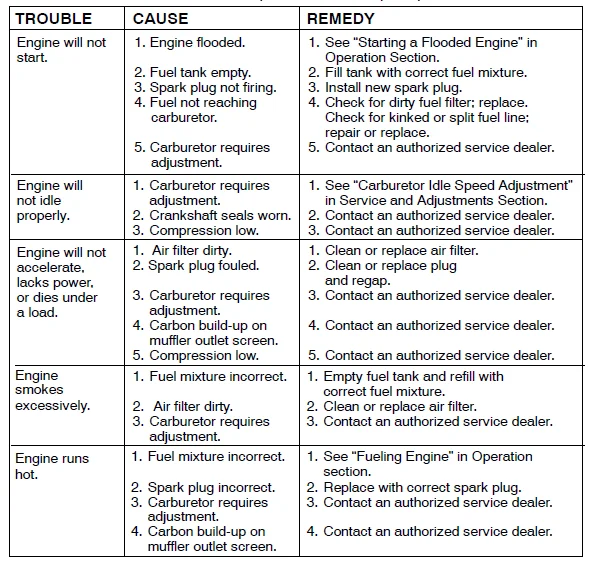
TROUBLESHOOTING TABLE
LIMITED WARRANTY
WEED EATER, a division of Husqvarna Consumer Outdoor Products N.A., Inc., warrants to the original consumer purchaser that each new WEED EATER brand gasoline tool or attachment is free from defects in material and workmanship and agrees to repair or replace under this warranty any defective gasoline product or attachment as follows from the original date of purchase.
2 YEARS — Parts and Labor, when used for household purposes.
90 DAYS — Parts and Labor, when used for commercial, professional, or income-producing purposes.
30 DAYS — Parts and Labor, if used for rental purposes.
This warranty is not transferable and does not cover damage or liability caused by improper handling, improper maintenance, or alteration, or the use of accessories and/or attachments not specifically recommended by WEED EATER for this tool. This warranty does not cover tune-up, spark plugs, filters, starter ropes, starter springs, cutting line, or rotating head parts that will wear and require replacement with reasonable use during the warranty period.
This warranty does not cover pre-delivery setup or normal adjustments explained in the instruction manual. This warranty does not cover transportation costs. In the event you have a claim under this warranty, you must return the product to an authorized service dealer. Should you have any unanswered questions concerning this warranty, please contact: WEED EATER, a division of Husqvarna Consumer Outdoor Products N.A., Inc. 1030 Stevens Creek Road, Augusta, GA 30907, 1-800-554-6723 In Canada, contact: WEED EATER, 850 Matheson Blvd. West, Mississauga, Ontario L5V 0B4
Give the model number, serial number, and date of purchase of your product, and the name and address of the authorized dealer from whom it was purchased. THIS WARRANTY GIVES YOU SPECIFIC LEGAL RIGHTS, AND YOU MAY HAVE OTHER RIGHTS WHICH VARY FROM STATE TO STATE. NO CLAIMS FOR CONSEQUENTIAL OR OTHER DAMAGES WILL BE ALLOWED, AND THERE ARE NO OTHER EXPRESS WARRANTIES EXCEPT THOSE EXPRESSLY STIPULATED HEREIN. SOME STATES DO NOT ALLOW LIMITATIONS ON HOW LONG AN IMPLIED WARRANTY LASTS OR THE EXCLUSION OR LIMITATIONS OF INCIDENTAL OR CONSEQUENTIAL DAMAGES, SO THE ABOVE LIMITATIONS OR EXCLUSIONS MAY NOT APPLY TO YOU.
This is a limited warranty within the meaning of that term as defined in the Magnuson-Moss Act of 1975. The policy of WEED EATER is to continuously improve its products. Therefore, WEED EATER reserves the right to change, modify, or discontinue models, designs, specifications, and accessories of all products at any time without notice or obligation to any purchaser. Visit www.weedeater.com for more information.
For More Manuals By Weed Eater, Visit ManualsLibraryy.
Weed Eater FL20 Grass Trimmer-FAQs
What type of trimmer is the Weed Eater FL20?
The Weed Eater FL20 is a lightweight gas-powered string trimmer designed primarily for residential lawn care. It features a straight shaft design that provides better reach under shrubs and along fences while maintaining good balance during use. It is ideal for trimming grass and light weeds around sidewalks, driveways, and garden beds, making it a practical choice for homeowners who need simple and reliable yard maintenance equipment.
What engine size does the Weed Eater FL20 have?
The FL20 typically comes equipped with a 20cc two-stroke engine. This engine size delivers sufficient power for routine trimming tasks without making the unit too heavy or difficult to handle. It is well-suited for small to medium-sized yards and provides enough torque to cut through standard grass and lighter vegetation efficiently.
How do you start the Weed Eater FL20?
To start the Weed Eater FL20, ensure it has fresh fuel and that the switch is in the on position. Engage the choke for a cold start, press the primer bulb several times to move fuel into the carburetor, and pull the starter rope firmly until the engine fires. Once it begins to run, move the choke to the run position. Proper starting procedure helps prevent engine flooding and ensures smoother ignition.
What fuel mixture does the Weed Eater FL20 require?
The Weed Eater FL20 uses a two-cycle fuel mixture, meaning gasoline must be mixed with two-cycle engine oil. Most models require a 50:1 ratio of unleaded gasoline to high-quality two-cycle oil, but it is important to confirm the exact ratio in the owner’s manual. Using straight gasoline without oil can cause severe engine damage because the oil provides essential lubrication.
How do you replace the trimmer line on the FL20?
Replacing the trimmer line involves turning off the engine and disconnecting the spark plug for safety. The trimmer head cover is removed to access the spool, where new line is wound evenly in the direction indicated. After feeding the line through the eyelets, the spool and cover are secured back in place. Using the correct line diameter ensures proper feeding and cutting performance.
Why does the Weed Eater FL20 stall during operation?
Stalling is often caused by old fuel, a clogged air filter, a dirty carburetor, or a worn spark plug. Two-stroke engines are sensitive to fuel quality, so stale gasoline can quickly cause running issues. Regular cleaning of the air filter and periodic spark plug inspection can significantly reduce stalling and maintain consistent performance.
How often should the Weed Eater FL20 be maintained?
Routine maintenance should be performed throughout the trimming season. The air filter should be checked and cleaned regularly, especially in dusty conditions. The spark plug should be inspected periodically and replaced if worn. Fuel lines and the primer bulb should also be examined for cracks or leaks. Proper maintenance extends the lifespan of the trimmer and ensures reliable starting.
Why won’t my Weed Eater FL20 start?
If the FL20 will not start, common causes include old or improperly mixed fuel, a fouled spark plug, or a clogged carburetor. Checking the fuel mixture, replacing the spark plug, and cleaning the air filter are good first steps. If those do not resolve the issue, the carburetor may need adjustment or cleaning to restore proper fuel flow.
Is the Weed Eater FL20 suitable for thick weeds?
The FL20 is best suited for trimming grass and lighter weeds. While it can handle moderate overgrowth, it may struggle with very dense brush or thick woody stems. For heavy-duty clearing tasks, a more powerful trimmer or brush cutter may be required to achieve efficient results.
How should the Weed Eater FL20 be stored during the off-season?
For long-term storage, it is recommended to empty the fuel tank or add fuel stabilizer and run the engine briefly to clear fuel from the carburetor. The unit should be cleaned of grass and debris and stored in a dry, sheltered location. Proper storage prevents fuel system clogs and ensures easier starting when the trimming season begins again.