
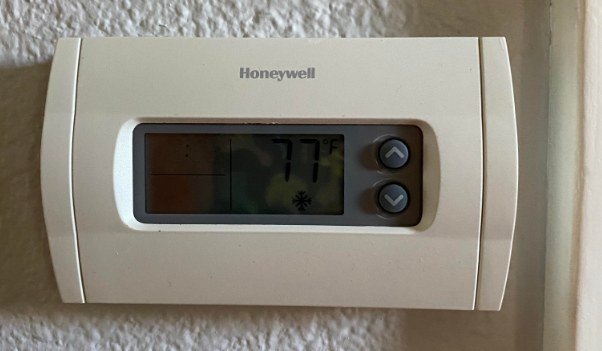

Honeywell RTH110B Non-Programmable Thermostat
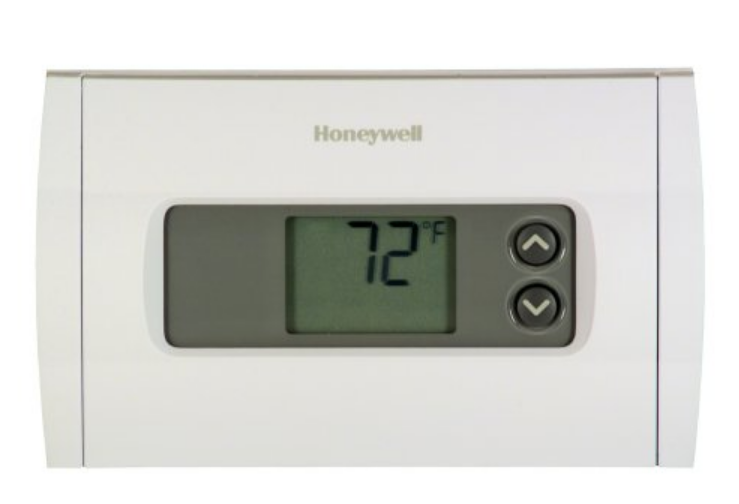
Introduction
The RTH110B non-programmable thermostat can be used to control:
- a gas, fuel oil, or electric furnace – 2 or 3 wires
- a central air conditioner – 2 or 3 wires
- a hot water system with or without a pump – 2 wires
- a millivolt system – 2 wires
- a central heating and cooling system – 4 or 5 wires
Note: This thermostat is not compatible with heat pumps or multistage systems.
Features
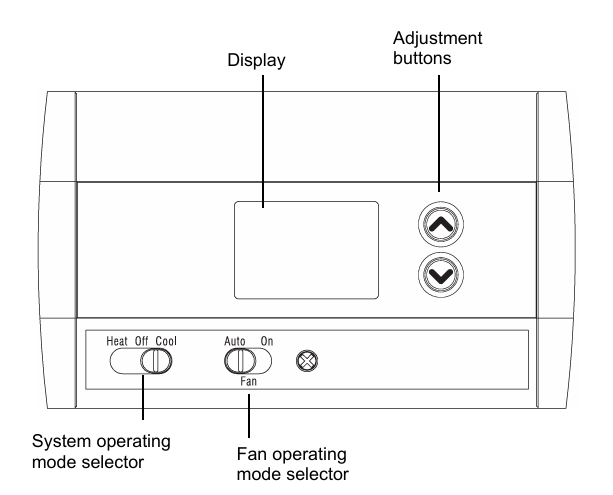
- System operating mode selection: heat, cool, or off
- Fan operating mode selection: automatic or on (continuous)
- Programmable heating and cooling cycle lengths: 10, 12, 15, 2,0 or 30 minutes
- Temperature display in °F or °C
- Battery replacement indicator
Installation
Removing the Old Thermostat
TO AVOID ANY RISK OF ELECTRIC SHOCK, CUT POWER TO THE HEATING SYSTEM.
- Remove the old thermostat to access the wires.
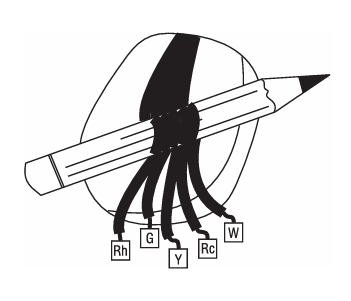
Attention: If the old thermostat was mounted onto an electrical box, it was probably powered by 120/240 volts. In this case, this thermostat cannot be used. - Identify and label each wire (with the corresponding letter on the wire terminal) and remove them from the terminals.
- If necessary, strip the end of each wire (maximum of 1/4 inch).
- Wrap the wires around a pencil to prevent them from falling into the wall.
- If the hole in the wall is too big, insulate it using a non-flammable material in order to avoid air draughts behind the thermostat.

Installing the New Baseplate
For a new installation, choose a location approximately 5 feet (1.5 m) above the floor and on an inside wall. Avoid draughty areas (top of staircase, air outlet, etc.), dead air spots (behind doors), direct sunlight or areas near concealed pipes or chimneys.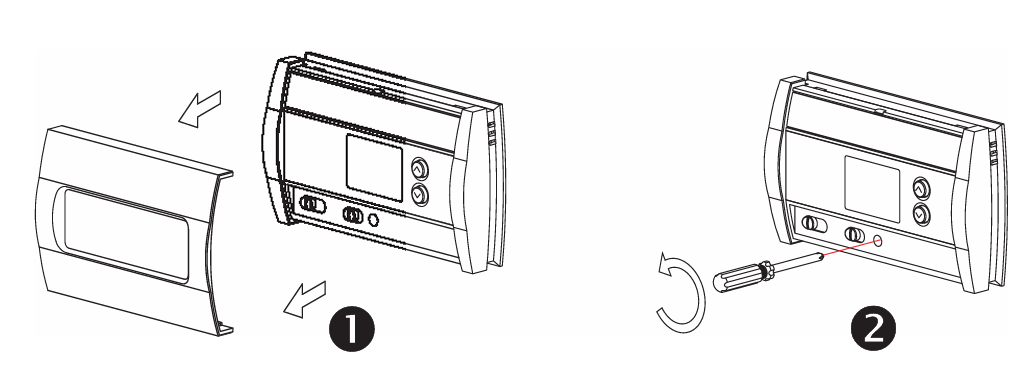
- Remove the thermostat faceplate.
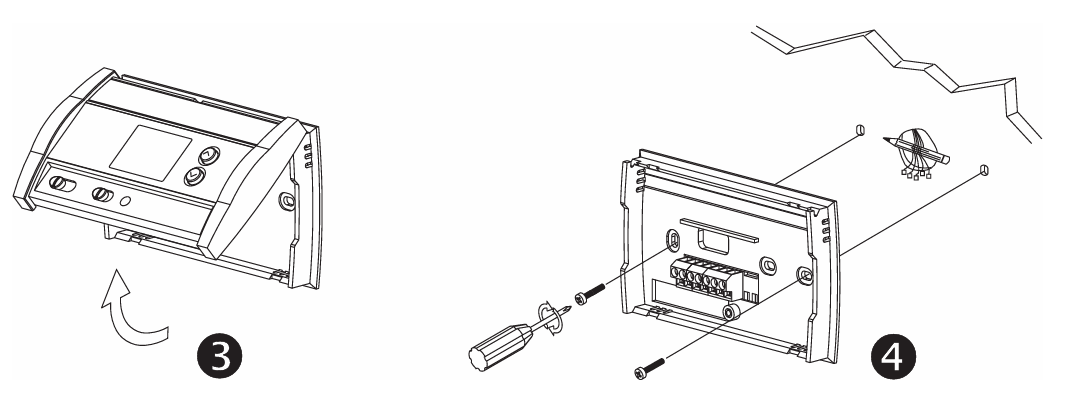
- Loosen the locking screw to separate the thermostat from its baseplate (the screw cannot be completely removed).

- Tilt the thermostat upwards.
- Mark and bore the appropriate mounting holes (or use the existing holes). Insert the plastic anchors.
- Pass the wires through the opening of the baseplate and fix the baseplate to the wall using the screws provided.
Connecting the Thermostat
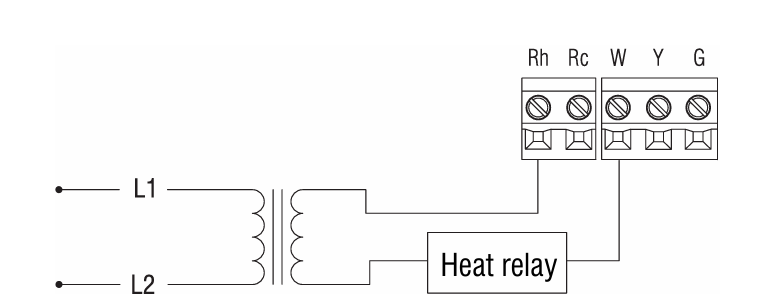
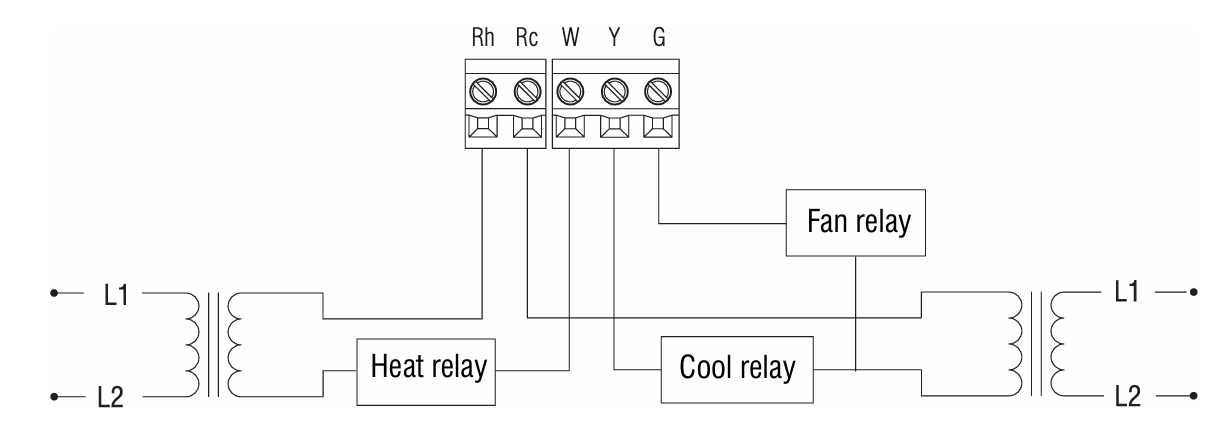
The connection of the new thermostat should be similar to that of the old thermostat; however, it can vary depending on the installation.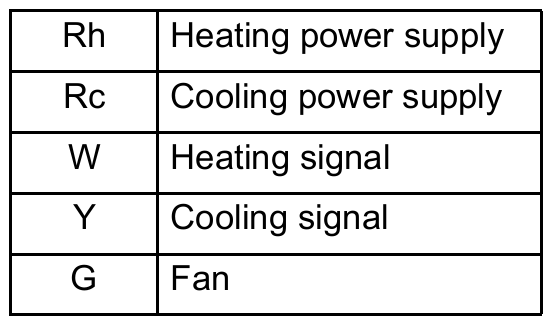
Note: The red jumper wire between the Rc and Rh terminals must be removed in 2- or 5-wire installations. The jumper must be used in 3- or 4-wire installations if you wish to use the mode selector switch for the fan.
2-wire Heating

2-wire Cooling

3-wire Heating

3-wire Cooling

4-wire Heating and Cooling

5-wire Heating and Cooling

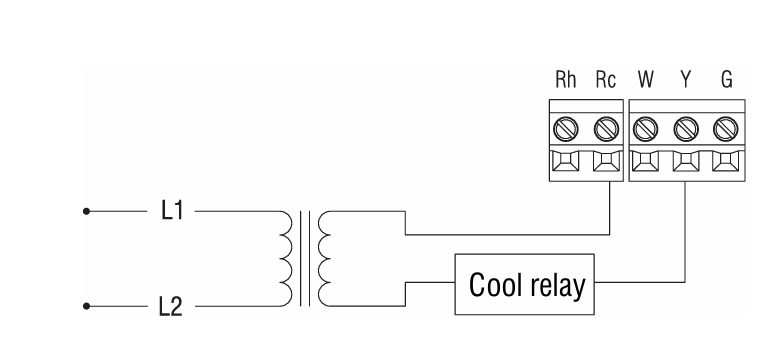
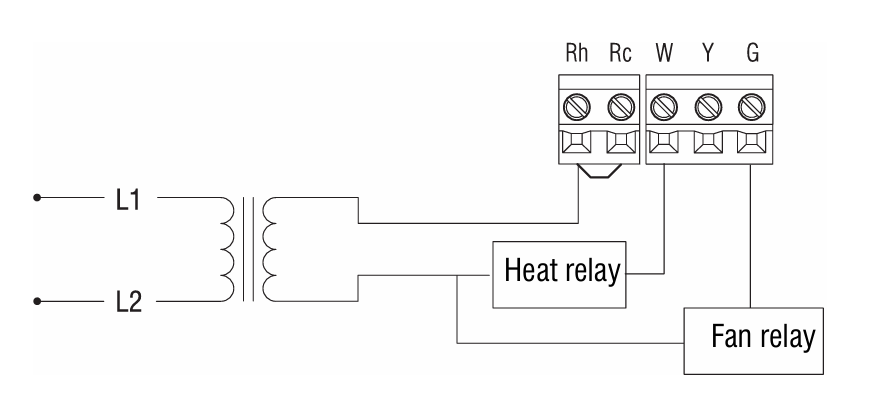
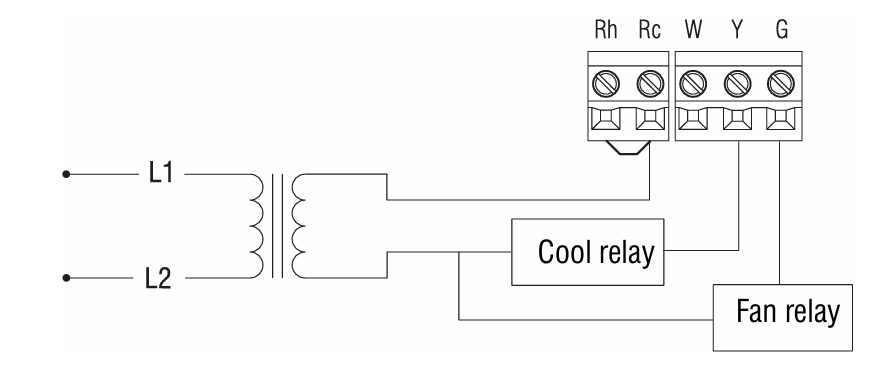
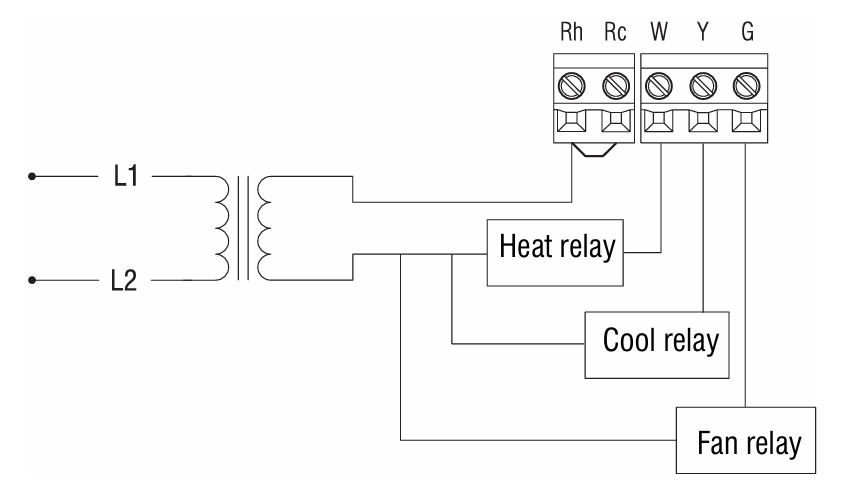
Setting J2 Jumper
The jumper defines the fan operation when the fan is placed in automatic mode.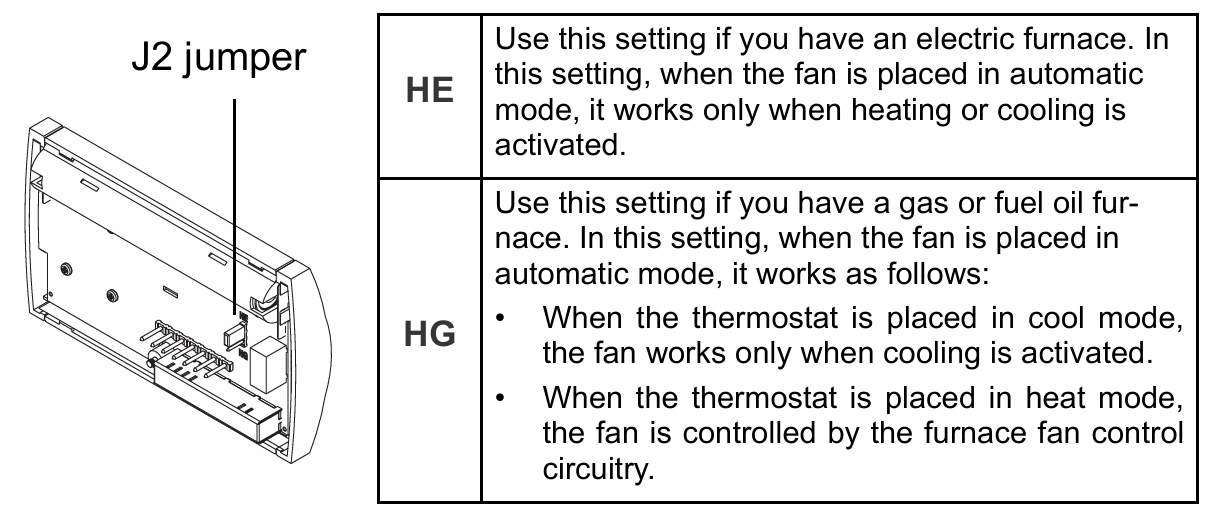
Installing the Batteries
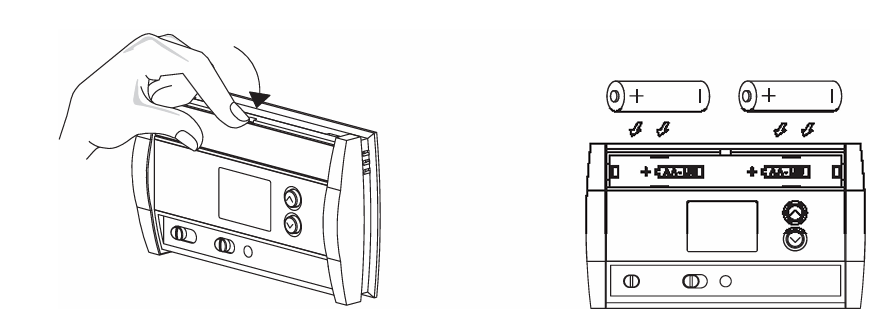
- Pull out the battery cover.
- Install the batteries as shown. Observe the polarity.
- Reinstall the battery cover. You will hear a clicking sound.
After the batteries are installed, the thermostat performs a series of tests for approximately 5 seconds. Afterward, the screen displays the actual temperature. It is normal that the displayed temperature will be higher than the ambient temperature if you hold the thermostat in your hands. It will display the ambient temperature after the thermostat is installed on the wall. By default, the setpoint is 70°F (21°C).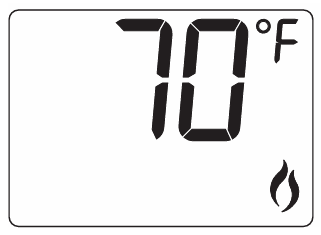
Completing the Installation
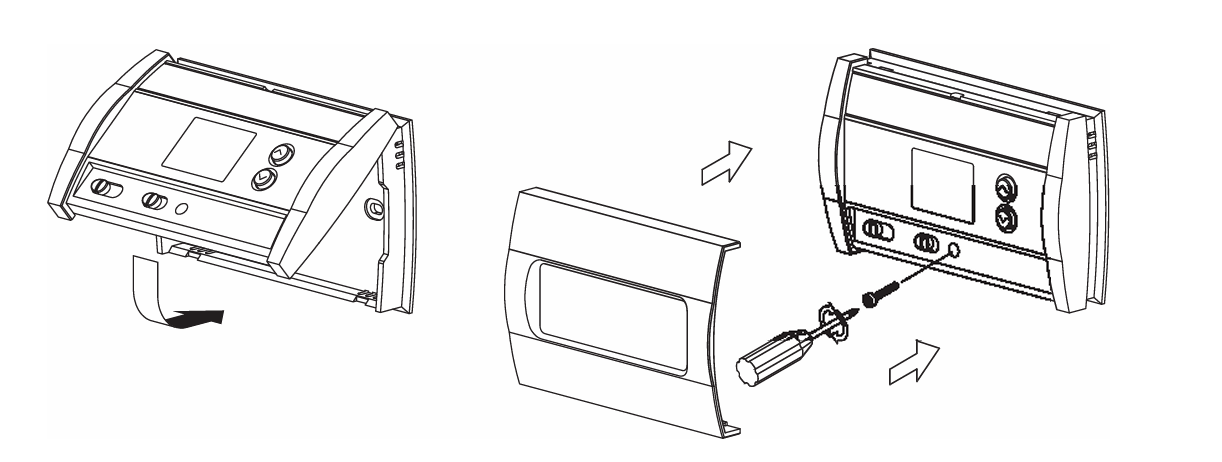
- Once the baseplate and the batteries are installed, mount the thermostat on the baseplate.
- Secure the thermostat using the locking screw and install the faceplate.
- Apply power back to the system.
Basic Functions
System Operating Mode
Use the selector switch to place the system in Heating mode (HEAT) or Cooling mode (COOL), or to turn the system off.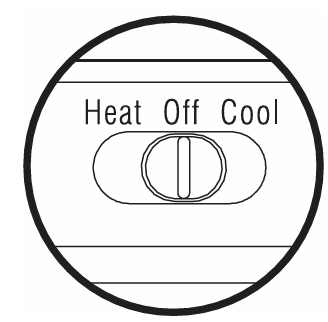
Note: When you place the thermostat in Cooling mode, you might need to wait up to five minutes before cooling can start. This is a safety feature for the compressor will flash on the screen until cooling can start again.
Fan Operating Mode
Use the selector switch to set the fan to automatic mode (AUTO) or continuous mode (ON).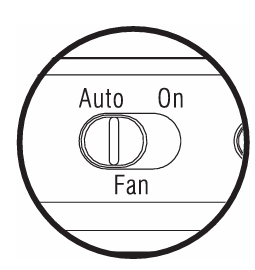
Note: This switch is not used if you have a 2-wire installation, as the fan is not connected to the thermostat.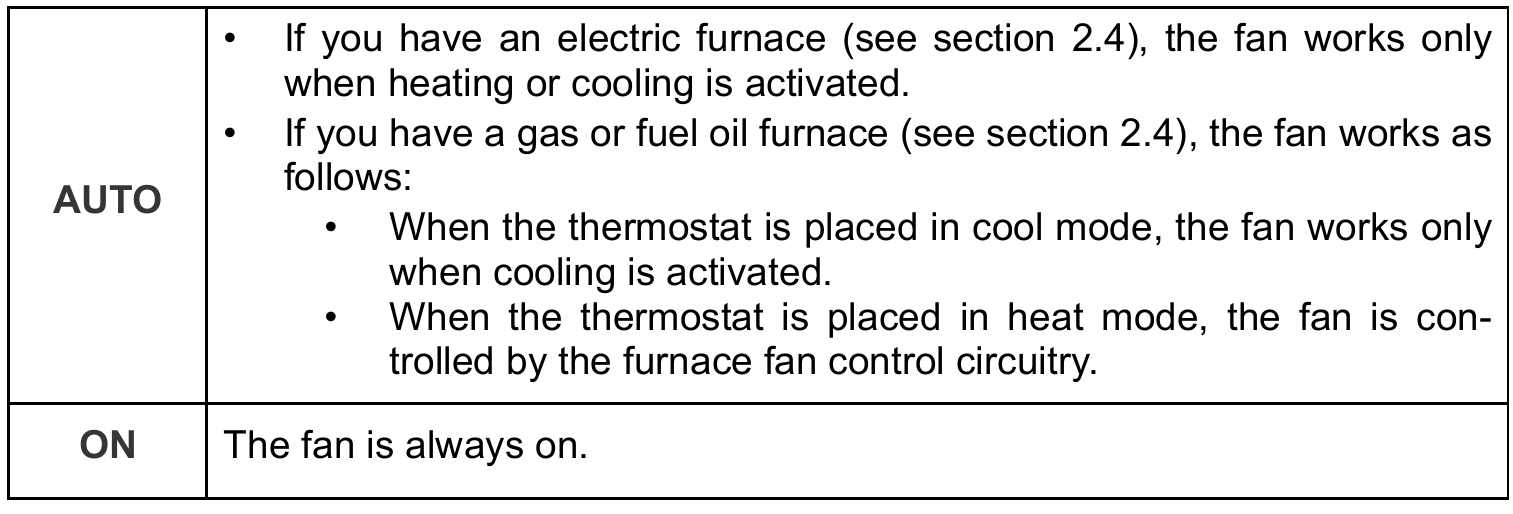
Displaying the Temperature
The actual temperature is normally displayed. To view the setpoint, press once on either of the buttons. The setpoint is displayed for 5 seconds along with the
 icon.
icon.
Note: Pressing any of thebuttons more than once will change the setpoint.
Setting the Temperature
Press one of the buttons until the desired temperature is displayed.
Battery Replacement Indicator
An icon appears when the batteries need replacement. This icon will flash for 120 days, then the thermostat will cut power to the heating/cooling unit. The icon disappears once the batteries are replaced. The temperature Settings are saved and do not need to be re-entered.
Warning: Before removing the batteries, place the system switch on the thermostat to Off. Otherwise, the heating/cooling unit might still be running even after the batteries are removed.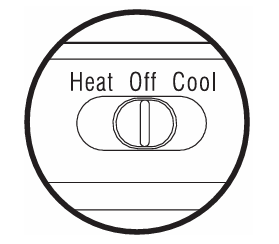
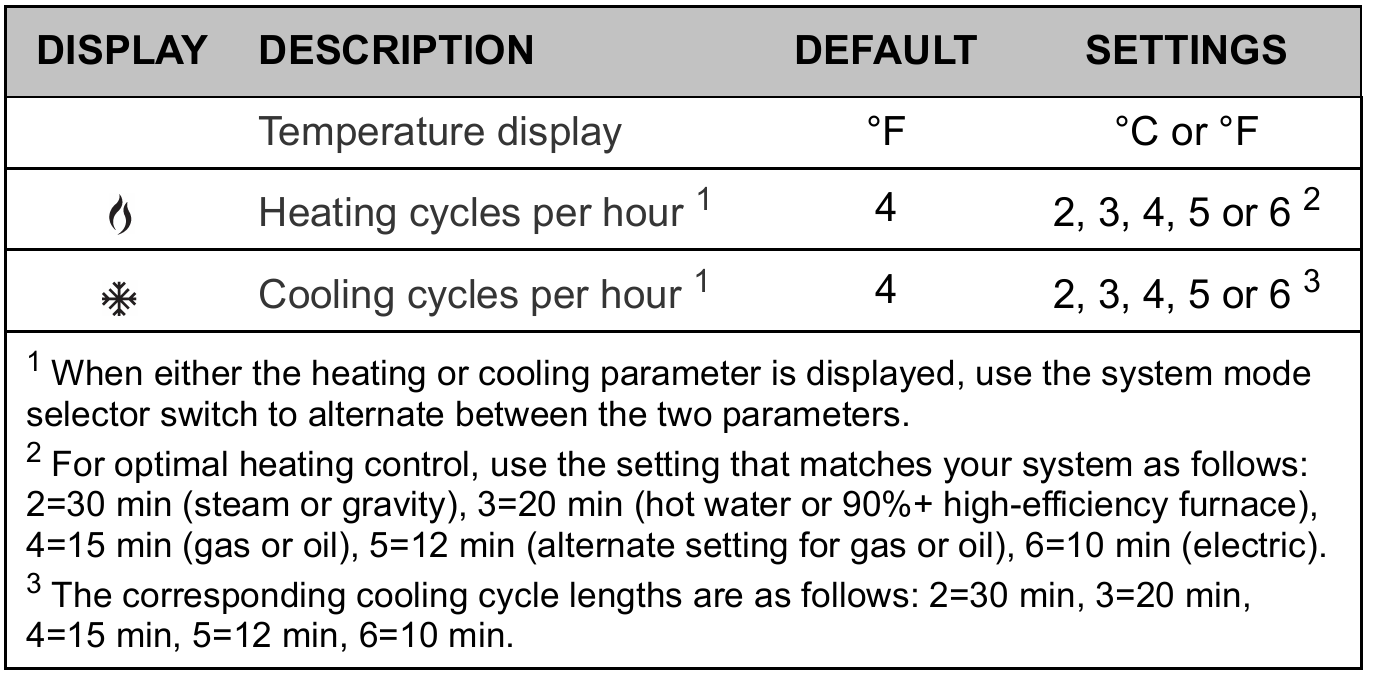
Configuration Menu
- To access the configuration menu, press both
 buttons simultaneously for 3 seconds.
 - To go to the next parameter (menu item), briefly press bothbuttons simultaneously.
- To modify a parameter, press one of thebuttons.
- Repeat steps 2 and 3 if necessary.
- Press bothbuttons simultaneously for 3 seconds to exit the configuration menu.

Technical Specifications
- Power supply: 2 AA batteries
- Maximum load: 1 A @ 24 Vac per output
- Setpoint range (heating): 41 to 82°F (5 to 28°C)
- Setpoint range (cooling): 59 to 95°F (15 to 35°C)
- Display range: 23 to 122°F (-5 to 50°C)
- Storage temperature: -2 to 122°F (-20 to 50°C)
- Temperature display resolution: 1°F (0.5°C)
- Accuracy: ± 1°F (0.5°C)
- Heating/cooling cycle lengths: 10, 12, 15, 20, or 30 minutes (programmable)
- Compressor short-cycle protection (minimum off time): 5 minutes
- Data memory: non-volatile
- Dimensions: 5 in. x 3 in. x 1 in. (127 mm x 75 mm x 28 mm)
Warranty
Honeywell warrants this product, excluding battery, to be free from defects in the workmanship or materials, under normal use and service, for a period of one (1) year from the date of purchase by the consumer. If at any time during the warranty period the product is determined to be defective or malfunctions, Honeywell shall repair or replace it (at Honeywell’s option). If the product is defective,
- return it, with a bill of sale or other dated proof of purchase, to the place from which you purchased it, or
- call Honeywell Customer Care at 1-800-468-1502. Customer Care will make the determination whether the product should be returned to the following address: Honeywell Return Goods, Dock 4 MN10-3860, 1885 Douglas Dr N, Golden Valley, MN 55422, or whether a replacement product can be sent to you.
This warranty does not cover removal or reinstallation costs. This warranty shall not apply if it is shown by Honeywell that the defect or malfunction was caused by damage that occurred while the product was in the possession of a consumer. Honeywell’s sole responsibility shall be to repair or replace the product within the terms stated above. HONEYWELL SHALL NOT BE LIABLE FOR ANY LOSS OR DAMAGE OF ANY KIND, INCLUDING ANY INCIDENTAL OR CONSEQUENTIAL DAMAGES RESULTING, DIRECTLY OR INDIRECTLY, FROM ANY BREACH OF ANY WARRANTY, EXPRESS OR IMPLIED, OR ANY OTHER FAILURE OF THIS PRODUCT. Some states do not allow the exclusion or limitation of incidental or consequential damages, so this limitation may not apply to you. THIS WARRANTY IS THE ONLY EXPRESS WARRANTY HONEYWELL MAKES ON THIS PRODUCT. THE DURATION OF ANY IMPLIED WARRANTIES, INCLUDING THE WARRANTIES OF MERCHANTABILITY AND FITNESS FOR A PARTICULAR PURPOSE, IS HEREBY LIMITED TO THE ONE-YEAR DURATION OF THIS WARRANTY. Some states do not allow limitations on how long an implied warranty lasts, so the above limitation may not apply to you. This warranty gives you specific legal rights, and you may have other rights which vary from state to state. If you have any questions concerning this warranty, please write Honeywell Customer Relations, 1985 Douglas Dr, Golden Valley, MN 55422 or call 1-800-468-1502. In Canada, write Retail Products ON15-02H, Honeywell Limited/Honeywell Limitée, 35 Dynamic Drive, Scarborough, Ontario M1V4Z9.
Customer Assistance
If you have any questions about the operation of your thermostat, please go to www.honeywell.com/yourhome or call Honeywell Customer Care toll-free at 1-800-468-1502.
For more manuals by Honeywell, visit ManualsLibraryy
Honeywell RTH110B Non-Programmable Thermostat-FAQs
How does a non-programmable Honeywell thermostat work?
It provides manual control, allowing you to set and adjust the temperature directly with buttons or a dial, without scheduling features.
Why is my Honeywell non-programmable thermostat not working?
Check the batteries or power source, inspect the wiring, and ensure the circuit breaker is not tripped. If issues persist, call an HVAC technician.
How do I unlock a Honeywell non-programmable thermostat?
If your model is locked, press and hold the designated button combination (varies by model) until the lock symbol disappears from the display.
Where is the reset button on a Honeywell RTH110B thermostat?
Some models have a reset button near the display or under the cover. Hold it for about 5–10 seconds while the power is off to reset.
How can I tell if my Honeywell thermostat is working properly?
Check if it powers on, responds to button presses, and turns the HVAC system on or off as expected. Inconsistent readings may indicate a problem.
What are common problems with Honeywell thermostats?
Frequent issues include unresponsive controls, incorrect temperature readings, wiring faults, or heating and cooling not turning on.
How long does a Honeywell thermostat last?
On average, Honeywell thermostats last around 10 years. However, many are replaced sooner due to upgrades or new features.
Do Honeywell non-programmable thermostats need batteries?
Some models run on household wiring, while others need batteries. If your thermostat requires batteries, replace them when the low-battery alert appears.
How do I set the temperature on my RTH110B thermostat?
Simply press the up or down buttons to adjust the temperature. The setting will remain until you change it again.
What are the benefits of using a non-programmable thermostat?
They are simple to use, reliable, affordable, and require minimal maintenance compared to programmable or smart thermostats.