


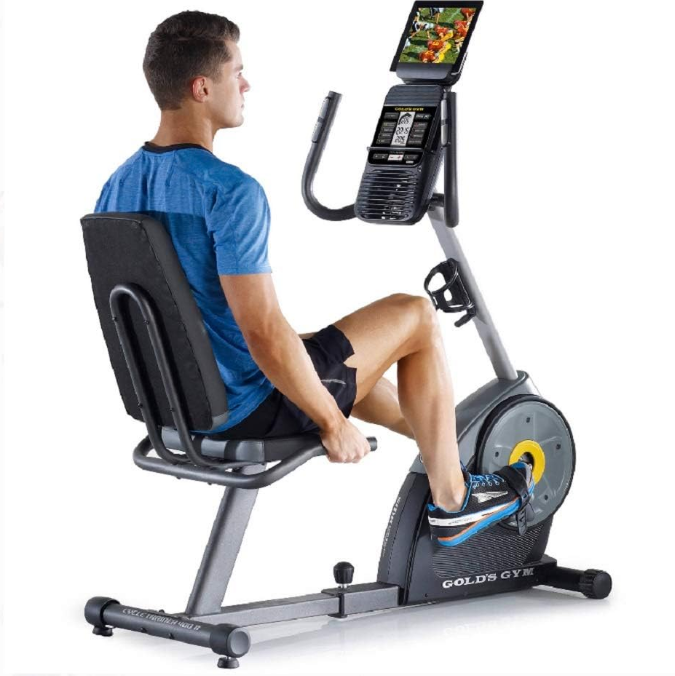
Golds Gym 290C Gym Cycle Trainer
IMPORTANT PRECAUTIONS
 WARNING: To reduce the risk of serious injury, read all important precautions and instructions in this manual and all warnings on your exercise bike before using your exercise bike. ICON assumes no responsibility for personal injury or property damage sustained by or through the use of this product.
- Before beginning any exercise program, consult your physician. This is especially important for individuals over the age of 35 or those with pre-existing health conditions.
- Use the exercise bike only as described in this manual.
- It is the owner’s responsibility to ensure that all users of the exercise bike are adequately informed of all necessary precautions.
- The exercise bike is intended for home use only. Do not use the exercise bike in a commercial, rental, or institutional setting.
- Keep the exercise bike indoors, away from moisture and dust. Do not put the exercise bike in a garage or covered patio, or near water.
- Place the exercise bike on a level surface, with a mat beneath it to protect the floor or carpet. Make sure that there is at least 2 ft. (0.6 m) of clearance around the exercise bike.
- Inspect and properly tighten all parts regularly. Replace any worn parts immediately.
- Keep children under age 12 and pets away from the exercise bike at all times.
- Wear appropriate clothes while exercising; do not wear loose clothes that could become caught on the exercise bike. Always wear athletic shoes for foot protection.
- The exercise bike should not be used by persons weighing more than 275 lbs. (125 kg).
- Always keep your back straight while using the exercise bike; do not arch your back.
- The heart rate monitor is not a medical device. Various factors may affect the accuracy of heart rate readings. The heart rate monitor is intended only as an exercise aid in determining heart rate trends in general.
- The exercise bike does not have a freewheel; the pedals will continue to move until the flywheel stops. Reduce your pedaling speed in a controlled way.
- Over-exercising may result in serious injury or death. If you feel faint or if you experience pain while exercising, stop immediately and cool down.
BEFORE YOU BEGIN
Thank you for selecting the new GOLD’S GYM® CYCLE TRAINER 290 C exercise bike. Cycling is an effective exercise for increasing cardiovascular fitness, building endurance, and toning the body. The CYCLE TRAINER 290 C exercise bike provides an impressive selection of features designed to make your workouts at home more effective and enjoyable.
For your benefit, read this manual carefully before you use the exercise bike. If you have questions after reading this manual, please see the front cover of this manual. To help us assist you, note the product model number and serial number before contacting us. The model number and the location of the serial number decal are shown on the front cover of this manual.
Before reading further, please familiarize yourself with the parts that are labeled in the drawing below.
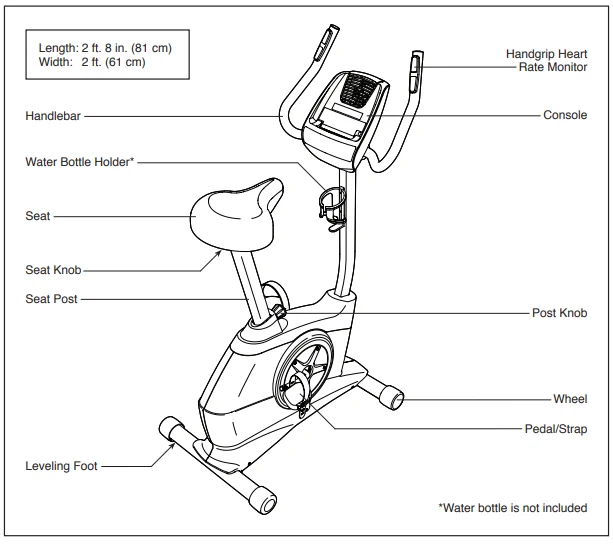
PART IDENTIFICATION CHART
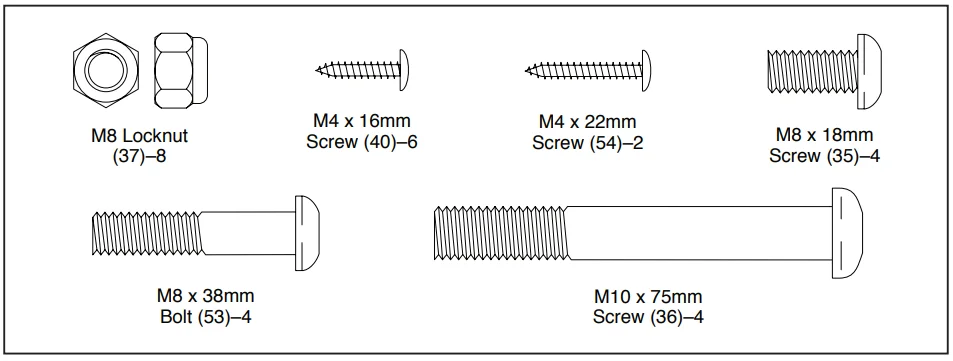
Use the drawings below to identify the small parts needed for assembly. The number in parentheses below each drawing is the key number of the part, from the PART LIST near the end of this manual. The number following the key number is the quantity needed for assembly. Note: If a part is not in the hardware kit, check to see if it has been preassembled. Extra parts may be included.
ASSEMBLY
- To hire an authorized service technician to assemble this product, call 1-800-445-2480.
- The assembly requires two persons.
- Place all parts in a cleared area and remove the packing materials. Do not dispose of the packing materials until you finish all assembly steps.
- Left parts are marked “L” or “Left,” and right parts are marked “R” or “Right.”
- To identify small parts, see page 5.
In addition to the included tool(s), assembly requires the following tools:
one Phillips screwdriver
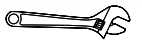
one adjustable wrench
Assembly may be easier if you have a set of wrenches. To avoid damaging parts, do not use power tools.

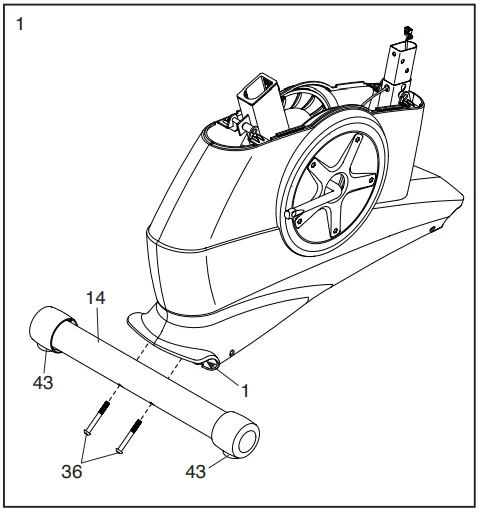
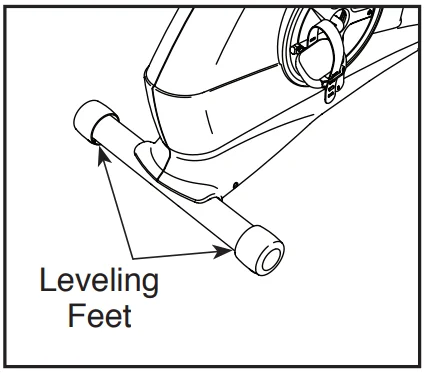
- Identify the Rear Stabilizer (14), which has a Leveling Foot (43) near each end.
Set a sturdy piece of packing material under the rear of the Frame (1). Have a second person hold the Frame to prevent it from tipping while you complete this step.
Attach the Rear Stabilizer (14) to the Frame (1) with two M10 x 75mm Screws (36).
Remove the packing material.
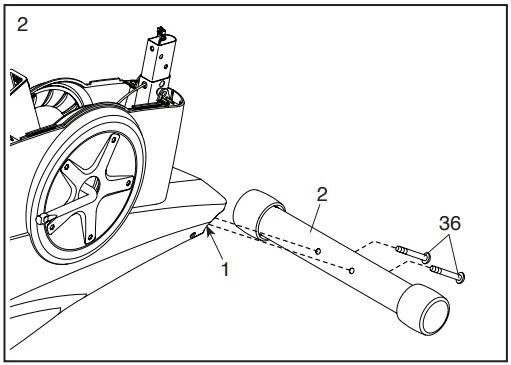
- Set a sturdy piece of packing material under the front of the Frame (1). Have a second person hold the Frame to prevent it from tipping while you complete this step.
Attach the Front Stabilizer (2) to the Frame (1) with two M10 x 75mm Screws (36).
Remove the packing material.
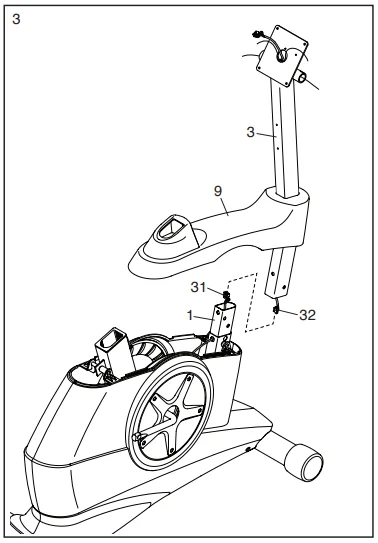
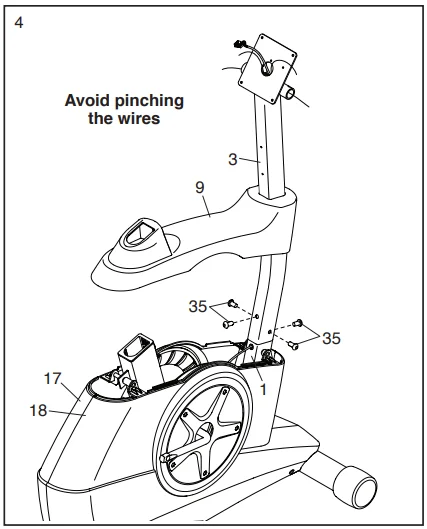
- Orient the Upright (3) and the Top Shield (9) as shown.
Have a second person hold the Upright (3) and the Top Shield (9) near the Frame (1) until you complete step 4.
Connect the Upper Wire (32) to the Lower Wire (31). Then, pull the excess Upper Wire out of the top of the Upright.
- Tip: Avoid pinching the wires. Slide the Upright (3) onto the Frame (1).
Attach the Upright (3) with four M8 x 18mm Screws (35).
Slide the Top Shield (9) downward and press it onto the Left and Right Shields (17, 18).
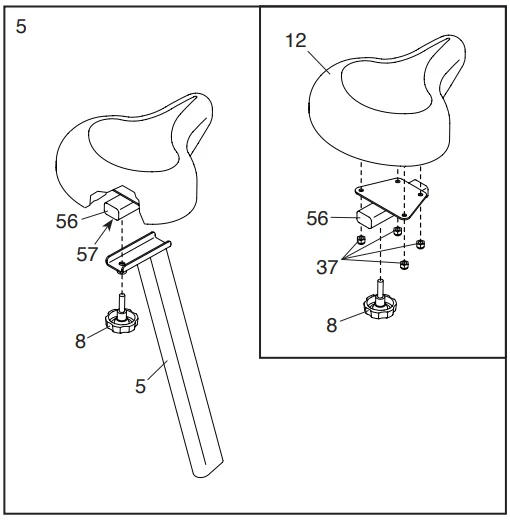
- See the inset drawing. Remove the Seat Knob (8) from the Seat Carriage (56). Next, attach the Seat (12) to the Seat Carriage (56) with four M8 Locknuts (37). Note: The Locknuts may be preattached to the underside of the Seat.
Next, orient the Seat Carriage (56) and the Seat Post (5) as shown. Set the Seat Carriage on the Seat Post and hold it in place.
Insert the Seat Knob (8) upward into the Seat Post (5), and tighten the Seat Knob into the Carriage Clamp (57) inside the Seat Carriage (56).
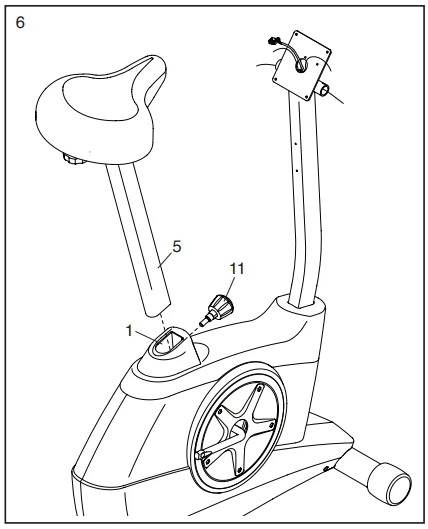
- Using an adjustable wrench, tighten the Adjustment Knob (11) into the Frame (1).
Next, loosen the Adjustment Knob (11) a few turns, pull it outward, and insert the Seat Post (5) into the Frame (1).
Slide the Seat Post (5) upward or downward to the desired position, and release the Adjustment Knob (11) into one of the adjustment holes in the Seat Post. Move the Seat Post upward or downward slightly to make sure that the Adjustment Knob is engaged in one of the adjustment holes in the Seat Post. Then, tighten the Adjustment Knob.
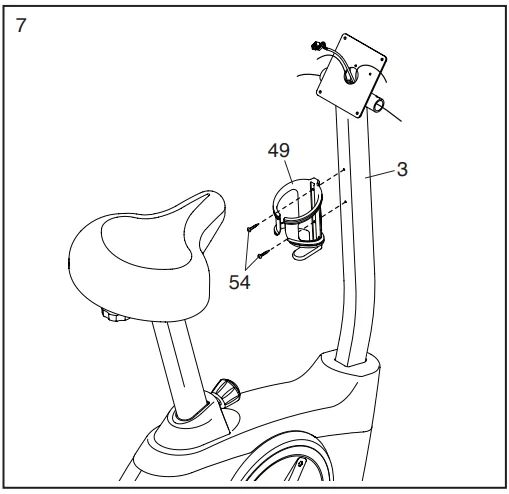
- Attach the Water Bottle Holder (49) to the Upright (3) with two M4 x 22mm Screws (54).

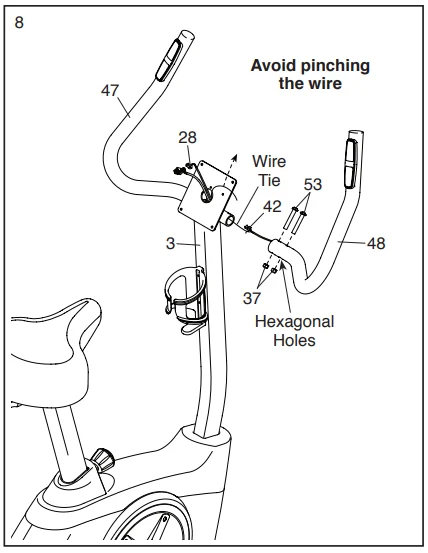
- Identify the Right Handlebar (48) and orient it as shown.
While a second person holds the Right Handlebar (48) near the Upright (3), tie the indicated wire tie to the Right Pulse Wire (42). Then, pull the other end of the wire tie upward out of the top of the Upright.
Tip: Avoid pinching the wire. Slide the Right Handlebar (48) onto the Upright (3).
Attach the Right Handlebar (48) with two M8 x 38mm Bolts (53) and two M8 Locknuts (37). Make sure that the Locknuts are in the hexagonal holes.
Attach the Left Handlebar (47) in the same way.
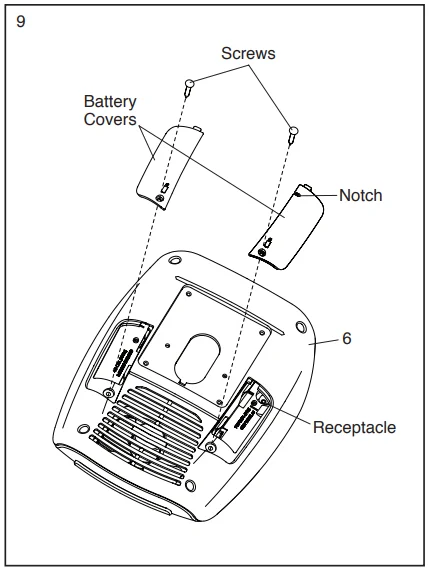
- The Console (6) can use four D batteries (not included); alkaline batteries are recommended. Do not use old and new batteries together or alkaline, standard, and rechargeable batteries together. IMPORTANT: If the Console has been exposed to cold temperatures, allow it to warm to room temperature before inserting batteries. Otherwise, you may damage the console displays or other electronic components. Remove the screws and the battery covers, insert batteries into the battery compartments, and then reattach the battery covers. Make sure to orient the batteries as shown by the diagrams inside the battery compartments.
To purchase an optional power adapter, call the telephone number on the front cover of this manual. To avoid damaging the console, use only the manufacturer-supplied power adapter. Plug one end of the power adapter into the receptacle inside the indicated battery compartment; route the power adapter through the notch in the battery cover. Then, plug the other end into an outlet installed in accordance with all local codes and ordinances.
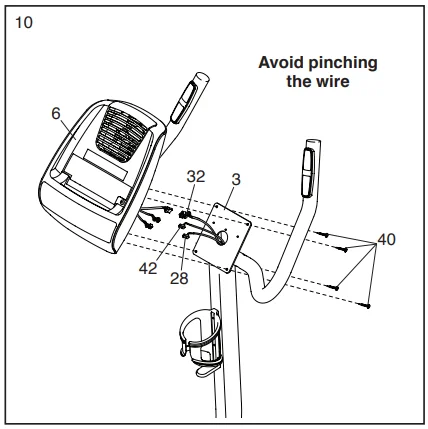
- While a second person holds the Console (6) near the Upright (3), connect the wires on the Console to the Upper Wire (32) and to the Right and Left Pulse Wires (42, 28).
Insert the excess wire into the Upright (3) or into the Console (6).
Tip: Avoid pinching the wires. Attach the Console (6) to the Upright (3) with four M4 x 16mm Screws (40).
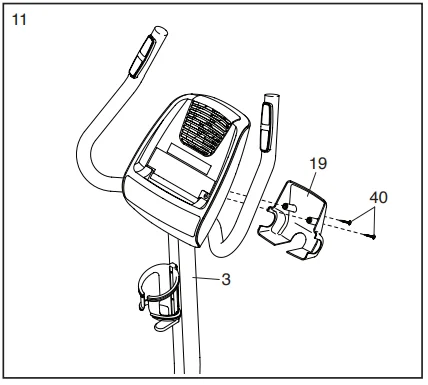
- Attach the Handlebar Cover (19) to the Upright (3) with two M4 x 16mm Screws (40).

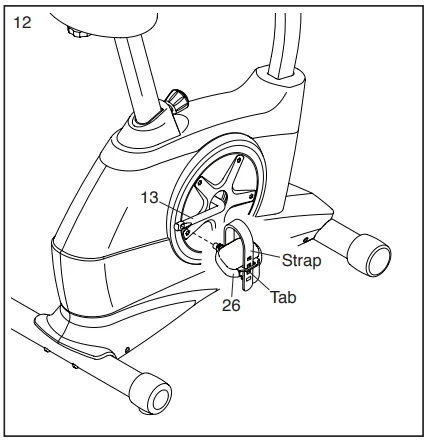
- Identify the Right Pedal (26).
Using an adjustable wrench, firmly tighten the Right Pedal (26) clockwise into the right arm of the Crank (13).
Tighten the Left Pedal (not shown) counterclockwise into the left arm of the Crank (not shown).
Adjust the strap on the Right Pedal (26) to the desired position, and press the end of the strap onto the tab on the Right Pedal. Adjust the strap on the Left Pedal (not shown) in the same way.
- Make sure that all parts are properly tightened before you use the exercise bike. Note: Extra parts may be included. Place a mat under the exercise bike to protect the floor or carpet.
HOW TO USE THE EXERCISE BIKE
HOW TO ADJUST THE HEIGHT OF THE SEAT
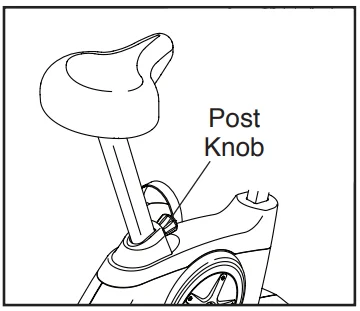
For effective exercise, the seat should be at the proper height. As you pedal, there should be a slight bend in your knees when the pedals are in the lowest position. To adjust the height of the seat, first loosen the post knob a few turns. Next, pull the knob outward, slide the seat post upward or downward to the desired position, and then release the knob into one of the adjustment holes in the seat post. Move the seat post upward or downward slightly to make sure that the knob is engaged in one of the adjustment holes in the seat post. Then, tighten the knob.
HOW TO ADJUST THE HORIZONTAL POSITION OF THE SEAT
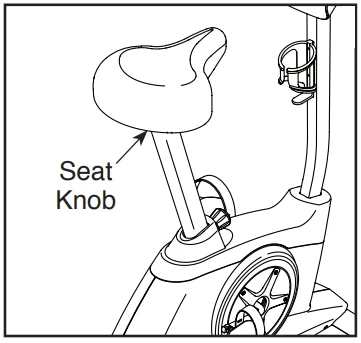
To adjust the horizontal position of the seat, first loosen the seat knob a few turns. Then, move the seat forward or backward to the desired position, and firmly tighten the knob.
HOW TO ADJUST THE PEDAL STRAPS
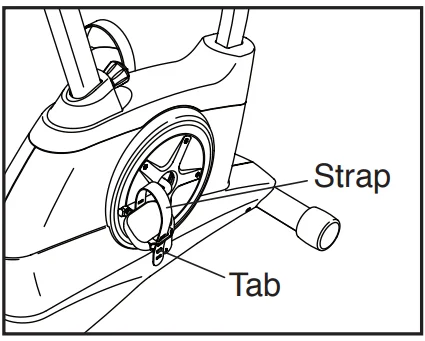
To adjust the pedal straps, first pull the ends of the straps off the tabs on the pedals. Then, adjust the straps to the desired position, and press the ends of the straps onto the tabs.
HOW TO LEVEL THE EXERCISE BIKE
If the exercise bike rocks slightly on your floor during use, turn one or both of the leveling feet under the rear stabilizer until the exercise bike is level.
FEATURES OF THE CONSOLE
The advanced console offers an array of features designed to make your workouts more effective and enjoyable.
When you use the manual mode of the console, you can change the resistance of the pedals with the touch of a button. As you exercise, the console will provide continuous exercise feedback. You can even measure your heart rate using the handgrip heart rate monitor. Lose unwanted pounds with the progressive 8-week weight-loss program. Each workout in the program controls the resistance of the pedals as it guides you through an effective workout designed to help you achieve the results you want.
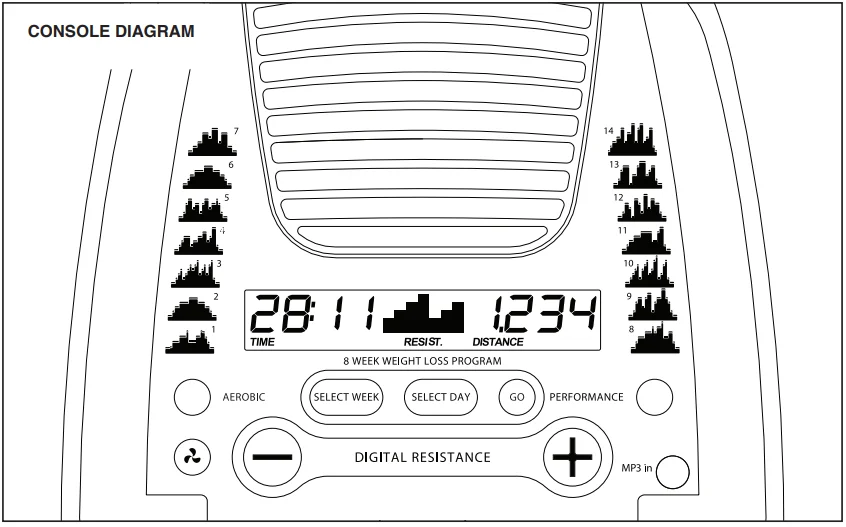
The console also offers a selection of preset workouts. Each preset workout automatically changes the resistance of the pedals as it guides you through an effective workout.
You can even connect your MP3 player or CD player to the console sound system and listen to your favorite music or audiobooks while you exercise.
To use the manual mode, see page 15. To use an 8-week weight-loss workout, see page 17. To use a preset workout, see page 18. To use the sound system, see page 19. To use the user mode, see page 19.
Note: Before using the console, make sure that batteries are installed (see assembly step 9 on page 10). If there is a sheet of plastic on the display, remove the plastic.
HOW TO USE THE MANUAL MODE
- Turn on the console.
Press any button or begin pedaling to turn on the console.
When you turn on the console, the display will turn on. A tone will sound, a nd the console will be ready for use. - Select the manual mode.
When you turn on the console, the manual mode will be selected.
If you have selected a workout, reselect the manual mode by pressing the Aerobic or Performance button repeatedly until a track appears in the center display.
- Begin pedaling and change the resistance of the pedals as desired.
As you pedal, change the resistance of the pedals by pressing the Digital Resistance increase and decrease buttons.
Note: After you press the buttons, it will take a moment for the pedals to reach the selected resistance level.
- Follow your progress with the display.
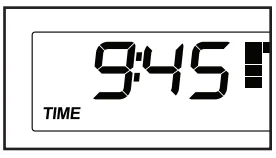
- The left display–This display can show the elapsed time and the approximate number of calories you have burned. The display will change modes every few seconds.
Note: During a preset workout, the display will show the time remaining in the workout. The left display will also show your heart rate when you use the handgrip heart rate monitor (see step 5).
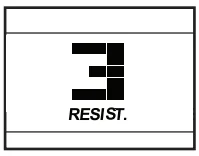
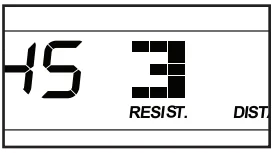
- The center display– This display will show the resistance level of the pedals for a few seconds each time the resistance level changes.
 This display will also show a track representing 1/4 mile (400 m). As you exercise, indicators will appear in succession around the track until the entire track appears. The track will then disappear, and the indicators will again begin to appear in succession.
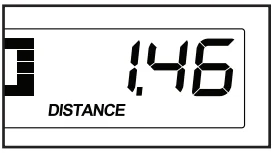
- The right display– This display can show the distance you have pedaled in miles or kilometers and your pedaling speed in miles per hour or kilometers per hour. The display will change modes every few seconds.

- The left display–This display can show the elapsed time and the approximate number of calories you have burned. The display will change modes every few seconds.
- Measure your heart rate if desired.
If there are sheets of plastic on the metal contacts on the handgrip heart rate monitor, remove the plastic. In addition, make sure that your hands are clean. To measure your heart rate, hold the handgrip heart rate monitor with your palms resting against the contacts. Avoid moving your hands or gripping the contacts tightly.
When your pulse is detected, a heart-shaped symbol will flash in the display, and then your heart rate will be shown. For the most accurate heart rate reading, hold the contacts for at least 15 seconds. If your heart rate is not shown, make sure that your hands are positioned as described. Be careful not to move your hands excessively or to squeeze the contacts tightly. For optimal performance, clean the contacts using a soft cloth; never use alcohol, abrasives, or chemicals to clean the contacts.
 - Turn on the fan if desired.
The fan has high and low speed settings. Press the fan button repeatedly to select a fan speed or to turn off the fan. Note: If the pedals do not move for about thirty seconds, the fan will turn off automatically.
 - When you are finished exercising, the console will turn off automatically.
If the pedals do not move for several seconds, a series of tones will sound, the console will pause, and the time will flash in the display.
If the pedals do not move for several minutes, the console will turn off and the display will be reset.
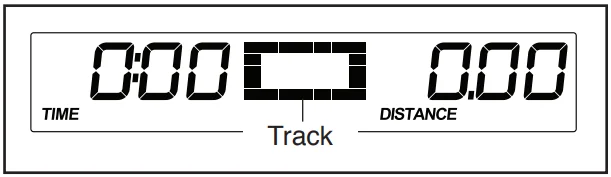
 This display will also show a track representing 1/4 mile (400 m). As you exercise, indicators will appear in succession around the track until the entire track appears. The track will then disappear, and the indicators will again begin to appear in succession.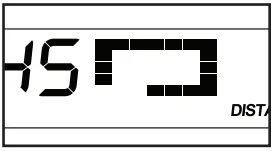
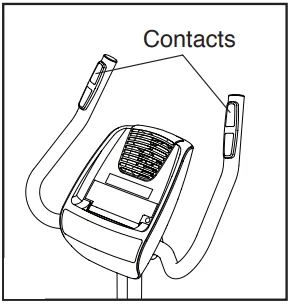 If your heart rate is not shown, make sure that your hands are positioned as described. Be careful not to move your hands excessively or to squeeze the contacts tightly. For optimal performance, clean the contacts using a soft cloth; never use alcohol, abrasives, or chemicals to clean the contacts.
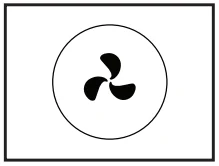 Note: If the pedals do not move for about thirty seconds, the fan will turn off automatically.
HOW TO USE AN 8-WEEK WEIGHT-LOSS WORKOUT
- Turn on the console.
Press any button or begin pedaling to turn on the console. - Select the desired week of the program.
To select the desired week of the program, press the Select Week button repeatedly until the number of the desired week appears in the display.
- Select the desired day of the program.
There are three-day workouts for each week of the program. To select the desired day of the program, press the Select Day button repeatedly until the number of the desired day appears in the display. Then, the duration of the workout will appear in the left display, and a profile of the resistance levels of the workout will scroll across the center display.
- Start the workout.
Press the Go button and begin pedaling to start the workout.
Each workout is divided into one-minute segments. One resistance level and one target speed are programmed for each segment. Note: The same resistance level and/or target speed may be programmed for consecutive segments. During the workout, the workout profile will show your progress. The flashing segment of the profile represents the current segment of the workout. The height of the flashing segment indicates the resistance level for the current segment.
At the end of each segment of the workout, a series of tones will sound, and the next segment of the profile will begin to flash.
The resistance level for the next segment will appear in the center display for a few seconds to alert you. The resistance of the pedals will then change.
The target speed for the next segment will appear in the right display for a few seconds to alert you. As you exercise, keep your pedaling speed near the target speed for the current segment.
IMPORTANT: The target speed is intended only to provide motivation. Your actual pedaling speed may be slower than the target speed. Make sure to pedal at a speed that is comfortable for you.
If the resistance level for the current segment is too high or too low, you can manually override the setting by pressing the Digital Resistance buttons.
IMPORTANT: When the current segment of the workout ends, the pedals will automatically adjust to the resistance level programmed for the next segment.
If you stop pedaling for several seconds, a series of tones will sound and the workout will pause. To restart the workout, simply resume pedaling. The workout will continue until the last segment of the profile flashes and the last segment of the workout ends. - Follow your progress with the display.
See step 4 on page 15. - Measure your heart rate if desired.
See step 5 on page 16. - Turn on the fan if desired.
See step 6 on page 16. - When you are finished exercising, the console will turn off automatically.
See step 7 on page 16.
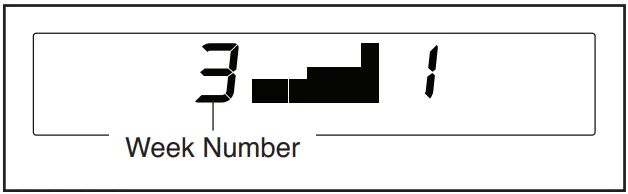
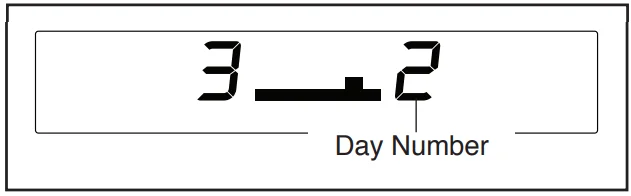 Then, the duration of the workout will appear in the left display, and a profile of the resistance levels of the workout will scroll across the center display.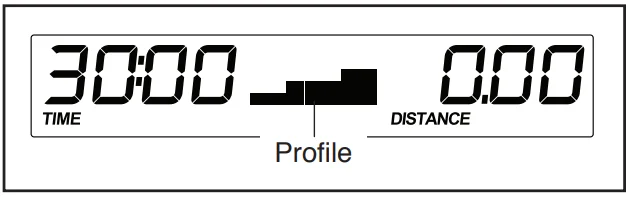
HOW TO USE THE SOUND SYSTEM
To play music or audiobooks through the console sound system while you exercise, plug your audio cable into the jack on the console and into a jack on your MP3 player or CD player; make sure that your audio cable is fully plugged in.
Next, press the play button on your MP3 player or CD player. Adjust the volume level using the volume control on your MP3 player or CD player.
THE USER MODE
The console features a user mode that allows you to select a unit of measurement for the console, select the volume level for the console, and view console usage information.
To select the user mode, press and hold down the Performance button for a few seconds until the user mode information appears in the display.
The console can show pedaling speed and distance in either miles or kilometers.
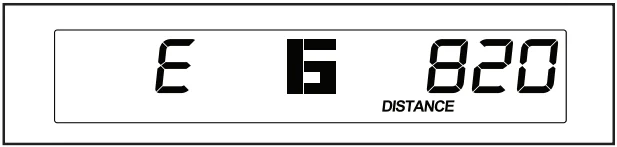
The left display will show the selected unit of measurement. An E for English miles or an M for metric kilometers will appear in the display. To change the unit of measurement, press the Aerobic button repeatedly.
Note: When you replace the batteries, it may be necessary to reselect the unit of measurement. The center display will show the volume level of the console. To change the volume level, press the Digital Resistance increase and decrease buttons. The right display will show the total distance that the exercise bike has been pedaled.
To exit the user mode, press the Performance button.
FCC INFORMATION
This equipment has been tested and found to comply with the limits for a Class B digital device, pursuant to part 15 of the FCC Rules. These limits are designed to provide reasonable protection against harmful interference in a residential installation. This equipment generates, uses, and can radiate radio frequency energy and, if not installed and used in accordance with the instructions, may cause harmful interference to radio communications.
However, there is no guarantee that interference will not occur in a particular installation. If this equipment does cause harmful interference to radio or television reception, which can be determined by turning the equipment off and on, try to correct the interference by one or more of the following measures:
- Reorient or relocate the receiving antenna.
- Increase the separation between the equipment and the receiver.
- Connect the equipment into an outlet on a circuit different from that to which the receiver is connected.
- Consult the dealer or an experienced radio/TV technician for help.
FCC CAUTION
To assure continued compliance, use only shielded interface cables when connecting to computer or peripheral devices. Changes or modifications not expressly approved by the party responsible for compliance could void the user’s authority to operate this equipment.
MAINTENANCE AND TROUBLESHOOTING
Inspect and tighten all parts of the exercise bike regularly. Replace any worn parts immediately.
To clean the exercise bike, use a damp cloth and a small amount of mild soap. IMPORTANT: To avoid damage to the console, keep liquids away from the console and keep the console out of direct sunlight.
CONSOLE TROUBLESHOOTING
Most console problems are the result of low batteries. See assembly step 9 on page 10 for battery replacement instructions.
If the console does not display your heart rate when you use the handgrip heart rate monitor, see step 5 on page 16.
HOW TO ADJUST THE REED SWITCH
If the console does not display correct feedback, the reed switch should be adjusted.
To adjust the reed switch, you must remove the seat post, the post knob, and the top shield (see the instructions below).
To remove the Seat Post (5), loosen the Post Knob (11) a few turns, pull the Post Knob outward, and remove the Seat Post. Then, using an adjustable wrench, remove the Post Knob.
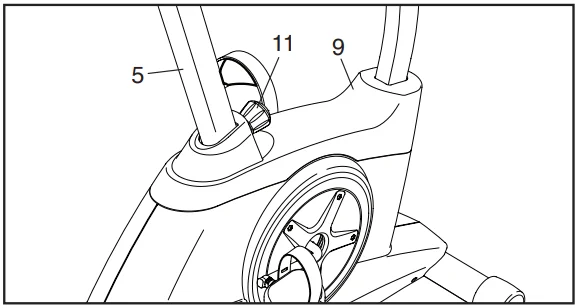
Using a flat screwdriver, release the tabs along the bottom edge of the Top Shield (9) and slide the Top Shield upward.
Locate the Reed Switch (21). Turn the Pulley (13) until a Pulley Magnet (16) is aligned with the Reed Switch. Loosen, but do not remove, the indicated M4 x 16mm Screw (40). Slide the Reed Switch slightly closer to or away from the Magnet, and then retighten the Screw.
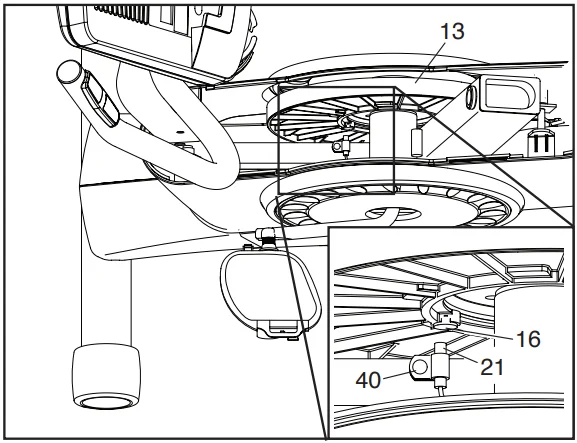
Turn the Pulley (13) for a moment. If necessary, repeat the step above until the console displays correct feedback.
When the reed switch is correctly adjusted, reattach the shield cover, the post knob, and the seat post.
HOW TO ADJUST THE DRIVE BELT
If the pedals slip while you are pedaling, even while the resistance is adjusted to the highest level, the drive belt may need to be adjusted.
To adjust the drive belt, you must remove the seat post, the post knob, the top shield, the right pedal, and the right shield (see the instructions below).
To remove the Seat Post (5), loosen the Post Knob (11) a few turns, pull the Post Knob outward, and remove the Seat Post. Then, using an adjustable wrench, remove the Post Knob.
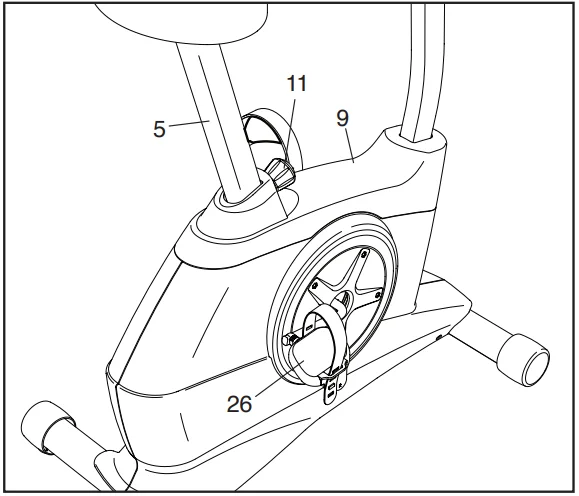
Using a flat screwdriver, release the tabs along the bottom edge of the Top Shield (9) and slide the Top Shield upward. Then, using an adjustable wrench, turn the Right Pedal (26) counterclockwise and remove it.
Remove all the screws from the left and right shields; there are two sizes of screws in the shields—note which size of screw you remove from each hole. Then, gently pull the right shield away from the frame. Loosen the M6 x 20mm Hex Screw (46). Then, tighten the M10 x 50mm Hex Screw (33) until the Drive Belt (23) is tight.
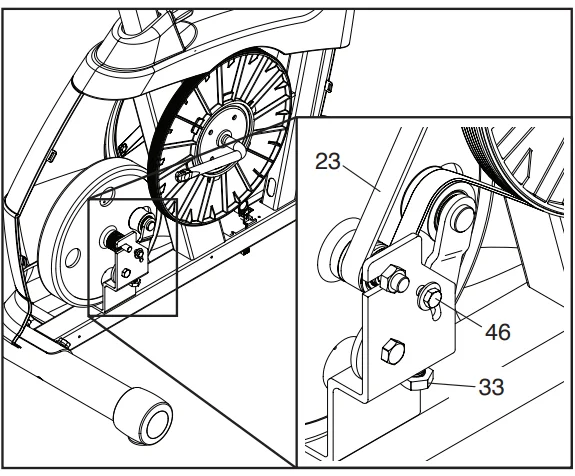
When the Drive Belt (23) is tight, tighten the M6 x 20mm Hex Screw (46).
Then, reattach the left and right shields, the right pedal, the top shield, the post knob, and the seat post.
For more manuals by Gold’s Gym, visit ManualsLibraryy
Golds Gym 290C Gym Cycle Trainer- FAQs
How do I start the Golds Gym 290C cycle trainer?
Plug the trainer into a power source (if needed), adjust the seat and handlebars for comfort, and start pedaling. Some models have a digital display to select workout programs.
What is the weight limit for the Golds Gym 290C trainer?
The cycle supports a maximum user weight of 300 lbs (≈136 kg).
How do I adjust the resistance?
Turn the resistance knob or use the digital console (depending on your model) to increase or decrease pedaling difficulty.
Can I use the trainer if I exceed the weight limit?
No. Exceeding the weight limit can damage the trainer and void the warranty. Always stay within the recommended limit.
How long should a beginner workout on the cycle?
Start with 15–20 minutes per session, gradually increasing to 30–45 minutes as your stamina improves.
Can I lose weight using this cycle?
Yes. Regular cycling on the 290C helps burn calories, tone muscles, and improve cardiovascular health. Around 30 minutes can burn 250–400 calories, depending on intensity and body weight.
How do I maintain the cycle trainer?
Wipe the frame and seat after each use
Check pedals and screws for tightness periodically
Lubricate moving parts if recommended in the manual
Can overweight people use this cycle safely?
Yes, as long as the user stays within the weight limit and adjusts the seat and resistance appropriately.
Does the cycle have a digital display?
Many models come with an LCD display that tracks time, speed, distance, and calories burned.