
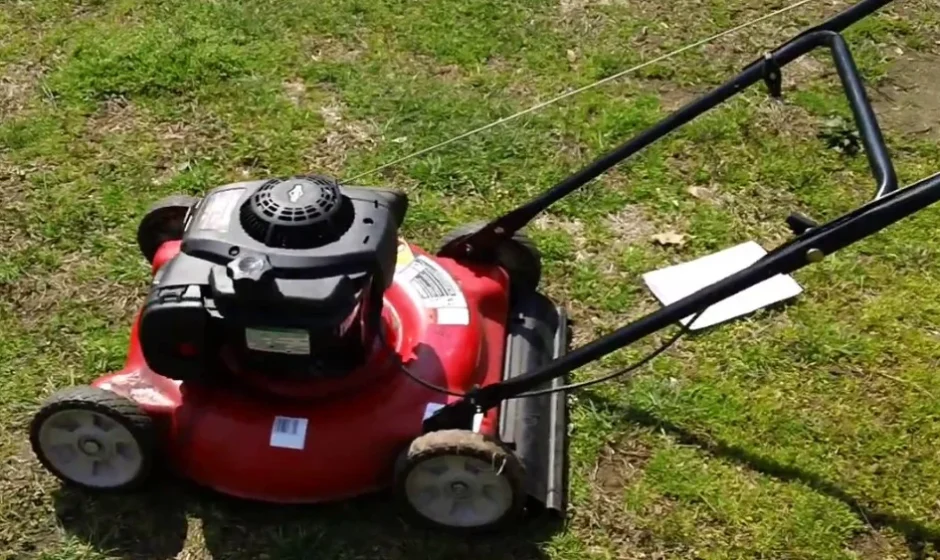

MTD 510 Series Push Lawn Mower

IMPORTANT SAFE OPERATION PRACTICES
GENERAL OPERATION
- Your rotary mower is a precision piece of power equipment, not a plaything. Therefore, exercise extreme caution at all times. Your unit has been designed to perform one job: to mow grass. Do not use it for any other purpose.
- Never allow children under 14 years old to operate a power mower. Children 14 years old and over should only operate a mower under close parental supervision. Only responsible individuals who are familiar with these rules of safe operation should be allowed to use your mower.
- Keep the area of operation clear of all persons, particularly small children and pets. Stop the engine when they are in the vicinity of your mower to help prevent blade contact or thrown object injury. Although the area of operation should be completely cleared of foreign objects, an object may have been overlooked and could be accidentally thrown by the mower in any direction and causing serious personal injury to the operator or others allowed in the area.
- Always wear safety glasses or safety goggles during operation or while performing an adjustment or repair, to protect eyes from foreign objects that may be thrown from the machine in any direction.
- Do not put hands or feet near or under rotating parts. Keep clear of the discharge opening at all times as the rotating blade can cause injury.
- Many injuries occur as a result of the mower being pulled over the foot during a fall. Do not hang on to the mower if you are falling; release the handle immediately.
- Step back from the mower to fully extend your arms.
- Be sure you are well-balanced with sure footing.
- Pull the mower back slowly, no more than halfway toward you.
- Repeat these steps as needed.
- Do not operate the mower while under the influence of alcohol or drugs.
- Do not engage the self-propelled mechanism on units so equipped while starting the engine.
CONTENTS OF HARDWARE PACK
MODEL 510 – 519 ONLY
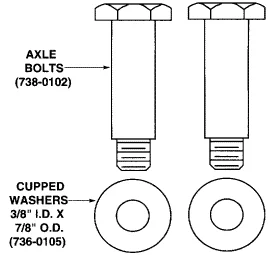
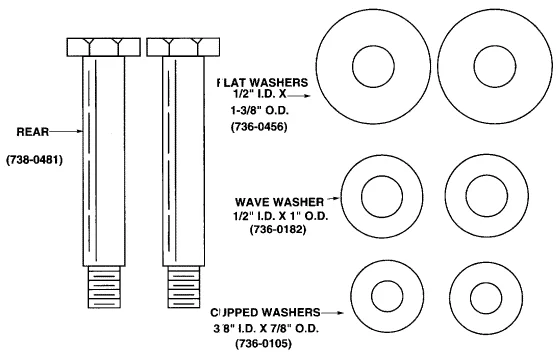
Remove this sheet from your owner’s guide and lay the hardware from the hardware pack on the illustration for identification purposes. After assembly, keep the Slope Gauge, which is on the reverse side of this sheet, for future use.
(Hardware pack may contain extra terms which are not used on your unit. Part numbers are shown in parentheses.)
ATTACHING THE FRONT WHEELS
ATTACHING THE REAR WHEELS
SETTING UP THE MOWER
This guide covers models 310 – 319 push mowers with soft top grass bags, 320 – 329 push mowers with hard top grass bags, and models 510 – 518 high wheel push mowers with hard top bags. Much of this guide pertains to both models. However, there are some areas where only one model is covered. Use only the information that is appropriate for your model.
REMOVING THE UNIT FROM THE CARTON
Remove staples, break the glue on top flaps, or cut the tape at the carton end and peel along the top flap to open the carton.
- Remove loose parts if included with the unit (i.e., owner’s manual, etc.).
- Cut along the dotted lines and lay the carton down flat.
- Remove packing material.
- Roll or slide the unit out of the carton. Check the carton thoroughly for loose parts.
- For Model 510-519, remove pages 5 and 6 of this manual listing the hardware pack and the slope gauge. Lay the contents of the hardware pack on the illustration on page 6 for easy identification.
Note: Make sure not to crimp the cables while removing the loose parts or the entire unit from the carton.
TOOLS REQUIRED
- Pair of Pliers
- 3/4″ Wrench or Socket Wrench
- Oil and Fresh Gasoline
DISCONNECTING THE SPARK PLUG
Before setting up your lawnmower, disconnect the spark plug wire from the spark plug, and ground it against the engine. See figure 3.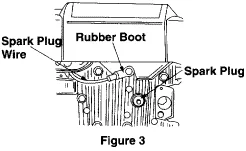
NOTE: Reference to the right or left hand side of the mower and/or front or behind the mower is observed from the operating position.
IMPORTANT: This unit is shipped without gasoline or oil in the engine. Be certain to service the engine with gasoline and oil before operating your mower.
ASSEMBLING HANDLE
(Refer to Figure 4.)
- Move the height adjustment levers to the highest cutting position.
- Raise the lower handle from position 1 to position 2 as shown in Figure 4. You may have to spread the lower handle slightly to move it around the height adjustment lever. The lower handle should snap into place.

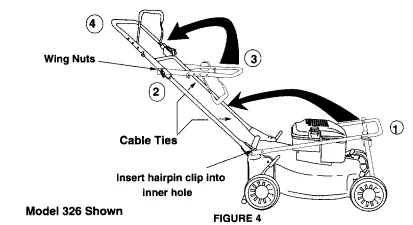
Note: Make sure to route the cables inside the lower handle. Also, do not crimp the cables while lifting the handle up.
For shipping purposes, the lower handles were placed on the unit with the hairpin clip on the outer role.
- Remove the hairpin clip from the outer hole of the lower handle.
- Using a pair of pliers, pinch the handle against the handle bracket and insert the hairpin clip into the inner hole in the weld pin. Repeat on the other side.
- Raise the upper handle from position 3 to position 4 as shown in Figure 4. Tighten the wing nuts that are already on the handle.
- Tighten the cable ties to secure all 1he cables on the lower handle in place and prevent them from getting in the way. Refer to Figure 4.
INSTALLING THE WHEELS
(FOR MODELS 510 THRU 519 ONLY)
FRONT WHEELS (Hardware A)
- Lift the front of the unit up and block securely.
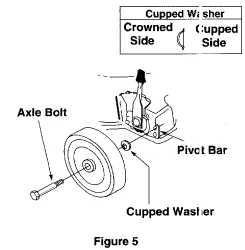
- Insert the front axle bolt through the front wheel. Place cupped washer on axle bolt (crowned side against the wheel). Thread the axle bolt into the top hole in the pivot bar. See figure 5. Tighten securely.
- Assemble the other front wheel in the same manner.
- Remove the block from the front of the unit. Lift the rear of the unit up and block securely.

REAR WHEELS (Hardware B)
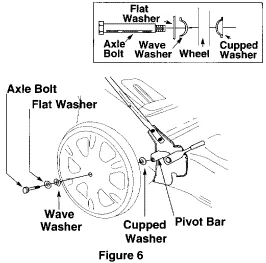
- Assemble the rear wheels as follows. See figure 6.
- Move the wheel height adjusters forward or back so the deck is in the lowest cutting position.
- Place one large flat washer on the axle bolt, then the wave washer as shown in Figure 6, inset.
- Insert the axle bolt through one rear wheel. Place cupped washer on axle bolt (crowned side of washer goes against the wheel).
- Thread the axle bolt into the rear hole of the pivot bar. Tighten securely.
- Assemble the other rear wheel in the same manner. Remove the block from the rear of the unit.
ATTACHING THE STARTER ROPE
The rope guide is already attached to the right side of the upper handle of your mower. See figure 7.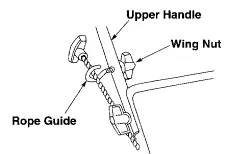
- Loosen the rope guide wing nut.
- With the spark plug wire disconnected and grounded, hold the blade control handle against the upper handle, and pull the starter rope out of the engine.
- Check and make sure that the rope guide faces as shown in Figure 7 so that the opening in the rope guide faces up.
- Slip the rope through the rope guide. Tighten the wing nut.
REMOVE MULCHING KIT
Mulching Plug top and bottom view.
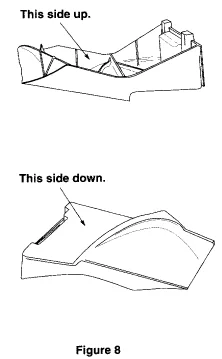
If your mower has been shipped with the mulching kit (model 190-120), it is installed on the mower. If you wish to mow instead of mulch, stand at the left side of the mower, lift the chute door, and grasp the mulching plug. Pull the mulching plug out of the mower. See figure 9. Then attach the grass catcher.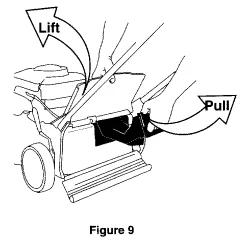
ATTACHING GRASS CATCHER
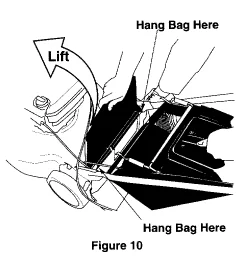
Lift the chute door on the mower. Place hooks on the grass catcher frame over the chute door pivot rod on the back of the unit. See figure 10. Release the chute door.
To remove the grass catcher, lift the chute door on the mower. Lift the grass catcher up and off the pivot rod. Release the door.
CONTROLS
BLADE CONTROL HANDLE
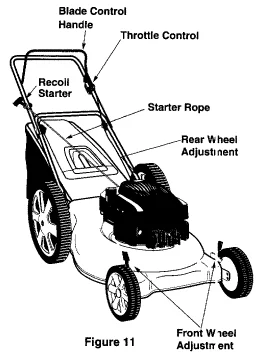
The blade control handle is located on the upper handle of the mower. See figure 11. The blade control handle must be depressed in order to operate the unit. Release the blade control handle to stop the engine and blade.
THROTTLE CONTROL
The throttle control is located on the side of the lever handle. It is used to regulate the engine speed. See figure 11.
RECOIL STARTER
The recoil starter handle is attached to the handle. See figure 11. Stand behind the unit in the operating position to start the unit.
HEIGHT ADJUSTERS
The height adjusters determine the cutting height of the mower. The adjusters are located behind each wheel.
OPERATION
WARNING: Keep hands and feet away from the chute area on the cutting deck. The operation of any lawn mower can result in foreign objects being thrown into the eyes, which can result in severe eye damage. Always wear safety glasses or eye shields.
NOTE: For shipping purposes, models 310 through 329 are set with the wheels in a low cutting height position. For best results, raise the cutting position until it is determined which height is best for your lawn. See the cutting height adjustment section.
GAS AND OIL FILL-UP
Service the engine with gasoline and oil as instructed in the separate engine manual packed with your mower. Read instructions carefully.
WARNING: Never fill the fuel tank indoors, with the engine running, or until the engine has been allowed to cool for at least two minutes after running.
BEFORE STARTING
Attach the spark plug wire to the spark plug. Make certain the metal cap on the end of the spark plug wire (inside the rubber boot) is fastened securely over the metal tip on the spark plug.
START ENGINE and ENGAGE BLADE
- Prime engine as instructed in the separate engine manual packed with your unit.
- Move the throttle control lever all the way forward.
- Standing behind the unit, depress the blade control handle and hold it against the upper handle. See figure 12.
- Grasp the starter handle and pull the rope out slowly until the engine reaches the start of the compression cycle (rope will pull slightly harder at this point). Let the rope rewind slowly. Then, pull the rope with a rapid, continuous, full arm stroke. Keep a firm grip on the starter handle. Return it slowly to the rope guide. See figure 12.
- After the engine starts, move the throttle control to the desired engine speed. (Mower is designed to be operated at full throttle.)
NOTE: If any problems are encountered, refer to the Troubleshooting Guide.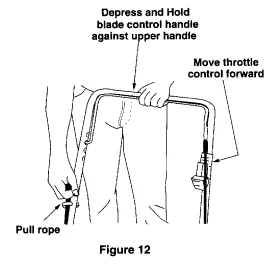
TO STOP THE ENGINE AND BLADE
- Release the blade control handle to stop the engine and blade.
- Disconnect the spark plug wire and ground it against the engine to prevent accidental starting while the equipment is unattended.
USING YOUR ROTARY MOWER
- Be sure that the lawn is clear of stones, sticks, wire, or other objects that could damage the lawn mower or engine. Such objects could be accidentally thrown by the mower in any direction and cause serious personal injury to the operator and others.
- For best results, do not cut wet grass because it tends to stick to the underside of the mower, preventing proper discharge of grass clippings, and could cause you to slip and fall. New grass, thick grass, or wet grass may require a narrower cut. Blade speed should be adjusted to the condition of the lawn.
- For a healthy lawn, always cut off one-third or less of the total length of the grass. The lawn should be cut in the fall as long as there is growth.
- This mower is designed to be operated at full throttle to give you the best cut and do the most effective job of bagging the cut grass.
WARNING: If you strike a foreign object, stop the engine. Remove the wire from the sparkplug, thoroughly inspect the mower for any damage, and repair the damage before restarting and operating the mower. Extensive vibration of the mower during operation is an indication of damage. The unit should be promptly inspected and repaired.
ADJUSTMENTS
CUTTING HEIGHT ADJUSTMENT
Nine position height adjusters.
Each tab and each space between tabs represents one of nine cutting positions available. Refer to illustration 13.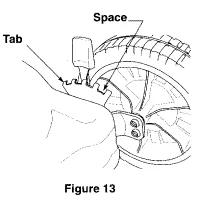
Front Wheel Adjustment
An adjusting plate and thumb lever at each front wheel provide cutting height adjustment. Each adjusting plate has nine height positions. The height of the unit will be changed when the thumb lever is moved from one position to another. Simply depress the lever towards the wheel and move the lever forward to raise and back to lower the wheel to the desired position. See figure 14.
Rear Wheel Adjustment
The height adjustment handles for the rear wheels are located between the deck and the rear wheels. The handles may be placed in one of nine cuttil_g height positions. Simply pull the handle towards the wheel and move the wheel and lever assembly to the desired position. See figure 15 A / B.
- Model 310/329: Back to lower; Forward to raise.
- Model 510/519: Forward to lower; Back to raise.
IMPORTANT: All wheels must be placed in the same relative position. For rough or uneven lawns, raise the cutting height of your mower.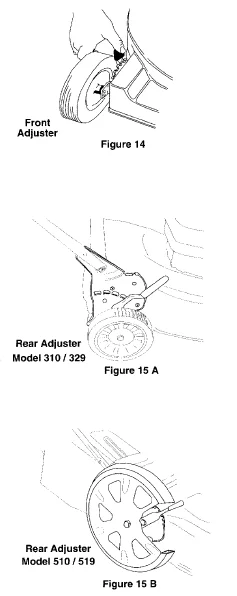
HANDLE HEIGHT ADJUSTMENT
Your mower is shipped with the handle in the higher height position. To lower the handle height, proceed as follows.
- Remove the starter rope from the rope guide.
- Remove the upper handle by removing the hand knobs and carriage bolts. Lay the upper handle out of the way, being careful not to bend or kink the cables.
- Remove the hairpin clips from the weld pins on the handle brackets. Press outward on the legs of the lower handle for self-propelled models. For push models, press inward on the legs of the lower handle. Remove the lower handle from the mower.
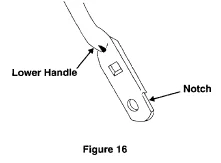
- Turn the lower handle around so the notch on the bottom of the lower handle is facing forward, as shown in Figure 16. Reassemble, placing the bottom holes in the handle over the weld pins in the handle mounting bracket.
- Reassemble the upper handle.
- Place the hairpin clips in the inner holes in the weld pins and attach the starter rope as instructed in the Set-Up Instructions.
THROTTLE CONTROL ADJUSTMENT
If the throttle control requires adjustment or if it has been replaced and needs adjustment, proceed as follows:
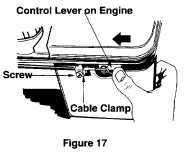
- Remove the screw shown in Figure 17. Remove the cable clamp from the cable.
- Push the throttle control lever on the handle all the way forward as far as it will go, then back it off one “click”. Make certain the throttle control lever remains in this position.
- Push the control lever on the engine as far toward the rear of the engine as it will go. Secure the cable in this position with the cable clamp and screw. See figure 17.

CARBURETOR ADJUSTMENTS
Minor carburetor adjustments may be required to compensate for differences in fuel, temperature, altitude, and load. To adjust the carburetor, refer to the separate engine manual packed with your mower.
NOTE: A dirty air cleaner will cause an engine to run rough. Be certain the air cleaner is clean and attached to the carburetor before adjusting the carburetor.
MAINTENANCE
LUBRICATION
(Refer to figure 18.)
Lubricate the pivot points on the blade control handle and the brake cable at least once a season with light oil. See figure 18. The blade control must operate freely in both directions.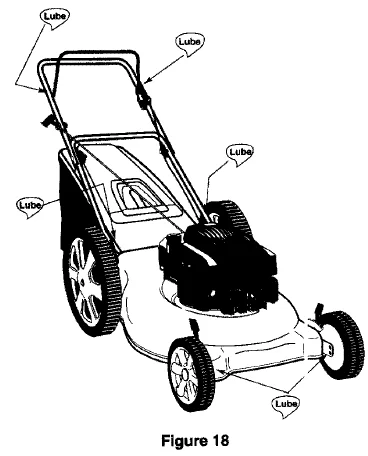
CHUTE DOOR
Lubricate the torsion spring and pivot point periodically with light oil to prevent any rust or binding. The door must work freely,
WHEELS
If your lawn mower has ball bearing wheels, lubricate at least once a season with light oil (or engine oil). Also, if the wheels are removed for any reason, lubricate the surface of the axle bolt and the inner surface of the wheel.
REPLACING BLADE
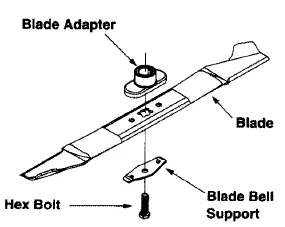
- Install the blade adapter on the crankshaft with the “star” away from the engine. See figure 20.
- Place the blade on the blade adaptor, aligning the star in the blade with the star on the adaptor. The side of the blade marked with the part number or bottom should be facing towards the ground.
- Place the blade bell support against the blade, aligning the tabs of the bell support with the holes of the blade. Insert the hex bolt through the assembly. Refer to Figure 20.
- Tighten the hex bolt according to the blade mounting torque mentioned below.
TROUBLE SHOOTING
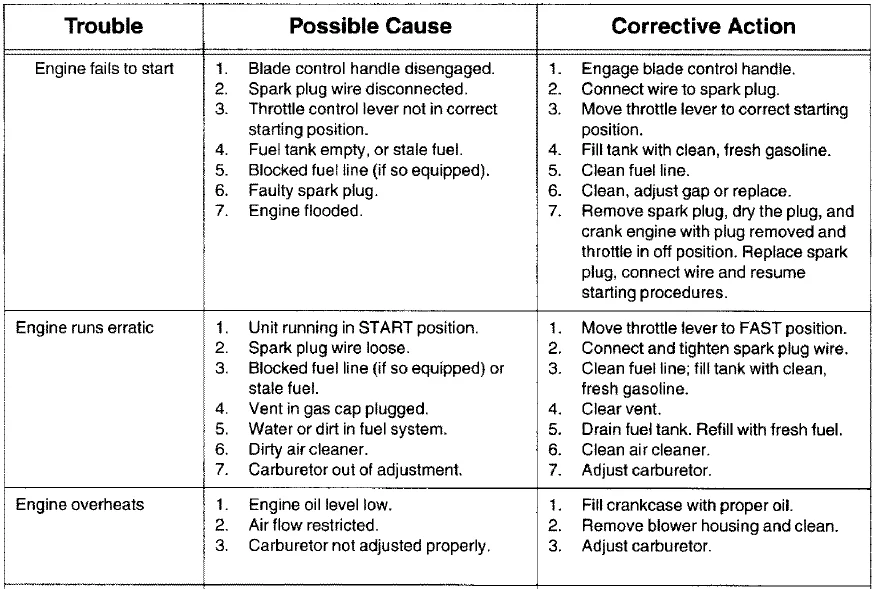
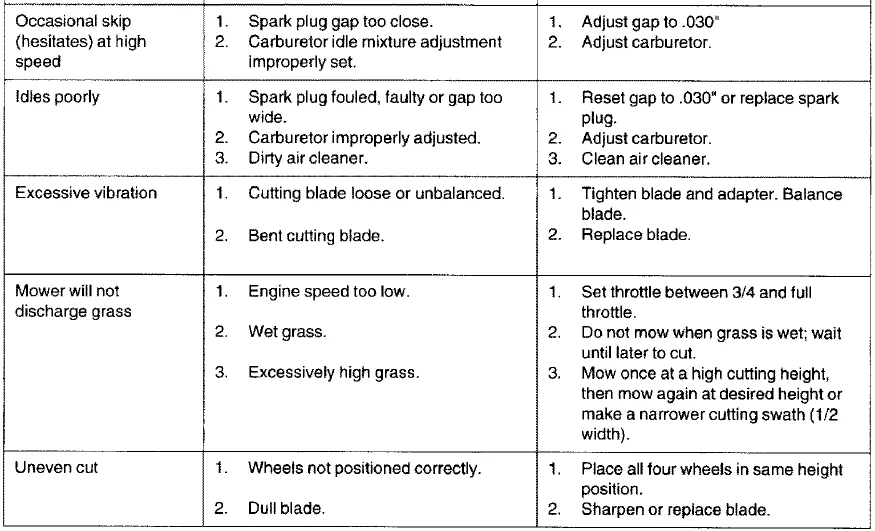
Refer to the separate engine manual packed with our mower for more engine-related information.
Note: For repairs beyond the minor adjustments listed above, contact your local authorized service dealer or call 1-800-800-7310 for the Customer Support Center.
For more Manuals by MTD Holdings, visit ManualsLibraryy
MTD 510 Series Push Lawn Mower-FAQs
How do I find my MTD mower’s model number?
Look for a sticker or metal plate on the mower frame, near the engine, or behind the discharge chute. MTD model numbers are usually 11 characters long and contain a mix of numbers, letters, or dashes.
How do I adjust the cutting height on my MTD push mower?
Pull or push the height adjustment lever near each wheel to raise or lower the blade height. Set all four wheels to the same level for even cutting results.
Why does my mower start and then stop running?
This usually happens due to old fuel, a clogged air filter, or a dirty carburetor. Clean or replace these parts and ensure the fuel is fresh.
How can I clean the carburetor without removing it?
Use a carburetor cleaner spray to remove dirt and deposits from the air intake. Spray it while the engine is off and let it sit for a few minutes before restarting the mower.
What is the “1/3 rule” for mowing lawns?
The one-third rule means never cut more than one-third of your grass height at once. This keeps your lawn healthy and prevents stress on the grass.
What cutting height should I use for the best lawn health?
Cool-season grass: 2.5–3 inches (6–8 cm)
Warm-season grass: 1.5–2 inches (3–5 cm)
Avoid mowing too short — taller grass promotes deeper roots and prevents weeds.
How often should I service my MTD push lawn mower?
Perform a quick check before each use and schedule full maintenance once per season. Replace oil, spark plugs, and filters regularly to extend engine life.
How long does a push lawn mower typically last?
A well-maintained push mower can last 8 to 10 years or longer. Regular cleaning, oil changes, and blade sharpening help increase its lifespan.
Who manufactures MTD lawn mower engines?
MTD lawn mowers are produced by Modern Tool & Die (MTD Products), a subsidiary of Stanley Black & Decker. Many MTD models use Briggs & Stratton or MTD-branded engines.