
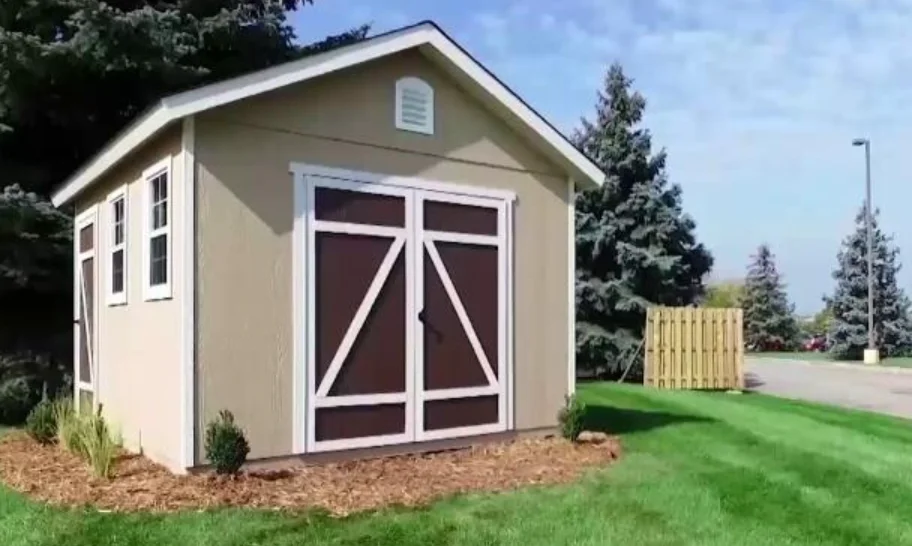

Heartland Hillsdale Wood Storage Shed
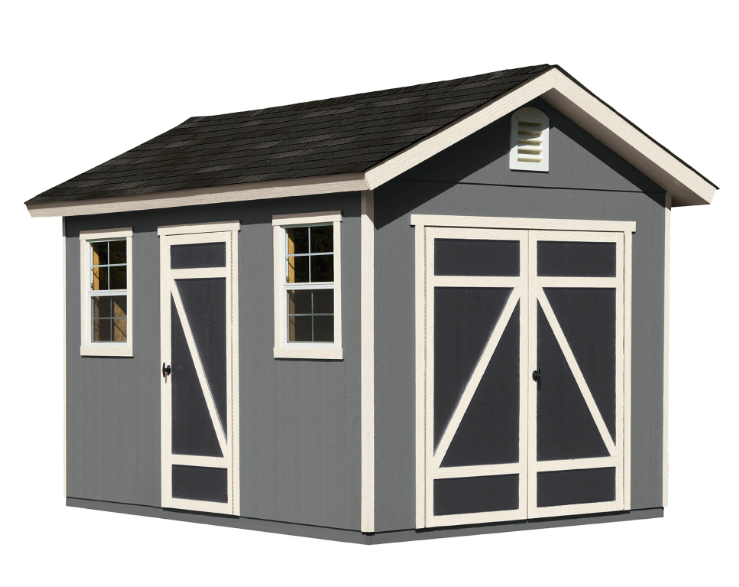
BEFORE YOU BEGIN
IMPORTANT!
READ INSTRUCTIONS THOROUGHLY PRIOR TO BEGINNING ASSEMBLY.
BUILDING RESTRICTIONS AND APPROVALS
Be sure to check with the local building department and homeowners association for specific restrictions and/ or requirements before building.
ENGINEERED DRAWINGS
Contact our Customer Service Team if engineered drawings are needed to pull local permits.
SURFACE PREPARATION
To ensure proper assembly, you must build your shed on a level surface. Recommended methods and materials to level your shed are listed on page 9.
CHECK ALL PARTS
Inventory all parts listed on pages 3 – 5. Contact our Customer Service Team if any parts are missing or damaged.
ADDITIONAL MATERIALS
You will need additional materials to complete your shed. See page 6 for required and optional materials and quantities.
TOOLS
Required
- Phillips Screwdriver
- Drill / Driver: 1/8″ Drill Bit, #2 Philips Drive Bit, 1/4″ Drill Bit, 5/16″ Drill Bit, 1/2″ Drill Bit
- Hammer
- Level
- Pencil
- Tape Measure
- Square
- Utility Knife
- Shingle Blades
- Caulk Gun
- Paint Tools
- Safety Glasses
- Hand Saw
- Ladder
Optional
- Tool Belt/Nail Pouch
- Chalk Line
- Nail Gun, gun nails
- Tin Snips (for drip edge)
- Gloves
ORIENT LUMBER AND TRIM FOR BEST APPEARANCE
Framing lumber is graded for structural strength and not appearance. Exterior trim is graded for one good side.
Always install the material, leaving the best edge and best surface visible. Please remember that these blemishes in no way negatively affect the strength or integrity of our product. (See Fig. A, B, C.)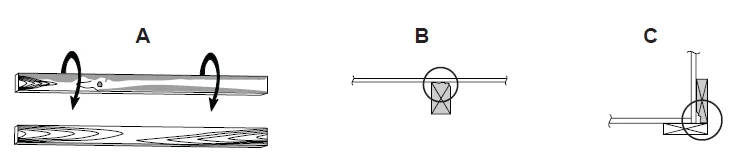
PARTS IDENTIFICATION AND SIZES
Part identification letters are stamped on some parts.
Check these locations for the part stamp.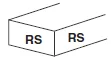
WOOD SIZE CONVERSION CHART
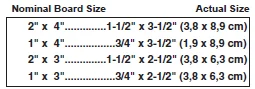
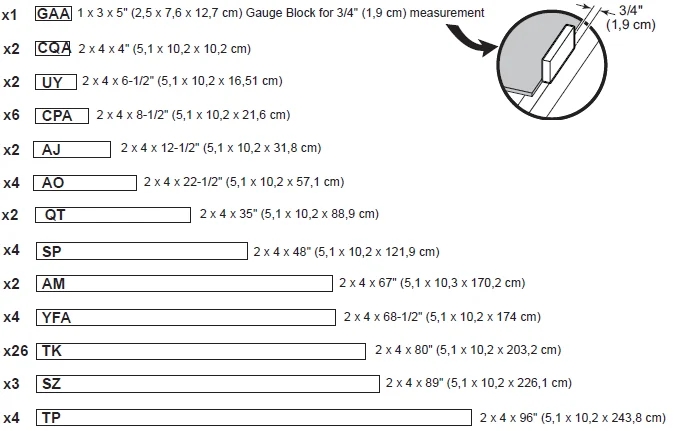
PARTS LIST
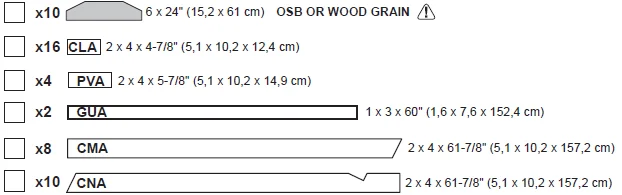
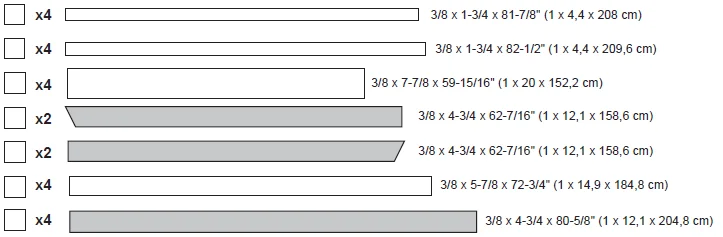
INVENTORY YOUR PARTS before you begin.
We suggest sorting parts by the category they are listed in.
WALLS
RAFTERS
TRIM
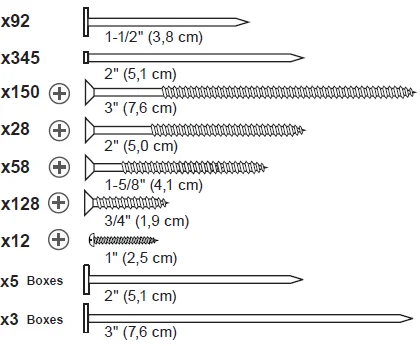
FASTENERS & HARDWARE
FASTENER/HARDWARE BAG
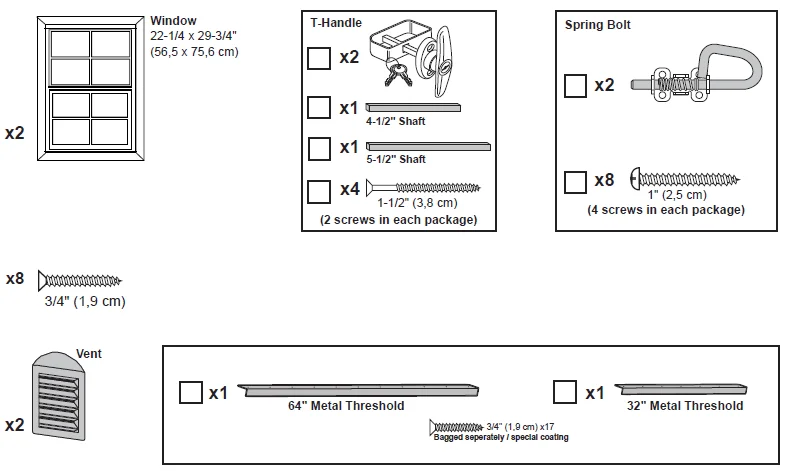
VENT/ DOOR HARDWARE/ WINDOWS
ADDITIONAL MATERIALS
FOUNDATION OR FLOOR MATERIALS
- This shed does not include any floor or leveling materials. Use our optional floor kit with building instructions and nails included.
- See the FLOOR LEVELING section on page 9 for recommended methods and suggested materials to properly level your floor, as this will vary depending on your specific site.
- If you choose to install your kit on a concrete slab, refer to page 7.
- If you choose to build your own wood floor foundation, refer to page 8.
REINFORCED WOOD FLOOR FRAME (OPTIONAL)
IMPORTANT! Depending on your specific use, you may want to construct a heavy-duty floor frame by adding additional floor joists (shown below as shaded). Below is a list of additional materials (not included):
- x3, 2 x 4 x 10′ (5 x 10 x 304,8 cm) Treated Lumber. Cut to (3) 2 x 4 x 117″ (5 x 10 x 297,2 cm)
- x12, ea. 3″ (7,6 cm) Hot Dipped Galvanized Nails
COMPLETING YOUR SHED
You will need these additional materials:
- 3-TAB SHINGLES ……………………….. 6 Bundles
- PAINT FOR SIDING …………………….. 2 Gallons, Use 100% acrylic latex exterior paint. (2) coats recommended.
- CAULK …………………………………………. 2 Tubes, Use acrylic latex exterior caulk that is paintable.
- 1″ GALVANIZED ROOFING NAILS…. 3 Lbs, For shingles.
- PAINT FOR TRIM ………………………2 Quarts, Use 100% acrylic latex exterior paint.
- WOOD GLUE ………………….. Exterior Rated
OPTIONAL MATERIALS
- DRIP EDGE ………………… 50 Feet
- #15 ROOFING FELT, To cover 148 sq. ft. of roof area.
- 1″ GALVANIZED ROOFING NAILS………1/4 Lb, For roofing felt.
CONCRETE FOUNDATION
Your kit contains all the materials to construct a wooden floor. If you choose to install your kit on a concrete slab, refer to the diagram below.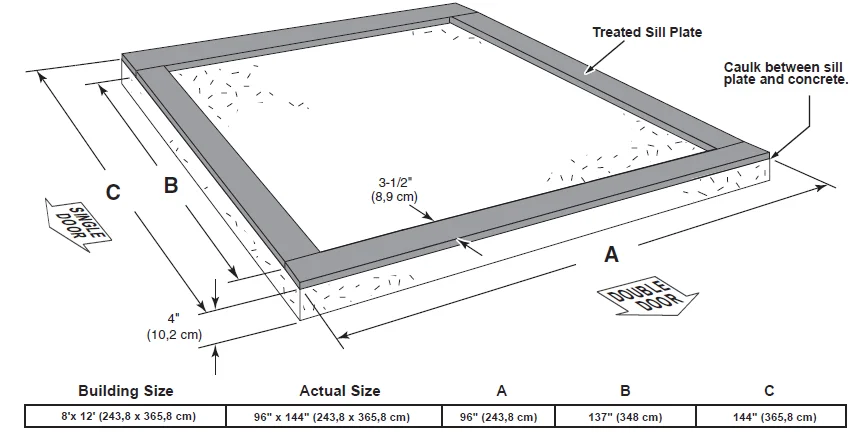
Note: Allow new concrete slabs to cure for at least seven (7) days.
- A treated 2 x 4″ (5,1 x 10,2 cm) sill plate is required when installing your shed on concrete. Hint: Purchase full-length treated lumber.
- Use a high-quality exterior-grade caulk beneath all sill plates.
- Fasten 2 x 4″ (5,1 x 10,2 cm) sill plates to the slab using approved concrete anchors (fasteners not included).
- Check local code for concrete foundation requirements.
BUILD YOUR OWN WOOD FLOOR OPTION
(Materials not included.)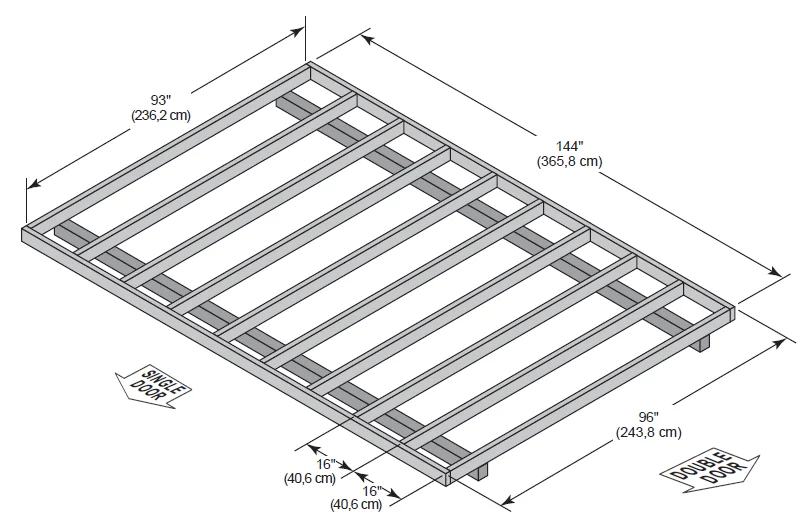
MATERIAL REQUIRED
- x2, 2″ x 4″ x 12′ (5,1 x 10,2 x 365,8 cm)
- x10, 2″ x 4″ x 10′ (5,1 x 10,2 x 304,8 cm)
- x2, 4″ x 4″ x 12′ (10,2 x 10,2 x 365,8 cm)
Note: Must be lumber
- x4, 5/8″ x 48″ x 96″ (1,6 x 121,9 x 243,8 cm)
- 1 lb. of 2″ (5,1 cm) Hot Dipped Galvanized Box-Type Nails
- 40 Nails – 3″ (7,6 cm) Hot Dipped Galvanized Box-Type Nails
- Screws for Frame to 4″x 4″, Minimum 3″ screws / exterior grade.
OPTIONAL WOOD FRAME FLOOR LEVELING OPTIONS
There are multiple ways to level your floor frame. Our recommended leveling method is shown below.
Leveling materials are not included in this kit.
PREFERRED METHOD – 4×4 TREATED RUNNERS (Typical for 8′ x 12′ Kit)
Runners are generally 12″ (30,5 cm) from the ends of the floor frame and under the seams.
Measurements to the centers of 4x4s.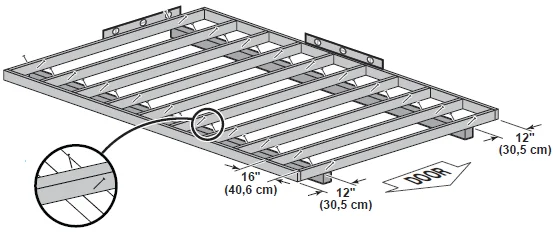
- 3″ Screws angled into 4×4.
- (2) at each point frame and 4×4 touch.
FLOOR FRAME NOT INCLUDED
Fasteners for Frame to 4″x 4″. (3″ Screws shown as one option.) Minimum 3″ screws / exterior grade.
MATERIAL REQUIRED
- x2, 4″ x 4″ x 12′ (10,2 x 10,2 x 365,8 cm) Treated Lumber
- x40 3″ (7,6 cm) Nails
Use only wood treated for ground contact and fasteners approved for use with treated wood.
Always support frame seams.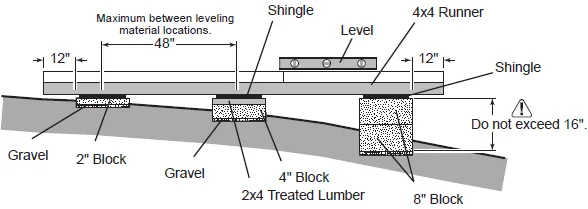
LEVELING METHODS
- Level under 4×4 runners only.
- Locate leveling material 12″ from the ends of runners and no more than 48″ apart.
- Asphalt shingles should be used between 4×4 runners and blocks or treated lumber. Never use shingles in direct contact with the ground.
- For best results and aiding in water drainage, use gravel under each concrete block.
LEVELING MATERIALS
- Gravel
- 2×4 Treated Lumber
- Solid Masonry Blocks in 1″, 2″, 4″, or 8″ thickness
- Asphalt Shingles
Leveling higher than 16″ is not recommended.
CONCRETE
If you are building your shed on a concrete foundation, see the following page.
LEVEL AND SQUARE FLOOR FRAME
Before attaching floor decking, it is important to level and square the floor frame.
A level and square floor frame is required to correctly construct your shed.
- See page 9 for the preferred floor leveling method.
- Use a level and check that the frame is level before applying floor panels.
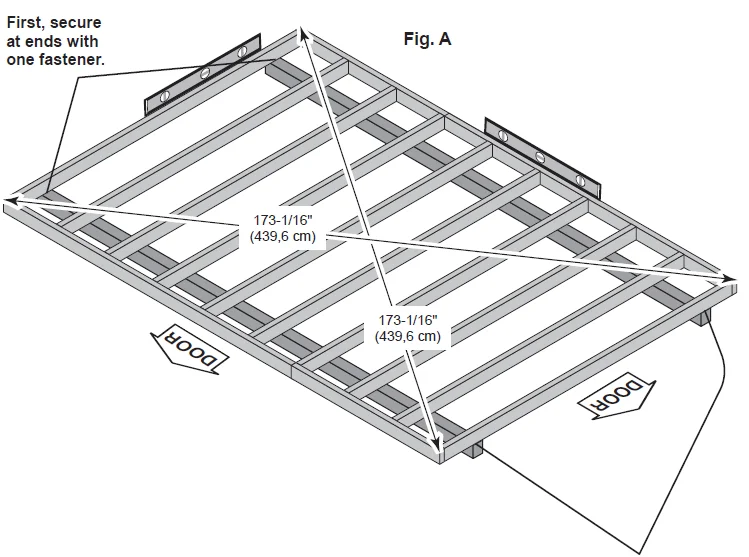
- Check for frame squareness by measuring diagonally across corners. If the measurements are the same, the frame is square. The diagonal measurement will be approximately 173-1/16″ (439,6 cm).
- When the frame is level and square, secure one side of the frame to the 4×4 runners using one fastener at the ends of each runner. Move to the opposite end of the frame. Secure the frame to 4×4 runners with one fastener at the ends of each runner, making sure the frame remains square (Fig. A).
- Once the floor frame is level and square, fasten the frame to the 4×4 runners at each point where the frame contacts the 4×4 runners.

IMPORTANT! Check that the floor frame is level after installing the floor panels. Re-level if needed.
HINT:
- The floor should be used as a stable work surface for wall construction.
- Organize your assembly procedure during the build process to avoid over-handling of the walls.

RAFTER ASSEMBLY
PARTS REQUIRED:
x3 PVA 2 x 4 x 5-7/8″ (5,1 x 10,2 x 14,9 cm)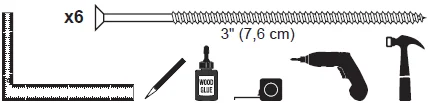
It is very important to assemble your rafters using the following method for an even and flat roof.
You will build a rafter jig using the floor and three PVA parts as shown.
- Secure one PVA flush to the floor deck using two 3″ screws. Measure over 96-3/4″ and install a second PVA flush to the floor deck. PVA will overhang the floor. Secure using two 3″ screws.
- Measure over 48″ and up 30″ from the floor edges and secure the third PVA using two 3″ screws. Check that this PVA is 30″ at both ends for squareness.

- You have finished the rafter jig. Proceed to assemble your rafters.

PARTS REQUIRED:
- x10 OSB OR WOOD GRAIN 6 x 24″ (15,2 x 61 cm)
- x10 CNA 2 x 4 x 61-7/8″ (5,1 x 10,2 x 157,2 cm)
- x 10 Nails 1-5/8″ (4,1 cm)
- x 118Nails 2″ (5,1 cm)
- Place two rafters CNA into the jig as shown.
- Keep the CNA firm against outside PVAs and push rafters tight to the middle PVA. Rafters should touch at the tips. Apply glue to rafters where the gusset will attach. Place the gusset onto the CNA, holding a 1/4″ gap from the edge and keeping rafters firm as instructed. Secure the gusset using one 1-5/8″ screw into each rafter. HINT: These screws will help hold the measurements when you nail on gussets. Use ten 2″ nails to finish securing the gusset to the rafters to the pattern.
- Flip rafters over and attach a second gusset using glue and (12) 2″ nails. No need to use a jig for this gusset.
- Repeat steps 1 through 3 to assemble four more rafters.
- Remove PVA from the floor.
- You have finished assembling your rafters.
GABLE END WALL WITH DOORS
PARTS REQUIRED:
- x3 CPA 2 x 4 x 8-1/2″ (5,1 x 10,2 x 21, 6 cm)
- x2 TK 2 x 4 x 80″ (5 x 10,2 x 203, 2 cm)
- x2 SZ 2 x 4 x 89″ (5 x 10,2 x 226, 1 cm)
- x1 AM 2 x 4 x 67″ (5,1 x 10,2 x 170,2 cm)
- x20 Nails 3″ (7,6 cm)
- Orient the parts on edge on the floor. Measure and mark.
- Use two 3″ nails at each mark.
- Orient parts on edge. Use two 3″ nails at each location.
- Use two 3″ nails at each end of TK.
- Place the left 48″ x 84″ panel onto the wall frame flush to the top of the SZ with the primed side up as shown. Secure panel with two 2″ nails 6″ (15,2 cm) apart.
- Repeat step 5 to attach t 6 he right 48″ x 84″ panel.
- You have finished building your front door wall.
HINT: For easier nailing, stand on the frame.
STOP: AS YOU FACE YOUR BUILDING, CHOOSE YOUR SINGLE DOOR (EAVE) LOCATION – LEFT, CENTER, OR RIGHT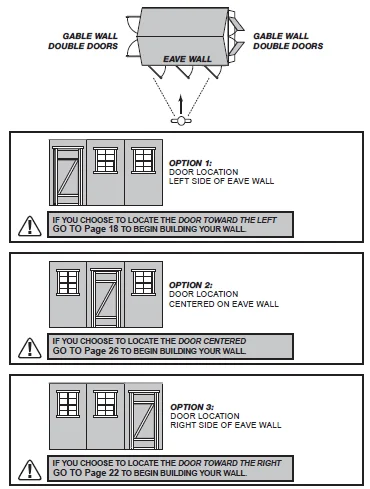
EAVE SIDE WALL WITH DOOR LEFT
PARTS REQUIRED:
- x3 CPA 2 x 4 x 8-1/2″ (5,1 x 10,2 x 21,6 cm)
- x2 AO 2 x 4 x 22-1/2″ (5,1 x 10,2 x 57,1 cm)
- x1 QT 2 x 4 x 35″ (5,1 x 10,2 x 88,9 cm)
- x2 SP 2 x 4 x 48″ (5,1 x 10,2 x 121,9 cm)
- x8 TK 2 x 4 x 80″ (5,1 x 10,2 x 203,2 cm)
- x2 TP 2 x 4 x 96″ (5,1 x 10,2 x 243,8 cm)
- x58 Nails 3″ (7,6 cm)
- Orient the parts on edge on the floor. Measure and mark.
- Use two 3″ nails at each mark and four 3″ nails at seams.
- Orient the parts on edge on the floor as shown. Measure and mark. Use two 3″ nails at each mark and four 3″ nails at seams.
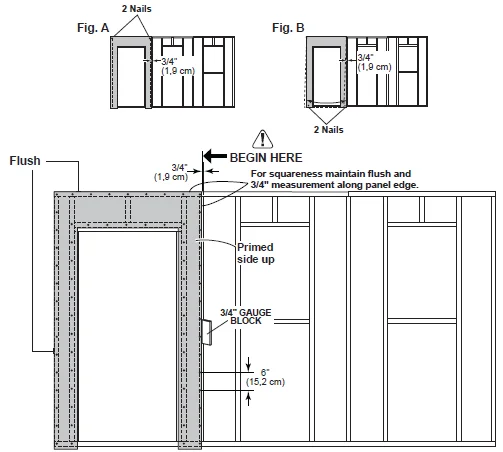
- Place a 48 x 84″ panel onto the wall frame flush to the top of the frame with the primed side up as shown. Use the gauge block to mark the 3/4″ measurement on the wall stud. Secure panel with two 2″ nails in the corners (Fig. A).
- Move to the opposite end. Using the long edge of the panel as a lever, move the panel side-to-side until you have a 3/4″ measurement on the wall stud. Secure the corner with two 2″ nails (Fig. B).
- Nail the panel using 2″ nails 6″ apart on edges and 12″ apart inside the panel.

- Place the center 48″ x 84″ panel on the frame as shown with the primed side facing up. Nails using 2″ nails 6″ apart on edges and 12″ apart inside panel.
- Place the end 48″ x 84″ panel on the frame as shown with the primed side facing up. Nails using 2″ nails 6″ apart on edges and 12″ apart inside panel.
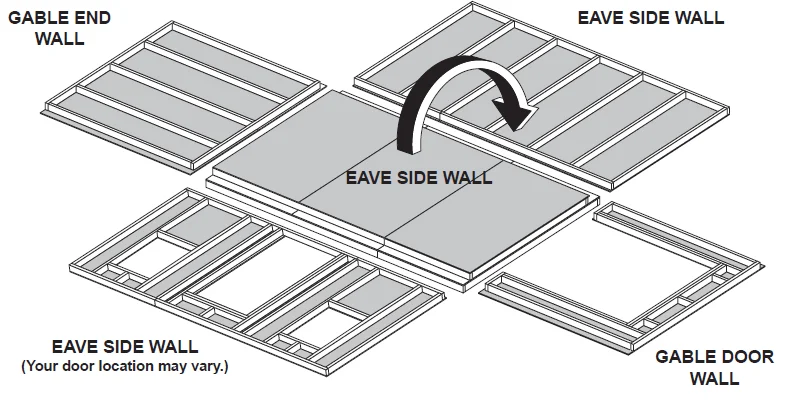
- Carefully flip the EAVE WALL over.
Note:
Ensure your wall frame is square by installing one panel and squaring the frame.
For squareness, maintain flush along panel edges.
PAINT & CAULK
NOT INCLUDED
- Use acrylic latex caulk that is paintable. Caulk all horizontal and vertical seams, between the trim and walls, and all around the door trim.
- Use a high-quality exterior acrylic latex paint. When painting your building, there are a few key areas that can be easily overlooked that must be painted:
- Bottom edge of all siding and trim
- Inside of doors and all 4 edges
Note:
Prime all unprimed exterior wood before painting. (Follow directions provided by manufacturer.)
ROOF FELT
NOT INCLUDED
Install felt flush to all roof edges overlapping 3″. Use a minimal amount of roofing nails to hold in place.
DRIP EDGE
NOT INCLUDED
- Install drip edge over the roof felt on the gable side and under the roof felt on the eave side.
- Do not use nails on the side of the drip edge that hangs over the side of the building.
- Only nail the top of the drip edge.
Snip the bottom side of the drip edge and bend it over to the other side of the roof.
(Follow directions provided by manufacturer.)
SHINGLES
NOT INCLUDED
Follow the directions provided by the manufacturer and these instructions.
NOTE: Familiarize yourself with a 3-Tab Shingle.
NEVER DRIVE FASTENERS INTO OR ABOVE SEALING STRIPS.
- Install the first starter row upside down and color up with a 1″ overhang at the back and bottom of the roof panel. Use (4) nails per shingle. The starter row must be straight and level all the way across with the lower edge of the roof deck. NOTE: If you have installed drip edge, install shingles flush to the drip edge.
- Beginning at the front of the shed, install the first row of shingles with a notch at 1″ past the roof edge or flush with the drip edge.
- Install the second row of shingles flush at the top of the first row’s rain slots. Ensure 1″ overhang or flush to the drip edge at the front, stagger each row.
- Continue installing rows of shingles by staggering at the front.
- Continue installing rows of shingles to the peak. At the peak, make sure there is a maximum of 5″ or less to the rain slot. If shingles overlap at the ridge, cut to the peak with a utility knife.
- Repeat steps 1 – 5 to shingle the opposite side of your roof. Trim shingles at the ridge.
- Once both sides are shingled, you need to trim the ends. Strike a chalk line 1″ from the edge.
- Using your shingle-hooked blade, carefully cut shingles along the chalk line.
- You have finished shingling your roof. Proceed to capping the ridge.
SHINGLES – RIDGE CAP
- Cut shingles into THREE pieces.
- Install the first ridge cap flush to the shingles at the front.
- Install the second ridge cap 5″ back.
- Continue installing the ridge cap on the back of the roof.
- Make sure there is 4″ between the shingle color and the edge of the shingles.
- When you have 4″ of shingle color, cut one piece to cap your roof.
- Install flush to shingles.
- You have finished your ridge cap.
CUSTOMER SERVICE
Call: 1-800-577-9663
Email: [email protected]
For more Manuals by Heartland Sheds, visit ManualsLibraryy
Heartland Hillsdale Wood Storage Shed-FAQs
How do I maintain my Heartland wood shed?
Inspect your shed regularly for cracks, leaks, or peeling paint. Clean debris, check the roof after bad weather, and apply a fresh coat of paint or wood sealant every few years to protect against rot and moisture.
Should I oil or treat the inside of my shed?
Treating the interior is optional but beneficial. Applying oil or wood preservative helps protect against moisture, makes cleaning easier, and adds a polished look.
What are common mistakes to avoid when building a shed?
Avoid placing untreated wood directly on the ground. This can cause early rot. Always build on a solid foundation like gravel, concrete blocks, or a wood platform.
What should I put under my shed?
A gravel base or concrete foundation works best. It keeps the shed level, improves drainage, and prevents wood decay caused by ground moisture.
What types of sheds does Heartland offer?
Heartland builds a variety of styles, including gable, lean-to, ranch, barn, and garden sheds. Some models offer loft storage or double-story designs for extra space.
How much does it cost to build a 12×12 shed?
A 12×12 wood shed typically costs between $2,000 and $25,000, depending on materials, design, and whether you assemble it yourself or hire professionals.
Do I need a foundation for my Heartland shed?
Yes. A stable foundation is essential for preventing shifting and moisture damage. Choose a concrete slab, gravel base, or treated wood frame for best results.
What items should not be stored in a shed?
Avoid storing clothing, books, or valuables. These can attract pests or develop mold due to changing temperatures and humidity inside the shed.
Where are Heartland sheds made?
All Heartland sheds are manufactured in Monroe, Michigan, USA, using high-quality lumber and craftsmanship to ensure durability and reliability.