
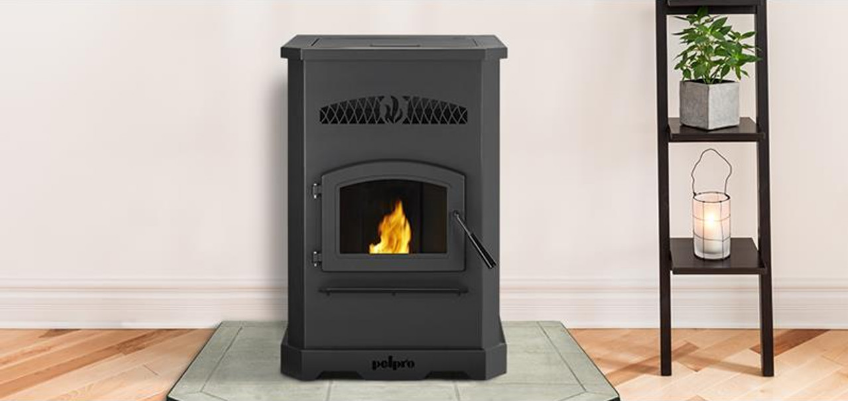

Pelpro PP130 Pellet Stove
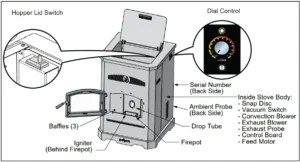
Get to Know Your PelPro® Stove
Safety First!
Safety Alert Key: It is important to pay attention to the alerts you will see throughout this manual to ensure your safety.
- DANGER! Indicates a hazardous situation which, if not avoided, will result in death or serious injury.
- WARNING! Indicates a hazardous situation which, if not avoided, could result in death or serious injury.
- CAUTION! Indicates a hazardous situation which, if not avoided, could result in minor or moderate injury.
- NOTICE: Indicates practices which may cause damage to the Stove or to property.
- Pro Tip: Indicates additional information to help you better understand your Stove and optimize its performance.
NOTICE
Fire Risk
Pelpro disclaims any responsibility, and the warranty and agency listing will be voideddby the following actions.

DO NOT:
- Install or operate a damaged Stove
- Modify Stove
- Install other than as instructed by the manufacturer
- Operate the Stove without fully assembling all components
- Over fire (burning at higher temperatures than recommended,causing permanent damage to the Stove)
- Install any component not approved by the manufacturer
- Install parts or components not listed or approved
- Disable safety switches
Improper installation, adjustment, alteration, service, or maintenance can cause injury or property damage. For assistance or additional information, consult a qualified installer, service agentt or your dealer.
 DANGER!
HOT SURFACES!
Glass and other surfaces are hot during operation AND cool down.
Hot glass will cause burns.
- Do not touch the glass until it is cooled
- NEVER allow children to touch glass
- Keep children away; if you expect that children may come into contact with this Stove, we recommend a barrier such as a decorative screen (see your retailer for suggestions)
- CAREFULLY SUPERVISE children in the same room as the Stove
- Alert children and adults to the hazards of high temperatures
High temperatures may ignite clothing or other flammable materials.
- Keep clothing, furniture, draperies and other flammable materials away
WARNING
This product and the fuels used to operate this product (wood), and the products of combustion of such fuels, can expose you to chemicals including carbon black, which is known to the State of California to cause cancer, and carbon monoxide, which is known to the State of California to cause birth defects or other reproductive harm. For more information, go to: WWW.P65Warnings.ca.gov..
Getting Started
Pallet Removal
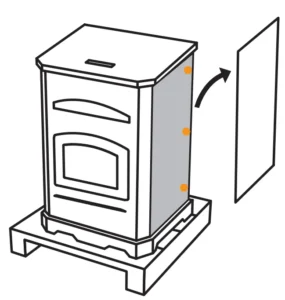
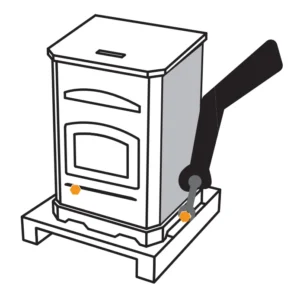
Bolts are holding your PelPro Stove in place on the pallet. To remove your Stove from the pallet:
- Loosen the three retaining bolts on the back of the Stove and remove the right and left side panels.

- Using a 5/16 inch wrench, on each side of the Stove, remove the two bolts. Remove shipping brackets by reaching into the Stove in the same area as the just removed bolts.

WARNING!
Inspect the Stove and components for damage. Damaged parts may impair safe operation.
- Do NOT install damaged components.
- Do NOT install incomplete components.
- Do NOT install substitute components. Report damaged parts to the dealer.
CAUTION!
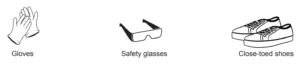
Risk of cuts, abrasions, or flying debris. Wear protective gloves & safety glasses during install. Metal edges are sharp.
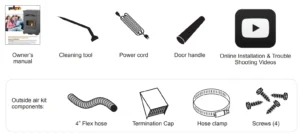
What’s Included
What You’ll Need
Tools & Supplies
- High temperature silicone (500°F+)
- Level
- Phillips screwdriver
- Plumb line
- Tape measure
- Framing square
- Reciprocating saw
- Electric drill & bits
- Caulking gun
- Stud finder
- Utility knife
- Pliers
- Flashlight
- Hammer
Safety Equipment
Recommended for all installation and maintenance steps.
Pellet Vent Pipe
Must be an approved 3” or 4” diameter Type “L” or “PL” vent. Use a 4” diameter vent if the flue height is over 15’ or if installation is over 3,000ft. Above sea level.
WARNING!
Fire Risk. NO OTHER vent components may be used. Substitute or damaged vent components may impair safe operation.
- Floor Protection
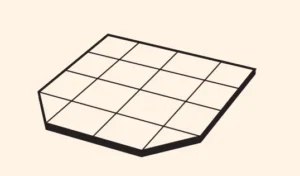
Non-combustible material (such as a hearth pad) is required underneath your Stove.
- Surge Protector
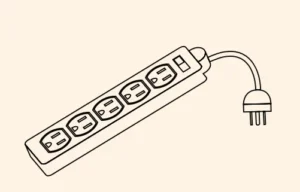
Protect the electrical components of your Stove by using a surge protector.
- Pellet Fuel
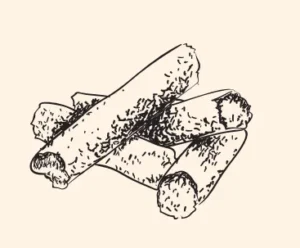
Use only wood pellets in your Stove. For best performance, use premium, low-ash pellets (<1%) less than 1.5” in length and avoid the dusty bits and pieces of pellets in the bottom of the bag.
Installing Your Stove
Getting Ready
Pro Tip
We highly recommend that your Stove and pellet vent pipe be installed by a professional installer. Your retailer can make recommendations for you. Installation MUST comply with local, regional, state, and national codes and regulations. Consult insurance carrier, local building inspector, fire officials, or authorities having jurisdiction over restrictions, installation inspection ,,and permits.
Placement
Where you place your Stove can significantly affect its performance and safety.
A. Your Home Acts Like a Chimney
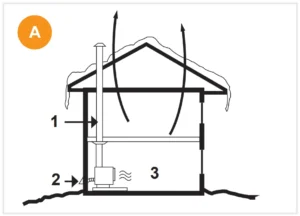
We recommend that you help your home by:
- Using a minimum of 5 feet of vertical venting
- Use the supplied outside air kit
- Install your Stove in a main-floor location
This will:
- Help your Stove breathe
Minimize smoke leakage in the house - Enhance performance
B. Clearance to Combustibles
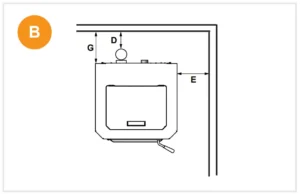
The space between your Stove and the items in your home that could burn. Materials such as:
- Wood
- Sheet rock (drywall)
- Carpet

WARNING!
Asphyxiation Risk.
DO NOT INSTALL IN A SLEEPING ROOM. Consumes oxygen in the room.
C. Pellet Venting
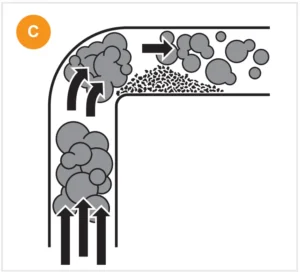
Adding bends in the exhaust path restricts air flow, reduces performance, and provides a collection point for ash deposits requiring more frequent cleaning.
CAUTION
- Do not connect to any air distribution duct or system
- Do not install a flue damper in the exhaust venting system of this Stove
- Do not connect this Stove to a chimney flue serving another Stove
- The structural integrity of the manufactured home floor, wall and ceiling/roof must be maintained
REQUIRED:
Use only 3” or 4” type “L” or “PL” pellet pipe.
Pro Tip
This Stove can be installed with a 3 to 6 inch (76-152mm) Top Vent Offset Adapter Kit. The 3 to 6 inch (76-152mm) Top Vent Offset Adapteisre tested to use 2424-gauge single-wall flue connector or a Listed double wall flue connector to Class A Listed metal chimneys, or masonry chimneys meeting International Conference of Building Officials (ICBO) standards for solid fuel Stoves.
Installation Video
Visit pelprostoves.com or scan this code:

Vent Termination Clearances
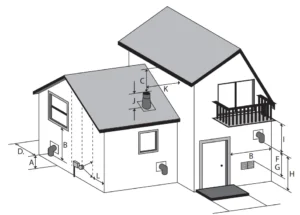
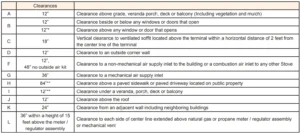
*Recommended to prevent condensation on windows and thermal breakage. **This is a recommended distance. For additional requirements, check local codes.
NOTICE
Do NOT terminate vent:
- In any location that will allow flue gases or soot from entering or staining the building
- In any location that could create a nuisance or hazard
- In any enclosed or semi-enclosed area such as a carport, garage, attic, crawl space, under a sun deck or porchh,or narrow walkway
- Closely fenced area, or any location that can build up a concentration of fumes, such as a stairwell, covered breezeway, etc.
Do NOT terminate below an air inlet.
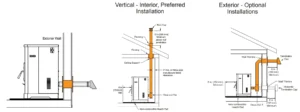
- It is recommended that at least 60” (1.52m) of vertical pipe be installed when the Stove is vented directly through a wall—this will create a natural draft, which will help prevent the possibility of smoke or odor venting into the home during a power outage.
- It will also keep exhaust from causing a nuisance or hazard by exposing people or shrubs to high tetemperatures
- The safest and preferred venting method is to extend the vent vertically through the roof or above the roof.
Placing Your Stove
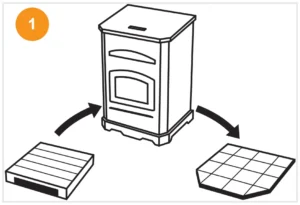
- It is necessary to install EMBER PROTECTION, a Type I floor protector for this Stove.
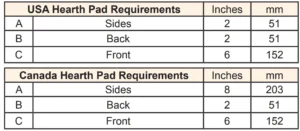
The Floor protector must be a non-combustible material, extending beneath the Stove with a minimum of 6 inches (152mm) in front of the glass and 6 inches (152mm) to both sides of the fuel loading door. Open the door and measure 6 inches (152mm) from the side edge of the opening in the face of the Stove.
Notice: Be careful to protect the bottom of the Stove and floor surfaces when moving the Stove. Bottom edges of the Stove are sharp and can scratch surfaces.
Notice: Clearances may only be reduced by means approved by the regulatory authority having jurisdiction. - Hearth pad minimum requirements:

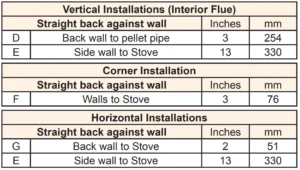
 Non-combustible floor protection extending beneath the flue pipe is required with horizontal venting or under the top vent adapter with vertical installation.
*Non-combustible floor protection must extend 2 inches (51mm) beneath the flue pipe when installed with horizontal venting or under the top vent adapter with vertical installation. CANADA REQUIRED, USA RECOMMENDED. - Confirm required clearances to combustibles:



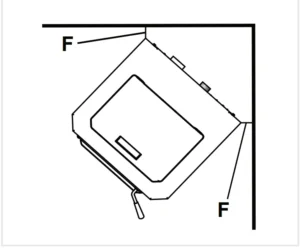
 Non-combustible floor protection extending beneath the flue pipe is required with horizontal venting or under the top vent adapter with vertical installation.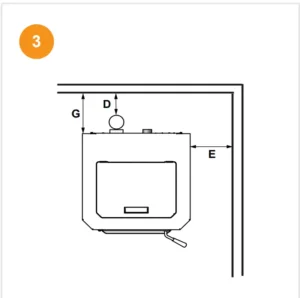
Venting Your Stove
CAUTION!
Take appropriate precautions to locate utilities within the wall and avoid contact.
- Mark and cut a wall for venting penetration on the exterior wall (if needed).
- Install wall thimble (sold separately) per manufacturer requirements.
- Install venting. (For additional installation options visit pelprostoves.com)
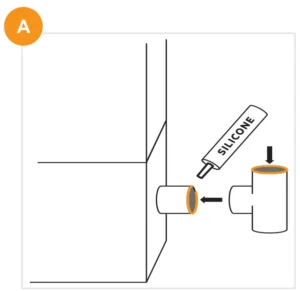
- Use silicone to create an effective vapor barrier at the location where the chimney or other component penetrates to the exterior of the structure.
 NOTE: In Canada, when using a factory-built chimnet,, must be safety listed, Type UL1032100°F100oFCLASS “ACLASS ” or conforming to CAN/ULC-S629M, STANDARD FOR 650oC FACTORY-BUILT CHIMNEYS.
Pro Tips
- See the venting manufacturer’s required clearances to combustibles
- For horizontal installations, the minimum clearance from exterior to termination cap is 6”—you may want to increase to 18” clearance to minimize soot blowback on the home exterior.
Install a vent at the clearances specified by the manufacturer
 WARNING!
Do not terminate venting in any enclosed or semi-enclosed area such as: a carport, garage, attic, crawl space, under a sun deck or porch, narrow walkway or closely fenced area, or any location that can build up a concentration of fumes such as a stairwell, covered breezeway, etc. CAUTION!
Ensure that your Stove venting terminates above your Stove. The following may occur:- Your Stove will not draft properly
- Smoke may seep into your house
- Excessive sooting
Venting Your Stove
The maximum horizontal venting allowed with no vertical venting attached is 48 inches, including one 90° elbow or two 45° elbows. Addition of any horizontal venting beyond 48 inches requires a minimum um 60 inches of additional vertical vent. Horizontal sections of vent pipe should have a 1/4 inch rise per foot. We recommend using the shortest venting and the fewest elbows possible when venting horizontally.
We recommend the use of 4 4-inch vents with any installation requiring more than two 90° elbows, or more than 15 feet of venting.
- 45° elbow is equivalent to 1 foot of straight pipe
- 90° elbow is equivalent to 3 feet of straight pipe

 WARNING!
Fire Risk.- Only LISTED venting components may be used.
- NO OTHER vent components may be used. Substitute or damaged vent components may impair safe operation.
Notice:
These are guidelines for successful venting of your pellet Stove. The more vertical rise you can obtain in your system, the better it will perform. Horizontal vent runs can accumulate ash and will need to be cleaned more often. Try to keep them as short as possible.
- Install pellet venting through the wall and connect the vent/pipe to Stove A
- Some venting manufacturers offer pellet Stove adapters for their venting for easier installation..
- Seal all pipe joints using high-temp silicone (500°+)
- Secure the exhaust venting system to the Stove with at least 3 screws or rivets per the pipe manufacturer’s instructions. Also, secure all connector pipe joints with at least 3 screws through each joint.
- Install the termination cap
- Confirm all required Stove clearances to combustibles.
 Pro Tip
Installing a clean-out “T” (sold separately) to the rear of your Stove, when venting vertically, can save time during cleaning.
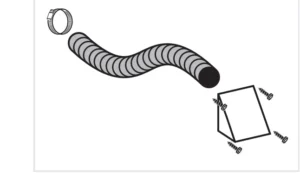
- Install outside air kit (included)
For optimal performance, PelPro recommends the outside air kit for all installations. An outside air kit is required for all mobile/manufactured home installations. Install through wall B- Maintain clearances from the exhaust
- Remove the knockout in the rear of the Stove
- Attach the flex pipe to the outside air connection on the Stove
- Use a hose clamp
- Route the tube outside the structure
- Attach cap
- Secure to the outside wall with appropriate fasteners.

 CAUTION!
Never draw outside combustion air from: - Wall,floorrr, or ceiling cavity
- Enclosed space such as an attic, garage, or crawl space.
 NOTE: In Canada, when using a factory-built chimnet,, must be safety listed, Type UL1032100°F100oFCLASS “ACLASS ” or conforming to CAN/ULC-S629M, STANDARD FOR 650oC FACTORY-BUILT CHIMNEYS.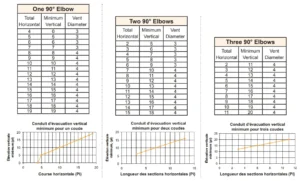
 Pro Tip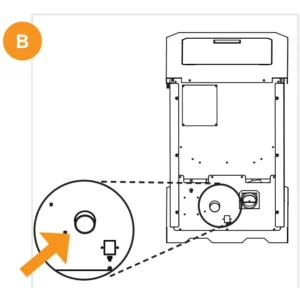
Take a Break
Inspect your work:
- Confirm clearances to combustibles are maintained
- Pipe joints are secure and properly sealed
- Outside air kit installed properly
- Confirm termination clearances
Using Your Stove
Fuel Tips
Fuel Material and Fuel Storage
Pellet fuel quality can greatly fluctuate. We recommend that you buy fuel in multi-ton lots whenever possible. However, we do recommend trying various brands before purchasing multi-ton lots to ensure your satisfaction. Store fuel in a dry location, not within clearances to combustibles of your Stove.
Fuel Material
- Made from sawdust or wood by-products
- Depending on the source material, it may have a high or low ash content.
Higher Ash Content Material
- Hardwoods with a high mineral content
- Fuel that contains bark
- Standard grade pellets or high ash pellets
Lower Ash Content Material
- Most softwoods
- Fuels with low mineral content
- Most premium-grade pellets
Pro Tip
We recommend the use of Pellet Fuels Institute-certified pellet fuel with this product.
Your Stove has a manufacturer-set minimum low burn rate that must not be altered. It is against federal regulations to alter this setting or otherwise operate your Stove in a manner inconsistent with the operation instructions in this manual.
Starting your Stove for the first time
What to Expect
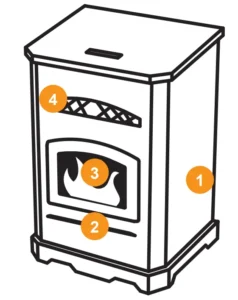
- The combustion blower will turn on..
- Igniter will turn on..
- Pellets will drop, smoke may occur in the firebox, but it will evacuate, and flame will appear in the fire pot.
- The convection blower will automatically turn on after the Stove heats up. The convection blower will continue to run even after your Stove has been shut down.
Pro Tips
- Odors and vapors are released during initial startup after purchase; burning your Stove on HI for 30 minutes will allow the paint to cure. Open windows or doors for air circulation until burn off is complete.
- During start-up and normal operation, your Stove’s front door must be closed..
- Priming is only required the first time your Stove is lit, or after a FUEL FEED ALARM.
WARNING!
Fire Risk
Keep combustible materials, gasoline, and other flammable vapors and liquids clear of the stove.
- Do NOT operate the Stove with the door open
- Do NOT operate the Stove with the fire pot floor open
- Do NOT store flammable materials in the Stove’s vicinity
- Do NOT use gasoline, lantern fuel, kerosene, charcoal lighter fluid, or similar liquids or gels to start or “freshen up” a fire in this Stove
Keep all such liquids well away from the Stove while it is in use, as combustible materials may ignite.
WARNING!
HOT SURFACES! Glass and other surfaces are hot during operation AND cool down.
Hot glass will cause burns.
- Do not touch the glass until it is cooled
- NEVER allow children to touch glass
- Keep children away
- CAREFULLY SUPERVISE children in the same room as the fireplace
- Alert children and adults to the hazards of high temperatures
- High temperatures may ignite clothing or other flammable materials
- Keep clothing, furniture, draperies, and other flammable materials away
WARNING
This product and the fuels used to operate this product (wood), and the products of combustion of such fuels, can expose you to chemicals, including carbon black, which is known to the State of California to cause cancer, and carbon monoxide, which is known to the State of California to cause birth defects or other reproductive harm. For more information, go to: WWW.P65Warnings.ca.gov..
Maintaining Your Stove
Cleaning & Maintenance
Important:
Regular cleaning helps to assure optimal performance of your Stove. Please refer to page 29 to log your maintenance and cleaning.
What You’ll Need
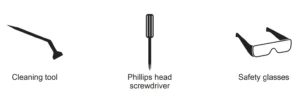
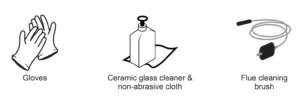
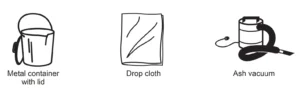
Where, When, and How
Disposal of Ashes
Ashes should be placed in a metal container with a tight-fitting lid. The closed container of ashes should be placed on a non-combustible floor or on the ground, well away from all combustible materials, pending final disposal. If the ashes are disposed of by burial in soil or otherwise locally dispersed, they should be retained in the closed container until all cinders have been thoroughly cooled.
WARNING!
Disconnect the Stove from the power supply before servicing
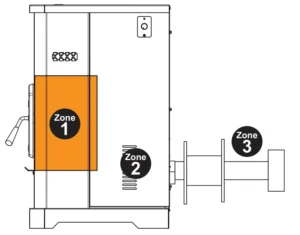
Zone 1 – Firebox
Fire pot
- Remove the fire pot
- Scrape clean and remove ashes
- Replace the fire pot
Firebox
- Remove baffles and vacuum residual ash
- Remove ashes from the firebox floor
WARNING!
If using a vacuum to clean the Stove, be sure embers are thoroughly cooled to prevent a fire in the vacuum.
Glass
- Apply ceramic glass cleaner
- Use a non-abrasive cloth to remove residue
Door Inspection
- The gasket between the glass and firebox should be inspected periodically to make sure there is a good seal.
Pro Tip
The type of fuel you are burning will dictate how often you have to clean your fire pot.
If the fuel you are burning has a high dirt or ash content, it may be necessary to clean the fire pot more than once a day.
Poor-quality fuel will cause clinkers to form in the fire pot. Clinkers are formed when dirt, ash, or a non-burnable substance is heated to 2000°C. F (1093 deg. C) and becomes glass-like.
Always burn dry fuel. Burning fuel with high moisture content takes heat from the fuel and tends to cool the Stove, robbing heat from your home. Damp pellet fuel can clog the feed system.
CAUTION!
Handle glass assembly with care and refer to maintenance instructions. When cleaning glass:
- Avoid striking, scratching, or slamming glass.
- Do NOT clean glass when hot
- Do NOT use abrasive cleaners
- Do NOT operate with the glass cracked, broken,, rscratched
WARNING!
Glass is 5mm thick high high-temperature heat-resistant ceramic glass.
- DO NOT REPLACE with any other material
- Alternate material may shatter and cause injury
Troubleshooting
Power Related
In the event of a power outage
- If using a generator, PelPro recommends a steady-state forest performance.
- This Stove needs 110V to run properly. This Stove has not been tested for use with a third-party battery backup.
Pro Tip
Check passages to ensure they are clear of ash and obstructions. Poor airflow leads to poor performance of your Stove.
The stove was plugged in, but no response
- Unplug your Stove
- Check your home’s circuit breaker
- Reset snap disc (located between drop tube and hopper (Zone 2)
- Visually inspect wires, blowers, and power cords for cracks or wear to find the cause of a possible short circuit (Zone 2)
Component (i.e., blower) fails to start or fails to turn off
- Unplug your Stove
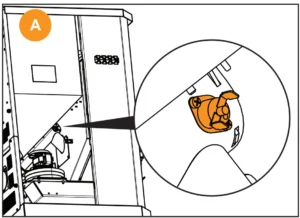
- Check all connections (A) and power plugs are secure
- Visually inspect wires, blowers,, the power cord to find the cause of a possible short circuit
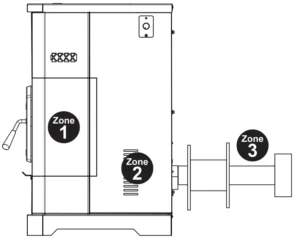
Blockage Related
Black soot on the outside of the house
- Confirm the exhaust path is clean and clear (Zoness 1 and 3)
- Adjust air/fuel ratio using trim adjustment dial (See page 23 for trim adjustment instructions )
- Ensure termination cap has at least 18” clearance to reduce the effects of soot blow-back on home exterior (ie, siding)—if not able, refer to page 10 for alternate installation options
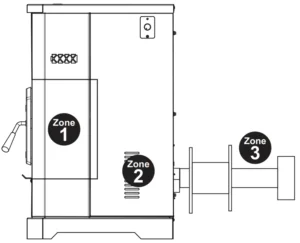
Rumbling/whistling noise during operation
- Confirm the exhaust path is clean and clear (Zone 1 & 3)
- Adjust air/fuel ratio using trim adjustment dial (See page 18 for trim adjustment instructions)
The stove will not light
- Confirm the firebox is clean and clear (Zone 1)
- Igniter is getting hot (glows orange)
- Inspect Stove body (Zone 2)
- Confirm fuel is in the hopper, and close the lid securely
- Remove the right side panel to access and confirm the vacuum switch is clear and connected at both ends.
- Confirm all exhaust blower connections …………secure
- Confirm the feed assembly and motor are clean and clear of debris
- Confirm the exhaust path is clean and clear (Zone 3)
Fire starts but goes out
- Confirm the firebox is clean and clear (Zone 1)
- Ensure fire pot holes are clear
- Inspect Stove body (Zone 2)
- Confirm the exhaust probe is connected
- Inspect and clean the exhaust outlet
- Confirm the exhaust path is clean and clear (Zone 3)
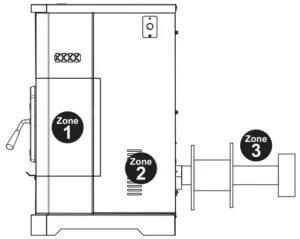
Starts and stops frequently in automatic mode..
- Determine if your room is experiencing varying temperatures due to repeated opening/closing of doors or windows—correct if necessary..ry
- Examine the Stove body (Zone 2)
- Inspect the ambient probe and confirm that at least 2” is exposed outside of the Stove body..
Slow or smoky start-up and/or lazy flame
- Confirm the exhaust path is clean and clear (Zone 3)
- Examine the Stove body (Zone 2)
- Align the igniter so it is properly placed and centered
- Review fuel quality (see Pellet Fuel information on page 13)
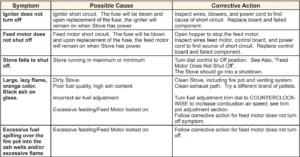
Following correction of any alarm, turn the dial control to the OFF position, wait 10 seconds, and turn back tthe o the desired setting, OR unplug the Stove, wait 10 seconds, then restore power.
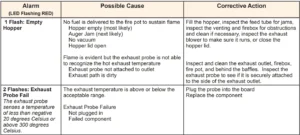
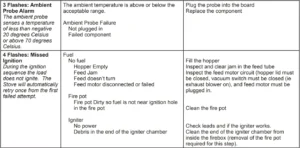
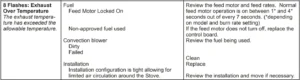
Still having trouble?
Access additional resources at: pelprostoves.com/troubleshooting
Warranty
If replacement parts are needed, please note that warranty coverage begins on the date of purchase. Retain your original receipt as proof of purchase. The warranty period for covered components is as follows:
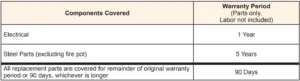
Additional terms and limitations apply. See page 28 for complete warranty information..
For more manuals by Pelpro, visit ManualsLibraryy
Pelpro PP130 Pellet Stove- FAQs
How do I operate the PelPro PP130 Pellet Stove step by step?
Fill the hopper with quality wood pellets, plug in the stove, and press the ON button. Adjust the heat level dial to your desired temperature. The stove will automatically feed pellets into the burn pot and maintain heat. Always monitor for proper airflow and flame quality.
How do I adjust the settings on my PelPro pellet stove?
Use the control knob to select the heat level — from low to high. Adjust the blower speed to control how much warm air circulates. Fine-tune settings for comfort while keeping efficiency in mind.
Is the PelPro PP130 worth the money?
Yes. The PelPro PP130 Pellet Stove is EPA-certified to produce 32% more heat than comparable models while burning cleaner. Its 130 lb hopper offers long burn times and excellent value for heating up to 2,500 sq. ft. efficiently.
How do I prime the PelPro PP130 Pellet Stove?
When the unit is cool, open the door and clean the firepot. To prime the feed tube, quickly turn the control dial from OFF → HI → OFF → HI. This helps the pellets flow properly into the burn pot.
Why isn’t my pellet stove igniting?
Check if the pellets are dry — moisture prevents ignition. Make sure the igniter rod (resistor) is heating correctly. If the problem continues, consult the manual or contact a certified technician.
What type of fuel should I use in the PP130?
Use only premium-grade wood pellets with low ash content (under 1%) and lengths under 1.5 inches. Avoid dusty pellets, as they can clog the feed system and reduce efficiency.
How large an area can the PelPro PP130 heat?
With a maximum heat output of 49,200 BTUs, the PP130 can warm up to 2,500 square feet, making it ideal for medium to large homes.
How long does a 40-pound bag of pellets last?
Depending on your heat setting and outside temperature, one 40 lb bag typically lasts 12 to 27 hours.
Is it cheaper to heat with pellets or oil?
In most areas, pellet fuel is more cost-effective and stable in price compared to heating oil. It’s also a cleaner and renewable energy source.
Can I leave my pellet stove running overnight?
While many owners do, it’s best to follow the manufacturer’s safety instructions. You may keep it on a low setting overnight, but avoid leaving it unattended for long periods.