
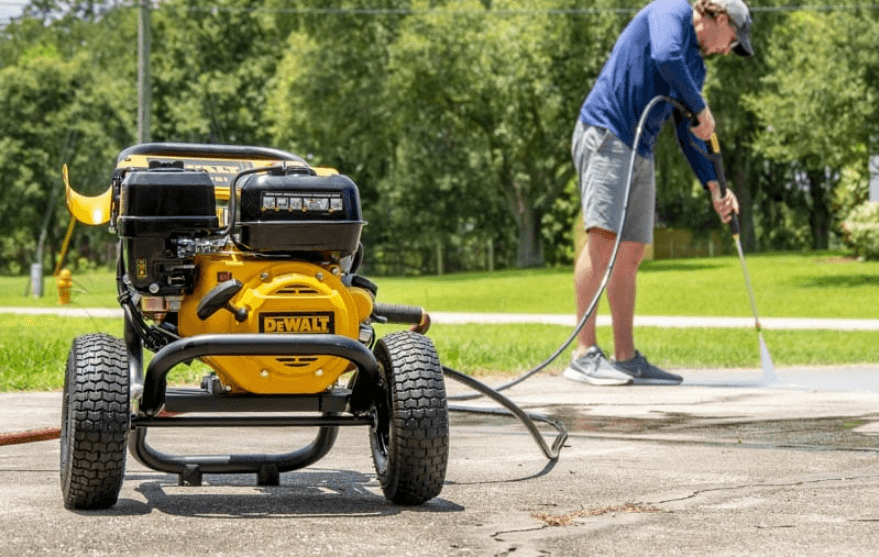

DeWalt DP3400 3400PSI Pressure Washer
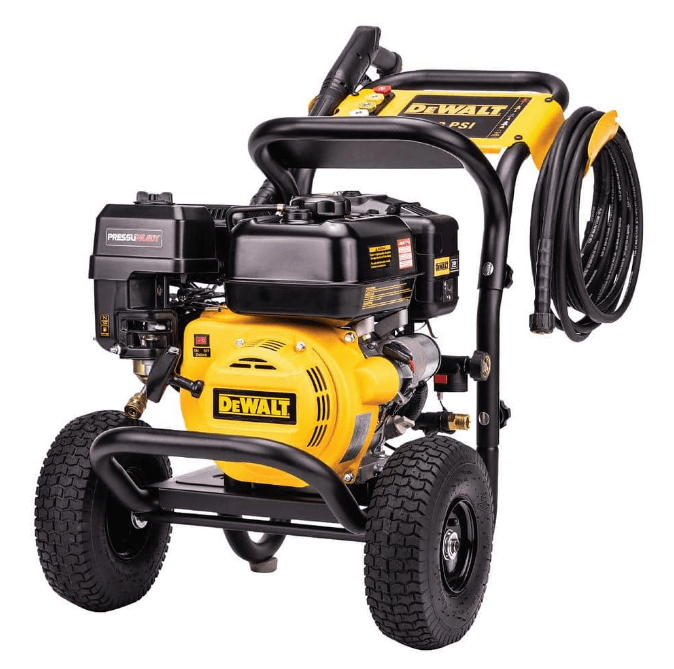
DP3400 Pressure Washer
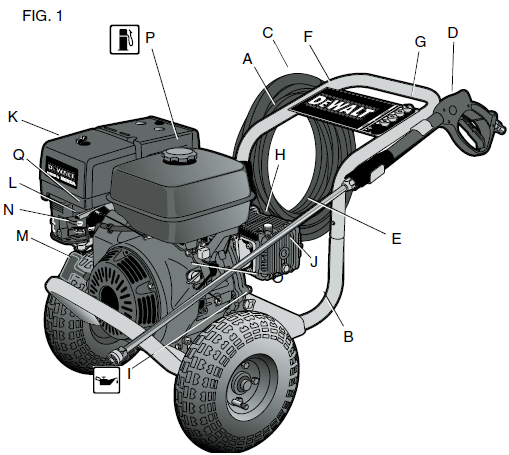
- Handle assemble
- Frame
- High-pressure hose
- Spray gun
- Quick-connect spray wand
- Panel assembly
- Nozzle holder
- High-pressure pump dipstick/oil plug
- Engine dipstick/oil plug
- High-pressure pump
- Engine
- Choke control
- Starter grip
- Fuel valve lever
- Engine switch
- Gas cap
- Throttle control lever
Important Safety Instructions
WARNING: Do not operate this unit until you read and understand this instruction manual and the engine instruction manual for safety, operation, and maintenance instructions.
Warning: When using this product, basic precautions should always be followed, including the following:
- Read all instructions before using the product.
- To reduce the risk of injury, close supervision is necessary when a product is used near children.
- Know how to stop the product and bleed pressures quickly. Be thoroughly familiar with the controls.
- Stay alert–watch what you are doing.
- Do not operate the product when fatigued or under the influence of alcohol or drugs.
- Keep operating area clear of all persons.
- Do not overreach or stand on unstable support. Keep good footing and balance at all times.
- Follow the maintenance instructions specified in the manual.
Danger: Risk of Injection or Severe Injury. Keep Clear of Nozzle. Do Not Direct Discharge Stream at Persons. This Product Is To Be Used Only By Trained Operators.
What can happen, How to prevent it
- Spilled gasoline and its vapors can become ignited from cigarette sparks, electrical arcing, exhaust gases, and hot engine components such as the muffler.
- Shut off engine and allow it to cool before adding fuel to the tank.
- Use care in filling tank to avoid spilling fuel. Move pressure washer away from fueling area before starting engine.
- Heat will expand fuel in the tank, which could result in spillage and possible fire or explosion.
- Keep maximum fuel level 1/2″ (12.7 mm) below bottom of filler neck to allow for expansion.
- Operating the pressure washer in an explosive environment could result in a fire.
- Operate and fuel equipment in well-ventilated areas free from obstructions. Equip areas with fire extinguisher suitable
for gasoline fires.
- Materials placed against or near the pressure washer can interfere with its proper ventilation features, causing overheating and possible ignition of the materials.
- Never operate pressure washer in an area containing dry brush or weeds.
INSTALLATION
Pressure Washer Assembly
- Place handle assembly (A) onto frame, depress the snap buttons, and slide the handle assembly onto the frame (B) until snap buttons are secured in place.
Caution: Risk of personal injury. Avoid placing hands between handle and frame when assembling to prevent pinching.
- Attach high-pressure hose (C) to spray gun (D). Make sure it is secure.
- Connect wand (E) to spray gun. Make sure connection is secure.
- Place the nozzle holder (G) onto the panel assembly (F) and push each nozzle holder into place.
- Remove the five colored quick-connect nozzles from the plastic bag and insert them into the correct grommet on the nozzle holder. Nozzles are color coded to match colored nozzles on panel assembly.
- Using a 7/8″ wrench, remove shipping plug from pump by turning it counterclockwise. Discard shipping plug.
NOTE: The high-pressure pump was filled with oil at the factory. Always check oil level before using (refer to Maintenance for more information).
- Remove dipstick/oil plug (H) from plastic bag and install into pump; tighten securely.
NOTE: The shipping plug must be removed and replaced with the dipstick/oil plug before operating the pressure washer.
Warning: Risk of bursting. Use a tire pressure gauge to check the tire pressure before each use and while inflating tires; see the tire sidewall for the correct tire pressure.
NOTE: Air tanks, compressors, and similar equipment used to inflate tires can fill small tires similar to these very rapidly. Adjust pressure regulator on air supply to no more than the rating of the tire pressure. Add air in small increments and frequently use the tire gauge to prevent overinflation.
OPERATION
Pressure Adjustments
The pressure setting is preset at the factory to achieve optimum pressure and cleaning. To lower the pressure, follow these instructions.
- Back away from the surface to be cleaned. The further away you are, the less the pressure will be on the surface to be cleaned.
- Change to the 40˚ nozzle (white). This nozzle delivers a less powerful stream of water and a wider spray pattern. Refer to Spray Wand Nozzles.
- Adjust the pressure regulator on the pump. Turn the pressure regulator knob (R) counterclockwise to lower pressure. Once you have finished using your pressure washer, return the pressure regulator to its original position by turning it clockwise.

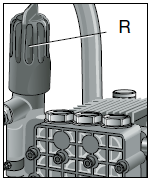
Caution: Do not try to turn pressure regulator knob past the built-in stop or damage to the pump will result.
Spray Wand Nozzles (Fig. 1)
The nozzles for the spray wand are stored in the nozzle holder (G) on the panel assembly (F). Colors on the panel identify nozzle location and spray pattern. Refer to the following chart to choose the correct nozzle for the job to be performed.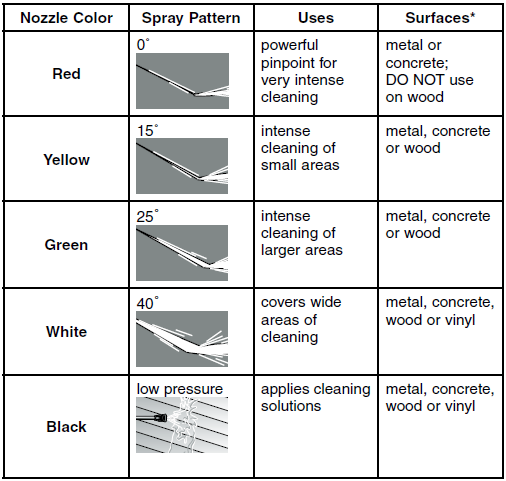
Caution: The high-pressure spray from your pressure washer is capable of causing damage to surfaces such as wood, glass, automobile paint, auto striping and trim, delicate objects such as flowers and shrubs. Before spraying, check the item to be cleaned to assure yourself that it is strong enough to resist damage from the force of spray.
Changing Nozzles on Spray Wand
Danger: Risk of fluid injection. Do not direct discharge stream toward persons, unprotected skin, eyes, or any pets or animals. Serious injury will occur.
Warning: Flying objects could cause risk of serious injury. Do Not attempt to change nozzles while pressure washer is running. Turn engine off before changing nozzles.
- Pull quick-connect coupler back and insert nozzle.
- Release quick-connect coupler and twist nozzle to make sure it is secure in coupler.
Warning: Flying object could cause risk of serious injury. Ensure nozzle is completely inserted in quick-connect socket and quick-connect snap ring is fully engaged (forward) before squeezing gun trigger.
Chemicals and Cleaning Solvents
Applying chemicals or cleaning solvents is a low-pressure operation.
NOTE: Use only soaps and chemicals designed for pressure washer use. Do not use bleach.
To apply chemicals and solvent
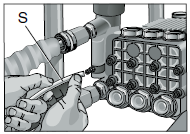
- Press chemical hose (S) onto barbed fitting located near high-pressure hose connection of pump as shown.

- Place the other end of chemical hose with filter on it into the container holding chemical/cleaning solution. NOTE: For every 7 gallons (26.5 liters) of water pumped, 1 gallon (3.8 liters) of chemical/cleaning solution will be used.
- Install low-pressure (black) nozzle into quick-connect fitting of spray wand, refer Spray Wand Nozzles.
- After use of chemicals, place chemical hose into container of clean water and draw clean water through chemical injection system to rinse system thoroughly. If chemicals remain in the pump, it could be damaged. Pumps damaged due to chemicals will not be covered under warranty.
NOTE: Chemicals and soaps will not siphon when spray wand is in the high-pressure setting.
Starting
Warning: To reduce the risk of injury, read the pressure washer instruction manual and the engine instruction manual before starting the pressure washer.
DANGER: Risk of fluid injection and laceration. When using the high-pressure setting, DO NOT allow the high-pressure spray to come in contact with unprotected skin, eyes, or with any pets or animals. Serious injury will occur.
- Your washer operates at fluid pressures and velocities high enough to penetrate human and animal flesh, which could result in amputation or other serious injury. Leaks caused by loose fittings or worn or damaged hoses can result in injection injuries. DO NOT TREAT FLUID INJECTION AS A SIMPLE CUT! See a physician immediately!
WARNING: Risk of fire, asphyxiation, and burning. Never fill fuel tank when engine is running or hot. Do not smoke when filling fuel tank.
- Never fill fuel tank completely. Fill tank to 1/2″ (12.7 mm) below bottom of filler neck to provide space for fuel expansion. Wipe any fuel spillage from engine and equipment before starting engine.
- Never run engine indoors or in enclosed, poorly ventilated areas. Engine exhaust contains carbon monoxide, an odorless and deadly gas.
- DO NOT let hoses come in contact with very hot engine muffler during or immediately after use of your pressure washer. Damage to hoses from contact with hot engine surfaces will NOT be covered by warranty.
CAUTION: Never pull water supply hose to move pressure washer.
This could damage hose and/or pump inlet.
- DO NOT use hot water, use cold water only.
- Never turn water supply off while pressure washer engine is running, or damage to pump will result.
- DO NOT stop spraying water for more than two minutes at a time. Pump operates in bypass mode when spray gun trigger is not pressed. When the temperature inside the pump rises too high, the thermal relief valve (T) will open and release a gush of water in an effort to lower the temperature inside the pump. The thermal relief valve will then close. If pump is left in bypass mode for more than two minutes, internal components of the pump can be damaged.
Start-up Procedure
- In a well-ventilated outdoor area, add fresh, high-quality, unleaded gasoline with a pump octane rating of 86 or higher. Do not overfill. Wipe up spilled fuel before starting the engine. Refer to engine instruction manual for correct procedure.
- Check engine oil level. Refer to the engine instruction manual for correct procedure.
- Connect the water hose to the water source. Turn the water source on to remove all air from the hose. When a steady stream of water is present, turn the water source off.
- Verify the filter screen (U) is in the water inlet of the pump. The cone side faces out.
- Connect the cold water source (V) to pump inlet. NOTE: Water source must provide a minimum of 5 gallons per minute at 20 PSI. Warning: To reduce the possibility of contamination, always protect against backflow when connected to a potable water system.
- Connect high-pressure hose (C) to pump outlet.
- If applying a chemical or cleaning solution, refer to Chemicals and Cleaning Solvents.
- Turn the water source on. Caution: Risk of property damage. Failure to do so could cause damage to the pump.
- Remove all air from the pump and high-pressure hose by depressing trigger until a steady stream of water is present.
- Start engine. Refer to the engine instruction manual for correct procedure. Warning: Risk of unsafe operation. If the engine does not start after two pulls, squeeze the trigger of the gun to relieve pump pressure. Pull starter cord slowly until resistance is felt. Then pull cord rapidly to avoid kickback and prevent hand or arm injury.
- Depress trigger on gun to start water flow. Warning: Risk of unsafe operation. Stand on a stable surface and grip gun/wand firmly with both hands. Expect the gun to kick back when triggered.
- Release trigger to stop water flow. DANGER: Risk of injury from spray. Engage the trigger lock (W) when gun is not in use to prevent accidental spraying.
- Adjust spray for the task being performed by changing quick-connect nozzle. Refer to Spray Wand Nozzles.
Shutting Down
- If chemicals were applied, place the chemical hose into a container of clean water and draw clean water through the chemical injection system to rinse the system thoroughly. Caution: Risk of property damage. Failure to do so could cause damage to the pump.
- Turn engine off. Refer to the engine instruction manual. Caution: Risk of property damage. Never turn water supply off while pressure washer engine is running, or damage to pump will result.
- Turn water source off.
- Pull trigger on spray gun to relieve any water pressure in hose or spray gun.
- Refer to Storage for proper storage procedures.
MAINTENANCE
WARNING: Risk of burning. When performing maintenance, you may be exposed to hot surfaces, water pressure, or moving parts that can cause serious injury or death.
WARNING: Risk of fire. Always disconnect spark plug wire, let the engine cool, and release all water pressure before performing any maintenance or repair. The engine contains flammable fuel. Do not smoke or work near open flames while performing maintenance.
To ensure efficient operation and longer life of your pressure washer, a routine maintenance schedule should be prepared and followed.
If the pressure washer is used in unusual conditions, such as high temperatures or dusty conditions, more frequent maintenance checks will be required.
Engine
Consult the engine instruction manual for the manufacturer’s recommendations for any and all maintenance.
NOTE: The pressure washer frame is equipped with an oil drain hole to help make changing the engine oil easier.
Pump
NOTE: The pump was filled with oil at the factory.
- Change pump oil after the first 10 hours of operation and every 250 hours thereafter.
To Check Oil
- The oil level should come to the dot in the middle of the sight glass (X).
How To Change H Pump Oil
- Loosen pump dipstick/oil plug (H).
- Place a container under the oil drain plug (Y).
- Remove pump oil drain plug.
- After oil is drained, replace oil drain plug. Tighten securely.
- Remove pump dipstick/oil plug and fill with 14 oz. (414 ml) of DP70 pump oil. If DP70 is not available, use 30W non-detergent oil.
- Replace pump dipstick/oil plug and tighten securely.
Nozzle Cleaning
If the nozzle becomes clogged with foreign materials, such as dirt, excessive pressure may develop. If the nozzle becomes partially clogged or restricted, the pump pressure will pulsate. Clean the nozzle immediately using the nozzle kit supplied and the following instructions:
- Shut off the pressure washer and turn off the water supply.
- Pull trigger on gun handle to relieve any water pressure.
- Disconnect the spray wand from the gun.
- Remove the high-pressure nozzle from the spray wand. Remove any obstructions with the nozzle cleaning tool (Z) provided and back flush with clean water.
- Direct water supply into spray wand to back flush loosened particles for 30 seconds.
- Reassemble the nozzle to the wand.
- Reconnect spray wand to gun, then turn on water supply.
- Start pressure washer and place spray wand into high-pressure setting to test.
To Clean the Water Inlet Filter
This filter screen (U) should be checked periodically and cleaned if necessary.
- Remove the filter screen (U) by grasping the end and removing it from the water inlet of the pump.
- Clean filter by flushing it with water on both sides.
- Reinsert filter into water inlet of pump. Cone side faces out.
NOTE: Do not operate pressure washer without filter properly installed.
To Remove Tires
- Using a 1/8″ hex head wrench, loosen set screw in hub collar.
- Slide hub collar from axle and remove the tire.
STORAGE
Engine
Consult the engine instruction manual for the manufacturer’s recommendations for storage.
Pump
The manufacturer recommends using a pump protector/winterizer, such as DP80, when storing the unit for more than 30 days and/or when freezing temperatures are expected. DP80 is available at the store where the pressure washer was purchased. If a pump protector/winterizer is not available, RV antifreeze or windshield washer fluid needs to be run through the pump as outlined in the steps below.
NOTE: Using a pump protector/winterizer, RV antifreeze, or windshield washer fluid is to provide proper lubrication to the internal
seals of the pump regardless of temperature or environment.
- Obtain a funnel, 6 oz. (170 mL) of RV antifreeze or windshield washer fluid, and 16–36″ (40–91cm) of garden hose with a male hose connector attached to one end.
- Disconnect spark plug wire.
- Connect length of garden hose to water inlet of pump.
- Add RV antifreeze or windshield washer fluid to hose as shown.
- Pull engine starter rope slowly several times until antifreeze/washer fluid comes out of high-pressure hose connection of pump.
- Remove garden hose from water inlet of pump.
- Reconnect spark plug wire.
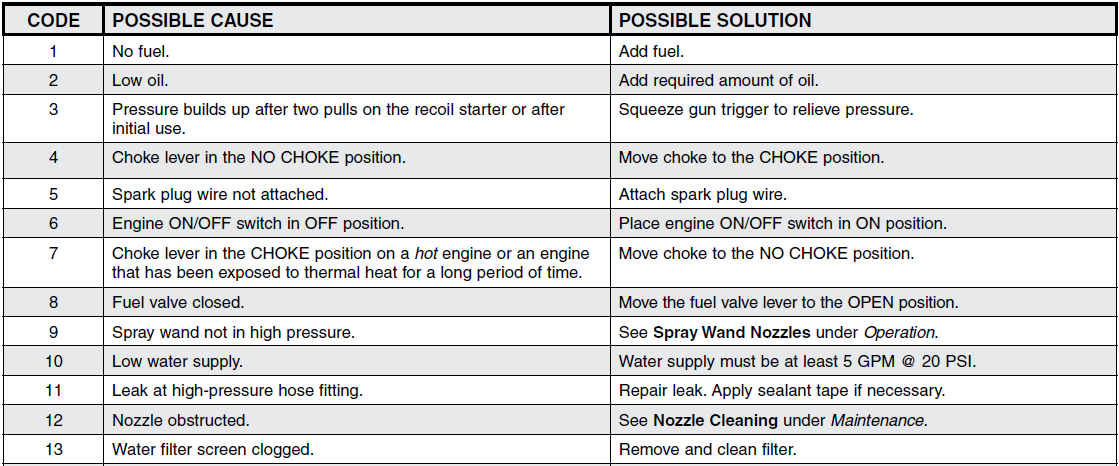
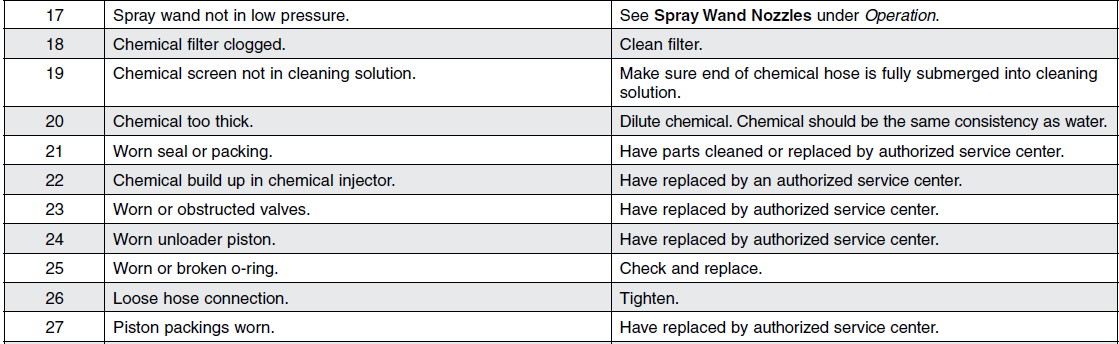
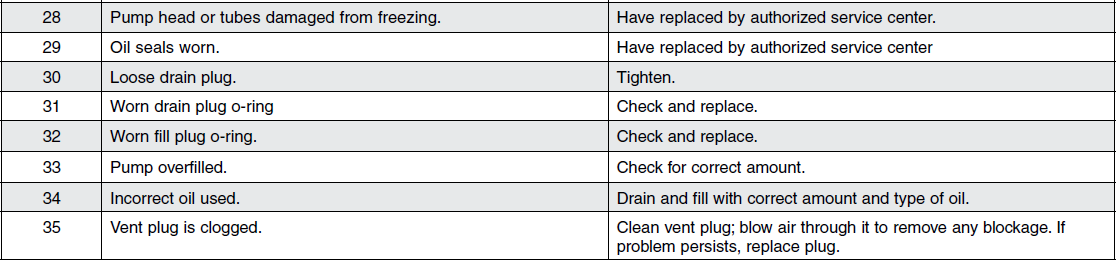
Troubleshooting Codes

For more Manuals by DeWalt, visit ManualsLibraryy
DeWalt DP3400 3400PSI Pressure Washer-FAQs
Can I use hot water in the DeWalt DP3400?
No—this model is designed for cold water only (max 80°F / 27°C).
What’s the best PSI for home pressure washing?
Light-duty (cars, patio furniture): 1000–2000 PSI
Medium-duty (fences, driveways): 2000–3000 PSI
Heavy-duty (concrete, grime): 3000+ PSI (Like the DeWalt DP3400)
Can I run it without water?
No! Running dry can damage the pump. Always ensure water flow before starting.
What maintenance does it need?
Use SAE 10W-30 oil (check manual for specifics).
Flush system after each use.
Store in a dry place.
Can I use soap with this pressure washer?
Yes! It has a built-in soap tank—use pressure-washer-safe detergents.
How does it compare to Simpson or Kärcher?
DeWalt: Great for power & portability (Honda engine).
Simpson: More heavy-duty industrial use.
Kärcher: Known for German engineering & reliability.
What’s the best nozzle for different jobs?
0° (Red): Spot cleaning (caution—high damage risk).
15° (Yellow): Tough stains on concrete.
25° (Green): General cleaning (siding, decks).
40° (White): Gentle washing (cars, windows).
How long do DeWalt pressure washers last?
With proper care, 5–10 years (depending on usage & maintenance).
Can I pressure wash in winter?
Yes, but drain all water afterward to prevent freezing damage.
What’s the difference between gas & electric pressure washers?
Gas (DeWalt DP3400): More power (3000+ PSI), portable.
Electric: Quieter, better for light-duty tasks (<2000 PSI).