
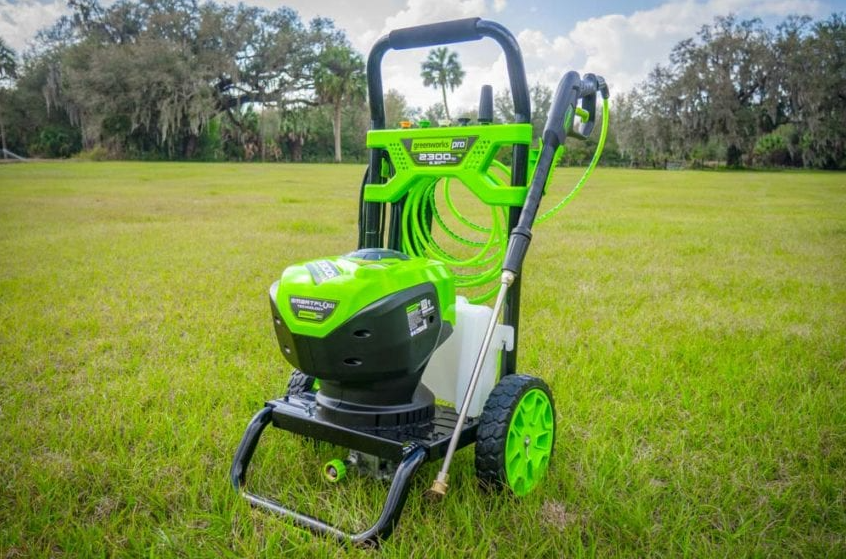

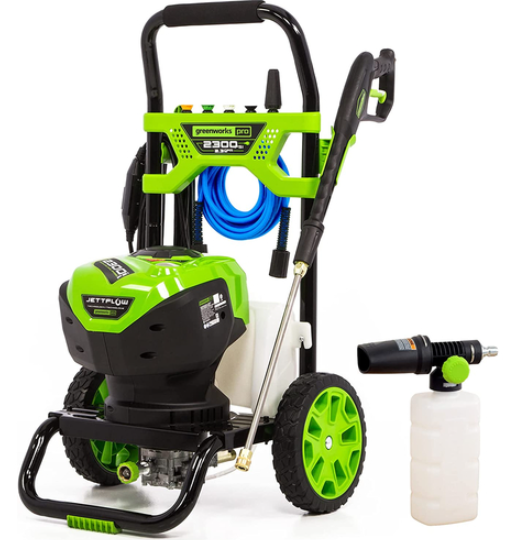
Greenworks GPW-2300 PSI Pressure Washer
SAFETY INFORMATION
WARNING
When using this product, basic precautions should always be followed.
READ ALL INSTRUCTIONS BEFORE USING THIS PRODUCT
- To reduce the risk of injury, close supervision is necessary when a product is used near children.
- Be thoroughly familiar with controls. Know how to stop the product and release pressure quickly.
- Stay alert and exercise control. Watch what you are doing and use common sense. Do not operate the product when you are tired. Do not rush.
- Do not operate the product while under the influence of drugs, alcohol, or any medication.
- Keep the area of operation clear of all people, particularly small children and pets.
- Don’t overreach or stand on unstable support. Keep proper footing and balance at all times.
- Follow the maintenance instructions specified in this manual.
WARNING
High-pressure jets can be dangerous if subject to misuse. The jet must not be directed at people, animals, electrical devices, or the machine itself.
- Keep the motor away from flammables and other hazardous materials.
- Check bolts and nuts fixing the pressure washer shell for looseness before each use. A loose bolt or nut may cause serious motor problems.
- Before storing, allow the motor to cool.
- When servicing, use only identical replacement parts. Use of any other parts may create a hazard or cause product damage.
- ONLY use cold water.
- Make sure a minimum clearance of 3 feet is maintained from combustible materials.
- Connect the pressure washer only to an individual branch circuit.
- Hold the handle and wand securely with both hands. Expect the trigger handle to move when the trigger is pulled due to reaction forces. Failure to do so could cause loss of control and injury to yourself and others.
- Save these instructions. Refer to them frequently and use them to instruct other users. If you loan someone this product, loan them these instructions also.
ELECTRICAL
ELECTRICAL CONNECTION
This product has a precision-built electric motor. It should be connected to a power supply that is 120 volts, 60 Hz, AC only (normal household current). Do not operate this product on direct current (DC). A substantial voltage drop will cause a loss of power, and the motor will overheat.
DRIP LOOP
To prevent water from flowing along the power cable and possibly reaching the electrical outlet and plug, we recommend using a simple drip loop.
WARNING
Keep the extension cord clear of the working area. Position the cord so that it will not get caught on lumber, tools, or other obstructions while you are working with a power tool. Failure to do so can result in serious personal injury.
KNOW YOUR PRESSURE WASHER
The safe use of this product requires an understanding of the information on the tool and in this operator’s manual, as well as a knowledge of the project you are attempting. Before using this product, familiarize yourself with all operating features and safety rules.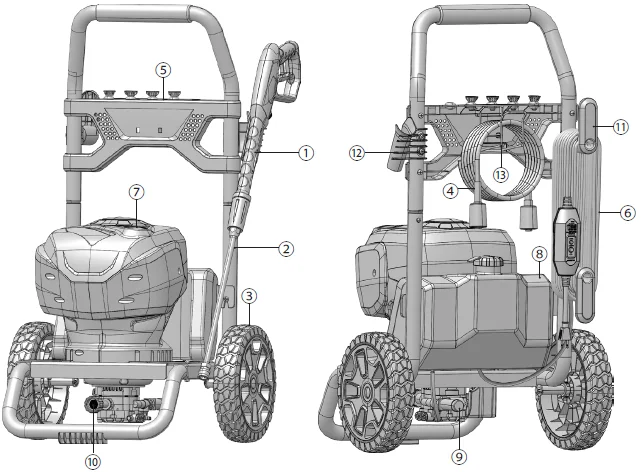
- Gun
- Spray wand
- Wheel
- High pressure hose
- Front panel
- Power cord
- ON/OFF Switch
- Soap tank
- Water outlet
- Water inlet
- Cord retainer
- Gun holder
- Hose hook
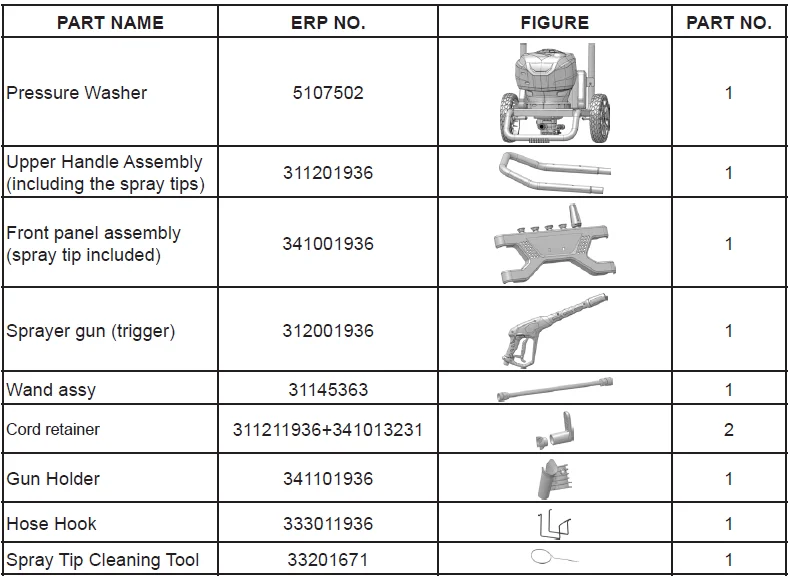
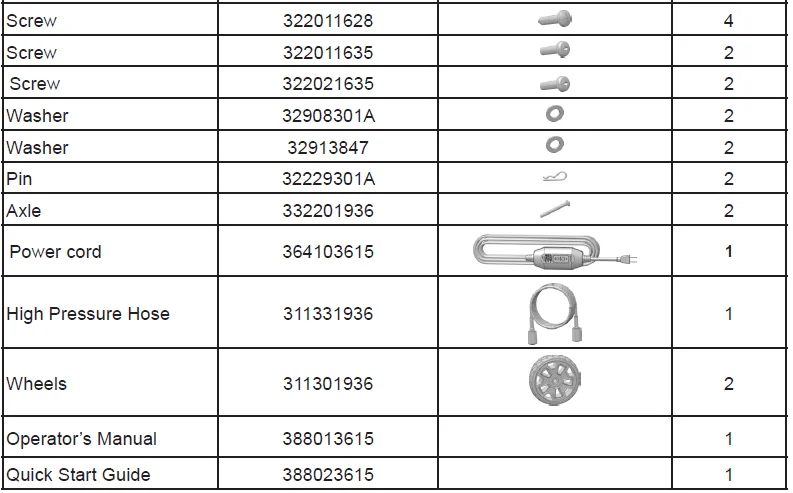
PACKING LIST
ASSEMBLY
UNPACKING
This product requires assembly.
- Carefully remove the product and any accessories from the box. Make sure that all the contents from the packaging list are included.
- Inspect the product carefully to make sure no breakage or damage occurred during shipping.
- Do not discard the packing material until you have carefully inspected and satisfactorily operated the product.
- If any parts are damaged or missing, please call 1-855-345-3934 for assistance.
WARNING
- Do not use this product if any parts on the Packing List are already assembled to your product when you unpack it. Parts on this list are not assembled to the product by the manufacturer and require customer installation. Use of a product that may have been improperly assembled could result in serious personal injury.
- If any parts are damaged or missing, do not operate this product until the parts are replaced. Use of this product with damaged or missing parts could result in serious personal injury.
- Do not connect to the power supply until assembly is complete. Failure to comply could result in accidental starting and possible serious personal injury.
- Do not attempt to modify this product or create accessories not recommended for use with this product. Any such alteration or modification is a misuse and could result in a hazardous condition leading to possible serious personal injury.
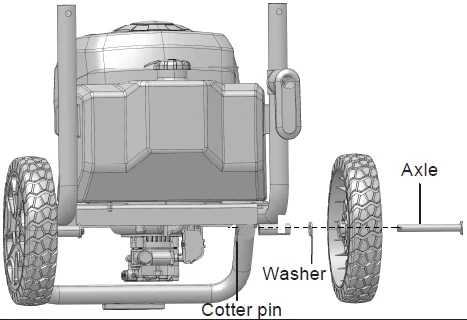
ASSEMBLING THE WHEELS
- Insert an axle through a wheel, a washer, and then the frame of the unit.
- Insert a cotter pin through the hole in the axle to secure. Repeat for the second wheel.

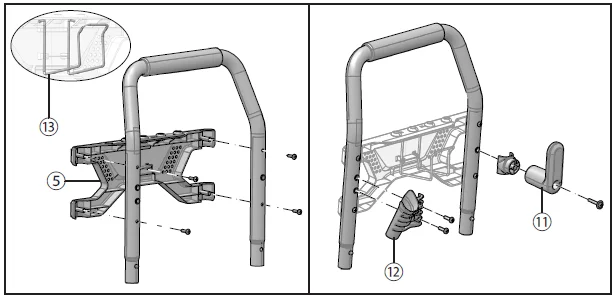
ASSEMBLING THE FRONT PANEL AND GUN HOLDER
- Line up the screw sleeves with the holes in the upper handle and push them through.
- Insert the screw and turn clockwise with a Phillips head screw driver (not included) until the screw is tight.
ASSEMBLING THE HOSE HOOK
- Line up the hose hook upper end with the holes on the back of the front panel
- Insert the hose hook end into the hole and push through.
- Press the hose hook lower end into the clip on the back of the front panel.

ASSEMBLING THE HANDLE
Push and hold the button on the handle as you slide the handle into the holes in the frame.
NOTE: Before use, pull the handle up until the lock button snaps through the locking slot to secure the handle in place.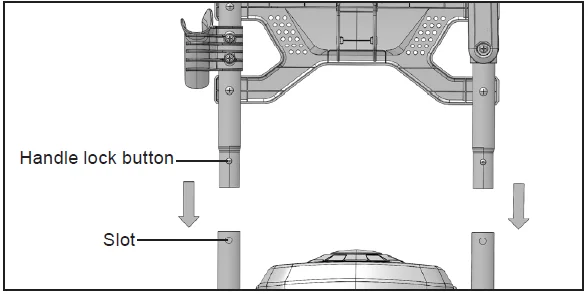
ASSEMBLING THE SPRAY WAND
- Push the end of the spray wand into the trigger handle and rotate clockwise to secure.
- Pull on the spray wand to be certain it is properly secured.
CONNECTING HIGH PRESSURE HOSE TO TRIGGER HANDLE
- Align the pressure hose with the trigger handle and push up and into position.
- With the hose pushed into position on the trigger handle, secure it in place by turning the hose lock clockwise until fully tightened.
NOTE: For easier installation of the hose to the unit or trigger, it is suggested to add pressure washer or dish detergent to the rubber seal at each end of the hose. This will allow for easier installation and a snug fit.
- Connect one end of the hose to the water outlet connector and the other end to the trigger gun.
CONNECTING THE GARDEN HOSE
CAUTION
Always observe all local regulations when connecting hoses to the water main. Some areas have restrictions against connecting directly to the public drinking water supply to prevent the feedback of chemicals into the drinking water supply. Direct connection through a receiver tank or backflow preventer is usually permitted.
- Uncoil the garden hose.
NOTE: There must be a minimum of 10 feet of unrestricted garden hose between the water inlet and the garden hose faucet or shut-off valve (such as a “Y” shut-off connector).
- Run water through the garden hose for 30 seconds to clean any debris from the garden hose.
- Inspect the screen in the water inlet (10).
- If the screen is damaged, do not use the machine until the screen has been replaced.
- If the screen is dirty, clean it before connecting the garden hose to the machine.
- With the hose faucet turned completely off, attach the end of the garden hose to the water inlet. Tighten by hand only.
OPERATION
WARNING
- Do not allow familiarity with tools to make you careless. Remember that a careless fraction of a second is sufficient to inflict serious injury.
- Always wear eye protection with side shields marked to comply with ANSI Z87.1. Failure to do so could result in objects being thrown into your eyes, resulting in possible serious injury.
- Do not use any attachments or accessories not recommended by the manufacturer of this tool. The use of attachments or accessories that are not recommended can result in serious personal injury.
- Never direct a water stream toward people or pets, or any electrical device. Failure to heed this warning could result in serious injury.
APPLICATIONS
You may use this product for the purposes listed below:
Cleaning boats, cars, trucks, motorcycles, outdoor furniture, grills, house siding, driveways, patios, and decks.
DETERGENT ADDING AND USE
Use only detergents designed for pressure washers; household detergents, acids, alkalines, bleaches, solvents, flammable material, or industrial-grade solutions can damage the pump. Many detergents may require mixing prior to use. Prepare cleaning solution as instructed on the solution bottle.
SOAP APPLICATION
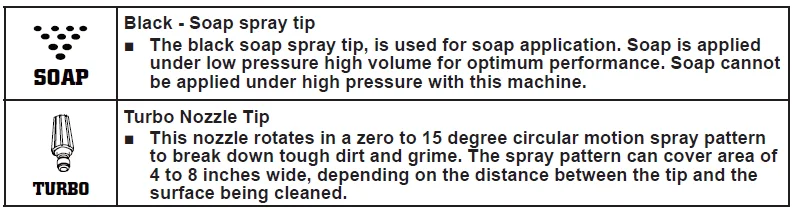
Soap is applied under low-pressure, high-volume conditions for optimum performance.
Soap can not be applied under high pressure with this machine.
Soap/detergent can only be applied with this machine when the black (75-degree) soap tip is installed.
To add detergent:
- Place the pressure washer upright on a flat surface.
- Remove the cap from the detergent tank.
- Pour detergent into the tank.
- Reinstall the cap.
CAUTION
Use only approved pressure washer cleaners. Do not use bleach, chlorine, or any cleaners containing acids.
To use:
- Connect the low-pressure black soap spray tip to the wand connector.
- Squeeze the trigger, and the detergent will automatically be mixed with the water and dispensed from the spray tip.
NOTE: Use a funnel, if needed, to prevent accidental spilling of the detergent outside the tank. If any detergent is spilled during the filling process, make sure the unit is cleaned and dried before proceeding.
STARTING AND STOPPING THE PRESSURE WASHER
CAUTION
Do not run the pump without the water supply connected and turned on.
- Connect the garden hose.
- Turn the water supply on, then squeeze the trigger and run the water hose with the motor in the OFF position until a steady stream of water appears. This helps drain air from the tank and lines.
NOTE: If the pressure washer pulsates and the water stream is intermittent, turn the pressure washer off and continue to bleed air out of the system. Ensure to check that the garden hose is fully turned on and not kinked.
- After ensuring the On/Off switch is in the OFF ( O ) position, connect the pressure washer to the power supply.
- Press the switch to the ON ( I ) position to start the motor.
- To stop the motor, release the trigger and press the switch to the OFF ( O ) position.
NOTE: The pressure washer may be on and the system may have pressure even when the pump and/or motor cannot be heard running. Always use caution around the pressure washer.
CAUTION
Hold the trigger handle securely with both hands. Expect the trigger handle to move when the trigger is pulled due to reaction forces. Failure to do so could cause loss of control and injury to yourself and others.
NOTE: AUTO ON/OFF SWITCH: This pressure washer is equipped with an auto start/stop feature. To operate: Set the power switch to the On (I) position. The pump will pressurize and shut down immediately. Once the trigger of the gun is depressed, the unit will turn on. The unit will shut off and be in standby mode when the trigger is released.
USING THE SPRAY TIPS
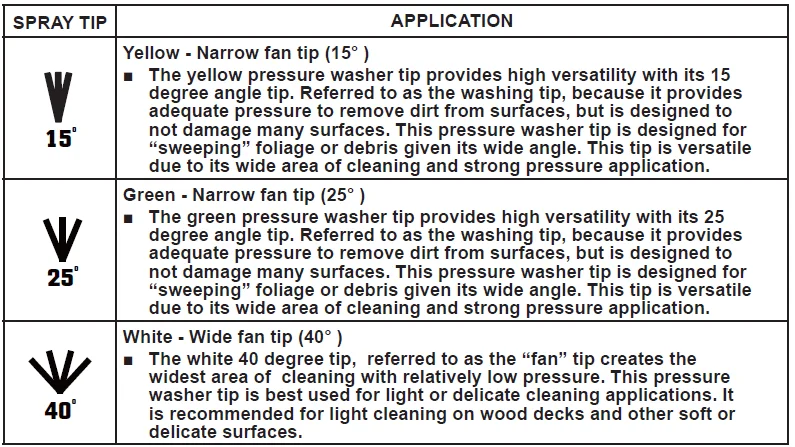
Each of the spray tips has a different spray pattern. Before starting any cleaning job, determine the best spray tip for the job. The following chart offers some general guidelines to help you choose the best spray tip for your application.
NOTE: Always try the spray tip in an inconspicuous area first.
- Turn off the pressure washer and shut off the water supply. Pull the trigger to release water pressure.
- Engage the lock-out on the trigger handle by pushing the trigger lock button to the right.
- Pull out the desired spray tip from the tip storage on the handle.
- Pull back the quick-connect collar on the spray wand.
- Push the spray tip into place in the spray wand.
- Push the collar forward so that the spray tip is secured properly. Check to see that the spray tip is secure.
NOTE: Make sure the faucet is turned on fully and that there are no kinks or leaks in the hose.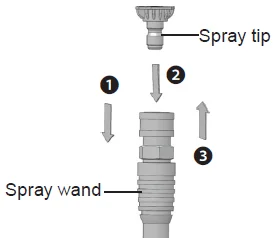
- Pull back the quick-connect collar
- Push the spray tip into place
- Push the collar forward
WARNING
NEVER change spray tips without engaging the lock-out on the trigger handle, and NEVER point the wand at your face or at others. The quick-connect feature contains small springs that could eject the spray tip with some force. Failure to heed this may cause personal injury.
TO DISCONNECT A SPRAY TIP FROM THE SPRAY WAND ONCE THE CLEANING JOB IS COMPLETE:
- Turn off the pressure washer and shut off the water supply. Pull the trigger to release water pressure.
- Remove the spray tip by placing your hand over the spray, then pulling back the quick-connect collar. Place the spray tip in the tip storage area on the unit’s folding handle.
USING THE SPRAY WAND TRIGGER
For greater control and safety, keep both hands on the trigger handle at all times.
- Pull back and hold the trigger to operate the pressure washer.
- Release the trigger to stop the flow of water through the tip.
TO ENGAGE THE LOCK-OUT:
Push the lock-out down until it clicks into the slot.
TO DISENGAGE THE LOCK-OUT:
Push the lock-out up and into its original position.
OPERATING THE PRESSURE WASHER
Use only detergents designed for pressure washers. Many detergents may require mixing prior to use. Prepare cleaning solution as instructed on the solution bottle.
To clean:
- Pour detergent into the detergent tank.
- Install the black soap tip on the spray wand.
- Start the pressure washer and spray the detergent on a dry surface using long, even, overlapping strokes. To prevent streaking, do not allow detergent to dry on the surface.
To rinse:
- Using the 25° spray tip, spray away from the rinsing surface for approximately 10 seconds to allow any remaining detergent to be flushed from the line.
- Start at the top of the area to be rinsed and work down, overlapping the strokes.
For the most effective cleaning, the spray tip should be between 8 in. and 24 in. from the surface to be cleaned. If the spray is too close, it can damage the surface.
MOVING THE PRESSURE WASHER
To move the pressure washer:
- Turn the pressure washer off. Point the spray wand in a safe direction and pull the trigger to release water pressure.
- Tilt the machine toward you until it balances on the wheels, then roll the machine to the desired position.
MAINTENANCE
GENERAL MAINTENANCE
SPRAY TIP MAINTENANCE
- Excessive pump pressure (a pulsing sensation felt while squeezing the trigger) may be the result of a clogged or dirty spray tip.
- Unplug the pressure washer.
- Turn off the pressure washer and shut off the water supply. Pull the trigger to release water pressure.
- Remove the spray tip from the spray wand.
NOTE: Never point the spray wand at your face.
- Using the spray tip cleaning tool provided, free any foreign materials clogging or restricting the spray tip opening.
- Using a garden hose, flush debris out of the spray tip by back flushing (running the water through the spray tip backwards or from the outside to the inside).
- Reconnect the spray tip to the spray wand.
- Turn on the water supply.
STORING THE PRESSURE WASHER
Store in a dry, covered area where the weather can’t damage it. It is important to store this product in a frost-free area. Always empty water from all hoses, the pump, and the detergent container before storing.
NOTE: Use of a pump saver will give you better performance and increase the life of the machine.
QUICK WINTERIZING PROCEDURE
You can protect your pressure washer from winter damage by doing below:
- Disconnect all water connections.
- Turn on the machine for a few seconds until the remaining water in the pump exits. Turn off immediately.
- Do not allow the high-pressure hose to become kinked.
- Store the machine and accessories in a room that does not reach freezing temperatures. Do not store near the furnace or other sources of heat, as it may dry out the pump seals.
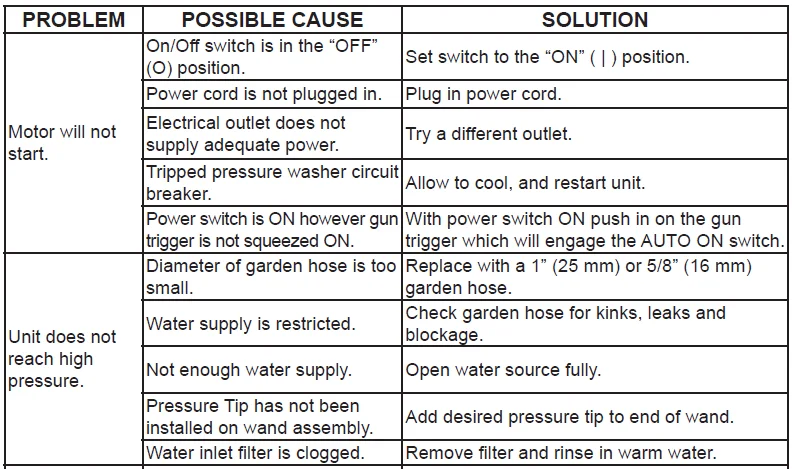
TROUBLESHOOTING
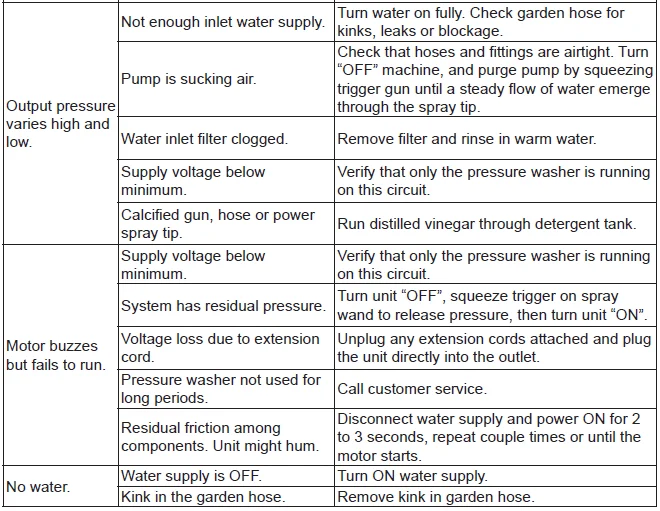
GREENWORKS HELPLINE (1-855-345-3934):
Warranty service is available by calling our toll-free helpline at 1-855-345-3934.
TRANSPORTATION CHARGES:
Transportation charges for the movement of any power equipment unit or attachment are the responsibility of the purchaser. It is the purchaser’s responsibility to pay transportation charges for any part submitted for replacement under this warranty unless such return is requested in writing by Greenworks ®.
For more Manuals by Greenworks Tools, visit ManualsLibraryy
Greenworks GPW-2300 PSI Pressure Washer-FAQs
Is 2300 PSI enough for a pressure washer?
Yes, 2300 PSI is sufficient for most home tasks, including cleaning patios, decks, siding, and vehicles. For delicate surfaces like wood, start at the lower end to avoid damage.
Can I wash my car with this pressure washer?
Yes, but keep the pressure at 1500–2000 PSI and use a wide spray nozzle to prevent paint damage.
Can I use hot water with the Greenworks GPW-2300?
No, this model is designed for cold water use only.
Do Greenworks electric pressure washers require oil?
No. Electric models are maintenance-free compared to gas washers and don’t need oil changes.
How long do Greenworks electric pressure washers last?
Typically, 3–5 years with proper care and occasional maintenance.
Can I use dish soap or detergent in this washer?
Yes. Use low-sudsing soaps like Dawn or specialized pressure washer detergents. Avoid harsh chemicals that may damage the unit.
Where are Greenworks pressure washers made?
They are primarily manufactured in China under the Greenworks brand.
Is the Greenworks GPW-2300 suitable for home use?
Yes, it is ideal for home and small business tasks like cleaning cars, outdoor furniture, patios, and decks.
What are common problems with Greenworks washers?
Users may experience spray gun or hose connector issues, reduced pressure due to clogs, or motor overheating if used excessively.