
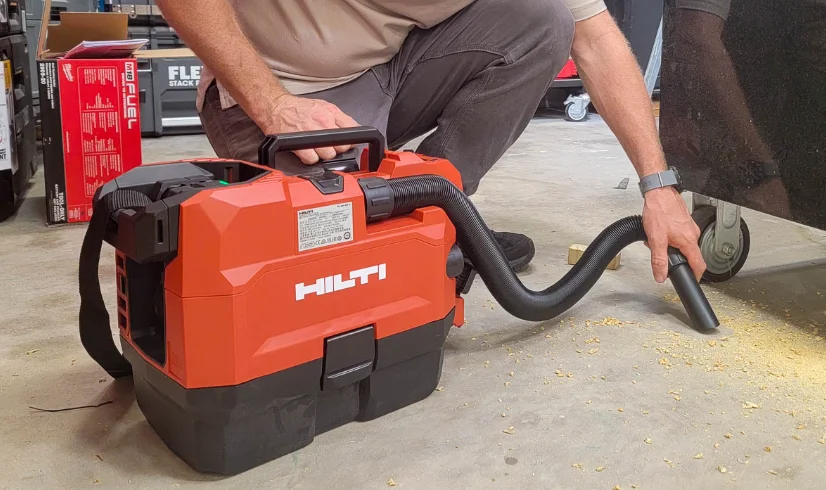

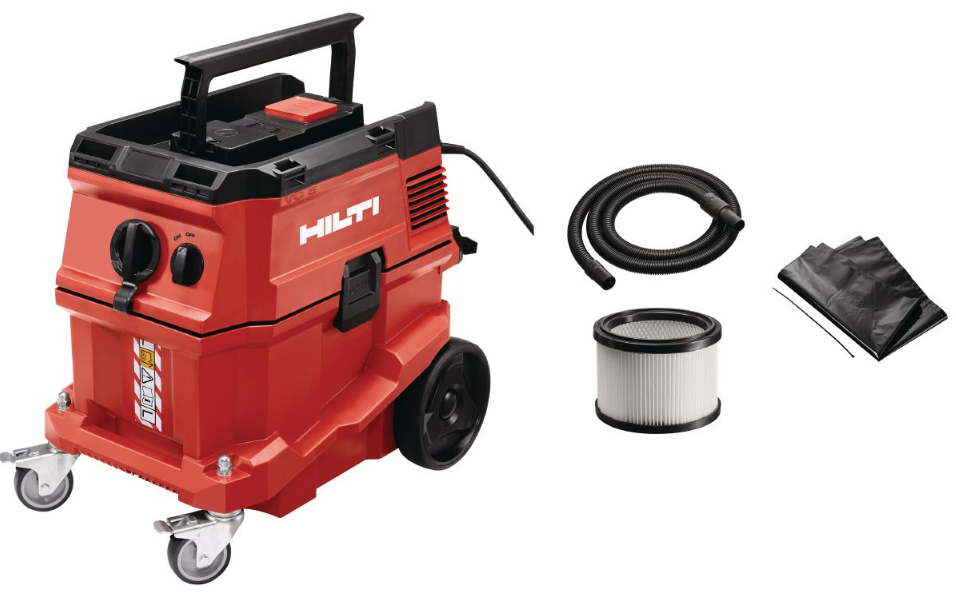
Hilti VCD 50-L Vacuum Motor Cleaner
Component parts
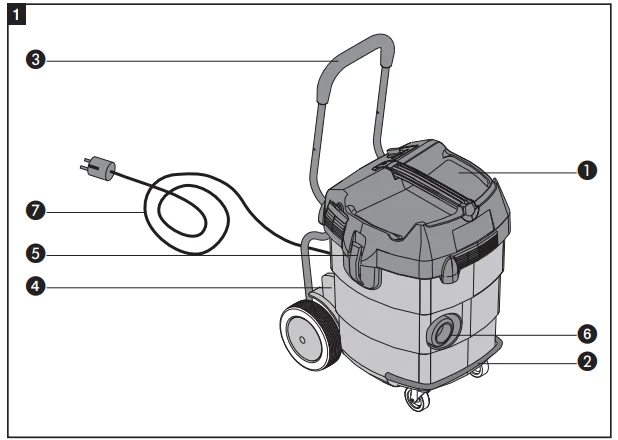
- Top section
- Container
- Transport handle
- Tool compartment
- Latch
- Hose socket
- Mains plug with supply cord

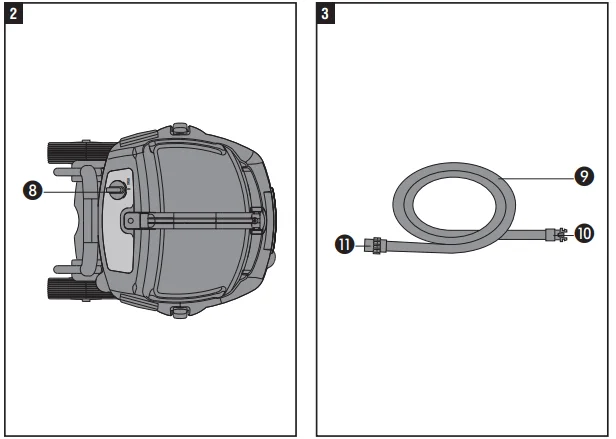
- Switch
- Hose
- Snap-lock connector
- Rotating connector

- Disposal bag holder
- Disposal bag
- Disposal bag connector
- Filter support basket
- Filter
- Filter retaining disc
- Wing screw
- Cooling air filter

4. Specific safety rules
4.1 Basic safety information
In addition to the safety precautions listed in the individual sections of these operating instructions, the following points must be strictly observed at all times.
4.2 Correct use
The appliance is a dry-type vacuum cleaner of the dust class L in accordance with EC 60335-2-69. It is particularly suitable for removing large quantities of mineral dust with an MAK value of > 1 mg/m3 (MAK = maximum workplace concentration), in conjunction with Hilti diamond grinders, Hilti diamond cutters, Hilti rotary hammer drills, and Hilti dry-cutting diamond coring machines.
4.3 Incorrect use (misuse)
- The appliance must not be used to suck up liquids (water, gasoline, oil, acids, alkalis, etc.), hot or explosive substances, or substances hazardous to health.
- Dusts with an MAK value of < 1 mg/m3 are hazardous to health and must not be sucked up.
- The appliance is not suitable for use in automatic or semi-automatic systems.
- Manipulation of, or modifications to, the appliance are not permissible.
- To avoid risk of injury, use only original Hilti accessories and ancillary equipment.
- Observe the information in the operating instructions concerning operation, care, and maintenance.
4.4 State of the art
- The appliance is designed and manufactured according to the state of the art.
- The appliance and its ancillary equipment may present hazards when used incorrectly by untrained personnel or not as directed.
4.5 Proper arrangement and organisation of the workplace
- Wear non-slip shoes and work from a safe stance at all times.
- Avoid unfavourable body positions.
- Ensure that the workplace is well-lit.
- Ensure that the workplace is well ventilated.
- Objects that could cause injury should be removed from the working area.
- Keep other persons, children in particular, outside the working area.
- Always lead the supply cord, extension cord, and extraction hose away to the rear of the appliance when working.
- Take care to avoid tripping over the supply cord, extension cord, or extraction hose.
- Do not transport the appliance by crane.
4.6 Types of dust
- Dusts with an MAK value of < 1 mg/m3 are hazardous to health and must not be sucked up.
- Avoid all sources of ignition, such as the smoking of cigarettes, while working or while emptying the appliance.
4.7 General hazards presented by the appliance
- Operate the appliance only as directed and only when it is in a faultless condition.
- Never leave the appliance unsupervised.
- Ensure that the appliance is switched off before inserting the supply cord plug into the mains socket.
- Disconnect the supply cord plug from the socket when the appliance is not in use (e.g., during pauses between work), before maintenance, and before changing the filter.
- When the appliance is not in use, it must be stored in a dry place, locked up, or out of reach of children.
- Check that the filter is mounted in the correct position.
- Make sure that the filter is not damaged in any way.
4.8.1 Mechanical hazards
- Follow the instructions concerning care and maintenance.
- Check whether parts have suffered damage and that all moving parts function faultlessly without sticking. All parts must be fitted correctly and fulfil all of the conditions necessary to ensure faultless operation of the appliance.
- Use only Hilti original tools and accessories.
4.8.2 Electrical hazards
- Protect yourself from electric shocks. Avoid body contact with earthed objects, e.g., pipes and radiators.
- Check the condition of the appliance, including the supply cord and extension cord, as well as the plug connections. Do not operate the appliance if damage is found, if the appliance is not complete, or if its controls cannot be operated faultlessly.
- Grip the plug and not the cable when pulling it out of the socket.
- Do not expose the supply cord to heat, oil, or sharp edges.
- Do not touch the supply cord in the event of it becoming damaged while working. Disconnect the supply cord plug from the socket.
- When working outdoors, use only extension cords approved and correspondingly marked for this application.
- Check the appliance for any damage. All parts of the appliance must be checked carefully to ensure correct, faultless functionality before further use.
- Damaged switches must be replaced at a Hilti service centre. Do not use the appliance if it cannot be switched off and on properly.
- If necessary, have the appliance repaired by an electrical specialist (Hilti service department).
- To avoid the risk of accidents, use only original Hilti spare parts.
- Insert the supply cord plug in the socket only when the appliance is switched off.
- In the event of a power cut-switch the appliance off and unplug the supply cord.
- Avoid using extension cords with multiple sockets and operating several appliances simultaneously.
- The connections used for supply cords, extension cords, or electric tool connecting cables must offer protection from sprayed water.
- To ensure safety, the appliance may be serviced or repaired only at an authorised Hilti repair centre.
4.9 Requirements to be met by the user
- The appliance is intended for professional use.
- The appliance may be operated, serviced, and repaired only by authorised, trained personnel. This personnel must be informed of any special hazards that may be encountered.
4.10 Personal protective equipment
- The user requires no personal protective equipment.
5. Description
Items supplied
- 1 VCD50L dry-type vacuum cleaner
- 1 D36 hose (D1.4 inch hose), length 5 m (16.4 feet), anti-static type with rotating connector and snaplock connector
- 1 Filter
- 1 Disposal bag
- 1 Disposal bag holder
- 1 Tapered adaptor
- 1 Operating instructions
6. Accessories
- 1 Toolbox
- 1 Accessory set
- 1 Adaptor (tapered)
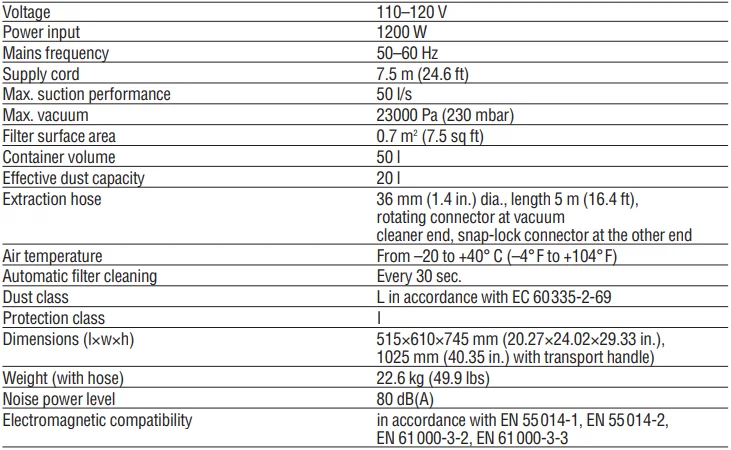
7. Technical data
8. Before use
 It is essential that the safety precautions printed in these operating instructions are read and observed.
8.1 Transport
 When moving the appliance, bring the transport handle into the extended position and lock it in place with the sleeves.
- Hang the hose and supply cord over the transport handle.
- The total permitted weight must not exceed 60 kg (132.4 lbs).
 When moving the appliance, bring the transport handle into the extended position and lock it in place with the sleeves.
8.2 Attaching the Hilti toolbox or the Hilti DPC 20 to the appliance
- Slide the toolbox or the DPC 20 into the guides on the rear of the appliance.
- Press the toolbox or the DPC 20 toward the appliance until it engages.
8.3 Releasing the Hilti toolbox or the Hilti DPC 20 from the appliance
- Push the locking mechanism upwards.
- Remove the toolbox or the DPC 20 from the guides on the appliance.
8.4 Preparing the appliance for initial use
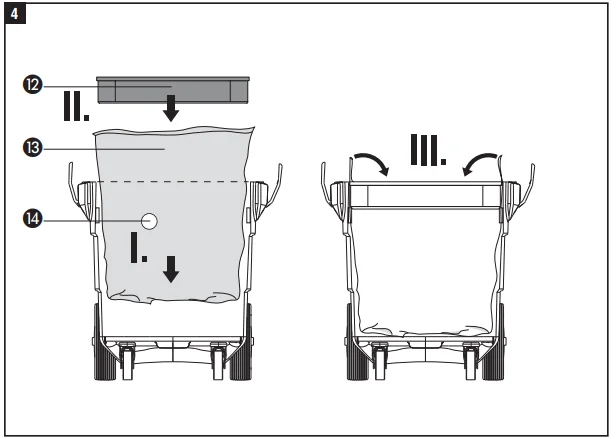
The appliance may not be plugged into an electric supply when any kind of adjustments or maintenance work is being carried out. Labels in the local language displaying the warning for dust class L are supplied inside the appliance. You should select the warning label in your local language and apply it over the English warning text on the dust class L label already attached to the rear of the top section of the vacuum cleaner. The accessory items are supplied in container 12 and must be removed before the appliance is used for the first time.
- Extend the transport handle into the upright position 13.
- Open the latch 15.
- Lift off the top section of the appliance 11.
- Remove the disposal bag holder 4 12.
- Remove the small tapered adaptor for Hilti diamond cutters and Hilti dry-cutting diamond coring machines.
- Remove the disposal bag 4 13.
- Fit the disposal bag.
- Attach the disposal bag connector 4 14 to the hose socket 16.
- Insert the disposal bag holder 42.
- Fold over the edge of the disposal bag 4 III.
- Fit the top section 11 onto the container 12.
- Close the latch 15.
- Connect the end of the hose with the rotating connector 311 to the hose socket.
NOTE: The disposal bag must always be folded over the disposal bag holder inside the container.
9. Operation
It is essential that the safety precautions printed in these operating instructions are read and observed.
9.1 Connecting to the mains supply
The voltage provided by the mains supply must correspond to the voltage rating printed on the type plate. The appliance must be switched off (switch position 0). Insert the mains plug in the socket.
9.2 Switching on the appliance 2
Turn the switch to the “MAN” position. The appliance then starts immediately (soft start function).
9.3 After finishing work
- Turn the switch to the “0” position.
- Disconnect the mains plug from the socket.
- Roll up the hose and the supply cord.
10 Care and maintenance
10.1 Cleaning the filter
The filter is cleaned automatically during operation. Nevertheless, should it become heavily soiled, complete cleaning is necessary.
- Switch the appliance off.
- Hold the hose in the hand.
- Use one hand to close off the end of the hose.
- 8. Turn the switch to the “MAN” position and, using the hand to close off the end of the hose, allow the appliance to run for 10 seconds.
In addition to this, the filter may be cleaned with water and a cloth (do not use a high-pressure cleaning system). Mineral dust may clog the filter, reducing its suction performance, if it is not cleaned adequately. Do not knock the filter against a hard object or use a hard or pointed object to clean it. This reduces the life of the filter.
10.2 Changing the disposal bag 4
Removing the bag
- Open the latch.
- Lift off the top section.
- Remove the disposal bag holder.
- Close the disposal bag.
- Pull the disposal bag sleeve from the hose socket and use the cover provided to close the opening in the disposal bag.
- Use the cable tie supplied to close the disposal bag.
- Remove the disposal bag and dispose of it in accordance with national and local regulations.
Inserting the bag
- Fit the disposal bag.
- Attach the disposal bag sleeve to the hose socket.
- Insert the disposal bag holder.
- Fold the edge of the disposal bag over.
- Fit the top section onto the container.
- Close the latch.
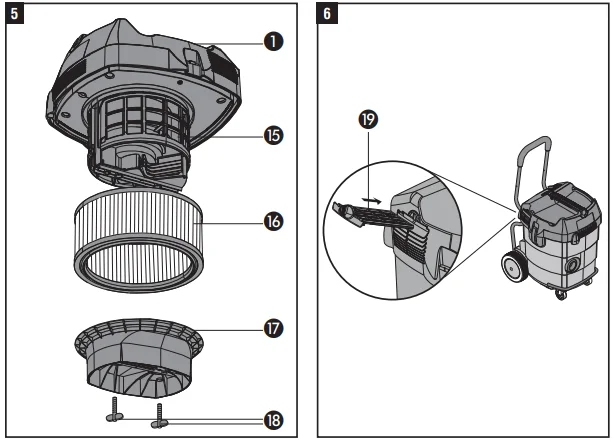
10.3 Changing the filter 5
Removing the filter
- Open the latch.
- Lift off the top section of the appliance and lay it down with the filter facing upwards.
- Release the two wing screws.
- Pull off the filter retaining disc.
- Pull off the filter.
Fitting the filter
- Push on the new filter as far as it will go.
- Fit the filter retaining disc.
- Insert and tighten the two wing screws.
- Fit the top section onto the appliance.
- Close the latch.
10.4 Changing the cooling air filter 6
- Pull the cooling air filter out of the grip depression in the appliance.
- Fit the new cooling air filter into the grip depression in the appliance.
10.5 Caring for the appliance
The outer casing of the appliance is manufactured from impact-resistant plastic. Always keep the ventilation slots free from obstructions. Clean the ventilation slots carefully with a dry brush. Clean the outer surface of the appliance at regular intervals with a slightly damp cloth. Do not use a spray cleaning system, a steam cleaning system, or running water for cleaning. This may negatively affect the electrical safety of the appliance. Do not use cleaning agents, polish, etc., containing silicone.
10.6 Maintenance
Check all external parts of the appliance for damage at regular intervals and ensure that all operating controls function faultlessly. Do not operate the appliance when parts are damaged or when the operating controls do not function faultlessly. If necessary, have the appliance repaired at a Hilti service centre. The electrical parts of the appliance may be repaired only by trained electrical specialists.
10.7 Checking after cleaning and maintenance
After cleaning and maintenance work, check that all parts of the appliance have been fitted and that they function correctly.
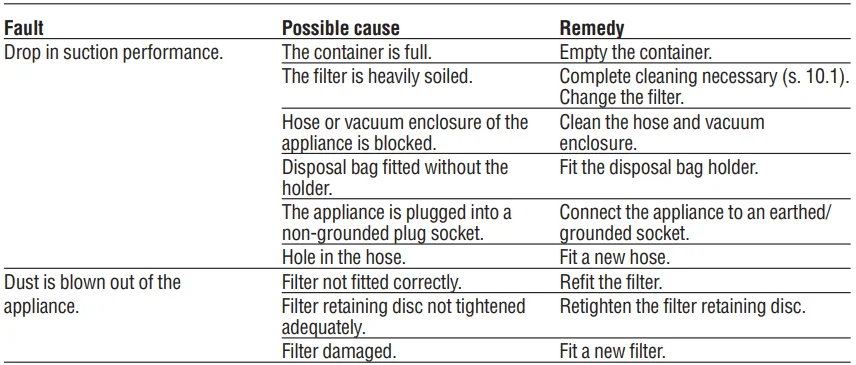
11. Troubleshooting
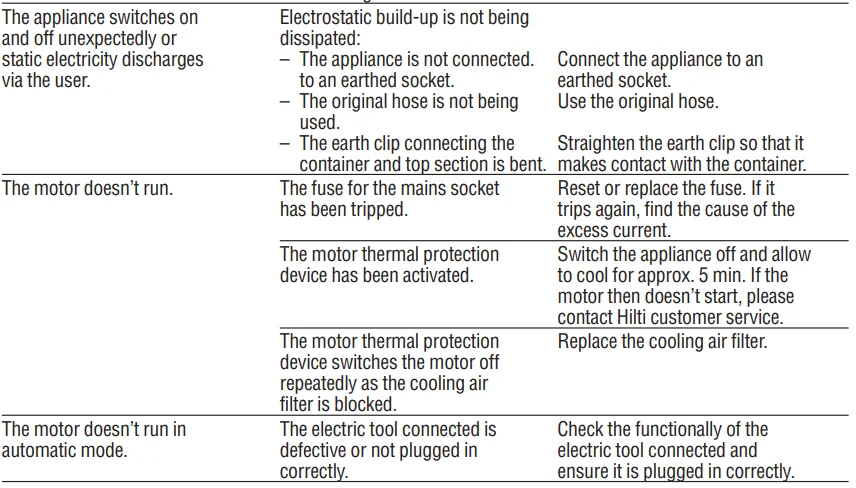
12. Disposal
Most of the materials from which Hilti appliances are manufactured can be recycled. The materials must be correctly separated before they can be recycled. In many countries, Hilti has already made arrangements for taking back your old appliances for recycling. Please ask your Hilti customer service department or Hilti sales representative for further information. Should you wish to return the appliance yourself to a disposal facility for recycling, proceed as follows: Dismantle the appliance as far as possible without the need for special tools.
Separate the individual parts as follows:
13. Warranty
Hilti warrants that the tool supplied is free of defects in material and workmanship. This warranty is valid so long as the tool is operated and handled correctly, cleaned and serviced properly, and in accordance with the Hilti Operating Instructions, all warranty claims are made within 12 months from the date of the sale (invoice date), and the technical system is maintained. This means that only original Hilti consumables, components, and spare parts may be used in the tool. This warranty provides the free-of-charge repair or replacement of defective parts only. Parts requiring repair or replacement as a result of normal wear and tear are not covered by this warranty.
Under no circumstances will Hilti be obligated for direct, indirect, incidental, or consequential damages, losses, or expenses in connection with, or by reason of, the use of, or inability to use the tool for any purpose. Hilti specifically excludes the implied warranties of merchantability and fitness for a particular purpose. For repair or replacement, send the tool and/or related parts immediately upon discovery of the defect to the address of the local Hilti marketing organization provided. This constitutes Hilti’s entire obligation about warranty and supersedes all prior or contemporaneous comments and oral or written agreements concerning warranties.
Hilti Corporation
Feldkircherstrasse 100
FL-9494 Schaan
Principality of Liechtenstein Tel.: +423/234 21 11
Fax: +423/23429 65
www.hilti.com
USA
Hilti, Inc.
5400 South 122 East Avenue
Tulsa, Oklahoma 74146
Telephone (918) 252-6000
CANADA
Hilti (Canada) Limited/Limitée
6790 Century Avenue, Suite 300
CDN-Mississauga, Ontario
L5N 2V8
Telephone (905) 813 9200
LATIN AMERICA
Hilti Latin America, Ltd.
5400 South 122 East Avenue
P.O. Box 21148
Tulsa, Oklahoma 74146
Telephone (918) 252-6595
For More Manuals By HILTI, Visit ManualsLibraryy
Hilti VCD 50-L Vacuum Motor Cleaner-FAQS
What is the Hilti VCD 50-L Vacuum Motor Cleaner?
The Hilti VCD 50-L is a professional-grade vacuum designed for construction and workshop use. It effectively removes dust, debris, and fine particles while protecting the motor through advanced filtration.
Why is my Hilti battery blinking yellow?
A blinking yellow light usually means the battery health check did not complete. The battery can still be used. Repeat the check procedure, and if the issue continues, contact Hilti Service.
Why is my Hilti vacuum cleaner beeping?
The beeping sound indicates low airflow in the hose. This often happens due to a blockage or an incorrect hose diameter setting. Check for clogs and ensure the hose size is correctly selected.
Why is my Hilti battery blinking red?
A blinking red light means the battery is too hot or too cold. Charging will pause automatically and resume once the battery reaches a safe temperature.
How can I tell if the vacuum motor is damaged or burnt out?
Common signs include the vacuum not turning on, unusual noises, a burning smell, reduced suction, or frequent overheating and shutdowns.
What is the most common problem with vacuum cleaners?
Loss of suction is the most common issue. It is usually caused by clogged filters, blocked hoses, a full container, or worn motor components.
How do I improve suction performance on the Hilti VCD 50-L?
Clean or replace filters regularly, check hoses for blockages, ensure tight connections, and empty the dust container before it becomes full.
Are Hilti vacuum motors AC or DC?
Most industrial vacuum cleaners use universal motors that can operate on AC power, providing strong suction and durability.
How do I know if my Hilti battery is faulty?
Frequent blinking lights, reduced runtime, failure to charge, or overheating are common signs of a faulty battery.
Can I continue using the vacuum if the battery indicator flashes?
Yes, in many cases you can continue using it, especially with a yellow blinking light. However, repeated warnings should be checked by Hilti Service.