
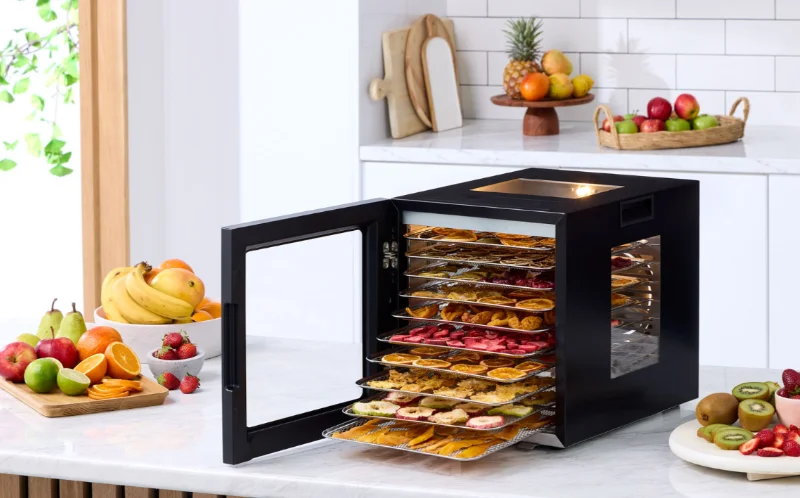

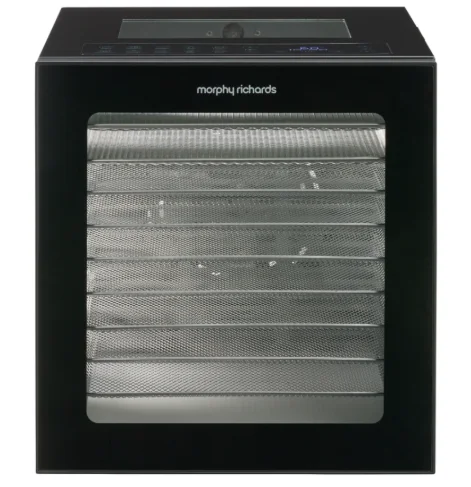
Morphy Richards MRFD10SS 10-Shelf Food Dehydrator
IMPORTANT SAFETY INSTRUCTIONS
WARNING: Before using this product, please read and understand this instruction manual carefully, and keep it in a safe place.
- WARNING: Do not immerse the base in water or any other liquid, and do not rinse under the tap.
- WARNING: Misuse of the appliance could cause personal injury.
- WARNING: Do not use this product to dry liquid foods.
- Make sure to remove all paper and cardboard before first use.
- During first use, the unit may emit a slight odour. This is normal.
- This appliance is not intended to be operated by means of an external timer or a separate remote-control system.
- This appliance is not intended for use by persons with reduced physical, sensory, or mental capabilities or a lack of experience and knowledge unless they have been given supervision or instruction concerning use of the appliance by a person responsible for their safety.
- Keep the appliance and its cord out of reach of children.
- Children should be supervised to ensure that they do not play with this appliance, and children should be watched carefully to avoid scalding themselves.
- In the absence of supervision, the cleaning and maintenance work should not be done by a child.
- Use of accessories not recommended or sold by the original manufacturer may cause risks of fire, electric shock, or personal injury.
- This appliance must be used in accordance with the instructions and must not be used for other purposes.
- Do not store any packing material, cardboards or plastic while the appliance is not in use.
- This appliance is intended to be used in household and similar applications such as:
- staff kitchen areas in shops, offices, and other working environments;
- farm houses;
- by clients in hotels, motels, and other residential-type environments;
- bed and breakfast type environments.
- The longest continuous use time should not exceed 72 hours each time, so as not to affect the service life of the dryer.
- Do not use accessories or components made by other manufacturers.
Location
- For indoor use only. Do not use outdoors or near water.
- The appliance and accessories should be positioned on a flat, heat-resistant surface away from water.
- The appliance should not be used on or near a high-temperature gas or electric stove.
- Do not store any items on top of the unit or near the rear outlet when in use.
- Do not cover the top of the unit with foil paper to avoid overheating.
- Keep the appliance away from flammable materials such as curtains.
Power cord
- WARNING: This appliance should NOT be used with extension leads and/or power boards.
- To protect against electric shock, do not touch the plug with wet hands or immerse the power cord, plug, or appliance in water or other liquid.
- If the power cord is damaged, it must be replaced by the manufacturer, its service agent, or a similarly qualified person in order to avoid a hazard.
- The power cord should reach from the socket to the appliance without straining the connections.
- Remove the plug from the socket, grasp the plug, and pull out the power cord; do not pull on the cord directly.
- Do not let the cord hang over the edge of the table or counter, and keep it away from any hot surfaces.
- Do not let the cord run across an open space, e.g., between a low socket and a table.
- Do not modify or lengthen the power cord of this product in any way.
Personal safety
- WARNING: The inner and outer surfaces, including the door of the oven, get hot during operation.
- WARNING: This appliance is hot during operation and retains heat for some time after turning OFF. Always use oven gloves when handling hot materials and allow metal parts to cool before cleaning. Do not place anything on top of the appliance while it is operating or while it is hot.
- WARNING: After use, the racks, trays, and all dried foods are hot. Extreme caution must be used when handling the racks and trays. Place the racks and trays on a heat-resistant surface after use.
- Unplug from the outlet when not in use and before cleaning. Allow to cool completely before removing or adding parts, and before cleaning the appliance.
- Do not operate any appliance with a damaged cord or plug, or after an appliance has malfunctioned, or has been dropped or damaged in any way.
- Always unplug when not in use.
- Do not use any of the appliance accessories in a microwave or on any cooking/heated surfaces.
Treating scalds
- Run cold water over the affected area immediately. Do not stop to remove clothing; seek medical advice quickly.
Electrical requirements
- WARNING: This appliance should NOT be used with extension leads and/or power boards.
- Check that the voltage on the rating label of your appliance corresponds with your house electricity supply, which must be A.C.
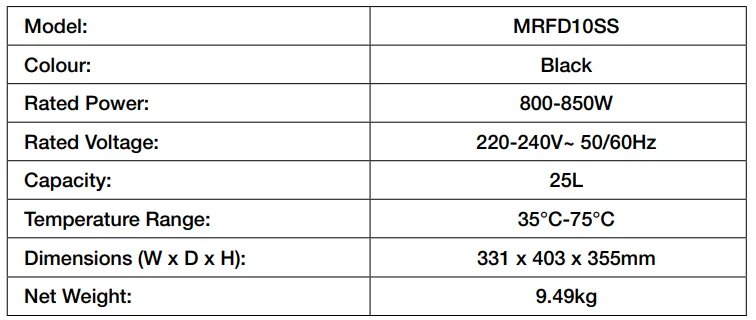
SPECIFICATIONS
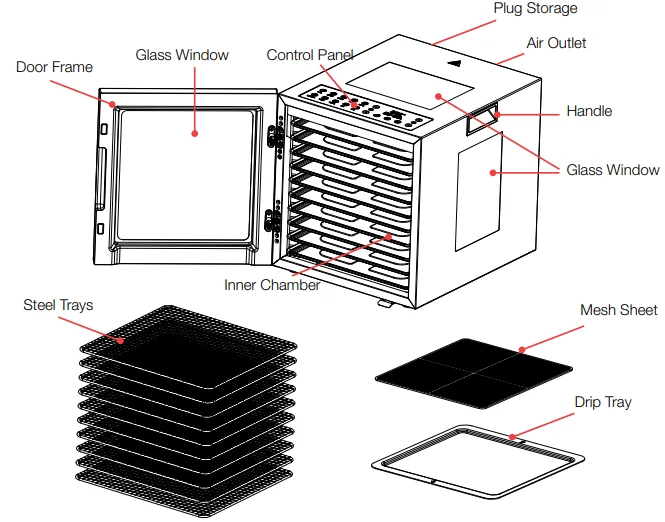
PRODUCT OVERVIEW
TOUCH CONTROL PANEL
Food Dehydrators are used for gently removing moisture from fruits, vegetables, meats, fish, herbs, and spices by using controlled low-temperature heat. Air is circulated from the rear of the unit to each of the shelves and the base. This method of drying food seals in the natural flavours and nutrients, leaving a highly nutritious and vitamin-rich product. Drying fresh fruit and vegetables enables you to enjoy these healthy treats all year round. Dried foods have a longer shelf life when stored in air-tight containers, depending on the type of food and climate, and do not require any artificial colouring or preservatives. Storing dehydrated food is simple and takes up little storage space.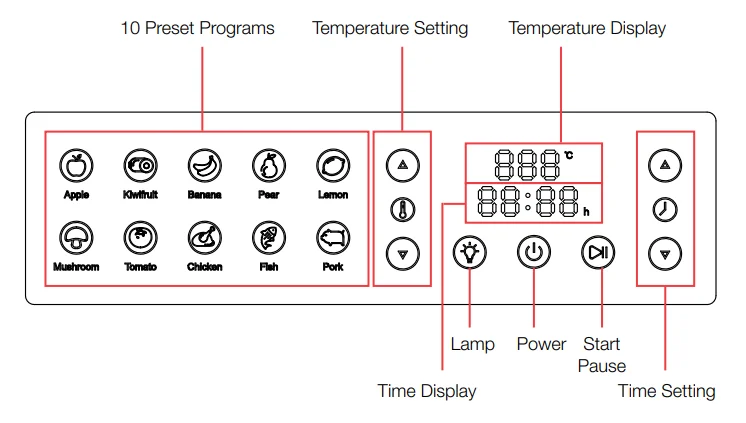
BEFORE FIRST USE
- Remove all packaging materials.
- Remove stickers and labels from the appliance. Do NOT remove the rating label on the back of the appliance.
- Clean all parts to remove any dust or manufacturing residue.
- Thoroughly wash the accessories by hand with warm, soapy water and a non-abrasive sponge. Do NOT immerse the housing in water.
- Wipe the inside and outside of the appliance with a moist cloth. Do not use chemical cleaners.
- Ensure accessories are inserted securely.
- Use the appliance on a horizontal, flat, and stable heat-resistant surface, away from a heating source and where it will not come in contact with water.
- The appliance should be placed with good ventilation and away from walls or curtains.
NOTE: During first use, the oven may emit a slight odour and smoke. This is normal.
USING THE DEHYDRATOR
- Place the food to be dehydrated on the steel trays or mesh sheet, for finer food, i.e., herbs, and securely slide the trays into the machine and close the door.
- Ensure the drip tray is positioned on the bottom of the dehydrator to collect any liquid from the dehydrating food.
- Put the plug in the wall socket and turn on the power supply.
- Press the Power button on the touch control panel (see page 7).
- Select the desired program from the 10 preset programs on the touch control panel. Press once to select, and the program icon will illuminate after flashing three times. Press the button again, and all program buttons will illuminate. You can reselect any of these programs.
- You can adjust the temperature setting from the preset program anywhere between 35–75°C by using the temperature setting button. The upper icon increases the temperature, and the lower icon lowers the temperature in increments of 5°C (see page 7).
- You can adjust the dehydrating time from the preset program anywhere between 1 and 48 hours by using the time setting button. The upper icon increases the time, and the lower icon reduces the time in increments of 30 minutes (see page 7).
- After making your selection, press the Start/Pause button, and the machine will start heating.
- The inner lamp can be turned on and off at any time. The dehydrator does not need to be heating for the lamp to work.
- If you need to pause the dehydrating process at any point, press the Start/Pause button to pause dehydrating, and the timer will stop. Press the Start/Pause button again to resume reheating, and the timer will continue to count down.
- Press the Power button twice to turn off the dehydrator.
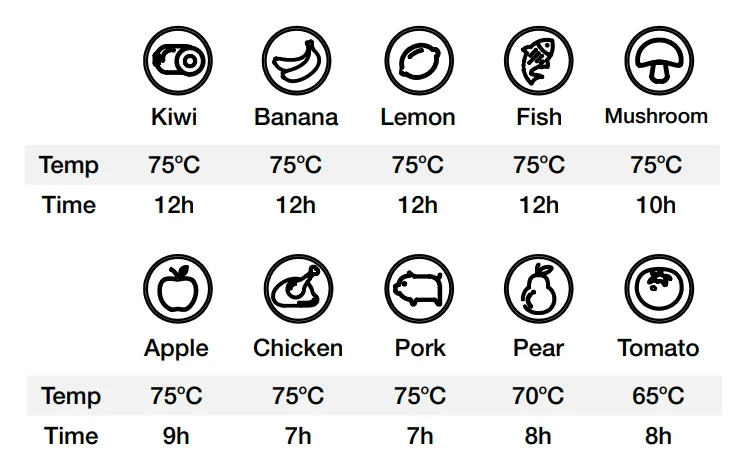
NOTE: There are 10 preset programs with suggested times and temperatures on the touch control panel (see page 10). However, you may wish to customise the drying time and temperature according to your own preferences and the food you are dehydrating.
DEHYDRATOR PROGRAM GUIDE
CARE & CLEANING
- WARNING: Unplug the appliance and allow it to cool completely before cleaning.
- The steel trays, mesh sheet, and drip tray are dishwasher safe, but it is recommended for longevity to use a mild detergent to clean all accessories.
- Use a soft cloth to clean the inner cavity regularly.
- Clean the door with a cloth soaked with warm detergent or soaking solution.
- Do not immerse the dehydrator in water for cleaning.
- Do not use steel wool, abrasive cleaners, or corrosive liquids (such as acetone or alcohol) to clean the product.
TROUBLESHOOTING
- During first use, the unit may emit a slight odour and smoke. This is normal.
- If an open circuit fault is detected, fault code ‘E1’ will be displayed on the control panel. Turn the power off at the plug and try to power up the unit again. If the fault is still showing, return the unit to your place of purchase or contact the Customer Care Centre. Do not try to repair the unit yourself.
- If a short circuit fault is detected, fault code ‘E3’ will be displayed on the control panel. Turn the power off at the plug and try to power up the unit again. If the fault is still showing, return the unit to your place of purchase or contact the Customer Care Centre. Do not try to repair the unit yourself.
MAINTENANCE
If the unit fails to operate efficiently, is broken, or other problems arise, unplug and do not operate. Ask for advice by calling your local after-sales service agent or the Customer Care Centre on 1300 556 816 (AU) / 0800 666 2824 (NZ). For product hints and tips plus more join us at www.morphyrichards.com.au.
WARRANTY
Please refer to the warranty card in the box for warranty information. For any troubleshooting advice, please contact the relevant Customer Care Centre below.
Glen Dimplex Australia Pty Ltd
8 Lakeview Drive, Scoresby 3179, Victoria, Australia
Ph: 1300 556 816
Glen Dimplex New Zealand Ltd
38 Harris Road, East Tamaki, Auckland 2013, New Zealand
Ph: 0800 666 2824
For More Manuals By Morphy Richards, Visit ManualsLibraryy.
Morphy Richards MRFD10SS 10-Shelf Food Dehydrator-FAQs
What foods work best in the Morphy Richards MRFD10SS food dehydrator?
This food dehydrator works best with fruits, vegetables, and lean meats. Popular options include apples, bananas, mangoes, strawberries, carrots, mushrooms, tomatoes, zucchini, and herbs. Lean meats like beef or turkey are ideal for making jerky. The 10-shelf stainless steel design ensures even airflow, making it suitable for drying large batches at once.
What are good foods to dehydrate for beginners?
Beginners should start with simple, low-fat foods such as apples, bananas, strawberries, tomatoes, carrots, and herbs. These foods dehydrate evenly and don’t require complex preparation. Using the Morphy Richards MRFD10SS makes the process easier thanks to its consistent temperature control and spacious shelves.
What foods should not be dehydrated?
Foods high in fat or dairy should be avoided. This includes avocados, olives, nut butter, cheese, and milk-based products. High-fat foods do not dry properly and can spoil quickly. For safe and long-lasting results, stick to low-moisture, low-fat foods when using a food dehydrator.
Can bacteria grow in dehydrated food?
If food is not dried properly or stored incorrectly, bacteria can grow. Ensuring complete dehydration, using clean equipment, and storing food in airtight containers helps prevent contamination. Proper temperature control is key to food safety.
What are common mistakes to avoid when dehydrating food?
Common mistakes include overcrowding trays, cutting uneven slices, and not allowing proper airflow. These errors can lead to uneven drying or spoilage. Always leave space between food slices and follow recommended temperature settings for best results.
Is it cheaper to use a dehydrator or an oven?
Using a food dehydrator is cheaper than an oven. Dehydrators are designed for long, low-temperature operation and use less electricity. Ovens consume more power and are less efficient for drying food evenly over extended periods.
Does a food dehydrator use a lot of electricity?
No, food dehydrators are energy-efficient. On average, they consume about 1 kWh per hour, which is less expensive than using an oven. Running the Morphy Richards MRFD10SS for long hours is usually cost-effective and suitable for overnight use.
How long does dehydrated food last?
Dehydrated foods can last anywhere from 4 months to 1 year when stored in airtight containers in a cool, dry, and dark place. Fruits generally last longer than vegetables, while dehydrated meat has a shorter shelf life unless vacuum-sealed and refrigerated.