
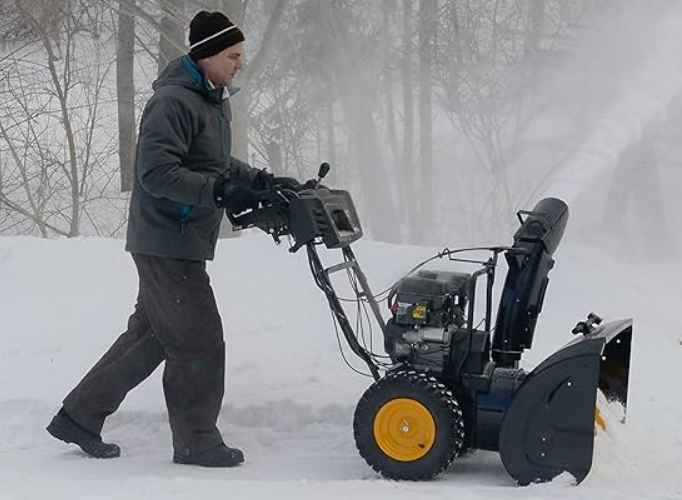

Poulan Pro PR240 Snow Blower

PARTS PACKED SEPARATELY IN CARTON

ASSEMBLY / PRE-OPERATION
Read these instructions and this manual in their entirety before you attempt to assemble or operate your new snow thrower. Reading the entire manual will familiarize you with the unit, which will assist you in assembly, operation, and maintenance of the product.
Your new snow thrower has been assembled at the factory with the exception of those parts left unassembled for shipping purposes. All parts, such as nuts, washers, bolts, etc., necessary to complete the assembly have been placed in the parts bag. To ensure safe and proper operation of your snow thrower, all parts and hardware you assemble must be tightened securely. Use the correct tools as necessary to ensure proper tightness.
REMOVE SNOW THROWER FROM CARTON
- Remove all accessible loose parts and parts boxes from the carton.
- Cut down all four corners of the carton and lay the panels flat.
- Remove the two (2) screws securing the auger housing to the pallet and remove additional steel brackets from the skid plate if equipped.
- Remove all packing materials.
- Remove plastic ties securing the snow thrower to the pallet.
- Remove the snow thrower from the carton and check the carton thoroughly for additional loose parts.
HOW TO SET UP YOUR SNOW THROWER
Store the extra shear bolts, nuts, and multi-wrench provided in the parts bag. NOTE: The multi-wrench may be used for assembly of the chute rotator head to the snow thrower and for making adjustments to the skid plates.
UNFOLD UPPER HANDLE (See Figs. 1-3)
- Raise the upper handle to the operating position.

- Remove and discard temporary mounting bolts. Adjust the handle height to the desired position using the appropriate mounting holes. Install carriage bolts that are supplied in the bag of parts and tighten the lower handle knobs securely.

- Install the additional carriage bolts and handle knobs that are supplied in the bag of parts to secure the upper handle to the lower handle.


INSTALL DISCHARGE CHUTE / CHUTE ROTATOR HEAD (See Fig. 4)
NOTE: The multi-wrench provided in your parts bag may be used to install the chute rotator head.
- Place the discharge chute assembly on top of the chute base with the discharge opening toward the front of the snow thrower.
- Position the chute rotator head over the chute bracket. If necessary, rotate the chute assembly to align the square and pin on the underside of the chute rotator head with holes in the chute bracket.
- With the chute rotator head and chute bracket aligned, position the chute rotator head on the pin and threaded stud of the mounting bracket.
- Install the locknut and cable guide on the threaded stud and tighten securely.

- Place rotator cables through the cable guide and secure cables to the lower handle using the double clip.

- Install all control lever knobs by pressing them down onto the control levers.


CHECK TIRE PRESSURE
The tires on your snow thrower were overinflated at the factory for shipping purposes. Correct and equal tire pressure is important for the best snow throwing performance.
- Reduce tire pressure to 14-17 PSI.
OPERATION
KNOW YOUR SNOW THROWER
READ THIS OWNER’S MANUAL AND ALL SAFETY RULES BEFORE OPERATING YOUR SNOW THROWER. Compare the illustrations with your snow thrower to familiarize yourself with the location of various controls and adjustments. Save this manual for future reference.
These symbols may appear on your snow thrower or in literature supplied with the product. Learn and understand their meaning.

MEETS A.N.S.I. SAFETY REQUIREMENTS
Our snow throwers conform to the standards of the American National Standards Institute.
- Safety ignition key – must be inserted for the engine to start and run. Remove when the snow thrower is not in use.
- Electric start button – used for starting the engine.
- Recoil (auxiliary) starter handle – used for starting the engine.
- Primer – pumps additional fuel from the carburetor to the cylinder for use when starting a cold engine.
- Choke Control – used for starting a cold engine.
- ON / OFF switch – used to STOP the engine.
- Fuel shut-off valve – used for shutting off the fuel flow to the engine.
- Drive speed control lever – used to select forward or reverse motion and speed of the snow thrower.
- Traction drive control lever – used to engage the power-propelled forward or reverse motion of the snow thrower.
- Auger control lever – used to engage auger motion (throw snow).
- Discharge chute control lever – used to change the direction the snow is thrown.
- Skid plate – used to adjust the height of the scraper bar from the ground.


HOW TO USE YOUR SNOW THROWER
Know how to operate all controls before adding fuel or attempting to start the engine.
STOPPING
TRACTION DRIVE
- Release the traction drive control lever to stop the forward or reverse movement of the snow thrower.
AUGER
- Release the auger control lever to stop throwing snow.
ENGINE
- Move the ON / OFF switch to the “OFF” position.
- Remove (do not turn) the safety ignition key to prevent unauthorized use.
NOTE: Never use the choke to stop the engine.
TO USE FUEL SHUT-OFF VALVE (See Fig. 8)
The fuel shut-off valve is located beneath the fuel tank on the engine. Always operate the snow thrower with the fuel shut-off valve in the OPEN position.
TO USE CHOKE CONTROL (See Fig. 9)
The choke control is located on the engine. Use the choke control whenever you are starting a cold engine. Do not use it to start a warm engine.
- To engage choke, rotate lever clockwise to “FULL” position.


TO CONTROL SNOW DISCHARGE (See Figs. 10 & 11)
The DIRECTION in which snow is to be thrown is controlled by the discharge chute control lever.
- To change the discharge chute position, pull backward on the discharge chute control lever and move the lever left or right until the chute is in the desired position. Be sure the lever springs back and locks into the desired position.

- The DISTANCE that snow is thrown is controlled by the position of the chute deflector. Set the deflector low to throw snow a short distance; set the deflector higher to throw snow farther.
- To change the deflector position, loosen the knob, move the deflector to the desired position, and tighten the knob securely.


TO THROW SNOW (See Fig. 12)
The auger rotation is controlled by the auger control lever located on the right side handle.
- Squeeze the auger control lever to handle to engage the auger and throw snow.
- Release the auger control lever to stop throwing snow.


USING THE CLEAN-OUT TOOL (See Fig. 13)
In certain snow conditions, the discharge chute may become clogged with ice and snow. Use the clean-out tool to dislodge this blockage.
- Release the auger control lever and shut off the engine.
- Remove the clean-out tool from its mounting clip. Grasp the tool firmly by the handle while pushing and twisting the tool into the discharge chute to dislodge the blockage.
- After the packed snow has been dislodged, return the clean-out tool to its mounting clip by pushing it into the clip.
- Make sure the discharge chute is pointed in a safe direction (no vehicles, buildings, people, or other objects are in the direction of discharge) before restarting the engine.
- Restart the engine, then squeeze the auger control lever to the handle to clear snow from the auger housing and the discharge chute.


TO MOVE FORWARD AND BACKWARD (See Fig. 14)
SELF-PROPELLING, forward and reverse movement of the snow thrower is controlled by the traction drive control lever located on the left side handle.
- Squeeze the traction drive control lever to handle to engage the drive system.
- Release the traction drive control lever to stop the forward or reverse movement of the snow thrower.
- SPEED and DIRECTION are controlled by the drive speed control lever.
- Push right on the speed control lever and move the lever to the desired position BEFORE engaging the traction drive control lever. Be sure the lever springs back and locks into the desired position.
- Slower speeds are for heavier snow, and faster speeds are for light snow and transporting the snow thrower. It is recommended that you use a slower speed until you are familiar with the operation of the snow thrower.


TO ADJUST SKID PLATES (See Fig. 15)
NOTE: The wrench provided in your parts bag may be used to adjust the skid plates.
Skid plates are located on each side of the auger housing and adjust the clearance between the scraper bar and the ground surface. Adjust skid plates evenly to the proper height for current surface conditions. For removal of snow in normal conditions, such as a paved driveway or sidewalk, place skid plates in the highest position (lowest scraper clearance) to give a 1/8″ clearance between the scraper bar and the ground. Use a middle position if the surface to be cleared is uneven.
NOTE: It is not recommended to operate the snow thrower over gravel or rocky surfaces. Objects such as gravel, rocks, or other debris can easily be picked up and thrown by the impeller, which can cause serious personal injury, property damage, or damage to the snow thrower.
- If the snow thrower must be operated over a gravel surface, use extra caution and be sure skid plates are adjusted to the lowest (highest scraper clearance) position.
- Shut off the engine and wait for all moving parts to stop.
- Adjust skid plates by loosening the 1/2″ hex nuts, then moving the skid plate to the desired position. Be sure both plates are adjusted evenly. Tighten securely.


SCRAPER BAR (See Fig. 15)
The scraper bar is not adjustable, but is reversible. After considerable use, it may become worn. When it has worn almost to the edge of the housing, it can be reversed, providing additional service before requiring replacement. Replace a damaged or worn scraper bar.
BEFORE STARTING THE ENGINE
CHECK ENGINE OIL LEVEL (See Fig. 16)
The engine on your snow thrower has been shipped from the factory already filled with oil.
- Check engine oil with the snow thrower on level ground.
- Remove the oil fill cap/dipstick and wipe clean, reinsert the dipstick and screw it tight, wait for a few seconds, remove and read the oil level. If necessary, add oil until the “FULL” mark on the dipstick is reached. Do not overfill.
- To change engine oil, see “TO CHANGE ENGINE OIL” in the Maintenance section of this manual.
ADD GASOLINE (See Fig. 16)
- Fill the fuel tank to the bottom of the tank filler neck. Do not overfill. Use fresh, clean, regular unleaded gasoline with a minimum of 87 octane. Do not mix oil with gasoline. Purchase fuel in quantities that can be used within 30 days to assure fuel freshness.


TO START ENGINE
- Ensure fuel shut-off valve is in the “OPEN” position. Your snow thrower engine is equipped with a recoil starter.
COLD START
- Insert safety ignition key (tied to recoil start cord) into ignition slot until it clicks. DO NOT turn the key. Keep the extra safety ignition key in a safe place.
- Place the ON / OFF switch in the “ON” position.
- Rotate choke control to “FULL” position.
- Push the primer three (3) times. NOTE: Over-priming may cause flooding, preventing the engine from starting. If you do flood the engine, wait a few minutes before attempting to start, and DO NOT push the primer.
- Pull the recoil starter handle quickly. Do not allow the starter rope to snap back.
- When the engine starts, release the recoil starter handle and slowly move the choke control to the “OFF” position. Allow the engine to warm up for a few minutes. The engine will not develop full power until it has reached normal operating temperature.
WARM START
Follow the steps above, keeping the choke in the “OFF” position. DO NOT push the primer.
BEFORE STOPPING
Run the engine for a few minutes to help dry off any moisture on the engine.
IF RECOIL STARTER HAS FROZEN
If the recoil starter has frozen and will not turn the engine on, proceed as follows:
- Grasp the recoil starter handle and slowly pull as much rope out of the starter as possible.
- Release the recoil starter handle and let it snap back against the starter. If the engine still fails to start, repeat the above steps.
SNOW THROWING TIPS
- Go slower in deep, freezing, or heavy wet snow. Use the drive speed control, NOT the ON / OFF switch, to adjust speed.
- It is easier and more efficient to remove snow immediately after it falls.
- The best time to remove snow is early morning. At this time, the snow is usually dry and has not been exposed to the direct sun and warming temperatures.
- Slightly overlap each successive path to ensure all snow will be removed.
- Throw snow downwind whenever possible.
- Adjust the skid plates to the proper height for current snow conditions. See “TO ADJUST SKID PLATES” in this section of this manual.
- For extremely heavy snow, reduce the width of snow removal by overlapping the previous path and moving slowly.
- Keep the engine clean and clear of snow during use. This will help airflow and extend engine life.
- After snow-throwing is completed, allow the engine to run for a few minutes to melt snow and ice off the engine.
- Clean the entire snow thrower thoroughly after each use and wipe it dry so it is ready for next use.
MAINTENANCE
SNOW THROWER
Always observe the safety rules when performing any maintenance.
TIRES
- Maintain proper air pressure in both tires (14–17 PSI).
- Keep tires free of gasoline and oil, which can harm rubber.
NOTE: To seal tire punctures and prevent flat tires due to slow leaks, tire sealant may be purchased from your local parts dealer. Tire sealant also prevents tire dry rot and corrosion.
BELTS
Check belts for deterioration and wear after every 50 hours of operation and replace if necessary. The belts are not adjustable. Replace belts if they begin to slip due to wear. (See “TO REMOVE BELT COVER” in the Service and Adjustments section of this manual).
The belts on your snow thrower are of special construction and should be replaced by original equipment manufacturer (OEM) belts available from your nearest dealer. Using other than OEM belts can cause personal injury or damage to the snow thrower.
AUGER GEAR CASE
- The gear case was filled with lubricant to the proper level at the factory. The only time the lubricant needs attention is if service has been performed on the gear case.
- If lubricant is required, use only Ronex ED #1 grease.
TRACTION DRIVE SYSTEM
DO NOT lubricate the drive components inside the snow thrower. The sprockets, hex shafts, drive disc, and friction wheel require no lubrication. The bearings and bushings are lifetime lubricated and require no maintenance.
ENGINE
See the engine manual.
LUBRICATION
Use only high-quality detergent oil rated with API service classification SG–SL. Select the oil’s SAE viscosity grade according to your expected operating temperature.
NOTE: Although multi-viscosity oils (5W30, 10W30, etc.) improve starting in cold weather, these multi-viscosity oils will result in increased oil consumption when used above 32°F. Check your engine oil level more frequently to avoid possible engine damage from running low on oil.
Change the oil after every 25 hours of operation or at least once a year if the snow thrower is not used for 25 hours in one year. Check the crankcase oil level before starting the engine and after each five (5) hours of continuous use. Tighten the oil fill cap/dipstick securely each time you check the oil level.
TO CHANGE ENGINE OIL
Determine the temperature range anticipated before the next oil change. All oil must meet API service classification SG–SL.
- Be sure the snow thrower is on a level surface.
- Oil will drain more freely when warm.
- Catch oil in a suitable container.
NOTE: A wheel may be removed from the snow thrower for easier access to the oil drain plug and placement of a suitable container.
- Remove the safety ignition key and disconnect the spark plug wire from the spark plug. Place the wire where it cannot come in contact with the spark plug.
- Clean the area around the drain plug.
- Remove the drain plug and drain oil in a suitable container.
- Install the drain plug and tighten securely.
- Wipe off any spilled oil from the snow thrower and engine.
- Install the left wheel (if removed for draining oil). Be sure to install the wheel pin and retainer pin into the proper hole in the wheel axle (See “TO REMOVE WHEELS” in the Service and Adjustments section of this manual).
- Remove oil fill cap/dipstick. Be careful not to allow dirt to enter the engine.
- Refill the engine with oil through the oil dipstick tube. Pour slowly. Do not overfill. For approximate capacity, see the “PRODUCT SPECIFICATIONS” section of this manual.
- Use the gauge on the oil fill cap/dipstick for checking the level. Be sure the dipstick cap is tightened securely for accurate reading. Keep oil at “FULL” line on dipstick.
- Wipe off any spilled oil.
MUFFLER
Inspect and replace the corroded muffler, as it could create a fire hazard and/or damage.
SPARK PLUG
Replace the spark plug at the beginning of each season or after every 100 hours of operation, whichever occurs first. Spark plug type and gap setting are shown in the “PRODUCT SPECIFICATIONS” section of this manual.
TROUBLESHOOTING


For More Manuals By Poulan Pro, Visit ManualsLibraryy.
Poulan Pro PR240 Snow Blower-FAQs
How do I start the Poulan Pro PR240 snow blower?
To start the snow blower, first check that the fuel and oil are at proper levels. Engage the choke if the engine is cold, then pull the starter cord firmly or use the electric start button if equipped. Adjust throttle and controls as needed to begin operation.
What is the recommended spark plug gap for the Poulan Pro snow blower?
The spark plug gap should be set to 0.025 inches to ensure proper ignition and engine performance.
What type of oil should I use in my Poulan Pro PR240 snow blower?
Use a high-quality synthetic 5W-30 motor oil, which is ideal for cold weather and provides good engine protection.
Who manufactures Poulan Pro snow blowers?
Poulan Pro snow blowers are made under the Poulan brand, which is owned by Husqvarna. The brands often share technologies for outdoor power equipment.
How often should I change the oil in my snow blower?
It’s recommended to change the engine oil at least once a year or after the first two hours of use on new machines to keep the engine running smoothly.
How do I maintain the spark plug?
Replace the spark plug every 100 hours of use or at least once each snow season to maintain optimal engine ignition.
What type of fuel should I use in the snow blower?
Use fresh, unleaded gasoline with a minimum octane rating of 87 for best performance. Avoid using old or contaminated fuel.
What should I do if my snow blower won’t start?
Check the fuel level, spark plug condition and gap, ignition key, and ensure the choke and safety controls are properly set. Refer to the troubleshooting section in the manual for detailed steps.
How do I adjust the skid plates on the snow blower?
Skid plates should be adjusted for proper height to avoid damage to surfaces while effectively clearing snow. Consult the owner’s manual for specific adjustment instructions.