
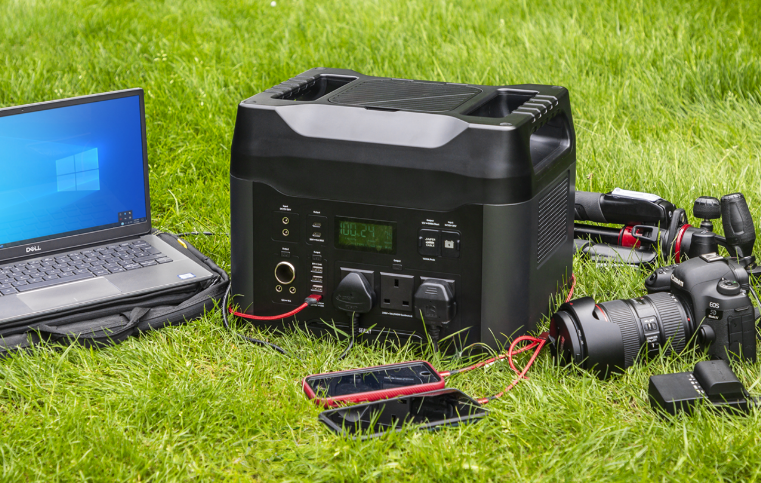

Sealey SPB2200W Portable Power Station
IMPORTANT: PLEASE READ THESE INSTRUCTIONS CAREFULLY. NOTE THE SAFE OPERATIONAL REQUIREMENTS, WARNINGS & CAUTIONS. USE THE PRODUCT CORRECTLY AND WITH CARE FOR THE PURPOSE FOR WHICH IT IS INTENDED. FAILURE TO DO SO MAY CAUSE DAMAGE AND/OR PERSONAL INJURY AND WILL INVALIDATE THE WARRANTY. KEEP THESE INSTRUCTIONS SAFE FOR FUTURE USE.
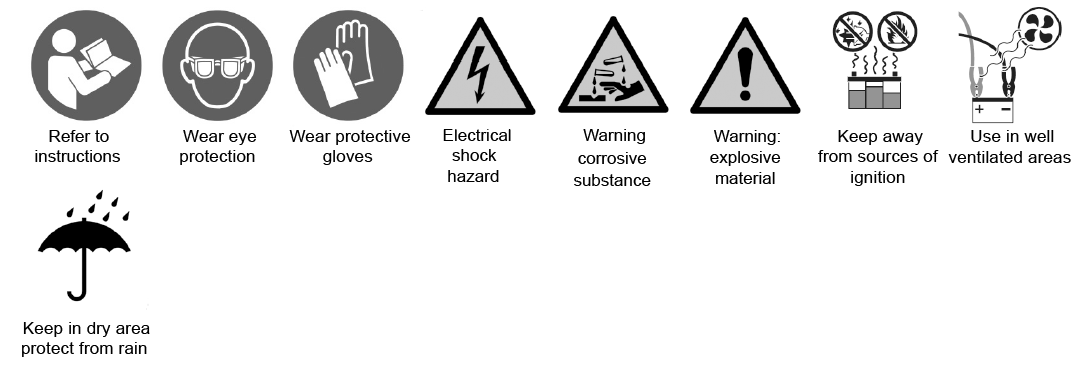
SAFETY
ELECTRICAL SAFETY FOR USE OF POWER STATION
WARNING! It is the user’s responsibility to read, understand, and comply with the following electrical instructions:
- You must ensure the risk of electric shock is minimised by the installation of appropriate safety devices.
An RCCB (Residual Current Circuit Breaker) should be incorporated in the main distribution board. We also recommend that an RCD (Residual Current Device) be used with all electrical products, particularly portable equipment that is plugged into an electrical supply not protected by an RCCB. - You must also read and understand the following instructions concerning electrical safety. The Electricity at Work Act 1989 requires all portable electrical appliances, if used on business premises, to be tested by a qualified electrician, using a Portable Appliance Tester (PAT).
- The Health & Safety at Work Act 1974 makes owners of electrical appliances responsible for the safe condition of the appliance and the safety of the appliance operator. If in any doubt about electrical safety, contact a qualified electrician.
You must ensure that you: - Inspect the power station, plugs, cables, and connectors for wear and damage to ensure items are safe before connecting to the mains power supply. If worn or damaged, DO NOT use.
- Uncoil the cable between the power station and any connected equipment.
- DO NOT pull the power station charger plug from the mains socket by the lead.
- WARNING! DO NOT use any other type of power station with this product, other than the supplied mains or car power station. Failure to observe this warning could result in injury and or fire and will invalidate the warranty.
- DO NOT try to take any of the power station and charger cables apart.
- DO NOT use the power station charger to charge or power any other electrical item.
- DO NOT get the power station wet, or use it in wet, damp conditions (for indoor use only).
BATTERY SAFETY
WARNING! To reduce the risk of burns or fire:
- DO NOT attempt to open, disassemble, modify, or service the power station.
- DO NOT crush, puncture, short external contacts, or dispose of in fire or water.
- DO NOT expose to temperatures above 60°C (140°F).
- Recycle or dispose of the used battery as stipulated by local regulations.
- If the electrolyte in the cells gets on your skin, thoroughly wash with soap and water. If it gets in your eyes, rinse thoroughly with cool water and seek immediate medical attention.
- Ensure the internal battery is fully charged before initial use.
- DO NOT move/handle/use the Power Station when it is being charged.
- DO NOT leave the unit in a discharged state, recharge battery immediately. Before storage, fully recharge the battery; subsequently, recharge the battery at least once every six months of non-use.
- Follow these instructions and those published by the battery and vehicle manufacturers, and the maker of any equipment you intend to use in the vicinity of the battery. Remember to review warning marks on all products and on engines.
- WARNING! Modern vehicles contain extensive electronic systems.
You are required to check with the vehicle Manufacturer for any specific instructions regarding the use of this type of equipment on each vehicle. No liability will be accepted for damage/injury, where this product is not used in accordance with all instructions.
PERSONAL PRECAUTIONS
- Ensure there is another person within hearing range of your voice and close enough to come to your aid, should a problem arise when working near a lead-acid battery.
- Wear safety eye protection and protective clothing. Avoid touching your eyes while working near a battery.
- Have fresh water and soap nearby in case battery acid contacts skin, clothing, or eyes.
- Wash immediately with soap and water if battery acid contacts skin or clothing. If acid enters the eye, flush the eye immediately with cool, clean running water for at least 15 minutes and seek immediate medical attention.
- Remove personal metallic items such as rings, bracelets, necklaces, and watches. A lead-acid battery can produce a short-circuit current that is high enough to weld a ring or the like to metal, which would cause severe burns.
- Ensure hands, clothing (especially belts), are clear of fan blades and other moving or hot parts of the engine, remove ties, and contain long hair.
- DO NOT smoke or allow a spark or flame in the vicinity of the battery or engine.
GENERAL SAFETY INSTRUCTIONS
- Familiarise yourself with the application and limitations of the Power station as well as the potential hazards.
- Use the Power station in the upright position only and ensure it is placed on a stable surface which will adequately support its weight.
- Keep tools and other items away from the engine and ensure you can see the battery and working parts of the engine clearly.
- Keep children and unauthorised persons away from the working area.
- DO NOT allow power clamps to touch each other or to make contact with any metallic part of the vehicle.
- DO NOT cross-connect power leads from the Power station to the battery. Ensure positive (+/RED) is to positive and negative (-/BLACK) is to negative.
- DO NOT pull the cables or clamps from the battery terminals.
- DO NOT use the power station outdoors, or in damp, or wet locations and DO NOT operate within the vicinity of flammable liquids or gases.
- DO NOT use it for a task for which it is not designed.
- When not in use, store carefully in a safe, dry, childproof location.
- Only use for starting vehicles with 12V systems. DO NOT use for other vehicles such as aircraft, ships, etc.
- DO NOT use in place of a vehicle battery.
- Use the jumper cable provided with this unit only.
- DO NOT jump-start more than 3 times in a row. It could damage the unit by overheating. Give two minutes between attempts.
- Remove the product from the vehicle battery within 30 seconds of jump-starting. If not, it could lead to damage.
- DO NOT modify or disassemble the Power Station. Only a repair technician may repair this unit.
- DO NOT drop the unit. If the unit receives a sharp blow or is otherwise damaged in any way, have it checked by a qualified technician.
- DO NOT use the unit to jump start a vehicle while charging the internal battery.
NOTE: This appliance can be used by children aged 8 years and above and persons with reduced physical, sensory, or mental capabilities or lack of experience and knowledge if they have been given supervision or instruction concerning the use of the appliance in a safe way and understand the hazards involved. Children shall not play with the appliance. Cleaning and user maintenance shall not be made by children without supervision.
INTRODUCTION
LiFePO4 battery can be charged and discharged 3000 times before it starts to lose performance. The power station is capable of charging an average phone battery over 100 times or supplying power to a car fridge for 12 hours (based on a 60W Continuous draw). 12 Different outlets mean you are able to connect up to 12 devices at once. Integral light with five different modes: High, medium, low, flashing, and SOS. Supplied with smart jump cables so the power station can be used to jump-start a vehicle. There are eight forms of built-in protection, including: Over-charge, short-circuit, reverse polarity, temperature protection,n, and more. Includes battery link cable, which allows you to expand the unit’s capacity with additional power stations. Audible alarm will sound at 10% battery power to help make sure you never run out of battery. From a completely flat battery, the power station will charge to full in 8 hours. Supplied with a power lead. Built-in handles for easy transportation.
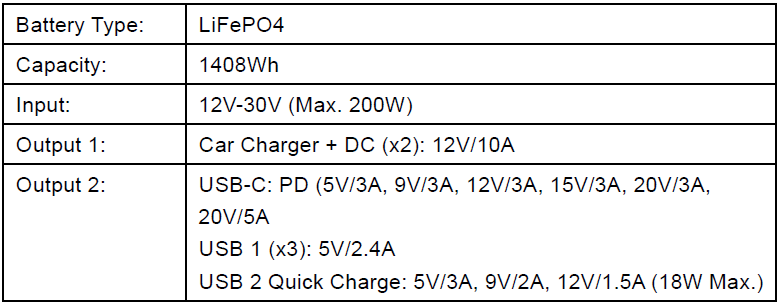
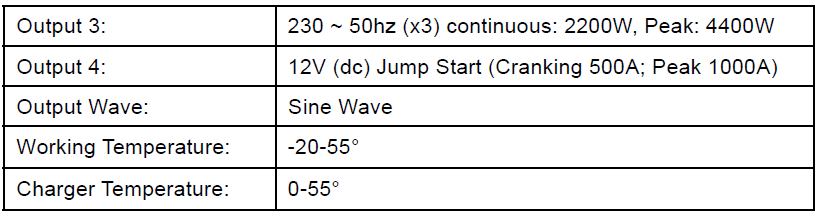
SPECIFICATION
OPERATION
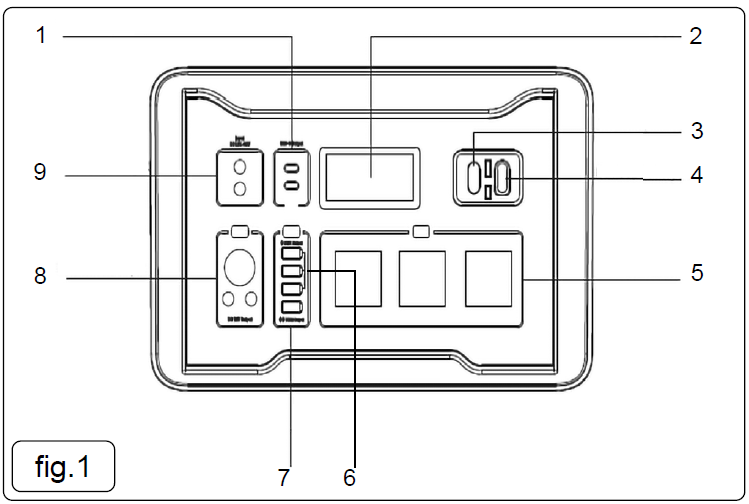
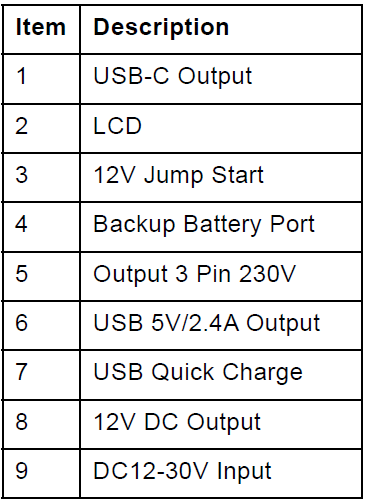
- Charge the unit before first use. Connect the charge unit to a power source and insert the connector into either of the two 12V input sockets (fig 1, item 9). The LED will display the current percentage charge stored and the time required to charge to 100%.
OPERATION SELECTION
- 12V DC Output (fig.1, item 8): Press the black button above the panel. The LCD will illuminate and display “DC” in the lower left-hand portion of the screen. The LCD will also display the current state of the power station.
- USB 5V/2.4A Output (fig.1, item 6): Press the black button above the panel. The LCD will illuminate and display symbols for both Type C and USB connectors in the lower portion of the screen. The LCD will also display the current state of the power station.
- USB Quick Charge(fig.1, item 7): Press the black button above the panel. The LCD will illuminate and display symbols for both Type C and USB connectors in the lower portion of the screen. The LCD will also display the current state of the power station.
- USB-C Output (fig.1, item 1): Press the black button below the panel. The LCD will illuminate and display symbols for both Type C and USB connectors in the lower portion of the screen. The LCD will also display the current state of the power station.
- Output 3 Pin 230V (fig.1, item 5): Press the black button above the panel. The LCD will illuminate and display “AC” in the lower right-hand portion of the screen. The LCD will also display the current state of the power station.
- Integral Light (on reverse face): The light has five modes: high, medium, low, flashing, and S.O.S. Cycle through by repeated pressing of the button beside the light.
- Backup Battery Port (fig 1 item 4): Connect the charging cable to the indicated socket and the other end to the unit being charged.
- DO NOT use to recharge car batteries.
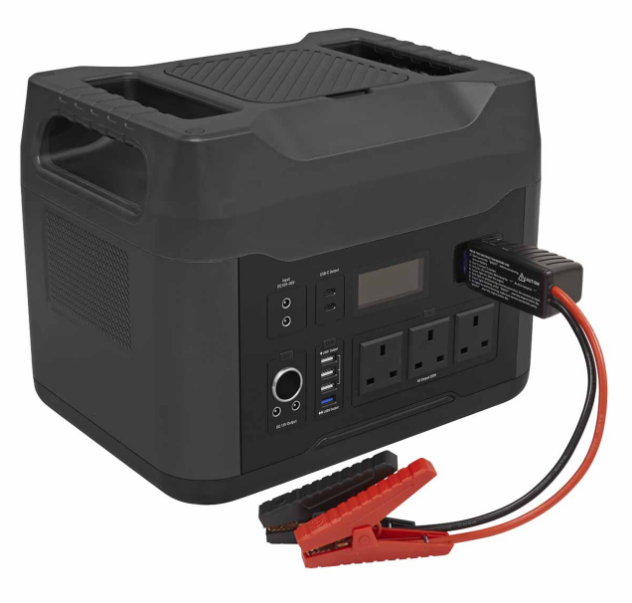
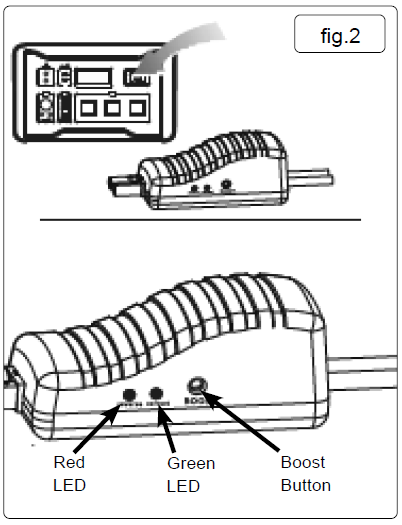
- 12V Jump Starting (fig. 1, item 3 / fig.2):

- Connect the Jump Start body to the Power Station (fig.2 & fig.1, item 3).
- Connect the red clamp to the positive battery terminal.
- Connect the black clamp to the negative battery terminal.
- If the green LED is lit (fig.2), the connection is correct, the circuit is working,g and jump starting can begin.
- If the green LED is blinking, it indicates that the vehicle battery is low. If so, press the Boost Button (fig.2) and hold until the green LED is solid, and then turn on the engine within 30 seconds.
- If the red LED is on and the unit is making a buzzing sound, it means that the negative cable is attached to the positive battery terminal and the positive cable is attached negative battery terminal. Reconnect the cables correctly and wait for the green LED to light before turning on the engine.
- When no LED is lit and no buzzing can be heard, it indicates the vehicle battery is damaged or the connection is incomplete. Check the connections and if correct, press the Boost Button and hold until the green LED is solid, and then turn on the engine within 30 seconds.
MAINTENANCE
- After each use, clean the battery charger clamps. Be sure to remove any battery fluid that will cause corrosion of the copper clamps.
- Clean the outside case of the unit with a soft cloth and, if necessary, mild soap solution and a damp cloth.
- Keep all cables/cords, etc., loosely coiled during storage to prevent damage to them.
- DO NOT use the unit if cords or clamps have been damaged in any way. If any cord is damaged, it must be replaced by the manufacturer, its service agent, or a qualified person to avoid a hazard.
- Store inside, in a cool, dry place. DO NOT store the clamps on the handle, clipped together, on or around metal, or clipped to the cables.
- Store the unit unplugged from the charge unit and store it in an upright position.
ENVIRONMENT PROTECTION

Recycle unwanted materials instead of disposing of them as waste. All tools, accessories, and packaging should be sorted, taken to a recycling centre, and disposed of in a manner that is compatible with the environment. When the product becomes completely unserviceable and requires disposal, drain any fluids (if applicable) into approved containers and dispose of the product and fluids according to local regulations.

BATTERY REMOVAL

Under the Waste Batteries and Accumulators Regulations 2009, Jack Sealey Ltd required to inform potential purchasers of products containing batteries (as defined within these regulations) that they are registered with Valpak’s registered compliance scheme. Jack Sealey Ltd’s Batteries Producer Registration Number (BPRN) is BPRN00705.
WEEE REGULATIONS

Dispose of this product at the end of its working life in compliance with the EU Directive on Waste Electrical and Electronic Equipment (WEEE). When the product is no longer required, it must be disposed of in an environmentally protective way. Contact your local solid waste authority for recycling information.
Note: It is our policy to continually improve products, and as such, we reserve the right to alter data, specifications, and parts without prior notice.
Important: No Liability is accepted for incorrect use of this product.
Warranty: The Guarantee is 12 months from the purchase date, proof of which is required for any claim.
Sealey Group, Kempson Way, Suffolk Business Park, Bury St Edmunds, Suffolk. IP32 7AR
Phone: 01284 757500
Email: [email protected]
Website: www.sealey.co.uk
For more manuals by Sealey, visit ManualsLibraryy
Sealey SPB2200W Portable Power Station- FAQs
What is a portable power station used for?
A portable power station provides off-grid electricity using a rechargeable battery. It works like a large power bank with AC outlets, USB, and DC ports, making it suitable for powering devices from phones to small appliances.
How does a portable power station work?
It stores energy in a rechargeable battery. The built-in inverter converts this energy into usable AC or DC power, allowing you to charge or run multiple devices without fuel, noise, or emissions.
What can a 2200W portable power station run?
A 2200W model can power small kitchen appliances such as coffee makers, kettles, blenders, TVs, laptops, fans, and even some refrigerators. However, high-wattage devices like electric stoves or dryers require more power.
How long can a 2200W portable power station last on one charge?
The runtime depends on the battery capacity and the device’s wattage. For example, a 2000Wh power station running a 300W TV could last about 6–7 hours before recharging.
Can I use the power station while it’s charging?
Yes, most modern units allow “pass-through charging,” meaning you can use the power station while it recharges. Always check the product manual for confirmation.
How do I know when the Sealey SPB2200W is fully charged?
The runtime depends on the battery capacity and the device’s wattage. For example, a 2000Wh power station running a 300W TV could last about 6–7 hours before recharging.
What type of battery does it use?
Portable power stations like the SPB2200W typically use lithium-ion batteries, known for their high energy density, longer lifespan, and lighter weight compared to lead-acid batteries.
How long does a portable power station last before replacement?
With proper care, most units last 5–10 years. Battery health depends on usage, charging habits, and storage conditions.
Can a portable power station run a refrigerator?
Yes, a 2200W station can usually power a standard fridge for several hours to a day, depending on the fridge’s size and energy consumption.
What are the disadvantages of a portable power station?
Some downsides include limited runtime compared to gas generators, slower recharge times, higher upfront cost, and relatively heavy weight.