
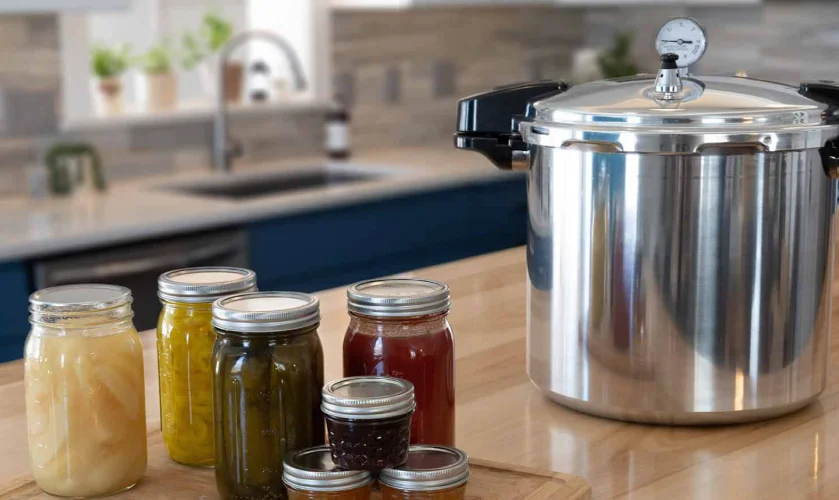

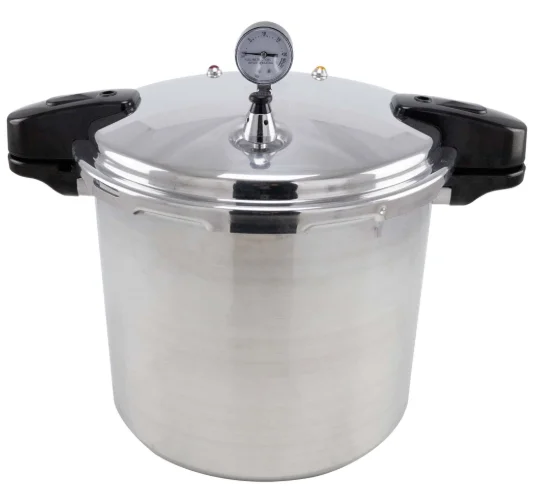
Nesco MPC-16 QT Pressure Canner & Cooker
IMPORTANT SAFEGUARDS
This product is designed for household use only.
- READ ALL INSTRUCTIONS BEFORE USE.
- Always check the vent tube before use. Look through the vent tube to ensure that it is clear.
- Do not touch hot surfaces. Use handles or knobs.
- Close supervision is necessary when the pressure cooker is used near children.
- Do not place the pressure cooker into a heated oven.
- Do not use the pressure cooker on an outdoor LP gas burner.
- Extreme caution must be used when moving a pressure cooker containing hot liquids.
- Do not use the pressure cooker outside of its intended use.
- Improper use of the pressure cooker while under pressure may result in scalding injury. Make certain the unit is properly closed before operating. See “Pressure Canning Instructions”.
- Do not fill the unit over 2/3 full. Note: When cooking foods that expand, such as rice or dried vegetables, do not fill the unit over ½ full. Overfilling may cause a risk of clogging the vent tube and developing excess pressure.
- Be aware that certain foods, such as applesauce, cranberries, pearl barley, oatmeal or other cereals, split peas, noodles, macaroni, rhubarb, or spaghetti, can foam, froth, and sputter, and clog the vent tube. These foods should not be cooked in a pressure cooker.
- Always check the vent tube for clogging before use.
- Do not open the pressure cooker until the unit has cooled and all internal pressure has been released. If the handles are difficult to push apart, this indicates that the cooker is still pressurized – do not force open. Any pressure in the cooker can be hazardous.
- Do not use the pressure cooker for pressure frying with oil.
- When the normal operating pressure is reached, turn the heat down so all the liquid, which creates the steam, does not evaporate.
About Your Canner
- This canner operates as a weighted-gauge canner. All recipes used should reflect this type of process. The dial gauge on the canner is for pressure reference only. Weighted gauges provided are rated for 10 lb and 15 lb, respectively.
- This unit is manufactured with a floating valve to prevent the unit from being opened while under pressure. We also include dual-pressure safety vents in the cover to prevent the unit from over-pressurizing while in use.
- The most up-to-date information regarding canning and recipes can be located at the National Center for Home Food Preservation: https://nchfp.uga.edu/.
Components
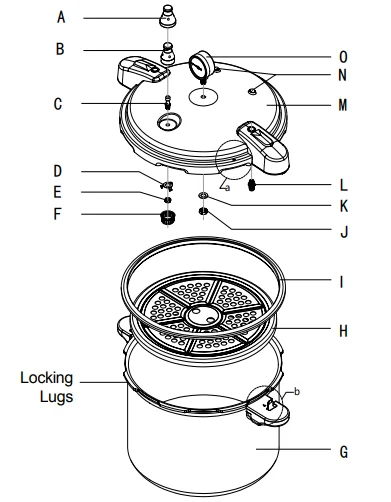
- A. Pressure Regulator, 15 PSI
- B. Pressure Regulator, 10 PSI
- C. Vent Tube
- D. Tri Capture Washer
- E. Vent Tube Nut
- F. Vent Tube Filter
- G. Canner/Cooker Body
- H. Canning Rack
- I. Silicone Cover Gasket
- J. Pressure Gauge Nut
- K. Pressure Gauge Washer
- L. Floating Valve
- M. Cover
- N. Safety Valves
- O. Pressure Gauge

- O. Pressure Gauge
Before First Canning Use
- Remove all packaging materials and labels from the pressure canner.
- Remove the silicone cover gasket from the cover, wash it along with the cover and canner body in warm soapy water. Rinse and wipe down to avoid water spotting on the polished surfaces of the canner.
- Remove the pressure gauge from the packaging material. Remove the washer and nut from the pressure gauge assembly. (Note: DO NOT remove the small silicone ring from the threaded portion of the pressure gauge.) Install the threaded portion of the pressure gauge through the hole in the center of the outside of the cover. Make sure that the silicone ring that is on the threaded portion of the pressure gauge is centered in the hole. From the underside of the cover, install first the washer and then the nut onto the threaded portion of the gauge. Hand-tighten the nut until finger-tight. WARNING: Care must be used in handling the pressure gauge. A drop or shock to the pressure gauge may cause it to lose calibration. DO NOT immerse the pressure gauge in water or any other liquid, as doing so may result in an incorrect pressure reading of the gauge.
- Apply a light coating of food-grade oil to the silicone cover gasket and install it back into the groove in the cover.
- Apply a light coating of food-grade oil to the underside of the locking lugs on the body to help make the cover easier to open and close.
Educational Canner Trial
Before canning for the first time, it is recommended that you familiarize yourself with the operation of the Pressure Canner. Before starting your canner trial, read steps 1 through 6 in the “Pressure Canning Instructions” to understand how to assemble the canner. Consult your range’s manufacturer guide for weight restrictions before pressure canning in our Nesco canner on a glass top stove.
- Pour three quarts of water into the pressure canner.
- Close the lid and place the 15-pound regulator on the vent tube.
- Place on high heat until the regulator begins to rock. Steam will expel from the unit; please use caution.
- Adjust the heat setting so that the regulator rocks lightly and consistently.
- Remove the pressure canner from the heat source and let it cool until the pressure gauge reads zero and the floating valve has dropped. At this time, you can attempt to open the lid. If the lid does not twist to the unlocked position, do not force it and allow more time for pressure to naturally release.
Pressure Canning Instructions
The US Department of Agriculture recommends pressure canning as the only safe way to can meats, fish, poultry, and vegetables. The most up-to-date information regarding canning and recipes can be located at the National Center for Home Food Preservation: https://nchfp.uga.edu/.
- Please make sure the pressure canner is thoroughly cleaned before canning. Hold the pressure canner cover up to a light source so that you can see through the vent tube to ensure it is clean and unobstructed.
- Place the canning rack into the bottom of the pressure canner body. Note: A rack should always be placed on the bottom of the canner for all canning processes.
- Place a minimum of three quarts of water into the canner body.
- Place your prepared jars on the rack in the canner. Whenever possible, make sure that the maximum number of jars is used. This will ensure an even and efficient canning process. Your canner has a volume capacity that allows you to do 7 quarts, 8 pints, or 8 half-pint jars. You can add a second layer of pints or half pints by placing an additional canning rack on top of your first layer of jars. (Additional racks can be ordered from Nesco Customer Service.) Note: Jar dimensions will vary by manufacturer. Always dry fit your jars before canning.
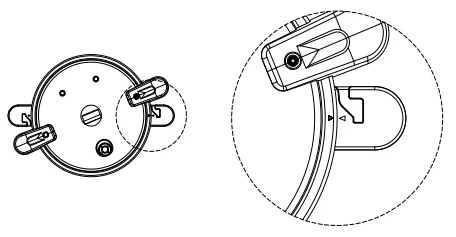
- Place the cover on the canner body, making sure to align the arrows located on the cover and body handle. Once aligned, apply slight downward pressure to the cover while rotating it clockwise until the handles on the cover line up with the handles on the canner body.

- Place the pressure canner onto your cooking range. An electric or gas burner can be used. Make sure to center the pressure canner over the burner. Warning: When using a glass top range, take care when moving the canner. Do not slide it across the glass top, as it can create scratches on your cooking surface. Pay close attention to the maximum weight limits set by your range’s manufacturer. A fully loaded canner is extremely heavy and can cause glass breakage. Note: This canner cannot be used on an induction stovetop or on a portable electric burner.
- Heat the canner on high and monitor until a continuous stream of steam is seen coming from the vent tube. Allow steam to be released from the vent tube for 10 minutes.
- At the end of your 10-minute countdown, place the proper pressure regulator on top of the vent tube based on your recipe. As pressure builds up within the canner, the weighted regulator will start rocking, and steam will escape. The goal is to maintain a steady rocking motion, which is achieved by adjusting the heat. Use your dial gauge to help verify the pressure. Once you have maintained the continuous rocking, you will be canning at the optimal pressure. You may start your countdown timer based on the recipe you selected.
- At the end of the processing time, turn off the burner and place the pressure canner on a heat-resistant surface so it can cool down naturally. Once the floating valve has dropped, use oven mitts to remove the weighted regulator to ensure all pressure is released.
- The cover can now be removed by turning it counterclockwise to open. Please be aware that steam may still be present, so open the cover away from you. DO NOT rapidly cool the pressure canner. Allow the canner to cool down naturally so processed food is canned properly and to avoid siphoning.
- Note that the canning jars will still be hot. Always use a jar lifter to remove them from the canner.
Water Bath Canning
The most up-to-date information regarding canning and recipes can be located at the National Center for Home Food Preservation: https://nchfp.uga.edu/.
NOTE: Your Nesco 17-quart canner can be used for water bath canning for half-pint and pint jars only. It is not tall enough to provide adequate coverage for quart jars. Consult your range’s manufacturer guide for weight restrictions before water bath canning in our Nesco 24-quart canner on a glass top stove.
- Place the canning rack inside the pressure canner body.
- Remove the pressure regulator from the canner cover. You will not be using a pressure regulator during the water bath process.
- Place your prepared jars into the canner, on the rack.
- Add water to the canner so that the water level is at least 1 inch above the canning jar lids.
- Place the cover onto the canner body, making sure that the arrows on the cover and on the handle are aligned. Once aligned, apply slight downward pressure to the cover while rotating it clockwise until the handles on the cover line up with the handles on the cooking body.
- Heat the canner on high until a consistent stream of steam is seen.
- Set a timer for the minutes required for processing the recipe you have selected.
- Adjust the heat setting of your burner, if necessary, to maintain a steady stream of steam.
- When the canning jars have been processed for the recommended time, turn off the heat and remove the canner cover. Use caution when removing the cover. Tip it away from yourself when you do. Steam can cause serious burns.
Pressure Cooking Instructions
- Please make sure the unit is thoroughly cleaned before cooking. Hold the cover up to a light source so that you can see through the vent tube to ensure it is clean and unobstructed.
- Following your chosen recipe, add your food and liquid to the unit. Note: Do not fill the unit over 2/3 full. When cooking foods that expand, such as rice or dried vegetables, do not fill the unit over ½ full. Overfilling may cause a risk of clogging the vent tube and developing excess pressure.
- Place the cover on the body of the unit, making sure to align the arrows located on the cover and body handle. Once aligned, apply slight downward pressure to the cover while rotating it clockwise until the handle on the cover lines up with the handles on the canner body.
- Place the unit onto your cooking range. An electric or gas burner can be used. Make sure to center the pressure canner over the burner. Warning: When using a glass top range, take care when moving the canner. Do not slide it across the glass top, as it can create scratches on your cooking surface. Pay close attention to the maximum weight limits set by your range’s manufacturer. A fully loaded canner is extremely heavy and can cause glass breakage.
- Based on your recipe, place the proper weighted regulator on the unit and adjust the heat setting so that the regulator starts rocking.
- When correct pressure is reached, maintain the steady rocking motion by adjusting the heat. Start the timer to count down cook time.
- When your timer is done, release the pressure by removing the weighted regulator using oven mitts. WARNING: Keep your fingers and face away from the steam escaping. The steam will be extremely hot.
- Allow the steam to subside. The cover can now be removed by turning it counterclockwise to open. Please be aware that steam may still be present, so open the cover away from you. NOTE: Do not run the unit under cold water to expedite cooling time, as the dial gauge could become damaged if exposed to water.
Care and Cleaning
- Do not place any of the canner components into a dishwasher. Handwash only. Placing the canner parts into a dishwasher will remove the polished surface and may compromise the assembly process. Use warm, soapy water to clean the cover. Do not submerge the cover in water or any other liquid. The pressure gauge will become damaged and fall out of calibration.
- Inspect the cover gasket after every use. Check for tears or weak spots. If a replacement is required, contact our customer service department at 800-288-4545, Monday-Friday 8 am-4:30 pm CST.
- For help with hard water stains, 2 tbsp of Cream of Tartar can be added to the canner water during the canning process.
- For help with cooked-on food from pressure cooking: Use a non-abrasive pad with a soft cleanser soap.
One-Year Limited Warranty
The Metal Ware Corporation warrants to the original purchaser that your product will be free from defects in material and workmanship for a period of one year from the date of purchase. Product must be used for personal or sole household usage in accordance with the instructions. Should your product prove defective within one year from the date of purchase, contact our customer service team at 1-800-288-4545 or email [email protected] with an explanation of the claim.
If a viable warranty claim is determined, a customer service member will provide you with the necessary details to have your unit replaced. Under this limited time warranty, we undertake to replace any parts found to be defective at our sole discretion. This limited-time warranty is void if the unit is connected to an unsuitable electrical supply, dismantled, interfered with in any way, or damaged through misuse. This warranty is not transferable.
LIMITATION OF REMEDIES AND DAMAGES: Except for the limited time warranty and remedies expressly stated above, the Metal Ware Corp shall not be liable to you, or to anyone claiming by or through you, for any obligations or liabilities, including, but not limited to, obligations or liabilities arising out of breach of contract, breach of warranty, statutory claims, negligence, or other tort, or any theory of strict liability, with respect to the product or the Metal Ware Corp’s acts or omissions or otherwise.
Buyer agrees that in no event shall the Metal Ware Corp be liable for incidental, compensatory, punitive, consequential, indirect, special, or other damages. Warranty does not cover consequential or incidental damages, such as property damage, and does not cover incidental costs and expenses resulting from any breach of this warranty, even if foreseeable.
Some states or provinces do not allow the exclusion or limitations of incidental or consequential damages, so the above limitation or exclusion may not apply to you depending on the state or province of purchase. You may register your product on our website, but you will need to retain a copy of your proof of purchase should a warranty issue arise. We suggest you staple your receipt to this care and use guide. https://www.nesco.com/customer-service/warranty-registration. Or fill in your warranty card and return it within one week from the date of purchase, along with a copy of proof of purchase.
NESCO Pressure Canner Cooker
C/O MW | PO Box 237 | Two Rivers, WI 54241-0237
For More Manuals By Nesco, Visit ManualsLibraryy.
Nesco MPC-16 QT Pressure Canner & Cooker-FAQs
What is the Nesco MPC-16 QT Pressure Canner & Cooker used for?
The Nesco MPC-16 QT is designed for both pressure canning and everyday pressure cooking. It helps preserve foods like vegetables, meats, and soups safely while also allowing you to prepare meals quickly. Its dual functionality makes it ideal for home food preservation and regular kitchen use.
What capacity does the Nesco MPC-16 QT canner offer?
This model provides approximately 16 to 17 quarts of capacity, making it suitable for processing multiple jars at once. It can handle half-pint, pint, and quart jars, which makes it practical for small to medium-sized batches of home canning or cooking needs.
Is the Nesco MPC-16 QT safe to use for pressure canning?
Yes, it includes multiple safety features such as a locking lid, pressure regulator, floating valve, and dual safety vents. These components work together to maintain proper pressure levels and prevent accidental opening, ensuring a safer canning and cooking experience.
Can the Nesco MPC-16 QT be used on all stovetops?
The canner is compatible with most stovetops, including gas, electric coil, ceramic, and sealed electric surfaces. This versatility allows users to operate it in various kitchen setups without needing special equipment, making it accessible for most households.
Does the Nesco MPC-16 QT function as a regular pressure cooker, too?
Yes, it works as both a pressure canner and a pressure cooker. You can use it to prepare meals like stews, beans, and meats quickly, while also using it for long-term food preservation, making it a versatile addition to your kitchen.
What materials is the Nesco MPC-16 QT made from?
The canner is constructed from heavy-gauge, rust-resistant, polished aluminum. This material ensures durability, even heat distribution, and long-lasting performance, while also being relatively lightweight compared to stainless steel alternatives, making it easier to handle during use.
What pressure settings are available in the Nesco MPC-16 QT?
It typically includes weighted pressure regulators for 10 PSI and 15 PSI settings. These options allow you to adjust pressure levels depending on the type of food being processed and your altitude, ensuring safe and effective canning results.
Is the Nesco MPC-16 QT beginner-friendly for home canning?
The design includes easy-grip handles, an indicator valve, and a straightforward pressure control system, making it suitable for beginners. While some learning is required for safe canning practices, the clear indicators and manual operation help users gain confidence quickly.
What safety features are included in this pressure canner?
The unit features a secure locking lid, built-in pressure valve, floating valve to prevent opening under pressure, and dual safety vents. These features work together to regulate pressure and minimize risks, making it reliable for both cooking and food preservation tasks.
What accessories come with the Nesco MPC-16 QT Pressure Canner?
The canner usually includes a canning rack and essential pressure components like regulators and valves. These accessories help organize jars during processing and ensure proper airflow and pressure distribution, which is necessary for safe and consistent canning results.