
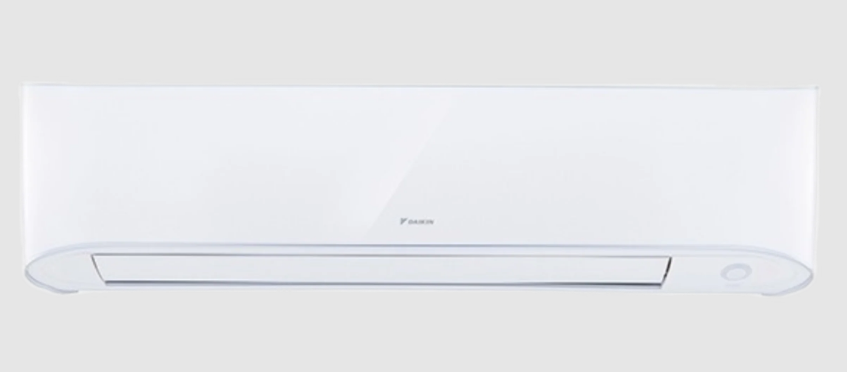

Daikin FTXB12AXVJU Wall Mounted Split AC

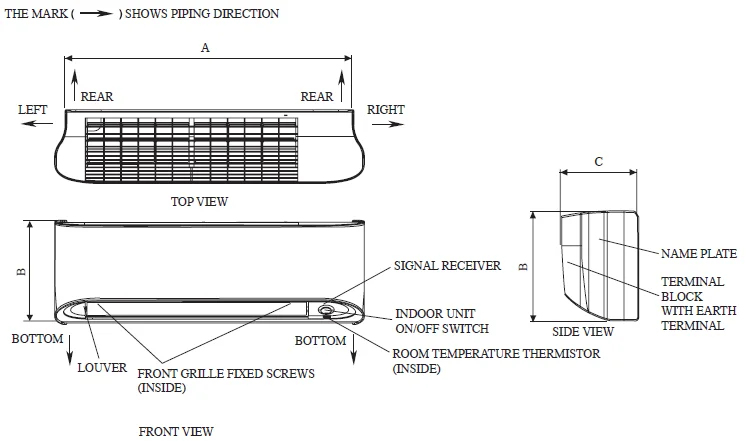
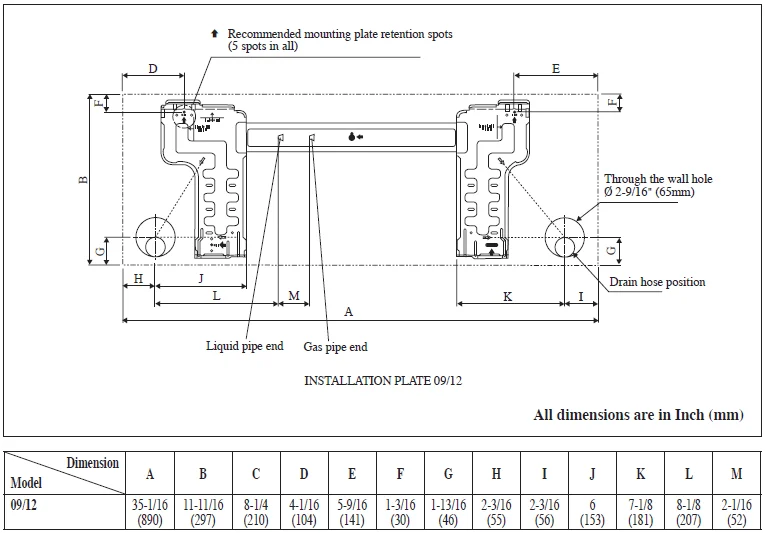
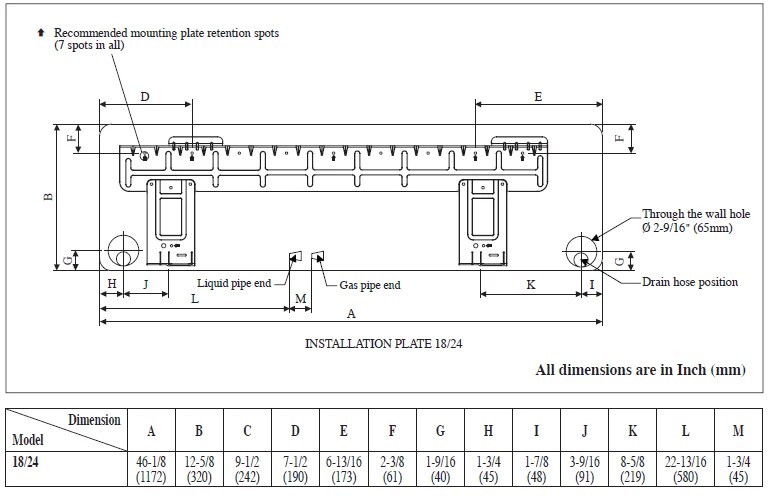
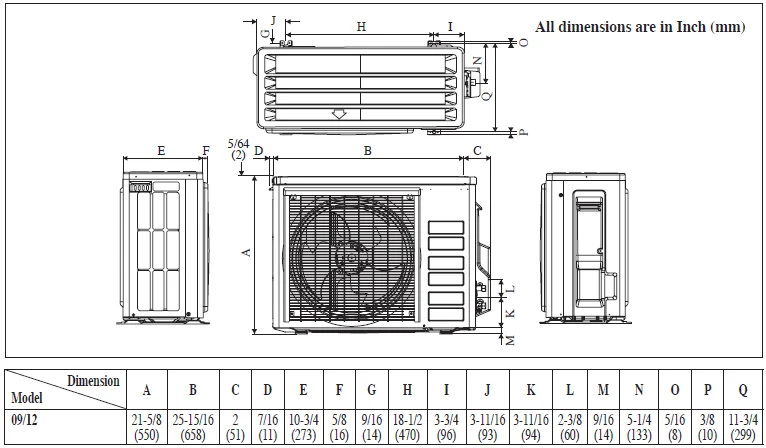
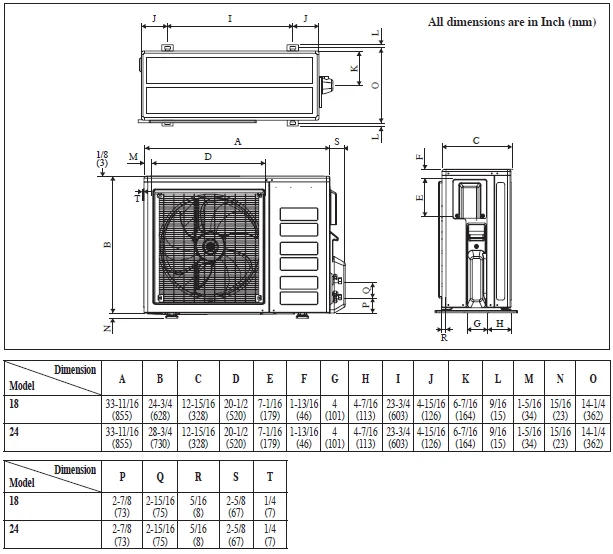
OUTLINE AND DIMENSIONS
Indoor Unit [FTXB/FTKB]
Outdoor Unit [RXB/RKB]
SAFETY PRECAUTIONS
WARNING
- Only qualified personnel must carry out the installation work. Installation must be done in accordance with this installation manual. Improper installation may result in water leakage, electric shock, or fire.
- When installing the unit in a small room, take measures to keep the refrigerant concentration from exceeding allowable safety limits. Excessive refrigerant leaks, in the event of an accident in a closed ambient space, can lead to oxygen deficiency.
- Use only specified accessories and parts for installation work. Failure to use specified parts may result in water leakage, electric shock, fire, or the unit falling. Install the air conditioner or heat pump on a foundation strong enough to withstand the weight of the unit. A foundation of insufficient strength may result in the unit falling and causing injuries.
- Take into account strong winds, typhoons, or earthquakes when installing. Improper installation may result in the unit falling and causing accidents.
- Make sure that a separate power supply circuit is provided for this unit and that all electrical work is carried out by qualified personnel according to local, state, and national regulations.
- An insufficient power supply capacity or improper electrical construction may lead to electric shock or fire.
- Make sure that all wiring is secured, that specified wires are used, and that no external forces act on the terminal connections or wires. Improper connections or installation may result in fire.
- When wiring, position the wires so that the electrical wiring box cover can be securely fastened. Improper positioning of the electrical wiring box cover may result in electric shock, fire, or the terminals overheating.
- Before touching electrical parts, turn off the unit.
- It is recommended to install a ground fault circuit interrupter if one is not already available. This helps prevent electric shock or fire.
- Securely fasten the outdoor unit terminal cover (panel). If the terminal cover/panel is not installed properly, dust or water may enter the outdoor unit causing fire or electric shock.
DANGER
- Refrigerant gas is heavier than air and replaces oxygen. A massive leak can lead to oxygen depletion, especially in basements, and an asphyxiation hazard could occur leading to serious injury or death.
- Do not ground units to water pipes, gas pipes, telephonewires, or lightning rods as incomplete grounding can cause a severe shock hazard resulting in severe injury or death. Additionally, grounding to gas pipes could cause a gas leak and potential explosion causing severe injury or death.
- If refrigerant gas leaks during installation, ventilate the area immediately. Refrigerant gas may produce toxic gas if it comes into contact with fire. Exposure to this gas could cause severe injury or death.
- After completing the installation work, check that the refrigerant gas does not leak throughout the system.
- Do not install unit in an area where flammable materials are present due to risk of explosions that can cause serious injury or death.
- Safely dispose all packing and transportation materials in accordance with federal/state/local laws or ordinances. Packing materials such as nails and other metal or wood parts,including plastic packing materials used for transportation may cause injuries or death by suffocation.
INSTALLATION DIAGRAM
INSTALLATION OF THE OUTDOOR UNIT
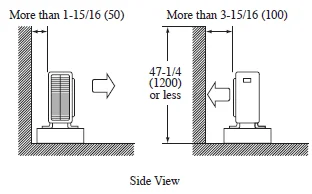
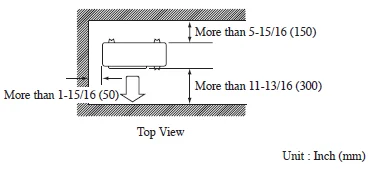
Where a wall or other obstacle is in the path of outdoor unit’s intake or exhaust airflow, follow the installation guidelines below.
For any of the below installation patterns, the wall height on the exhaust side should be 47-1/4″ (1200mm) or less.
Wall facing one side
Wall facing two sides
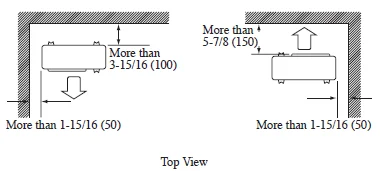
Wall facing three sides
Drain work. (Heat Pump Unit Only)
- Use a drain elbow for drainage.
- If the drain port is covered by a mounting base or floor surface, place additional foot bases of at least 1-3/16″(30mm) in height under the outdoor unit’s feet.
- In cold areas, do not use a drain elbow, drain plugs, or a drain hose with the outdoor unit. (Otherwise, drain water may freeze, impairing heating performance.)
INSTALLATION OF THE OUTDOOR UNIT (18/24)
The outdoor unit must be installed in such a way as to prevent short circuit of the hot discharged air or obstruction to the smooth air flow. Select the coolest possible place where the intake air temperature is not greater than the outside air temperature (Refer to operating range).
Installation clearances

Note: If there is any obstacle higher than half of the unit’s height (H), please allow more space than the figure indicated in the above table.
Condensed Water Disposal Of Outdoor Unit (Heat Pump Unit Only)
There are 10 holes on the base of the Outdoor Unit for condensed water to flow out. Insert the drain elbow into one of the holes.
To install the drain elbow, first insert one portion of the hook into the base (portion A), then pull the drain elbow in the direction shown by the arrow while inserting the other portion into the base. After installation, check to ensure that the drain elbow clings to the base firmly.
If the unit is installed in a snowy and chilly area, condensed water may freeze in the base. In such a case, please remove the plug at the bottom of the unit to smooth the drainage.
INSTALLATION OF THE OUTDOOR UNIT
Precautions for Selecting a Location
- Choose a place solid enough to bear the weight and vibration of the unit, where the operating sound will not be amplified.
- Choose a location where the hot air discharged from the unit or the operating sound will not cause a nuisance to the neighbors of the user.
- Avoid locations, such as near bedrooms, where the operating sound may cause disturbance.
- There must be sufficient space to carry the unit into and out of the site.
- There must be sufficient space for air passage and no obstructions around the air inlet and the air outlet.
- The site must not be prone to flammable gas leaks in the surrounding area.
- Install units, power cords, and inter-unit wire at least 10ft (3m) away from television and radio sets. (This is to prevent interference with images and sounds. Noise may be produced even if they are more than 10ft (3m) away, depending on radio wave conditions.)
- In coastal areas or other places with a salty atmosphere or one containing sulfate gas, corrosion may shorten the life of the air conditioner.
- Since water will flow from the drain of the outdoor unit, do not place anything under the unit anything which must be kept away from moisture.
NOTE
Cannot be installed, suspended from a ceiling, or stacked.
CAUTION
When operating the air conditioner in a low outdoor ambient temperature, be sure to follow the instructions described below.
- To prevent exposure to wind, install the outdoor unit with its suction side facing the wall.
- Never install the outdoor unit at a site where the suction side may be exposed directly to wind.
- To prevent exposure to wind, it is recommended to install a baffle plate on the air discharge side of the outdoor unit.
- In heavy snow areas, select an installation site where the snow will not affect the unit.
- If there is a likelihood of snow accumulating on the outdoor unit, attach a snow protection hood.
- In high-humidity areas or heavy-snow areas, it is recommended to attach a drain pan heater to prevent ice build-up from the bottom frame.
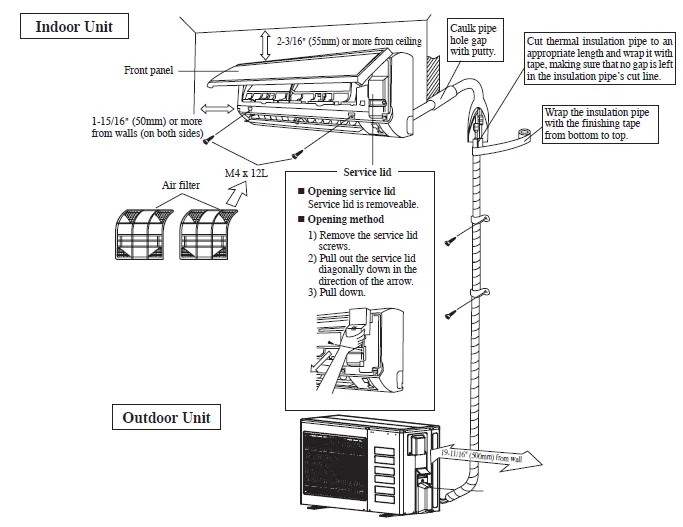
INSTALLATION OF THE INDOOR UNIT
The indoor unit must be installed in such a way so as to prevent short circuit of the cool discharged air with the hot return air. Please follow the installation clearance shown in the figure. Do not place the indoor unit where there could be direct sunlight shining on it. Also, this location must be suitable for piping and drainage, and be away from doors or windows.
The refrigerant piping can be routed to the unit in a number of ways (left or right from the back of the unit), by using the cut-out holes on the casing of the unit. Bend the pipes carefully to the required position in order to align it with the holes. For the side and bottom out, hold the bottom of the piping and then position it to the required direction. The condensation drain hose can be taped to the pipes.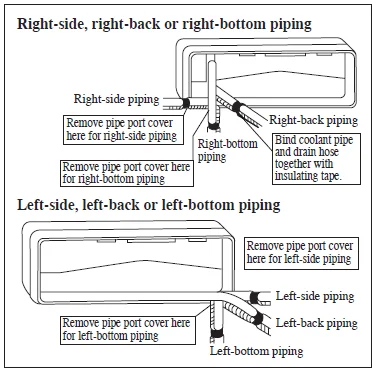
CAUTION
Must be mounted with the lowest moving parts at least 8ft (2.4m) above floor or grade level.
Bottom or side piping
- Cut off the pipe port cover with a copping saw.
- For bottom piping: On the bottom of the front grille
- For side piping: On the side cover (front grille side and unit side)
Apply the blade of the copping saw to the notch, and cut off the pipe port cover along the uneven inner surface.
- After cutting off the pipe cover, perform filing. Remove the burrs along the cut section using a half-round needle file.
- Wrap the inter-unit wire, refrigerant pipes, and drain hose together with insulation tape. Then, insert the drain hose and refrigerant pipes into the wall hole after inserting them into the cut-out piping hole.
Mounting Installation Plate
Ensure that the wall is strong enough to withstand the weight of the unit. Otherwise, it is necessary to reinforce the wall with plates, beams or pillars.
Use the level gauge for horizontal mounting, and fix it with 5 suitable screws for FTXB/FTKB 09/12 and 7 suitable screws for FTXB/FTKB 18/24.
In case the rear piping draws out, drill a hole 2-9/16″ (65mm) in diameter with a cone drill, slightly lower on the outside wall.
Mount The Unit Onto The Installation Plate
Hook the indoor unit onto the upper portion of the installation plate (Engage the two hooks at the rear top of the indoor unit with the upper edge of the installation plate). Ensure that the hooks are properly seated on the installation plate by moving it to the left and right.
How To Attach The Indoor Unit
Hook the claws of the bottom frame to the mounting plate.
How To Remove The Indoor Unit
Push up the marked area (at the lower part of the front grille) to release the claws.
Water Drainage Piping
The indoor drain pipe must be in a downward gradient for smooth drainage. Avoid situations that are likely to cause water to leak.
CAUTION
Do not install the unit at altitude over 6560 ft (2000m) for both indoor & outdoor.
REFRIGERANT PIPING
Piping Works And Flaring Technique
- Do not use contaminated or damaged copper tubing. If any piping, evaporator, or condenser had been exposed or had been opened for 15 seconds or more, the system must be vacuumed. Generally, do not remove plastic, rubber plugs, and brass nuts from the valves, fittings, tubing, and coils until it is ready to connect the suction or liquid line into the valves or fittings.
- If any brazing work is required, ensure that nitrogen gas is passed through the coil and joints while the brazing work is being done. This will eliminate soot formation on the inside wall of copper tubings.
- Cut the pipe stages by stages, advancing the blade of the pipe cutter slowly. Extra force and a deep cut will cause more distortion of the pipe and therefore extra burr.
- Remove burrs from the cut edges of the pipes with a remover. Hold the pipe in the top position and the burr remover in the lower position to prevent metal chips from entering the pipe. This will avoid unevenness on the flare faces, which will cause a gas leak.
- Insert the flare nuts, mounted on the connection parts of both the indoor unit and outdoor unit, into the copper pipes.
- The exact length of pipe protruding from the top surface of the swaging block is determined by the flaring tool.
- Fix the pipe firmly on the swaging block. Match the centers of both the swaging block and the flaring punch, then tighten the flaring punch fully.
- The refrigerant pipe connections are insulated by closed-cell polyurethane.
VACUUMING AND CHARGING
Vacuuming is necessary to eliminate all moisture and air from the system.
Vacuuming The Piping And The Indoor Unit
Except for the outdoor unit, which is pre-charged with refrigerant, the indoor unit and the refrigerant connection pipes must be air-purged because the air containing moisture that remains in the refrigerant cycle may cause malfunction of the compressor.
- Remove the caps from the valve and the service port.
- Connect the center of the charging gauge to the vacuum pump.
- Connect the charging gauge to the service port of the 3-way valve.
- Start the vacuum pump. Evacuate for approximately 30 minutes. The evacuation time varies with different vacuum pump capacity. Confirm that the charging gauge needle has moved towards -14.7psi (-760mmHg).
Charge Operation
This operation must be done by using a gas cylinder and a precise weighing machine. The additional charge is topped-up into the outdoor unit using the suction valve via the service port.
- Remove the service port cap.
- Connect the low-pressure side of the charging gauge to the suction service port center of the cylinder tank and close the high-pressure side of the gauge. Purge the air from the service hose.
- Start the air conditioner unit.
- Open the gas cylinder and low pressure charging valve.
- When the required refrigerant quantity is pumped into the unit, close the low-pressure side and the gas cylinder valve.
- Disconnect the service hose from the service port. Put back the service port cap.
SERVICE AND MAINTENANCE
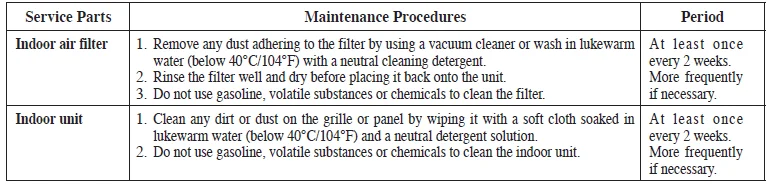
Open the front panel.
Hold the panel at the recesses on the main unit (2 recesses on the right and left sides) and lift it until it stops.
Remove the front panel.
While lifting the front panel further, slide it to the right and pull it to the front side. The left rotating shaft is detached. Slide the right rotating shaft to the left and pull it to the front side to remove it.
Attach the front panel.
Align the right and left rotating shafts of the front panel with the grooves and push them all the way in. Gently close the front panel. (Push both ends and the center on the front panel.)
TROUBLESHOOTING
For any enquiries on spare parts, please contact your authorized dealer. When any malfunction of the air conditioner unit is noted, immediately switch off the power supply to the unit. Check the following fault conditions and causes for some simple troubleshooting tips.
The compressor does not operate for 3 minutes after the air conditioner unit is started.
Protection against frequent starting. Wait for 3 to 4 minutes for the compressor to start operating.
The air conditioner unit does not operate.
- Power failure, or the fuse needs to be replaced.
- The power plug is disconnected.
- It is possible that your delay timer has been set incorrectly.
- If the fault persists after all these verifications, please contact the air conditioner unit installer.
The air flow is too low.
- The air filter is dirty.
- The doors or windows are open.
- The air suction and discharge are clogged.
- The regulated temperature is not high enough.
Discharge air flow has a bad odour.
Odours may be caused by cigarettes, smoke particles, perfume, etc., which might have adhered to the coil.
Condensation on the front air grille of the indoor unit.
- This is caused by the air humidity after an extended period of operation.
- The set temperature is too low. Increase the temperature setting and operate the unit at high fan speed.
Water is flowing out from the air conditioner unit.
Switch off the unit and call the dealer.
If the fault persists, please call your local dealer/serviceman.
For more Manuals by Daikin, visit ManualsLibraryy
Daikin FTXB12AXVJU Wall Mounted Split AC-FAQs
Is Daikin better than Gree?
Daikin is a top-tier Japanese brand known for its advanced inverter technology, durability, and energy efficiency. While Gree offers more affordable options, Daikin generally provides superior performance and warranty support.
what is the most common problem with Daikin air conditioners?
A common issue is low refrigerant levels, which can cause poor cooling or warm air output. This often happens due to leaks or incorrect installation. Regular servicing helps prevent such problems.
How large an area does the Daikin 12000 BTU AC cool?
A 12,000 BTU Daikin split AC can efficiently cool a room of 450 to 550 square feet, ideal for medium-sized bedrooms or living areas.
Which Daikin AC model is the best?
Daikin’s FTKM series is among the best, featuring a 5-star inverter rating and advanced swing compressor technology for excellent energy efficiency.
Is Daikin better than Mitsubishi?
Daikin excels in energy efficiency and innovation, while Mitsubishi is known for durability and quiet operation. Both are premium brands, but your choice depends on whether you prioritize performance or longevity.
Which is the No. 1 AC brand in the world?
Daikin is recognized globally as the No. 1 air conditioning brand, leading in HVAC technology, energy savings, and product reliability.
What size room will a 12000 BTU AC cool?
A 12,000 BTU air conditioner is suitable for rooms sized 450–550 sq. ft., such as large bedrooms or small living rooms.
Is a mini split cheaper to run than central AC?
Yes. Mini split systems are usually more energy-efficient since they cool specific zones rather than the whole house and don’t require ductwork, reducing energy loss.
How much power does a Daikin 12000 BTU split AC use?
A 12,000 BTU Daikin unit typically consumes 800–1,200 watts per hour, depending on settings, room insulation, and outside temperature.