
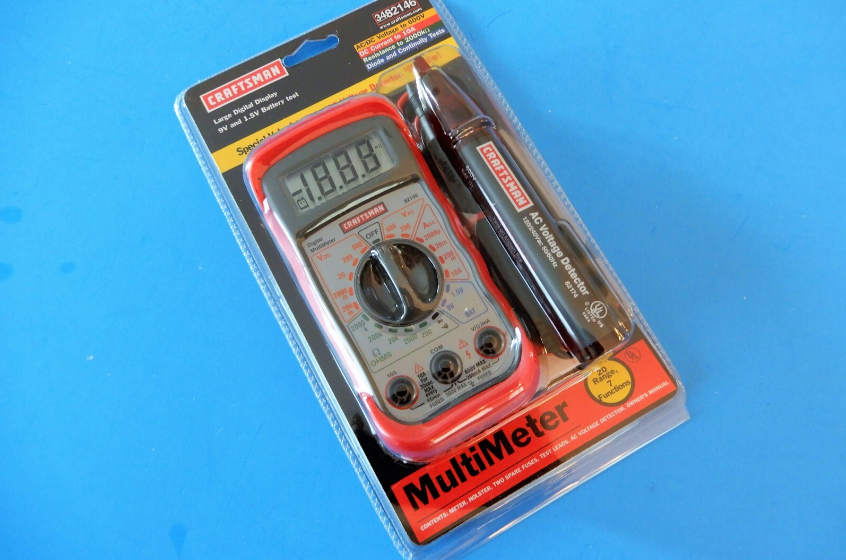

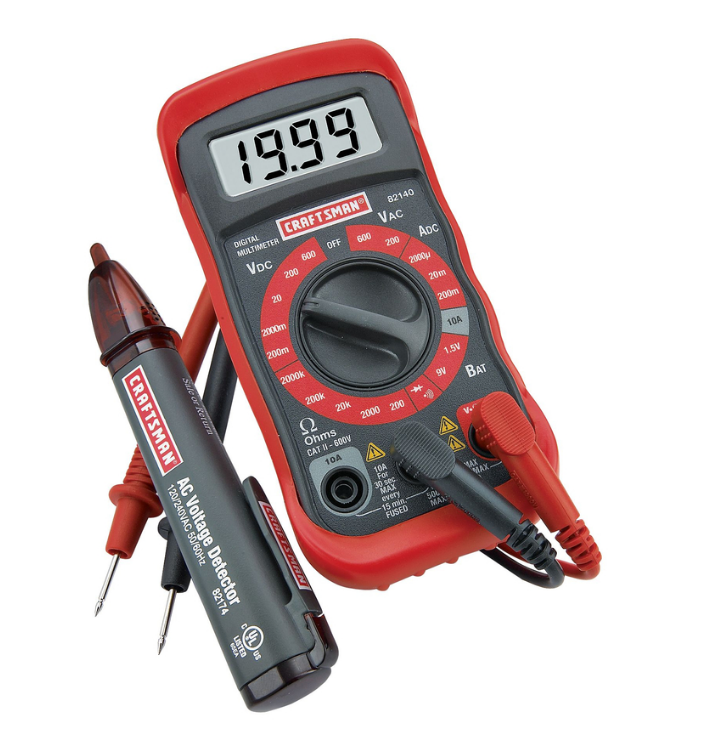
Craftsman 82140-82174 Digital Multimeter
ONE YEAR FULL WARRANTY
ONE-YEAR FULL WARRANTY ON CRAFTSMAN MANUAL RANGING MULTIMETER. If this CRAFTSMAN Manual Ranging MultiMeter fails to give complete satisfaction within one year from the date of purchase, return it to the nearest Sears store or other Craftsman outlet in the United States, and Sears will replace it free of charge. If this CRAFTSMAN Manual Ranging MultiMeter is used for commercial or rental purposes, this warranty applies for 90 days from the date of purchase.
This warranty gives you specific legal rights, and you may also have other rights which vary from state to state. Sears, Roebuck and Co., Dept. 817WA, Hoffman Estates, IL 60179
For Customer Assistance Call 9 AM–5 PM (EST), Monday through Friday: 1-888-326-1006
WARNING: USE EXTREME CAUTION IN THE USE OF THIS DEVICE. Improper use of this device can result in injury or death. Follow all safeguards suggested in this manual. In addition to the normal safety precautions used in working with electrical circuits, do not service this device if you are not qualified to do so.
SAFETY INSTRUCTIONS
This meter has been designed for safe use, but must be operated with caution. The rules listed below must be carefully followed for safe operation.
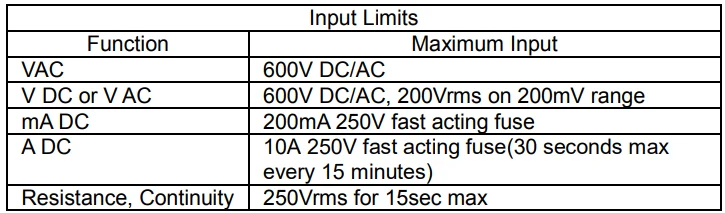
- NEVER apply voltage or current to the meter that exceeds the specified maximum.

- USE EXTREME CAUTION when working with high voltages.
- DO NOT measure voltage if the voltage on the COM input jack exceeds 500V above earth ground.
- NEVER connect the meter leads across a voltage source while the function switch is in the current, resistance, or diode mode. Doing so can damage the meter.
- ALWAYS discharge filter capacitors in power supplies and disconnect the power when making resistance or diode tests.
- ALWAYS turn off the power and disconnect the test leads before opening the doors to replace the fuse or batteries.
- NEVER operate the meter unless the back cover and the battery, and the fuse doors are in place and fastened securely.
CONTROLS AND JACKS
- LCD display
- Function switch
- COM jack
- 10A jack
- Positive jack

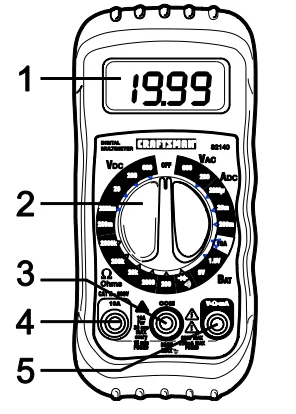
Note: The Tilt stand, fuse, and battery compartment are on the rear of the unit.
SYMBOLS AND ANNUNCIATORS
- •))) Continuity
 Diode test
- µ micro (amps)
- m milli (volts, amps)
- k kilo (ohms)
- Ω ohms
- VDC volts direct current
- VAC volts alternating current
- ADC amps direct current
 Battery low
 Diode test
 Battery low
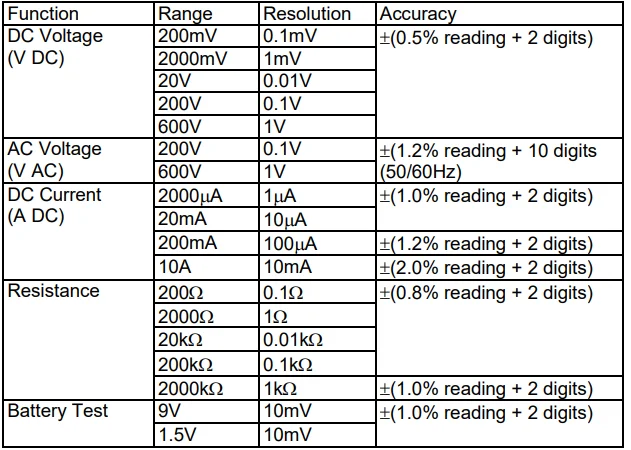
SPECIFICATIONS
NOTE: Accuracy specifications consist of two elements:
- (% reading) – This is the accuracy of the measurement circuit.
- (+ digits) – This is the accuracy of the analog-to-digital converter.
NOTE: Accuracy is stated at 65ºF to 83ºF (18ºC to 28ºC) and less than 75% RH.
- Diode Test: Test current of 1mA maximum, open circuit voltage 2.8V DC typical
- Continuity Check: Audible signal will sound if the resistance is less than approximately 30Ω
- Battery Test: Current 9V (6mA); 1.5V (100mA)
- Input Impedance: >1MΩ
- ACV Bandwidth: 45Hz to 450Hz
- DCA Voltage Drop: 200mV
- Display: 3½ digit, 2000 count LCD, 0.5″ digits
- Overrange Indication: “1” is displayed
- Polarity: Automatic (no indication for positive polarity); minus (-) sign for negative polarity
- Measurement Rate: 2 times per second, nominal
- Low Battery Indication: “BAT” is displayed if battery voltage drops below the operating voltage
- Battery: One 9-volt (NEDA 1604) battery
- Fuses: mA, µA ranges: 0.2A/250V fast blow. A range: 10A/250V fast blow
- Operating Temperature: 41ºF to 104ºF (5ºC to 40ºC)
- Storage Temperature: -4ºF to 140ºF (-20ºC to 60ºC)
- Operating Humidity: Max 80% up to 87ºF (31ºC), decreasing linearly to 50% at 104ºF (40ºC)
- Storage Humidity: <80%
- Operating Altitude: 7000 ft. (2000 meters) maximum
- Weight: 9.17 oz. (260g)
- Size: 4.78″ x 2.38″ x 1.57″ (121.5mm x 60.6mm x 40mm)
- Safety: For indoor use and in accordance with Overvoltage Category II, Pollution Degree 2. Category II includes local level, appliance, portable equipment, etc., with transient overvoltage less than Overvoltage Category III.
BATTERY INSTALLATION
WARNING: To avoid electric shock, disconnect the test leads from any source of voltage before removing the battery door.
- Disconnect the test leads from the meter.
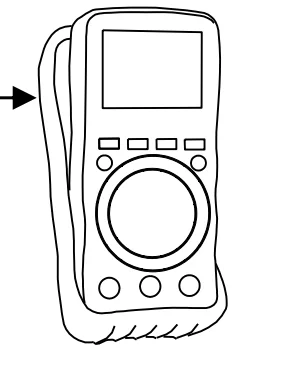
- Remove the protective red rubber cover (holster) from the black meter.

- Open the battery door (top panel) by loosening the screw using a Phillips-head screwdriver.
- Insert the battery into the battery holder, observing the correct polarity.
- Put the battery door back in place. Secure with the screw.
- Replace the red rubber cover (holster) over the meter for protection.
WARNING: To avoid electric shock, do not operate the meter until the battery door is in place and fastened securely.
NOTE: If your meter does not work properly, check the fuses and batteries to make sure that they are still good and properly inserted.
OPERATING INSTRUCTIONS
WARNING: Risk of electrocution. High-voltage circuits, both AC and DC, are very dangerous and should be measured with great care.
- ALWAYS turn the function switch to the OFF position when the meter is not in use.
- If “1” appears in the display during a measurement, the value exceeds the range you have selected. Change to a higher range.
NOTE: On some low AC and DC voltage ranges, with the test leads not connected to a device, the display may show a random, changing reading. This is normal and is caused by the high input sensitivity. The reading will stabilize and give a proper measurement when connected to a circuit.
DC VOLTAGE MEASUREMENTS
CAUTION: Do not measure DC voltages if a motor on the circuit is being switched ON or OFF. Large voltage surges may occur that can damage the meter.
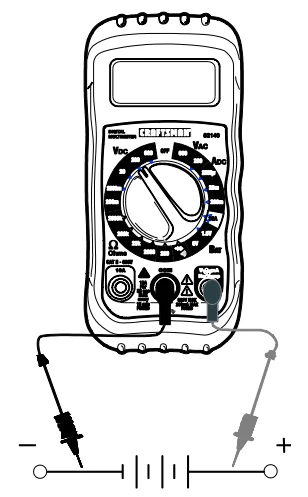
- Set the function switch to the highest VDC position.
- Insert the black test lead banana plug into the negative (COM) jack. Insert the red test lead banana plug into the positive (V) jack.
- Touch the black test probe tip to the negative side of the circuit. Touch the red test probe tip to the positive side of the circuit.
- Read the voltage in the display. Reset the function switch to successively lower VDC positions to obtain a higher-resolution reading. The display will indicate the proper decimal point and value. If the polarity is reversed, the display will show (-) minus before the value.

AC VOLTAGE MEASUREMENTS
WARNING: Risk of electrocution. The probe tips may not be long enough to contact the live parts inside some 240V outlets for appliances because the contacts are recessed deep in the outlets. As a result, the reading may show 0 volts when the outlet actually has voltage on it. Make sure the probe tips are touching the metal contacts inside the outlet before assuming that no voltage is present.
CAUTION: Do not measure AC voltages if a motor on the circuit is being switched ON or OFF. Large voltage surges may occur that can damage the meter.
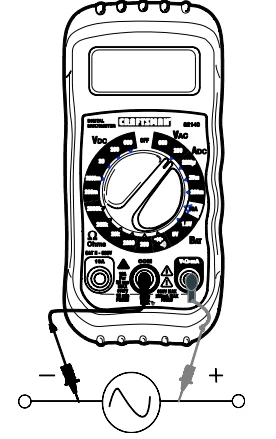
- Set the function switch to the highest VAC position.
- Insert the black test lead banana plug into the negative (COM) jack. Insert the red test lead banana plug into the positive (V) jack.
- Touch the black test probe tip to the negative side of the circuit. Touch the red test probe tip to the positive side of the circuit.
- Read the voltage in the display. Reset the function switch to successively lower VAC positions to obtain a higher-resolution reading. The display will indicate the proper decimal point and value.

DC CURRENT MEASUREMENTS
CAUTION: Do not make current measurements on the 10A scale for longer than 30 seconds. Exceeding 30 seconds may cause damage to the meter and/or the test leads.
- Insert the black test lead banana plug into the negative (COM) jack.
- For current measurements up to 200mA DC, set the function switch to the highest DC mA position and insert the red test lead banana plug into the mA jack.
- For current measurements up to 10A DC, set the function switch to the 10A range and insert the red test lead banana plug into the 10A jack.
- Remove power from the circuit under test, then open the circuit at the point where you wish to measure current.
- Touch the black test probe tip to the negative side of the circuit. Touch the red test probe tip to the positive side of the circuit.
- Apply power to the circuit.
- Read the current in the display. For mA DC measurements, reset the function switch to successively lower mA DC positions to obtain a higher-resolution reading. The display will indicate the proper decimal point and value.

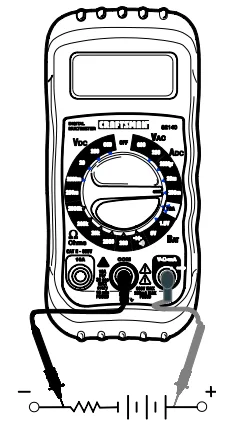
RESISTANCE MEASUREMENTS
WARNING: To avoid electric shock, disconnect power to the unit under test and discharge all capacitors before taking any resistance measurements. Remove the batteries and unplug the line cords.
- Set the function switch to the highest Ω position.
- Insert the black test lead banana plug into the negative (COM) jack. Insert the red test lead banana plug into the positive Ω jack.
- Touch the test probe tips across the circuit or part under test. It is best to disconnect one side of the part under test so the rest of the circuit will not interfere with the resistance reading.
- Read the resistance in the display and then set the function switch to the lowest Ω position that is greater than the actual or any anticipated resistance. The display will indicate the proper decimal point and value.

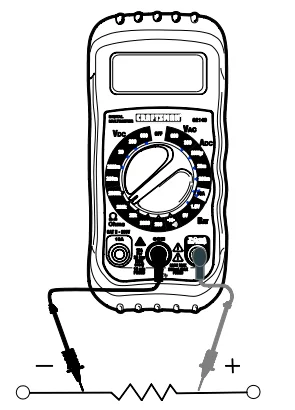
CONTINUITY CHECK
WARNING: To avoid electric shock, never measure continuity on circuits or wires that have voltage on them.
- Set the function switch to the
 •))) position.
 - Insert the black lead banana plug into the negative (COM) jack. Insert the red test lead banana plug into the positive (Ω) jack.
- Touch the test probe tips to the circuit or wire you wish to check.
- If the resistance is less than approximately 30Ω, the audible signal will sound. If the circuit is open, the display will indicate “1”.

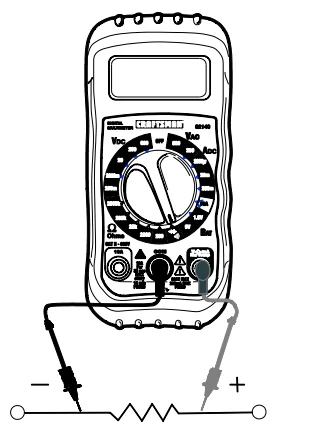
DIODE TEST
- Insert the black test lead banana plug into the negative COM jack and the red test lead banana plug into the positive diode jack.
- Turn the rotary switch to the
 •))) position.
 - Touch the test probes to the diode under test. Forward voltage will indicate 400 to 700mV. Reverse voltage will indicate “1”. Shorted devices will indicate near 0mV, and an open device will indicate “1” in both polarities.

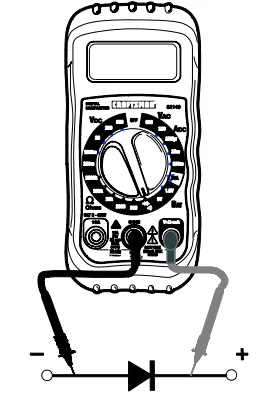
BATTERY TEST
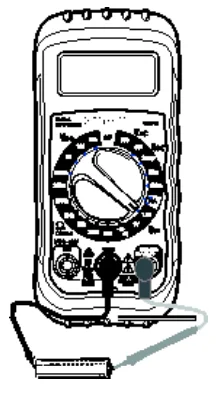
- Insert the black test lead banana plug into the negative COM jack and the red test lead banana plug into the positive V jack.
- Select the 1.5V or 9V BAT position using the function select switch.
- Connect the red test lead to the positive side of the 1.5V or 9V battery and the black test lead to the negative side of the 1.5V or 9V battery.

- Read the voltage in the display.


MAINTENANCE
WARNING: To avoid electric shock, disconnect the test leads from any source of voltage before removing the back cover or the battery, or the fuse doors.
WARNING: To avoid electric shock, do not operate your meter until the battery and fuse doors are in place and fastened securely.
This MultiMeter is designed to provide years of dependable service if the following care instructions are performed:
- KEEP THE METER DRY. If it gets wet, wipe it off.
- USE AND STORE THE METER IN NORMAL TEMPERATURES. Temperature extremes can shorten the life of the electronic parts and distort or melt plastic parts.
- HANDLE THE METER GENTLY AND CAREFULLY. Dropping it can damage the electronic parts or the case.
- KEEP THE METER CLEAN. Wipe the case occasionally with a damp cloth. Do not use chemicals, cleaning solvents, or detergents.
- USE ONLY FRESH BATTERIES OF THE RECOMMENDED SIZE AND TYPE. Remove old or weak batteries so they do not leak and damage the unit.
- IF THE METER IS TO BE STORED FOR A LONG PERIOD OF TIME, the batteries should be removed to prevent damage to the unit.
REPLACING THE BATTERIES
WARNING: To avoid electric shock, disconnect the test leads from any source of voltage before removing the battery door.
- When the batteries become exhausted or drop below the operating voltage, “ ” will appear in the LCD. The batteries should be replaced.
- Follow instructions for installing batteries. See the Battery Installation section of this manual.
- Dispose of the old batteries properly.
WARNING: To avoid electric shock, do not operate your meter until the battery door is in place and fastened securely.
REPLACING THE FUSES
WARNING: To avoid electric shock, disconnect the test leads from any source of voltage before removing the fuse door.
- Disconnect the test leads from the meter and any item under test.
- Remove the protective rubber holster.
- Open the fuse door by loosening the screw on the door using a Phillips-head screwdriver.
- Remove the old fuse from its holder by gently pulling it out.
- Install the new fuse into the holder.
- Always use a fuse of the proper size and value (0.2A/250V fast blow for the 200mA range, 10A/250V fast blow for the 10A range) (5x20mm).
- Put the fuse door back in place. Insert the screw and tighten it securely.
WARNING: To avoid electric shock, do not operate your meter until the fuse door is in place and fastened securely.
UL LISTED
The UL mark does not indicate that this product has been evaluated for the accuracy of its readings.
TROUBLESHOOTING
There may be times when your meter does not operate properly. Here are some common problems that you may have and some easy solutions to them.
Meter Does Not Operate:
- Always read all the instructions in this manual before use.
- Check to be sure the batteries are properly installed.
- Check to be sure the batteries are good.
- If the battery is good and the meter still does not operate, check to be sure that both ends of the fuse are properly installed.
If You Do Not Understand How the Meter Works, Call our Customer Service Line: 1-888-326-1006, 9 AM–5 PM Eastern Time, Monday–Friday.
SERVICE AND PARTS
- Item Number — Description
- 82374 — Fuse kit
- 93894 — 9V battery
- 82378 — Set of black and red test leads
For replacement parts shipped directly to your home, call Sears Parts Direct: 1-800-252-1698. For Customer Assistance Call 9 AM–5 PM (EST), Monday through Friday: 1-888-326-1006 © Sears, Roebuck and Co., Hoffman Estates, IL 60179 U.S.A. www.craftsman.com.
For More Manuals By Craftsman, Visit ManualsLibraryy.
Craftsman 82140-82174 Digital Multimeter-FAQs
How do I use the Craftsman digital multimeter step by step?
Turn the dial to the function you need (V for voltage, Ω for resistance, or A for current). Plug the black probe into the COM port and the red probe into the VΩmA port. Touch the probes to the test points — the reading will appear on the screen.
How do I check voltage using the Craftsman multimeter?
Set the dial to DCV (for batteries) or ACV (for outlets). Insert the black probe into COM and the red into VΩ. Touch the black probe to the negative side and the red probe to the positive side of the circuit. Read the voltage displayed.
How do I measure resistance (ohms) with a Craftsman multimeter?
Turn the dial to the Ω symbol. Connect the black probe to COM and red to VΩ. Touch both probes to the resistor or circuit. A reading on the display shows the resistance in ohms.
How do I set the Craftsman multimeter to measure ohms?
Simply rotate the function dial to the Ω range. Ensure the circuit is powered off before testing resistance to avoid damage.
How do I test 12V or 240V with a Craftsman multimeter?
For 12V systems (like batteries): set to DCV and measure across terminals.
For 240V outlets: set to ACV, then place the probes into the two hot slots. The display should show around 240 volts.
How do I test if a wire is live using the multimeter?
For 12V systems (like batteries): set to DCV and measure across terminals.
For 240V outlets: set to ACV, then place the probes into the two hot slots. The display should show around 240 volts.
How do I check if a battery is dead using the Craftsman multimeter?
Set to DC voltage and measure across the terminals. A 12V battery should read about 12.6–12.8V when fully charged. Below 12V suggests a weak or dead battery.
How do I replace the battery in the Craftsman AC voltage detector or multimeter?
Turn off the tool. Remove the screw on the back panel, take out the old battery, and insert a new one of the same type (usually a 9V). Reassemble and test before use.
Is 0 ohms an open or closed circuit?
A reading of 0 ohms indicates a closed circuit or a short, meaning electricity flows freely. A very high reading or “OL” (open loop) means the circuit is open.