
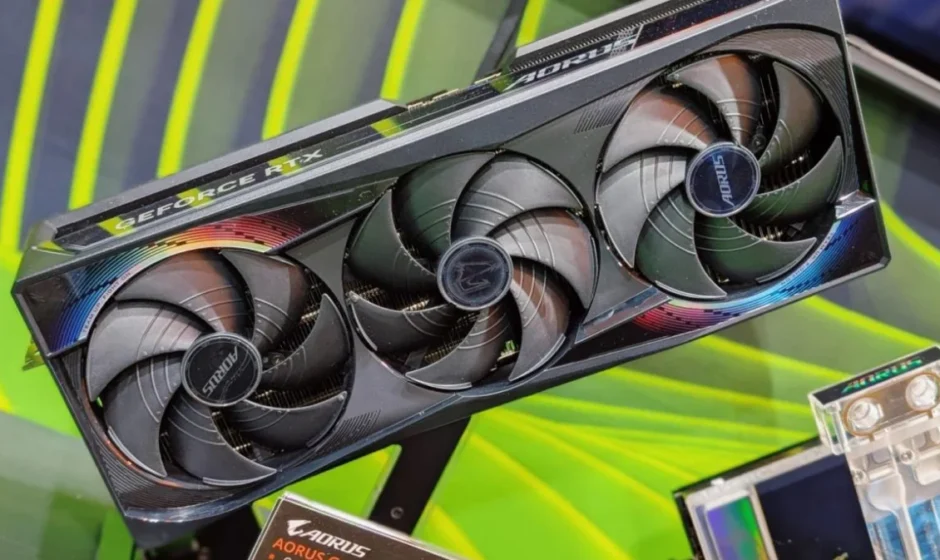
GeForce RTX 5070 Graphics Card
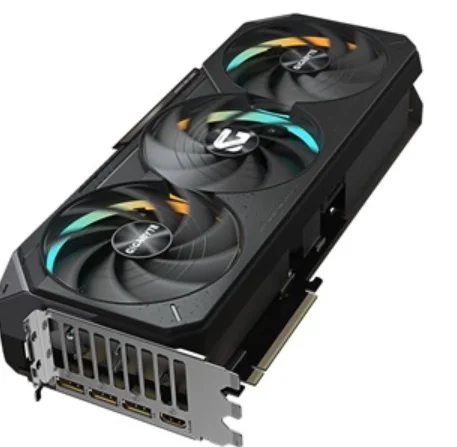
System Specifications
Thank you for choosing the NVIDIA® GeForce RTXTM 5070 graphics card. Before you begin, please review the following System Specifications to ensure your PC has the appropriate hardware and software for your new graphics card.
System Specifications
- Motherboard: PCI Express® graphics slot required.
- Clearance: Must have space for 244mm (L) x 112mm (W) x 41mm (H) card. One additional slot clearance in front of the fans is recommended for better airflow.
- System Power Supply:
- 650 W power rating minimum.
- Supported power connector configurations:
- At least two PCIe 8-pin cables (with RTX 5070 PCIe Gen 5 Power Connector Adapter).
- One 360 W or greater PCIe Gen 5 Cable (16-pin).
- Operating System:
- Microsoft® Windows® 11 64-bit recommended.
- Linux, 64-bit.
- Driver Installation: 2 GB of available disk space required.
Equipment
The following equipment is included in the NVIDIA GeForce RTX 5070 graphics card box.
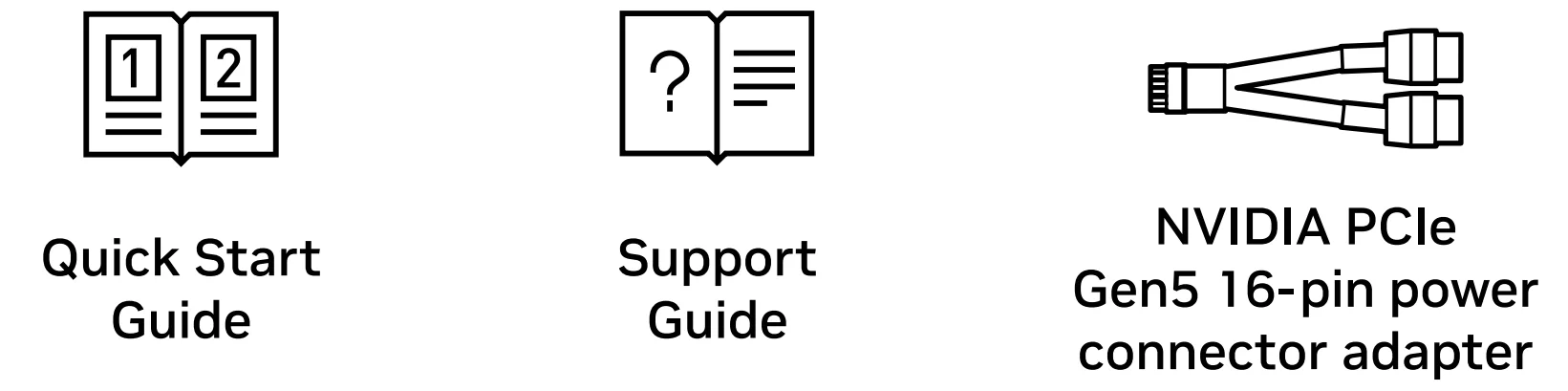
Attention: Use only the included NVIDIA power connector adapter for your GeForce RTX 50 Series Founders Edition graphics card.
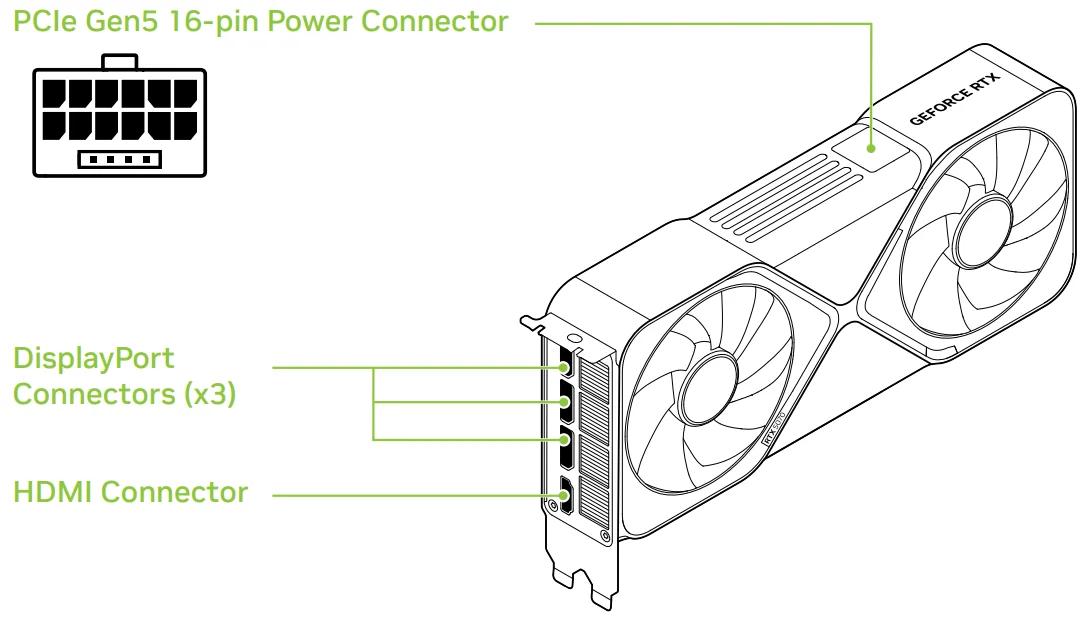
Hardware Installation
- Turn off your computer, disconnect the power cord, and remove any existing graphics card(s).
Note: Use the GeForce RTX 5070 graphics card with UL-listed ITE Personal Computer (PC)/Server.
Attention: You must wait until the graphics card has cooled before removing it from the system. - Remove two slot covers if there is no existing graphics card.
 Remove two adjacent slot covers that correspond to the PCI Express slot you are installing the graphics card in.
 - Connect the 16-pin plug of the NVIDIA power connector adapter to the power receptacle on the top of the GeForce RTX 5070 graphics card.
 Connect at least two independent dedicated cables with 8-pin PCI Express plugs from the system power supply to the NVIDIA power connector adapter.
Attention: Use only the included NVIDIA power connector adapter for your GeForce RTX 50 Series Founders Edition graphics card.
To help ensure the connector is secure, we recommend plugging the power dongle into the graphics card first to ensure it’s firmly and evenly plugged in, before plugging the graphics card into the motherboard.
Attention: Ensure the power plug is fully inserted and seated flush against the power receptacle.
- Install the GeForce RTX 5070 graphics card into the primary PCI Express x16 slot on your motherboard.
 Install your GeForce RTX 5070 into the Primary PCI Express x16 slot (the Primary slot is the one closest to the CPU).
Attention: This GPU card should not be installed with the I/O brackets facing downwards. - Reinstall the covers on your computer and reconnect any cables previously removed.
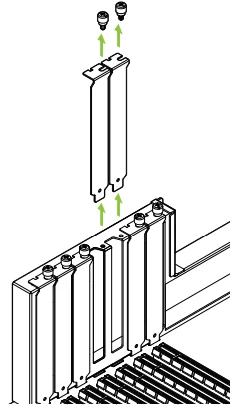 Remove two adjacent slot covers that correspond to the PCI Express slot you are installing the graphics card in.
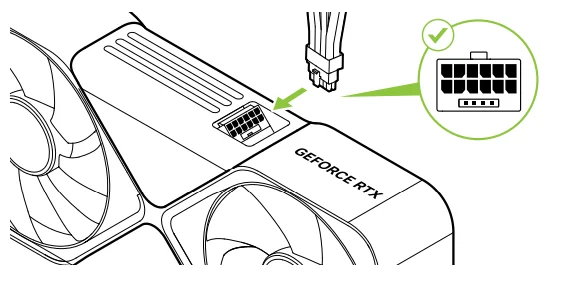 Connect at least two independent dedicated cables with 8-pin PCI Express plugs from the system power supply to the NVIDIA power connector adapter.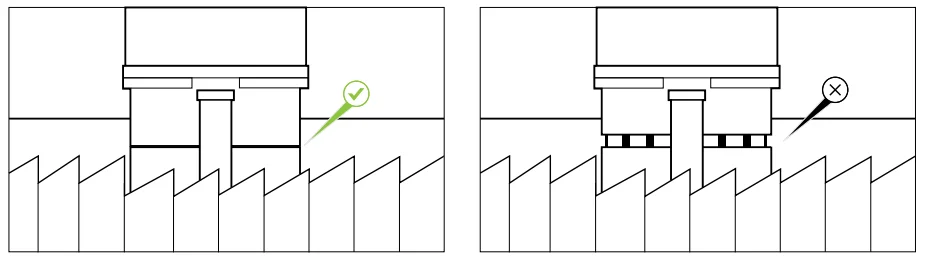
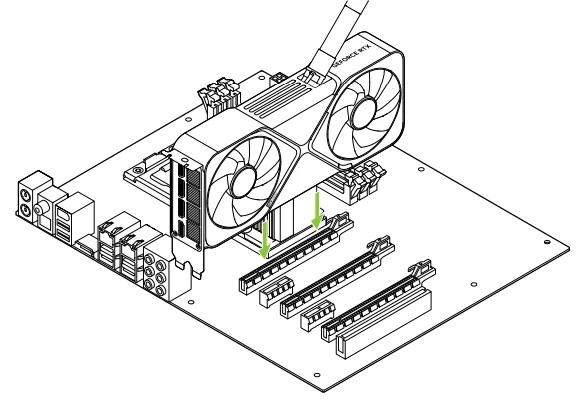 Install your GeForce RTX 5070 into the Primary PCI Express x16 slot (the Primary slot is the one closest to the CPU).
Connecting To The Display
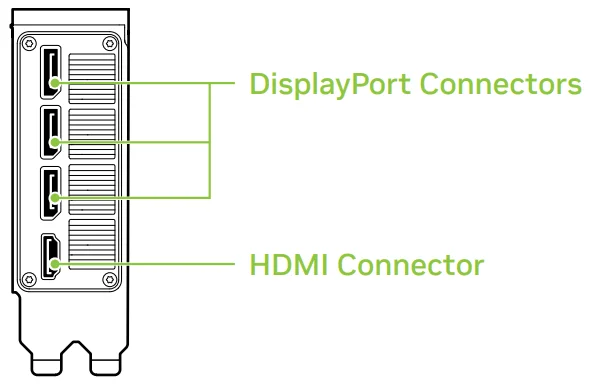
- Connect the display(s) to the graphics card.
- Reconnect your power cord to the PC.

Software Installation And Configuration
With the hardware installed, the final step is to install the NVIDIA App software to update your drivers and optimize your games.
- Download and install the NVIDIA App software.
- Go to https://www.nvidia.com/en-us/software/nvidia-app/ and click Download Now.
- Accept the NVIDIA software license agreement by selecting Agree and Continue. NVIDIA App software begins to install.
- Select Close to finish the installation.
- Congratulations! Your GeForce graphics card is now ready to use!
Note: If you have any questions about your NVIDIA product, you can chat live with NVIDIA Customer Care at www.nvidia.com/support or call 1-800-797-6530 (US) or 0800 404 7747 (UK).
Federal Communications Commission (FCC)
This device complies with part 15 of the FCC Rules. Operation is subject to the following two conditions: (1) this device may not cause harmful interference, and (2) this device must accept any interference received, including any interference that may cause undesired operation of the device. This equipment has been tested and found to comply with the limits for a Class B digital device, pursuant to Part 15 of the FCC Rules. These limits are designed to provide reasonable protection against harmful interference in a residential installation. This equipment generates uses and can radiate radio frequency energy and, if not
installed and used in accordance with the instructions, may cause harmful interference to radio communications.
However, there is no guarantee that interference will not occur in a particular installation. If this equipment does cause harmful interference to radio or television reception, which can be determined by turning the equipment off and on, the user is encouraged to try to correct the interference by one or more of the following measures:
- Reorient or relocate the receiving antenna.
- Increase the separation between the equipment and receiver.
- Connect the equipment into an outlet on a circuit different from that to which the receiver is connected.
- Consult the dealer or an experienced radio/TV technician for help.
FCC Warning: The FCC requires that you be notified that any changes or modifications to this device not expressly approved by the manufacturer could void the user’s authority to operate the equipment.
Notice
The information provided in this specification is believed to be accurate and reliable as of the date provided. However, NVIDIA Corporation [“NVIDIA”] does not give any representations or warranties, expressed or implied, as to the accuracy or completeness of such information. NVIDIA shall have no liability for the consequences or use of such information or for any infringement of patents or other rights of third parties that may result from its use. This publication supersedes and replaces all other specifications for the product that may have been previously supplied. NVIDIA reserves the right to make corrections, modifications, enhancements, improvements, and other changes to this specification, at any time and/or to discontinue any product or service without notice. The customer should obtain the latest relevant specification before placing orders and should verify that such information is current and complete. NVIDIA products are sold subject to the NVIDIA standard terms and conditions of sale supplied at the time of order acknowledgement, unless otherwise agreed in an individual sales agreement signed by authorized representatives of NVIDIA and the customer. NVIDIA hereby expressly objects to applying any customer general terms and conditions with regard to the purchase of the NVIDIA product referenced in this specification. NVIDIA products are not designed, authorized, or warranted to be suitable for use in medical, military, aircraft, space, or life support equipment, nor in applications where failure or malfunction of the NVIDIA product can reasonably be expected to result in personal injury, death, or property or environmental damage. NVIDIA accepts no liability for inclusion and/or use of NVIDIA products in such equipment or applications, and therefore, such inclusion and/or use is at the customer’s own risk. NVIDIA makes no representation or warranty that products based on these specifications will be suitable for any specified use without further testing or modification. Testing of all parameters of each product is not necessarily performed by NVIDIA. It is the customer’s sole responsibility to ensure the product is suitable and fit for the application planned by the customer and to do the necessary testing for the application in order to avoid a default of the application or the product. Weaknesses in the customer’s product designs may affect the quality and reliability of the NVIDIA product and may result in additional or different conditions and/or requirements beyond those contained in this specification. NVIDIA does not accept any liability related to any default, damage, costs or problem which may be based on or attributable to:
- the use of the NVIDIA product in any manner that is contrary to this specification or customer product designs.
No license, either expressed or implied, is granted under any NVIDIA patent right, copyright, or other NVIDIA intellectual property right under this specification. Information published by NVIDIA regarding third-party products or services does not constitute a license from NVIDIA to use such products or services or a warranty or endorsement thereof. Use of such information may require a license from a third party under the patents or other intellectual property rights of the third party.
ALL NVIDIA DESIGN SPECIFICATIONS, REFERENCE BOARDS, FILES, DRAWINGS, DIAGNOSTICS, LISTS, AND OTHER DOCUMENTS [TOGETHER AND SEPARATELY, “MATERIALS”) ARE BEING PROVIDED ··As Is.·· NVIDIA MAKES NO WARRANTIES, EXPRESSED, IMPLIED, STATUTORY, OR OTHERWISE WITH RESPECT TO THE MATERIALS, AND EXPRESSLY DISCLAIMS ALL IMPLIED WARRANTIES OF NON INFRINGEMENT, MERCHANTABILITY, AND FITNESS FOR A PARTICULAR PURPOSE. Notwithstanding any damages that the customer might incur for any reason whatsoever, NVIDIA’s aggregate and cumulative liability towards the customer for the products described herein shall be limited in accordance with the NVIDIA terms and conditions of sale for the product.
For more manuals by NVIDIA, visit ManualsLibraryy
GeForce RTX 5070 Graphics Card-FAQs
Is the GeForce RTX 5070 good for gaming?
Yes, the NVIDIA GeForce RTX 5070 is designed for high-performance gaming. It delivers strong frame rates in modern AAA titles and supports advanced graphics technologies like ray tracing and AI-powered upscaling. Gamers can comfortably play demanding games at high or ultra settings depending on the resolution. The card is particularly well-suited for 1440p gaming and can also handle many games at 4K with optimized settings.
Can the RTX 5070 handle 4K gaming?
The RTX 5070 is capable of running many modern games at 4K resolution. While some extremely demanding titles may require slightly reduced graphics settings, the card can still achieve smooth performance around or above 60 FPS. Features like DLSS (Deep Learning Super Sampling) help improve frame rates while maintaining high visual quality, making 4K gaming more practical on this GPU.
Is the RTX 5070 better than the RTX 4070?
In most benchmarks, the NVIDIA GeForce RTX 5070 performs better than the NVIDIA GeForce RTX 4070. Improvements in architecture, processing power, and memory bandwidth allow it to deliver higher frame rates and better performance in demanding games. The difference is particularly noticeable at higher resolutions such as 1440p, where GPU compute power plays a larger role in maintaining smooth gameplay.
Is the RTX 5070 considered a high-end graphics card?
Yes, the RTX 5070 falls into the high-end category of gaming GPUs. Built on a modern architecture and advanced manufacturing process, it supports technologies like DirectX 12 Ultimate, ray tracing, and AI-based graphics enhancements. These capabilities allow it to run most modern games smoothly and handle demanding graphics workloads, making it a strong choice for enthusiasts and serious gamers.
What resolution is best for the RTX 5070?
The RTX 5070 performs exceptionally well at 1440p resolution, where it can deliver very high frame rates with ultra graphics settings. It also performs well at 4K resolution, although some games may require slight adjustments to graphics settings to maintain smooth performance. For competitive gaming, many users choose 1440p to balance visual quality and high refresh rates.
How much RAM is recommended for a system with an RTX 5070?
For most gaming systems using the RTX 5070, 16GB of RAM is considered the minimum recommended amount. However, 32GB of RAM is becoming increasingly popular for modern AAA titles, especially for 1440p or 4K gaming. More memory can improve stability, reduce stuttering, and help when running background applications while gaming or streaming.
What power supply is recommended for the RTX 5070?
A 750-watt power supply is generally recommended for systems using the RTX 5070. This provides enough headroom for the graphics card along with a modern CPU and other components. Using a reliable PSU from a reputable brand is important to ensure stable performance and protect your system from power fluctuations during heavy gaming workloads.
Can the RTX 5070 run upcoming games like GTA 6?
While official PC requirements are still evolving, the RTX 5070 should be powerful enough to run demanding future titles such as Grand Theft Auto VI at high settings. Its modern architecture and support for advanced graphics technologies make it well-suited for next-generation games that require strong GPU performance.
How does the RTX 5070 compare to flagship GPUs?
The RTX 5070 offers excellent performance for its class, but flagship GPUs like the NVIDIA GeForce RTX 4090 or NVIDIA GeForce RTX 5090 still deliver higher performance, especially for extreme 4K gaming and heavy workloads. However, the 5070 provides a more balanced option for gamers who want strong performance without the higher cost of top-tier graphics cards.
Is the RTX 5070 a good choice for future-proof gaming?
Yes, the RTX 5070 is a solid option for gamers who want a graphics card that will remain capable for several years. Its support for modern graphics technologies, high processing power, and efficient architecture ensures compatibility with upcoming games and software. When paired with a strong CPU and sufficient RAM, it can provide excellent long-term gaming performance.