
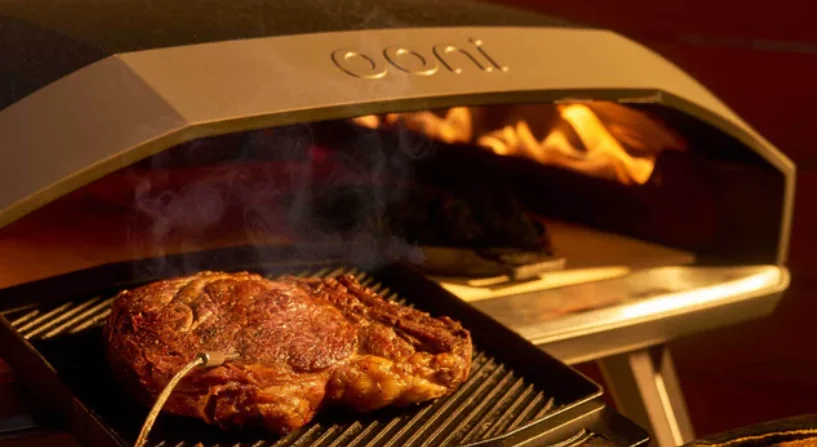
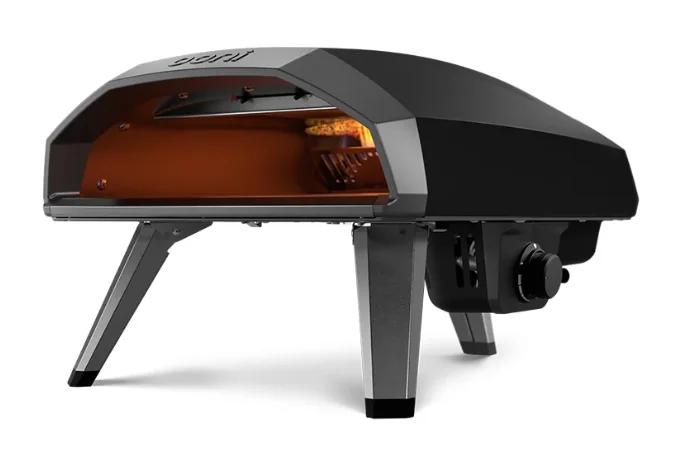
Ooni Koda 2 Max Natural Gas Pizza Oven
WARNING
- Do not modify the appliance. Contact Ooni support to obtain replacement parts.
- Allow the oven to cool completely before covering or moving it.
- Operate using the control dials only; never touch the outer metal surfaces, pizza stone or glass while the oven is on.
- Turn both control dials to the OFF position before connecting the gas cylinder.
- Only connect the gases listed on the rating plate.
- If at any time you smell gas, close the gas cylinder or regulator valve, turn the control dials on the oven to the OFF position, and extinguish any open flames.
- Do not wear loose clothing when operating or standing near the oven.
- Never check for leaks with a naked flame or attempt to ignite the burners while testing.
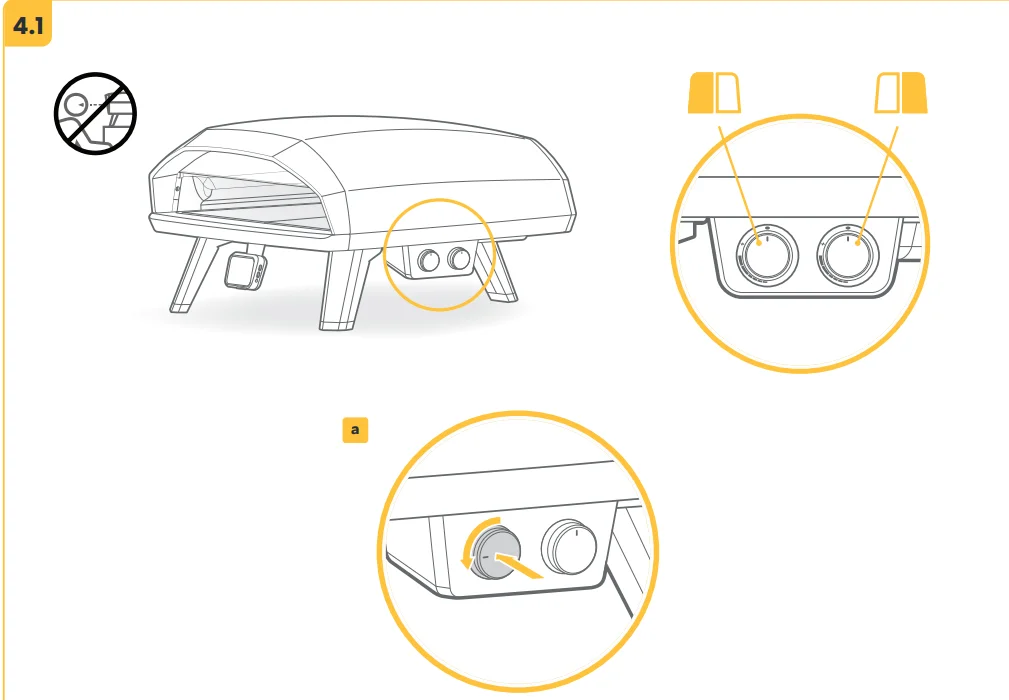
- Stand to the side when lighting. Never look directly into the mouth of the oven or at the flame.
- Never use chemical cleaners or soaps on the pizza stone surface.
- Never pour water onto the pizza stone, as this may cause it to crack.
- Wear heat protective gloves when using the oven and when handling particularly hot cooking apparatus.
- This appliance will be hot during and after use. Use insulated oven mitts or gloves for protection from hot surfaces or splatter from cooking liquids.
- Do not move the appliance when in use. Never attempt cleaning or maintenance while the oven is hot or in use.
- Do not use abrasive cleaners or scouring pads to clean any part of the oven.
- Use only Ooni-approved or official accessories and spare parts. Failure to do so may cause injury or damage to your oven or property
- If the oven is operating abnormally, turn the oven off and contact Ooni support.
- Sealed systems of the appliance shall not be manipulated.
- Take care when cleaning inside the oven because sharp edges may be present.
- The installation of this appliance must conform with local codes or, in the absence of local codes, with the National Fuel Gas Code ANSI Z223.1/NFPA 54 Storage and Handling of Liquefied Petroleum Gases ANSI/NFPA 58; or Natural Gas and Propane Installation Code CSA B149.1; Propane Storage and Handling CSA B149.2 as applicable.
- Do not leave the appliance unattended. Keep children and pets away from the appliance at all times.
- This appliance is intended for outdoor use only and must not be used inside a building, garage, or other enclosed area, on a boat, or in a recreational vehicle. It is not intended as, and should never be used as a heater.
- An appliance is considered to be outdoors if installed with shelter no more inclusive than within a partial enclosure that includes an overhead cover and no more than two sidewalls. The sidewalls may be parallel, as in a breezeway, or at right angles to each other; all openings shall be permanently open; sliding doors, garage doors, windows, or screened openings are not considered as permanent openings.
- The surface should allow for the mouth of the oven to face away from the wind and must be 40 inches away from any structure or combustible material.
- Clean and inspect the hose before each use of the appliance. If there is evidence of abrasion, wear cuts, or leaks the hose must be replaced prior to the appliance being put into operation. Use a suitable regulator certified to Regulator – ANSI/UL 144 and a flexible hose certified to and a flexible hose as specified by the manufacturer. Contact Ooni support for assistance.
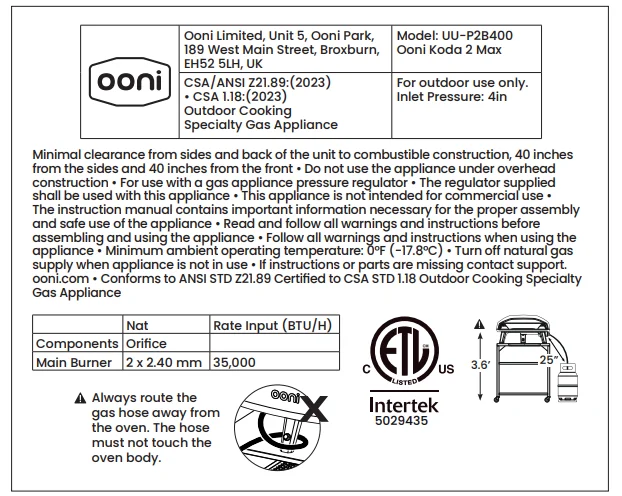
- Keep the fuel supply hose away from any heated surfaces.
- This appliance is not intended for commercial use.
- The use of alcohol, prescription or non-prescription drugs may impair the consumer’s ability to properly assemble or safely operate the appliance.
- Do not use near combustible materials.
- Do not block any air intakes.
- Use only with cylinders with a fuel capacity of under 20lb (9.1kg), with a maximum diameter of 22.8 inches (580mm) and a maximum height of 22.8 inches (580mm).
- The LP gas supply cylinder to be used must be constructed and marked in accordance with the specifications for LP gas cylinders, U.S. Department of Transportation (DOT) or the Standard for Cylinders, Spheres and Tubes for the Transportation of Dangerous Goods, CAN/CSA-B339. The pressure regulator and hose assembly supplied with the appliance must be used. Replacement pressure regulators and hose assemblies shall be those specified by Ooni.
- The regulator shall be installed in such a location that it will not attain a temperature above 130°F (54.5°C)
- The cylinder supply system must be arranged for vapor withdrawal.
- The cylinder used, if in excess of 2.2 lb (1 kg) propane capacity, must include a collar to protect the cylinder valve.
- Do not store a spare LP gas cylinder under or near this appliance;
- never fill the cylinder beyond 80 percent full; and
- If the instructions in 1 and 2 are not followed exactly, a fire causing death or serious injury may occur.
- Place the dust cap on the cylinder valve outlet whenever the cylinder is not in use. Only install the type of dust cap on the cylinder valve outlet that is provided with the cylinder valve. Other types of caps or plugs may result in leakage of propane.
- The appliance and its individual shutoff valve must be disconnected from the gas supply piping system during any pressure testing of that system at test pressures in excess of ½ psi (3.5 kPa)
- The appliance must be isolated from the gas supply piping system by closing its individual manual shutoff valve during any pressure testing of the gas supply piping system at test pressures equal to or less than ½ psi (3.5 kPa).
Getting started
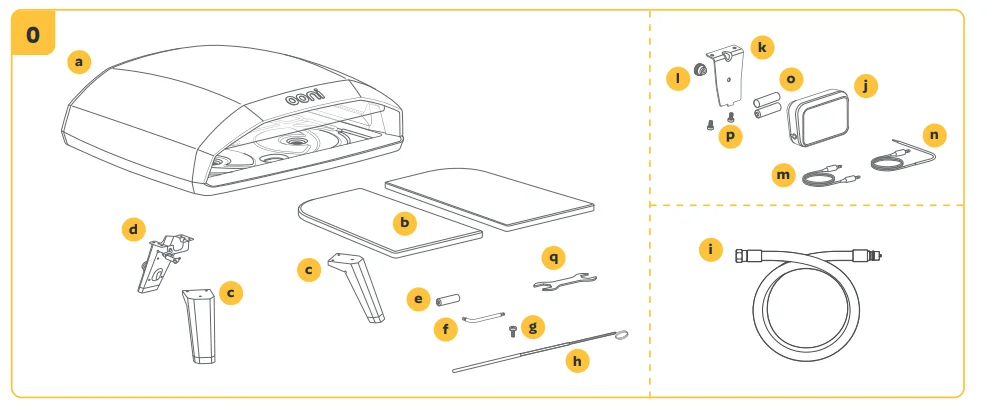
What’s in the box:
- a Ooni Koda 2 Max oven j Digital Temperature Hub
- b Pizza stone (x2) k Mounting bracket
- c Front leg (x2) l Thumb nut
- d Rear leg m Ambient temperature cable (x2)
- e AA battery for ignition n Food Probe (x2)
- f Torx key o AA Batteries (x2)
- g M5 screws (x10) p Bracket screws
- h Matchstick holder q Spanner
- i Regulator and hose
Koda 2 Max assembly instructions
Digital Temperature Hub assembly instructions
CAUTION: your oven is very heavy and will require two people to lift, assemble and position. DO NOT lift the oven with pizza stones in place.
ALWAYS hold the oven from the underside of the base, NEVER from the inside of the upper shell.
Setup and assembly
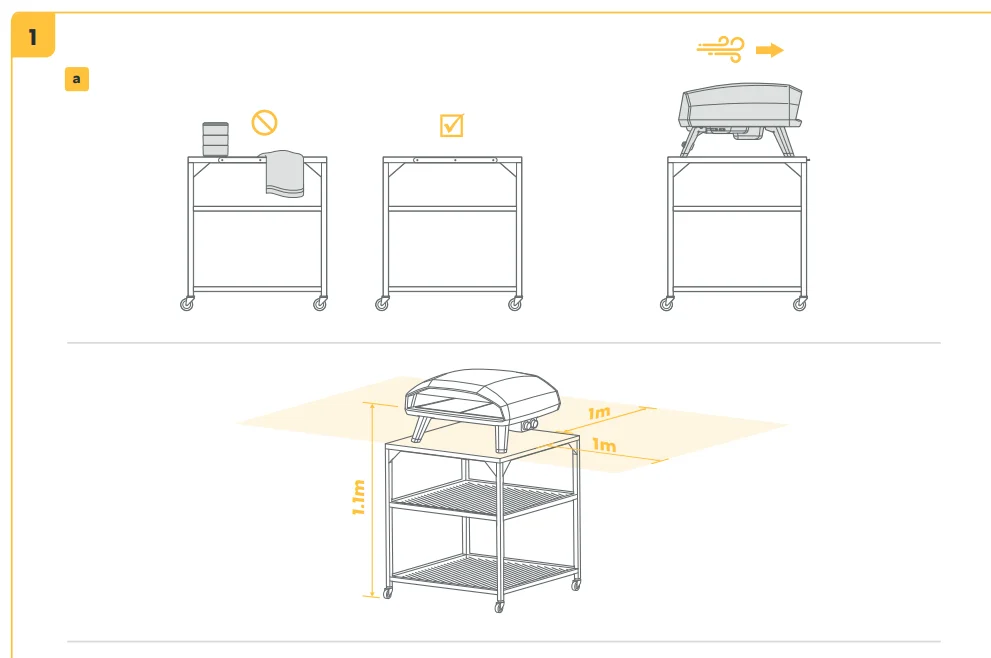
- a. Choose a suitable position and surface for setup.
- The Ooni Large Modular Table or another sturdy metal or wood surface is ideal for oven support. Do not set your oven on plastic or glass tables. Always ensure the table can withstand the weight of the oven.
- The surface should allow for the mouth of the oven to face away from the wind and must be one meter away from any structure or combustible material.
- We recommend positioning the oven so the pizza stone sits at a height of 1.1m from the ground.
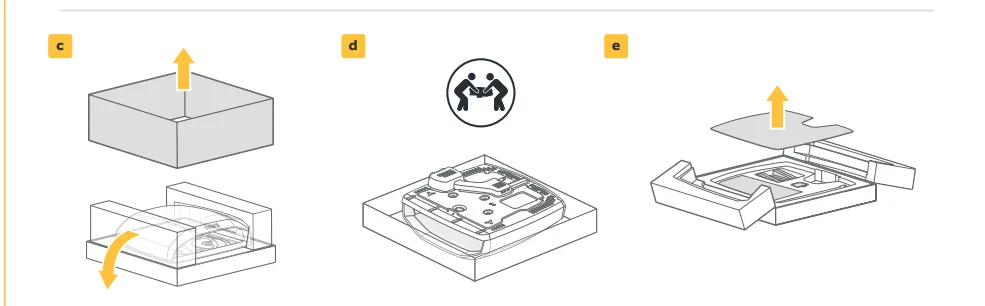
- b. Lift the lid off the box and place the lid upside down nearby.
- c. Lift the central outer box section up and away, allowing the packaging protecting the sides of the oven to fall open.
- d. With help from another person, carefully lift the oven out and place it upside down on the lid of the box to protect the top. Make sure all packaging is removed from the oven.
- e. Lift the cardboard divider inside the box to reveal the oven legs, Digital Temperature Hub, pizza stones and other parts for assembly.
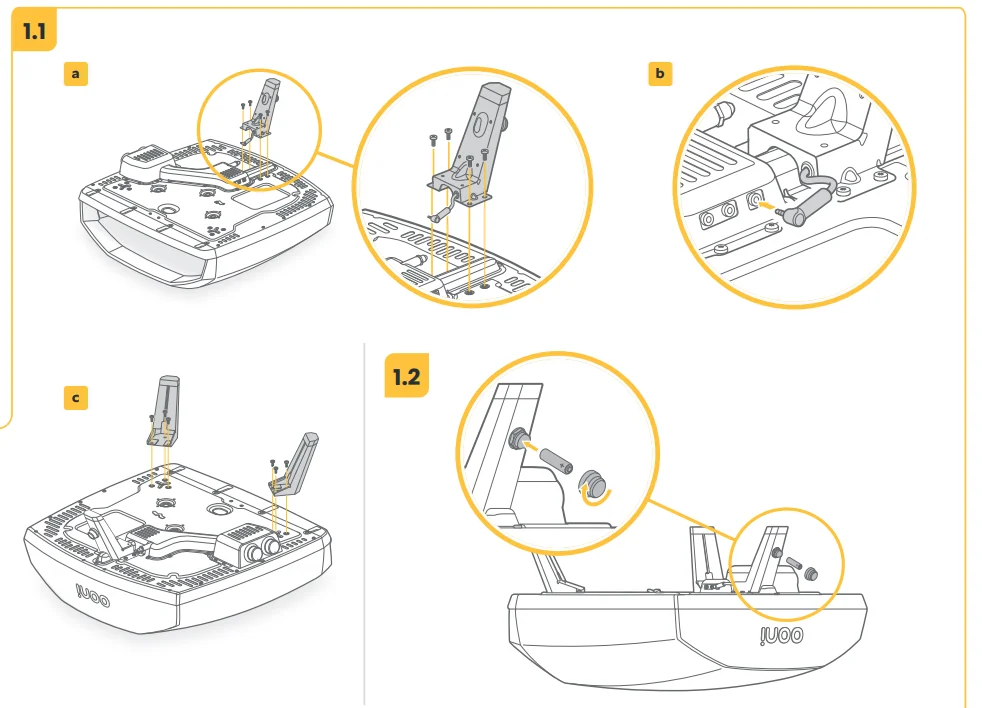
Attaching the legs
- a. Attach rear leg to the base with 4 x M5 screws using the
- included torx key.
- b. Plug the ignition battery cable into the socket on the base of the oven next to the leg.
- c. Attach the two front legs using 3 x M5 screws each.
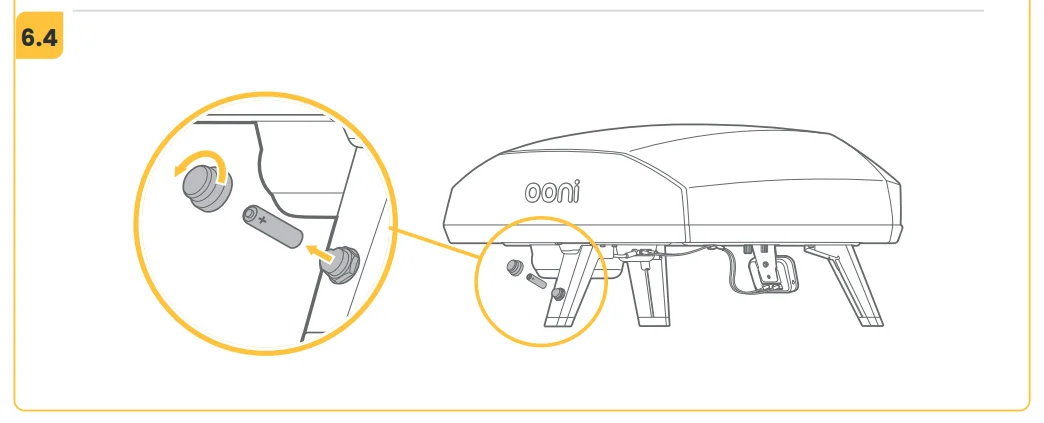
Installing the ignition battery
The ignition battery compartment is located inside the rear leg.
- a. Unscrew cap counterclockwise and install the supplied AA battery, paying attention to the +/- directions.
- b. Screw cap back on clockwise.
Follow the Digital Temperature Hub assembly instructions to install.
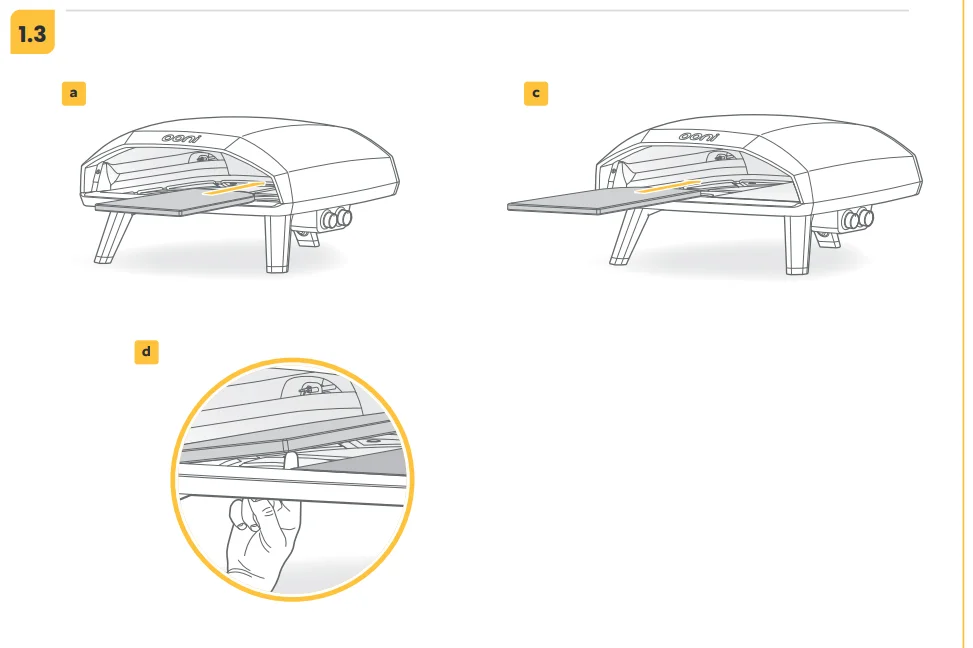
Inserting the pizza stones
The pizza stones are heavy; be careful not to pinch your fingers.
- a. If your oven is upside down: With help from another person, carefully turn the oven upright and then position in its intended location.
- b. Using both hands, carefully lift the first pizza stone and position so its rounded corner faces the back corner of the oven. Slide the pizza stone into position, taking care not to scratch the pizza ledge.
- c. Using both hands, pick up the second pizza stone and repeat the process on the other side.
- d. To remove either pizza stone, use one hand to push up through the hole in the base of the oven until the front of the pizza stone tips high enough to grab and slide out using your other hand.
- Never attempt to remove the pizza stones while they are hot.
Installation and removal of the hose pipe (if required)
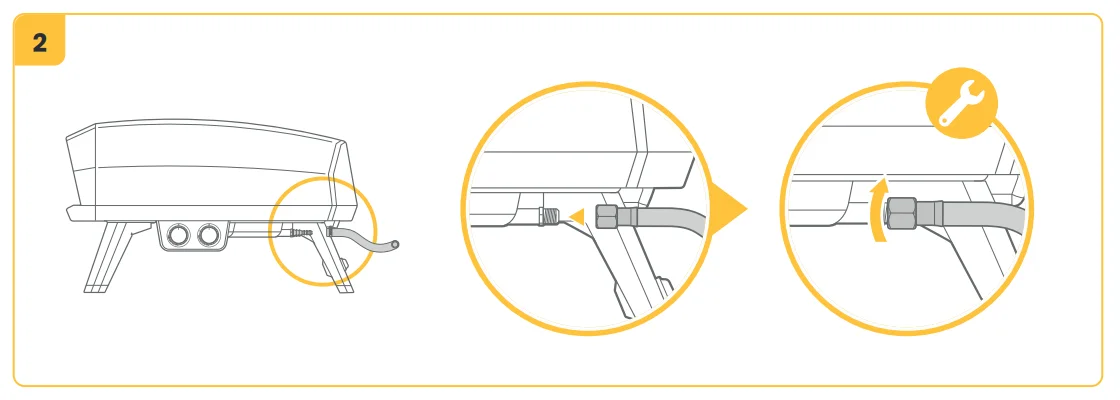
Tighten clockwise with suitable wrenches. Provide counterclockwise support to the gas inlet tube with an additional wrench. Regulator and hose connections will vary depending on your region. Your Ooni oven has a preinstalled hose. If damaged or in need of replacement, then the same hose type should be used. Contact Ooni customer support. Your oven is supplied with an in-line pressure regulator, which is necessary for when using a natural gas supply. Use only the hose assembly supplied with your oven. For replacement parts, contact Ooni support. NEVER use your oven without a pressure regulator.
Connecting to gas
Check that both gas dials on the product are set to the OFF position before connecting the gas supply.
Connecting to a natural gas source
- a. The gas supply cylinder to be used must be constructed and marked in accordance with the specifications for propane cylinders of the U.S. Department of Transportation (DOT), or CAN/CSA B339.
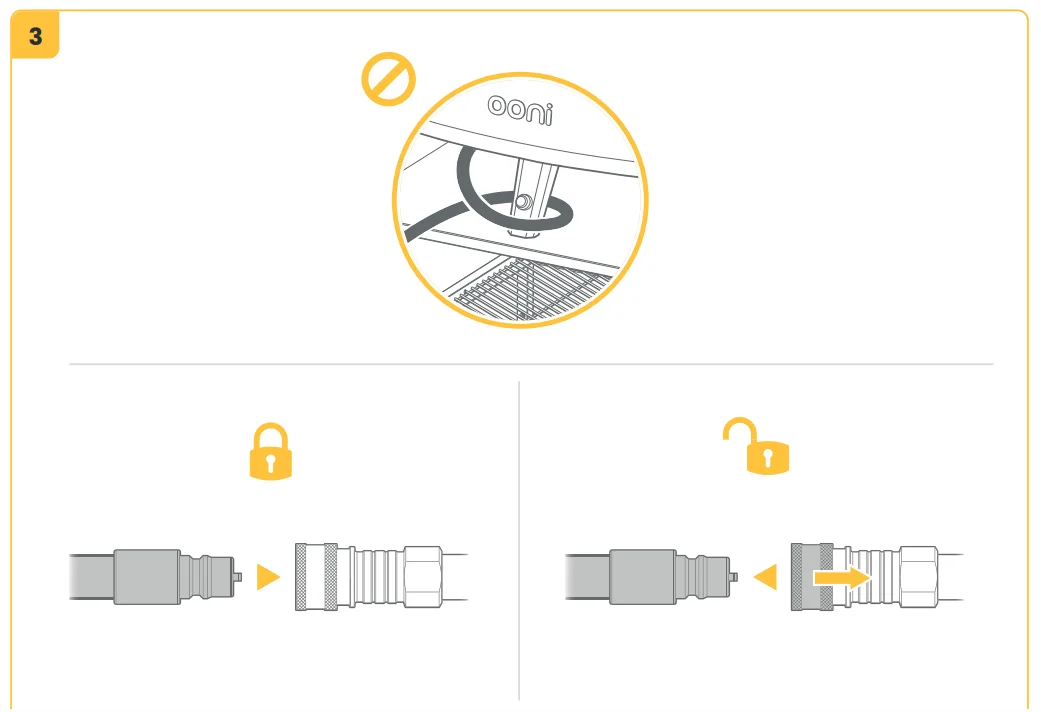
- b. Insert oven hose “A” into the quick connector “B”
- Note. the quick connector has a 3/8” NPT screw thread on the end which fits to your home gas supply. If you do not have this preinstalled, we recommend that you contact a local gas professional for advice.
- c. If a leak is found anywhere from the oven to the quick connection, do not use the oven. Disconnect the gas line and contact Ooni customer support.
- d. If a leak is found in the mains gas line then shut off gas at the mains and contact you local gas engineer.
Testing for leaks
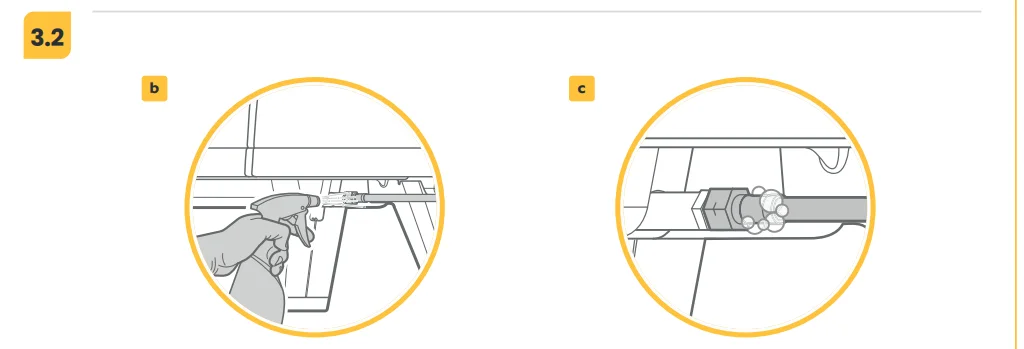
- a. Using a leak detector spray or a solution of dish soap and water, check for gas leaks every time you reconnect a fitting or replace the gas supply to be used.
- b. Use a brush or spray bottle to apply the solution to the connections and regulator. Inspect the gas hose and apply the solution to any cracks you find.
- c. If a leak is present, the solution will bubble. If you observe a leak in the hose fitting, tighten the fitting and recheck for leaks. If the leak persists or a crack in the hose is leaking, do not operate the oven. Contact Ooni support for assistance.
- d. If you find a leak, do not operate the oven. If the leak is found in the oven or hose, contact Ooni support. If the leak is found in the gas cylinder valve, contact your gas supplier.
Replacement regulators must be certified to EN16129 and hoses to EN16436, with a maximum length of 5 ft (1.5m).
Disconnecting gas
- a. Turn the oven burner valve OFF and make sure the oven is cool.
- b. Disconnect from your natural gas supply
Pressure Checking
The appliance must be isolated from the gas supply piping system by closing its individual manual shutoff valve during any pressure testing of the gas supply piping system at test pressures equal to or less than ½ psi (3.5 kPa).
WARNING
If at any time you smell gas, close the regulator valve, turn the control dials on the oven to the OFF position, and extinguish any open flames. Recheck your oven hose and mains line connection for leaks. Never check for leaks with a naked flame or attempt to ignite the burners while testing.
Lighting Koda 2 Max
WARNING
Stand to the side when lighting. Never look directly into the mouth of the oven or at the flame. If either burner fails to ignite as expected, refer to the troubleshooting guide. Turn the gas off and wait 5 minutes before attempting to light again. Operate using the control dials only; never touch the outer metal surfaces, pizza stone or glass while the oven is on. Wear heat protective gloves when using the oven and when handling particularly hot cooking apparatus.
Ignition
The left dial controls the left burner; the right dial controls the right burner.
- a. Push and hold either control dial in while slowly rotating counterclockwise to spark and light the gas. Once lit, continue holding for 5 seconds to maintain the flame.
- b. Verify the gas has ignited.
- If yes, go to 4.3.
- If the burner does not ignite, switch to the OFF position, wait 5 minutes, then try again.
- If the burner does not ignite after the second attempt, switch to the OFF position, wait 5 minutes, then follow step 4.2.
- If flames are ignited correctly, they should look like the illustration.
- If either or both burners are accidentally extinguished, please refer to troubleshooting.
Lighting the oven with the matchstick holder
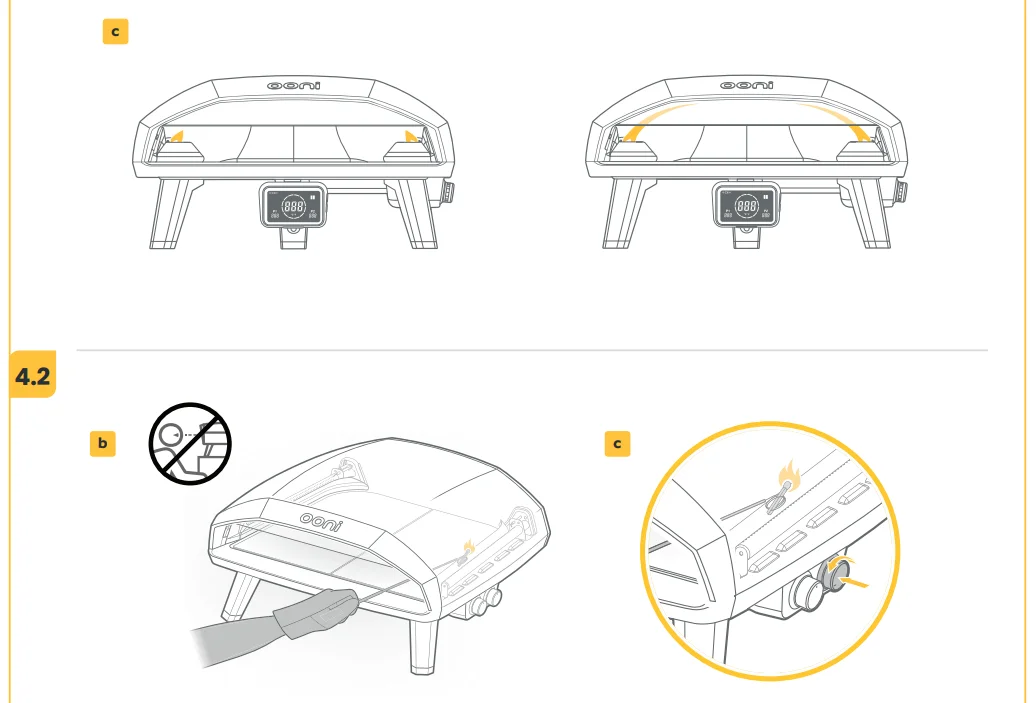
Never look directly into the oven when lighting; always stand to the side and wear gloves throughout. If burners will not light after several attempts using the control dials, you may light them with a match. The supplied matchstick holder is attached to the base on the opposite side of the control panel.
- a. If you have already attempted to light the burners using the control dials, first switch to the OFF position and wait 5 minutes for any gas to dissipate.
- b. Insert a match into the matchstick holder, ignite the match and touch it to one of the burners through the mouth of the oven.
- c. Push in the control dial that corresponds to the burner and slowly turn it to maximum. The burner should ignite immediately.
- d. Continue pushing the control dial in for 5 seconds after ignition, then release.
- e. If the burner does not light within seconds, turn the control dial off, wait 5 minutes, and then try again.
Using the gas burners
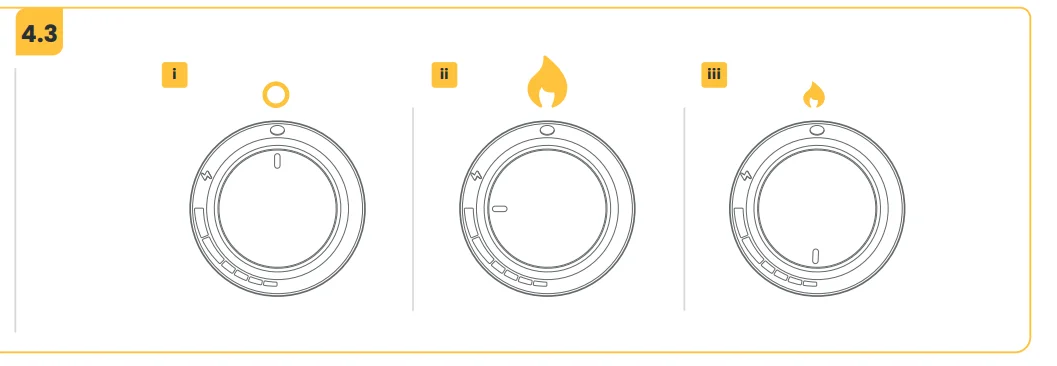
- a. Turn the control dial to adjust the corresponding flame and temperature as needed.
- The gas burner is OFF.
- The gas burner is set to maximum flame.
- The gas burner is set to minimum flame.
- b. Repeat the process (starting at 4.1) to light the second burner.
- c. To turn off, push in the control dial and rotate clockwise until it stops and the corresponding flame extinguishes.
Seasoning your oven
You must season your oven before cooking in it for the first time. Always wear gloves when putting your hand inside the oven.
- a. To do this, run the oven at top temperature for 30 minutes.
- b. Turn off the oven and allow it to cool completely, then wipe down the inside with dry paper towels.
Shutting off the oven
- a. To turn off after seasoning or cooking, push in the control dial and rotate clockwise until it stops and the corresponding flame extinguishes. Repeat for both burners.
- b. Disconnect from your natural gas supply.
Cooking in your oven
- a. Turn both burners on at full power to preheat the oven and pizza stones for at least 30 minutes.
- b. Only cook pizza and other dry, bread-based dishes directly on the pizza stone. To cook meat, vegetables or other dishes, use the range of Ooni Cast Iron and Ooni Pans or other Ooni-approved cooking accessories.
- c. The oven is equipped with two independent burners, enabling you to cook on just one side of the oven, on both sides at the same temperature, or on both sides at varying temperatures to accommodate different pizza styles.
Never reach into the oven to clear away food debris that has fallen onto the pizza stone. Leave it to burn out, then remove it once the oven has cooled. Refer to the pizza stone cleaning procedure in the maintenance section of this manual for additional tips. We strongly recommend using an Ooni Digital Infrared Thermometer to accurately measure the pizza stone temperature. Your pizza stone will heat up slower than the air inside the oven. (To cook great pizza, you need a balance of both.) That’s why it’s important to use an Ooni Digital Infrared Thermometer as well as the Digital Temperature Hub to ensure your pizza stone and air temperatures are within a close range. For everything you need to know about cooking with Koda 2 Max, download the Ooni app.
Installing the visor (if required)
Scan for video instructions

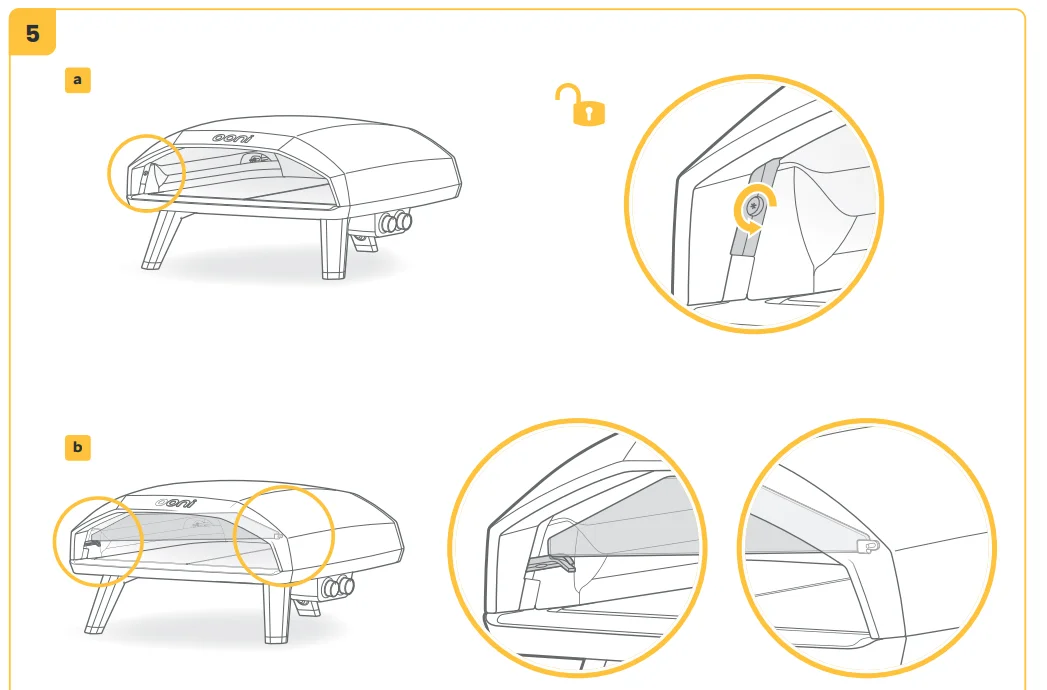
Wear protective gloves and make sure your oven is cool.
- a. Open the hinge by using the torx key to loosen the screw counterclockwise.
- b. Using both hands, guide the right-hand side of the visor into the U-shaped bracket at the top right of the oven mouth.
- c. Place the left-hand side of the visor into the recess on the left hinge.
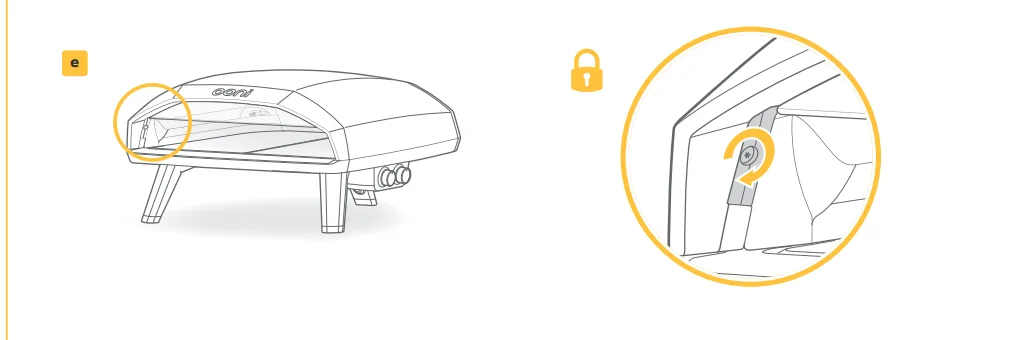
- d. Place your left thumb under the hinge and gently push it upward until it lies flat against the oven body. Hold the hinge in this position.
- e. Use the torx key to tighten the screw clockwise, locking the hinge.
- f. Ensure the hinge is locked into place.
Removing the visor
For deep cleaning or cooking larger items in the oven, follow these steps to remove the visor:
Wear protective gloves and make sure your oven is cool.
- a. Place your left thumb above the screw to support the hinge.
- b. Use the torx key to loosen the screw counterclockwise, unlocking the hinge.
- c. Gently lower the hinge using your left thumb, which will allow the visor to lower.
- d. Use both hands to carefully lift the left-hand side of the visor and pull forward to release the visor from the right bracket.
- e. To close the hinge, place your left thumb under the hinge and gently push it upward until it lies flat against the oven body. Hold the hinge in position and rotate the screw clockwise to lock.
- f. Ensure the hinge is locked into place.
Care and maintenance instructions
WARNING: Never attempt cleaning or maintenance while the oven is hot or in use. Always wear gloves when cleaning the oven. Do not use abrasive cleaners or scouring pads to clean any part of the oven. Do not use chemical cleaners on painted surfaces. Take care when cleaning inside the oven because sharp edges may be present.
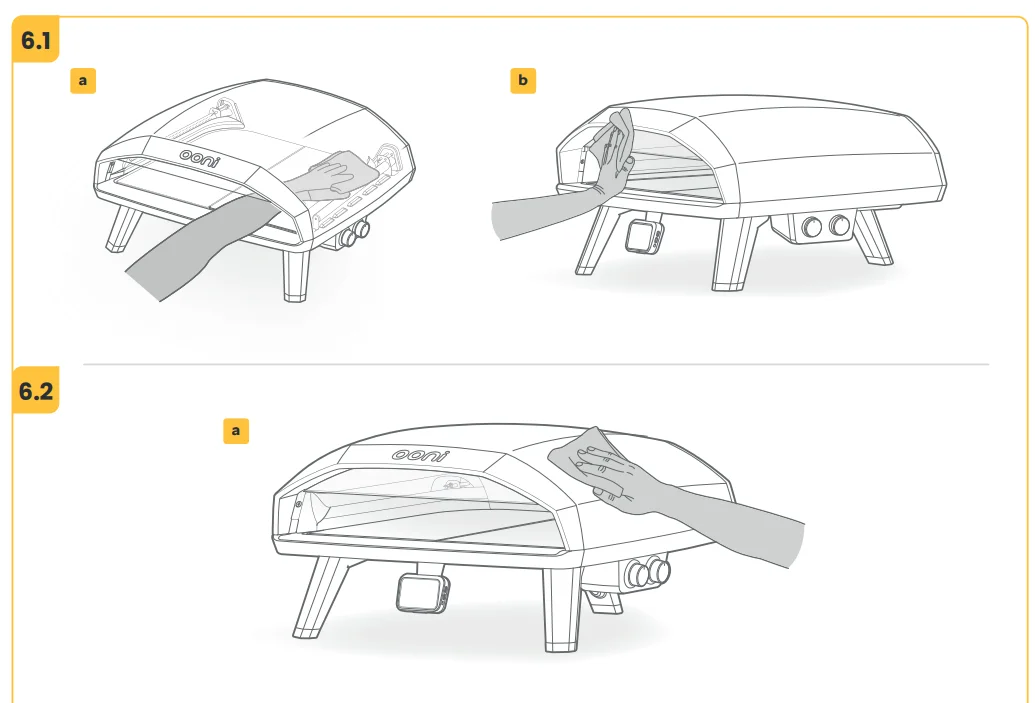
Cleaning the interior
- a. After each use, switch off the oven and allow it to cool completely before wiping down the inside surfaces and along the burner tubes with dry paper towels.
- b. If the glass visor is dirty, you can clean it carefully using a damp cloth or dry paper towel. For stubborn stains, remove the visor according to the included instructions (Step 5.1).
Cleaning the exterior
- a. The outer shell of Koda 2 Max can be wiped down with warm, soapy water and dried immediately. Avoid abrasive cleaning products or those with harsh chemicals.
- b. Dry immediately and cover with the Koda 2 Max Cover.
Cleaning the pizza stones
Never use chemical cleaners or soaps on the pizza stones. Never expose your pizza stones to water. There is no need to wash the pizza stones; it is perfectly normal for their appearance to change over time.
- a. Turn the oven on at full power for 45 minutes without cooking in it. The pizza stone will self-clean at high temperatures, and any food residue or debris will turn to ash.
- b. Allow the oven to cool completely, then brush the ash away with an Ooni Pizza Oven Brush.
Note: Your oven pizza stones are symmetrical and double-sided, so you can turn them over between uses (once cool) and burn off any stubborn residue from underneath the next time you cook.
Replacing the ignition battery
- a. The ignition battery compartment is located inside the rear leg.
- b. Unscrew the cap counterclockwise to remove the old battery and replace it with a new one, paying attention to the +/- directions.
- c. Screw the cap back on clockwise.
- d. Safely dispose of the old battery.
If you are storing the oven for more than a month, remove the battery.
Troubleshooting
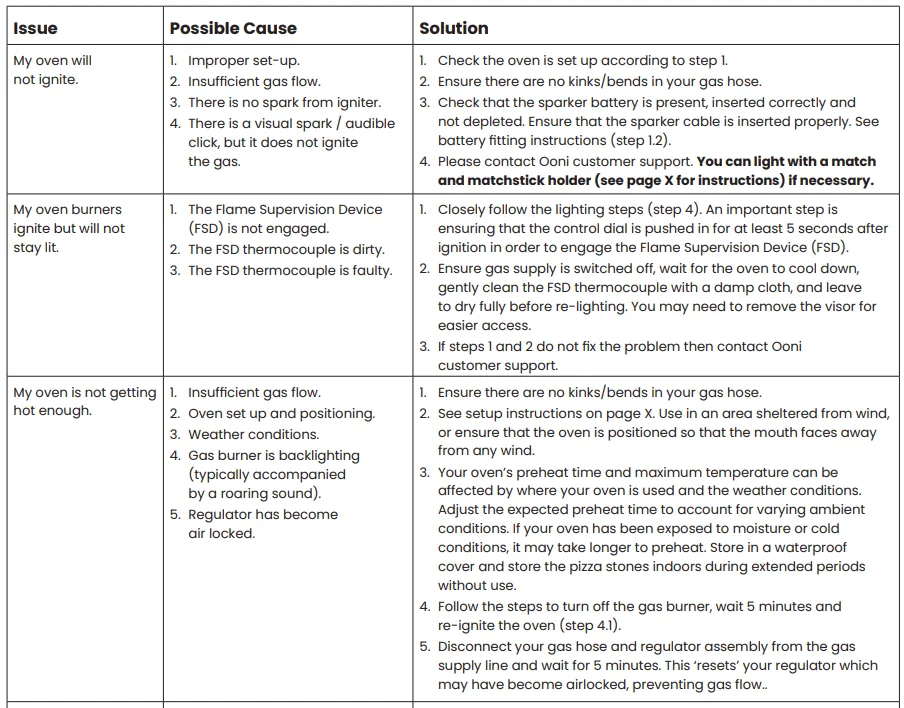
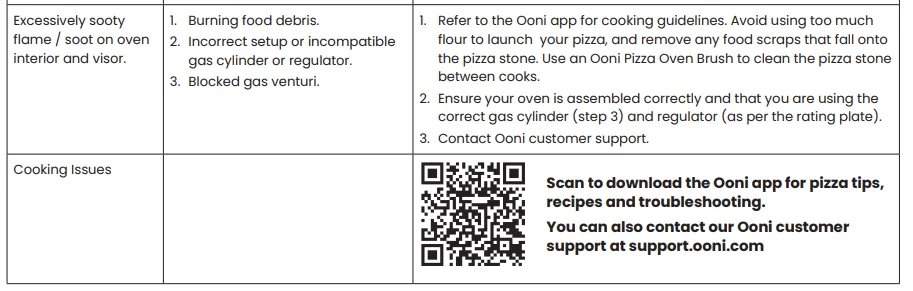
If a problem persists, please contact Ooni customer support at support.ooni.com.
For more manuals by Ooni, visit ManualsLibraryy
Ooni Koda 2 Max Natural Gas Pizza Oven-FAQs
How long does it take to preheat the Ooni Koda 2 Max?
The oven typically takes about 20–30 minutes to fully preheat. For best results, allow the stone to reach high temperatures (around 400–450°C) so your pizza cooks evenly and develops a crisp crust.
How do I start the Ooni Koda 2 Max gas oven?
Connect the gas supply securely, open the gas valve, and turn the control knob while pressing the ignition button. Once lit, adjust the flame to your desired heat level and allow the oven to preheat properly.
What temperature is ideal for cooking pizza?
The recommended temperature is around 400–450°C (750–850°F). At this heat level, pizzas cook quickly and develop a perfect balance of crispy crust and soft interior.
How do I maintain and store the oven?
Let the oven cool completely before cleaning. Store it in a dry place and use a protective cover if kept outdoors to prevent weather damage.
Can I cook foods other than pizza?
Yes, the oven is versatile. You can cook bread, vegetables, meats, and even desserts using different temperature zones.
What size pizzas can the Koda 2 Max cook?
It can handle one large pizza (up to about 20 inches) or multiple smaller pizzas at the same time, making it great for family cooking.
Why does my pizza turn out soggy?
A soggy pizza usually means the oven wasn’t hot enough or the dough had too much moisture. Ensure proper preheating and use well-balanced dough.
How do I prevent my pizza from burning?
Lower the flame slightly before placing the pizza inside and rotate it regularly. Avoid leaving it too close to the flame for long periods.
What should I do before using the oven for the first time?
Remove all packaging, check gas connections, and place the oven on a stable, heat-resistant surface. Run the oven empty for a short time to burn off any residues before cooking food.