


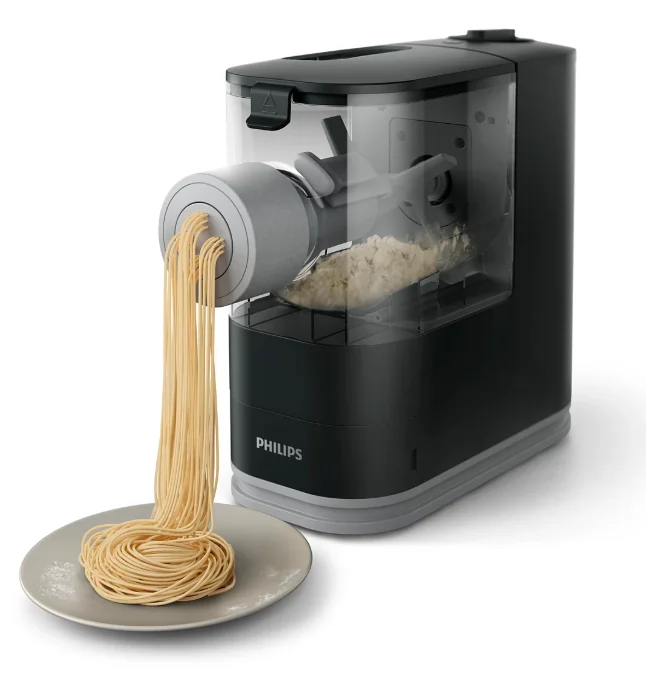
Philips Viva Collection Pasta-Noodle Maker
Quick Start Guide


IMPORTANT SAFEGUARDS
When using electrical appliances, basic safety precautions should always be followed including the following:
Read this user manual carefully before you use the appliance and save it for future reference.
 Warning:
- Read all instructions.
- Before you connect the appliance to the power, make sure that the voltage indicated on the bottom of the appliance corresponds to the local power voltage.
- To protect against the risk of electrical shock, do not immerse the main unit, cord, or plug in water or other liquid; do not rinse them under a tap either.
- This appliance is not intended for use by persons (including children) with reduced physical, sensory, or mental capabilities, or a lack of experience and knowledge, unless they are closely supervised and instructed concerning use of the appliance by a person responsible for their safety. Close supervision is necessary when any appliance is used by or near children. Children should be supervised to ensure that they do not play with the appliance.
- Do not leave the appliance unattended when in use.
- Do not move the appliance while in operation.
- Make sure the plug is firmly inserted into the power outlet.
- Make sure your hands are dry before you insert the plug into the power outlet.
- Do not operate any appliance with a damaged cord or plug or after the appliance malfunctions, or is dropped or damaged in any manner. For assistance in the U.S. or Canada only, call 1-866-309-8817.
- Do not place any part of this appliance on, ,, or near a hot gas, electric, convection or microwave oven or on a hot gas or electric burner.
- The use of accessory attachments not recommended or sold by the appliance manufacturer may cause fire, electricshock,, or injury.
- This appliance is designed for household u;e only, do not use outdoors.
- Do not let the cord hang over the edge of the table or counter, or touch hot surfaces.
- Do not use this appliance on an unstable or uneven surface, near the edge of a bench top, counter, or table during operation. Ensure the surface is level, cleannand free of water, fl, and other substances.
- Never connect this appliance to a timer switch or separate remote control system, to avoid a hazardous situation.
- Make sure the shaping disc hole is unblocked each time before using.
- The shaping discs and all detachable parts of the appliance are dishwasher safe. When you clean them in the dishwasher, make sure to select the proper program,, which has a maximum temperature of no higher than 60°C (140°F).
- Do not hold and move the appliance by grabbing the shaping disc holder. Hold the main unit to do so.
- Use only on a properly grounded outlet.
- Extension cords may be used if care is exercised in their use. If an extension cord is used, the marked electrical rating of the cord must be as great as the rating of the appliance. The longer cord should be arranged so that it will not drape over the edge of the counter or table top where it could be pulled by children or tripped over unintentionally. If the appliance is of grounded type, the extension cord should be a grounded-type 3-wire cord.
- Turn the appliance OFF, then unplug from the outlet when not in use, before assembling or disassembling parts and before cleaning. To unplug, grasp the plug and pull from the outlet. Never pull from the power cord.
SAVE THESE INSTRUCTIONS
What’s in the box

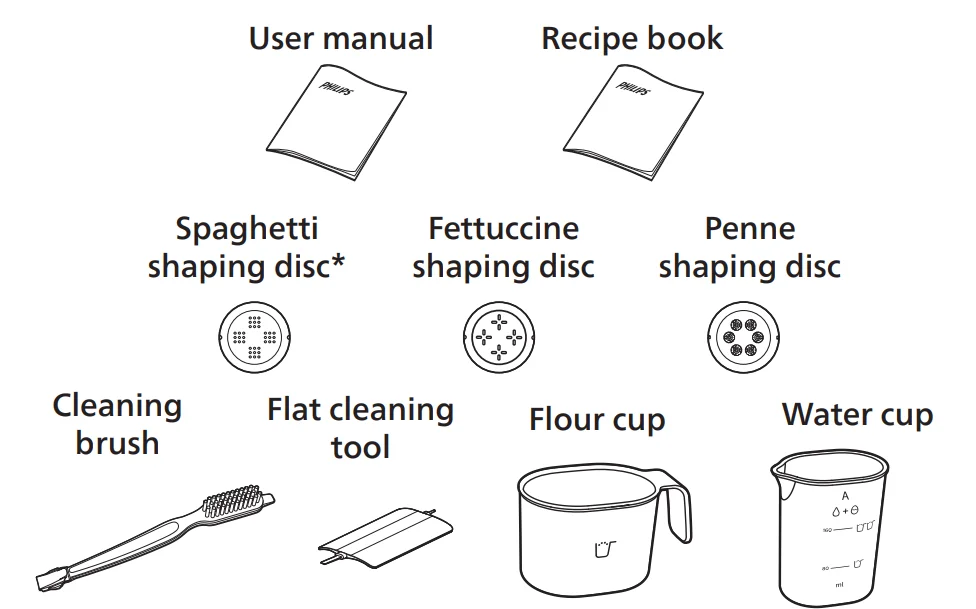
* The spaghetti shaping disc is assembled on the appliance upon purchase.
Overview


Disassembling and cleaning before first use
Important
- Before using the appliance for the first time, remove and safely discard any packing material and /or promotional labels.
- Take out all parts and accessories, wash and thoroughly dry all parts and accessories (refer to the chapter “Cleaning”).
- Do not use water to rinse or soak the main unit, the power coorand the power plug.
- Do not use a scouring pad or similar cleanerr, as these will scratch the plastic surface and affect the lifetime of the pasta maker.
- The shaping discs and all detachable parts of the appliance are dishwasher safe. When you clean them in a dishwasher, make sure to select the proper program that has a maximum temperature of at no higher than 60°C (140°F).
- This appliance is intended for household use only.
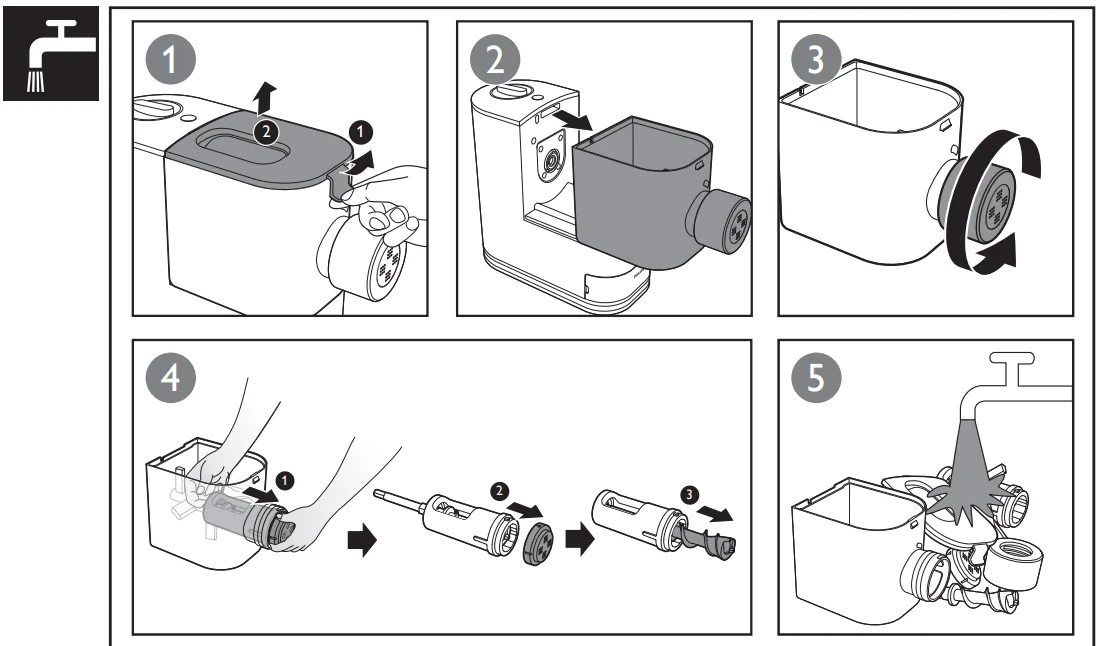
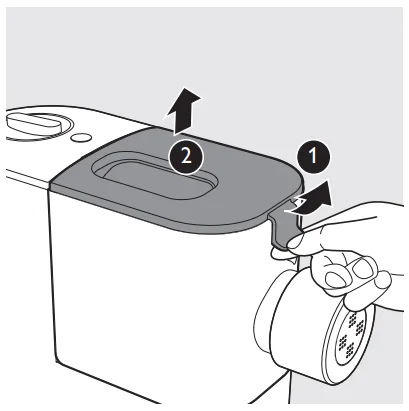
- Pull the lid to unlock it and then remove the lid from the mixing chamber.

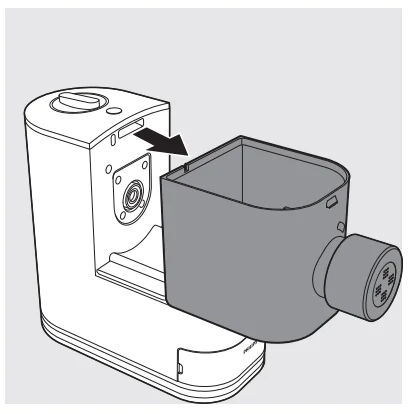
- Slide the mixing chamber off the main unit.

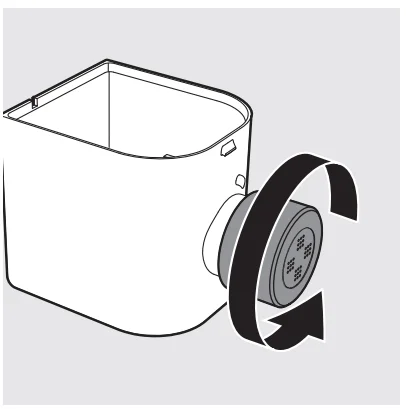
- Turn the shaping disc holder counterclockwise to remove it from the mixing chamber outlet.

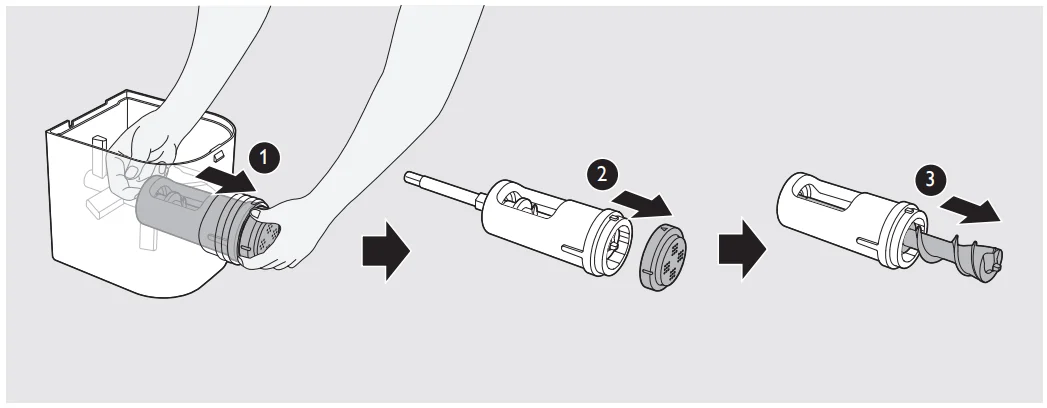
- Put your finger in the mixing chamber and push the squeezing tube outwards to slide it out of the mixing chamber outlet. Detach the shaping disc, and then pull the squeezing bar out of the squeezing tube.

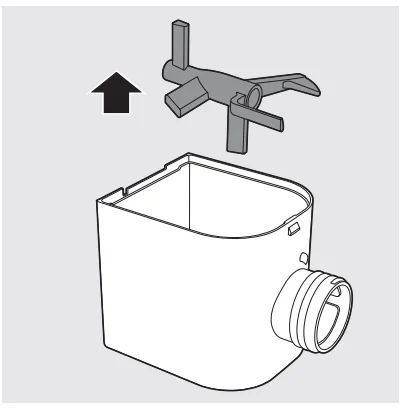
- Take the mixing paddle out of the mixing chamber.

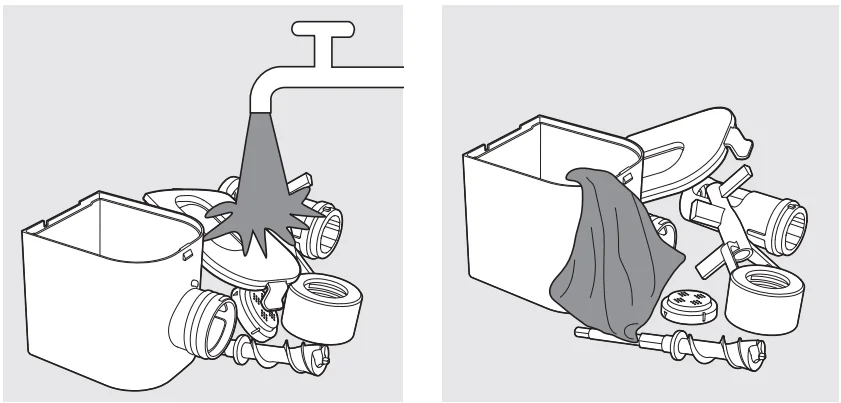
- Clean all detachable parts and accessories, and then wipe them dry.

Assembling
Follow the assembly steps below to assemblethe pasta maker.
IMPORTANT
- Make sure the appliance is not plugged in during assembly.
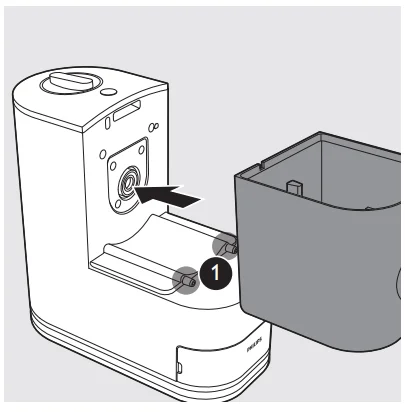
- Slide the mixing chamber onto the main unit.
Note:- Make sure the fixing levers 1 on the main unit are fitted with the openings on the bottom of the mixing chamber.

- Make sure the fixing levers 1 on the main unit are fitted with the openings on the bottom of the mixing chamber.
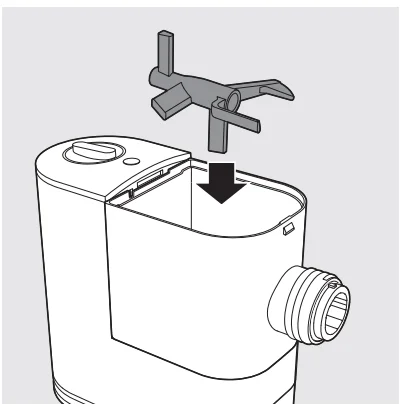
- Put the mixing paddle in the mixing chamber as shown in the illustration.

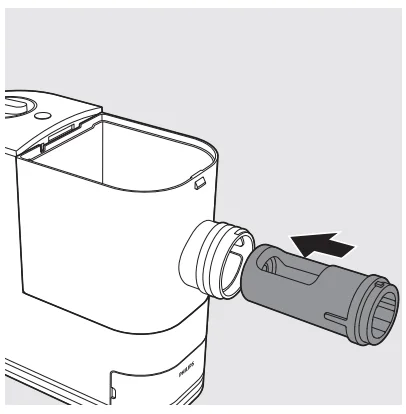
- Insert the squeezing tube into the mixing chamber.
 Note:
Note:- Make sure the big opening on the squeezing tube faces up when you insert the tube into the chamber.
- Insert the squeezing bar into the mixing chamber. Make sure the squeezing bar slides all the way through both the squeezing tube and the mixing paddle and into the shaft in the main unit.
 Note:
Note:- Slightly turn the mixing paddle to make sure the squeezing bar is connected correctly with the shaft in the main unit.
- Attach the shaping distoon to the mixing chamber outlet.
 Note:
Note:- Make sure the flat side of the shaping disc is facing out.
- Make sure the shaping disc fits into the fixing point on the squeezing bar.
- Make sure the arrow on the shaping disc faces upwards when you attach it to the mixing chamber outlet.
- Press the shaping disc through the opening of the shaping disc holder, and then assemble the holder on the mixing chamber outlet. Turn the holder clockwise to firmly lock it in place.
 Always attach the shaping disc to the mixing chamber outlet before you assemble the shaping disc holder. Never put the shaping disc in the shaping disc holder and assemble them on the mixing chamber outlet at the same time.
- Attach the lid to the mixing chamber.
 Note:
Note:- If the mixing chamber lid is not properly installed, the safety switch will prevent the appliance from working.
 Note:
Note: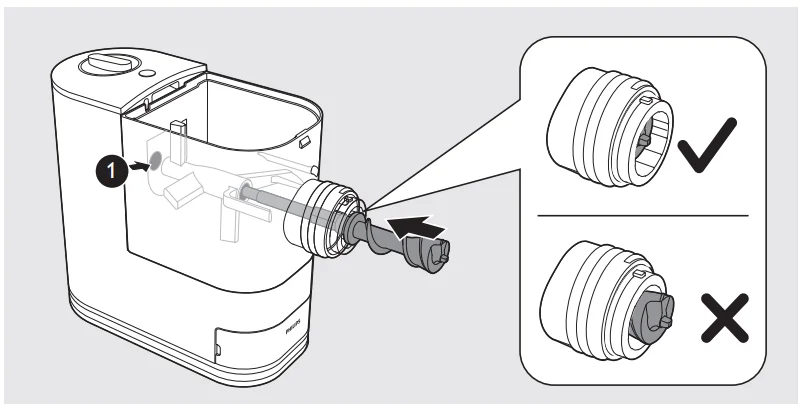 Note:
Note: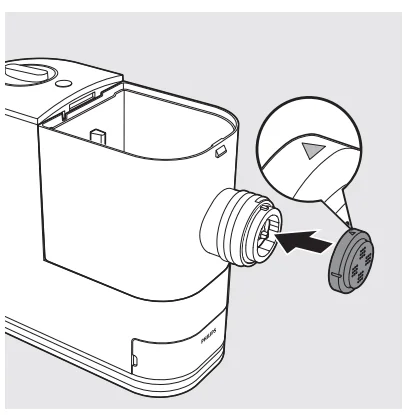 Note:
Note: Always attach the shaping disc to the mixing chamber outlet before you assemble the shaping disc holder. Never put the shaping disc in the shaping disc holder and assemble them on the mixing chamber outlet at the same time.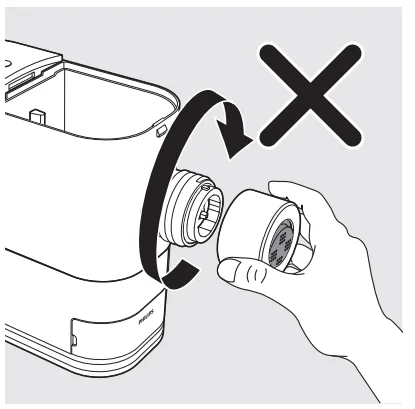
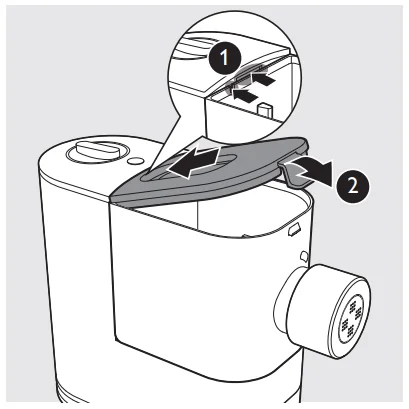 Note:
Note:Using the pasta maker
Important
- Place the product on a flat surface and prevent the table from shaking or vibration.
- Make sure all the parts are well assembled before plugging in.
- Do not put less than 200 g/7 oz (1 flour cup) or more than 400 g/14 oz (2 flour cups) of flour in the chamber.
- Pour in the liquid slowly through the water slot after the appliance starts kneading.
- If you want to dispose of the weighed flour before processing with the next batch, empty the chamber and restart the appliance by unplugging and plugging it in again.
- Do not put any ingredients that are 60°C/140°F or above into the pasta maker, or place the pasta maker in surroundings at high temperature (60°C / 140°F), for instanc, in a high-temperature sterilization environment. This will deform the appliance.
- Do not pour liquid into the mixing chamber before the Pasta maker starts running.
- Make sure the shaping disc and shaping disc holder are assembled properly before plugging in the appliance.
Preparing and measuring the flour
- Scoop one full cup of flour using the flour cup. Scrape off any excessive flour from the cup edge with the supplied flat cleaning tool. 1 full cup of flour weighs around 200 g/7 oz, and 2 full cups of flour weigh around 400 g/14 oz.
 Note:
Note:- Do not shake or hit the flour cup to remove excessive flour. This will affect the flour weight.
- Use a kitchen scale to measure the weight more accurately.
- 200 g/7 oz of flour makes about 200 g/7 oz of fresh pasta/noodles. 400 g/14 oz of flour makes about 450 g/16 oz of fresh pasta/noodles.

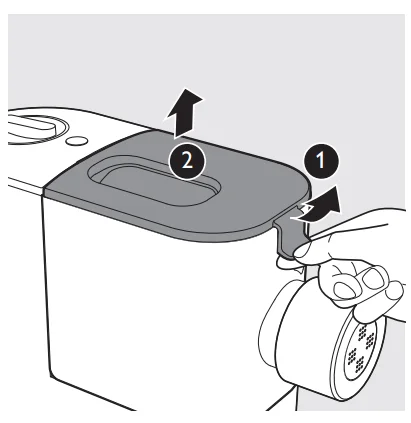
- Pull the lid to unlock it and then remove the lid from the mixing chamber.

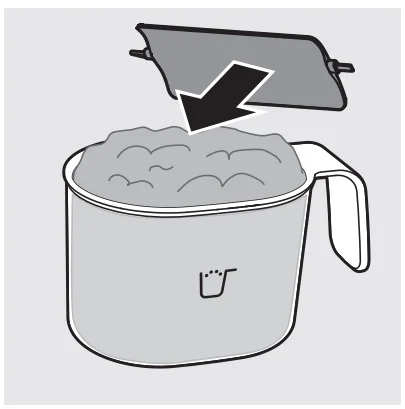
- Pour the flour into the chamber. If you want to make 2-3 servings, add a second cup of flour,, as you will need 2 cups (~400 g/14 oz) of flour in total.

Note:- Do not pour liquid into the mixing chamber at this point. Only pour liquid after the Pasta maker starts running.
- Do not put less than 200 g/7 oz or more than 400 g/14 oz of flour in the chamber. If you put too little or too much flour in the chamber, the appliance may not operate.
- Do not pour the flour into the opening of the squeezing tu;e, otherwise,, the flour in the squeezing tube will not be mixed evenly.

 Note:
Note: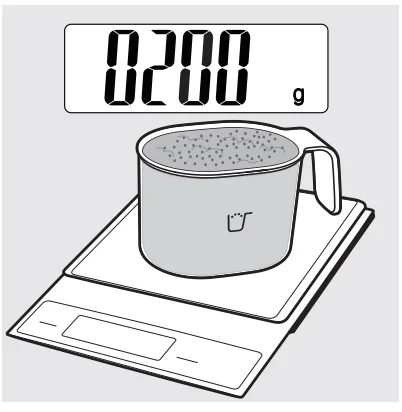


Preparing and measuring the liquid
- Measure the liquid volume at eye level on a flat surface.
Note:- Do not pour liquid into the mixing chamber before the Pasta maker starts running.
- Do not pour liquid into the mixing chamber before the Pasta maker starts running.
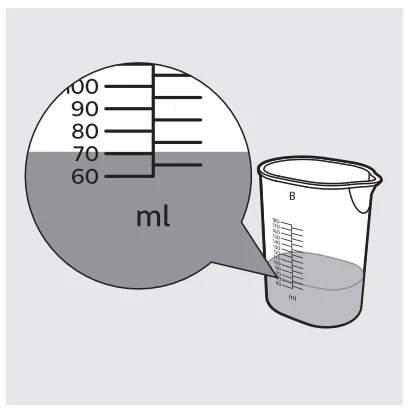
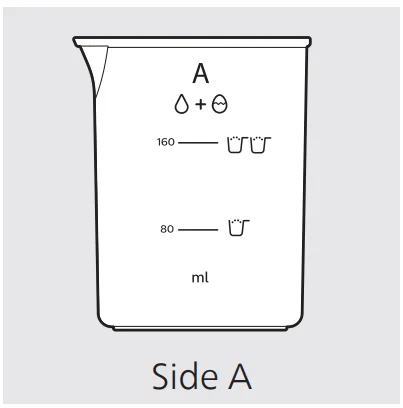
There are 2 sets of water markings on the supplied water cup.
- When using all-purpose flour and egg mixture to make plain egg pasta, refer to side A with two liquid levels.
- Level 1 (80ml): required egg mixture amount for 1 cup of flour.
- Level 2 (160ml): required egg mixture amount for 2 cups of flour.

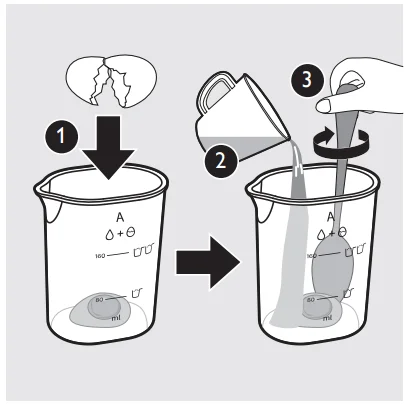
- To makthe e the egg mixture for plain egg pasta, crack 1 egg into the water cup. Add water up to the required amount as shown on side A, and then whisk the water and egg to combine.

- When using the following combinations of flour and liquid to make pasta, refer to side B forspthe ecific volume.
- All-purpose flour mixed with pure water/vegetable juice mixture.
- Various other flours (as shown in the following tables) are mixed with egg mixture/pure water/vegetable juice mixture.


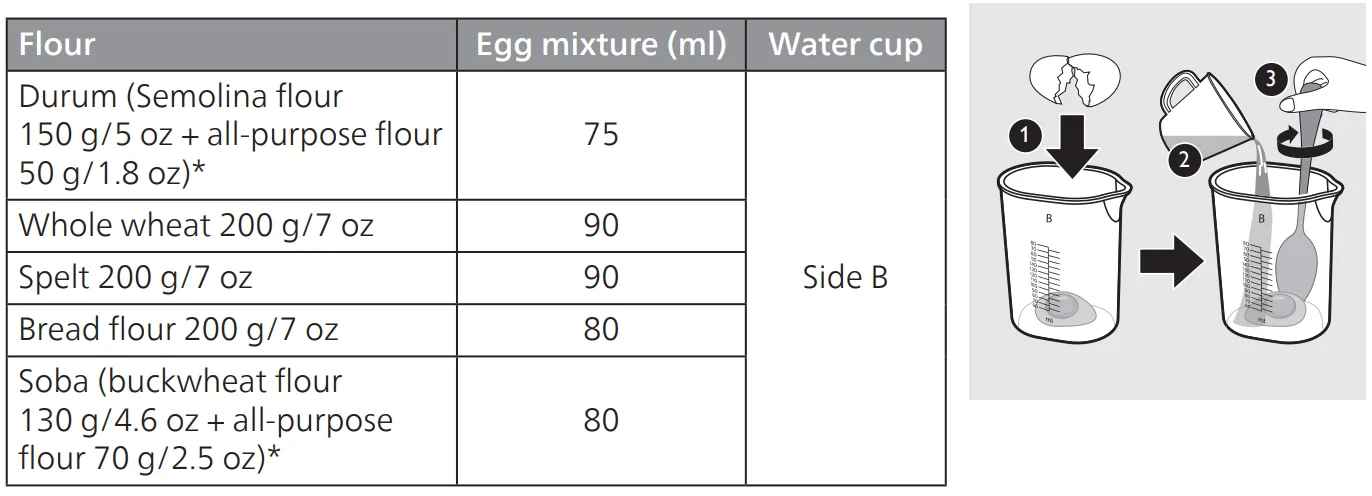
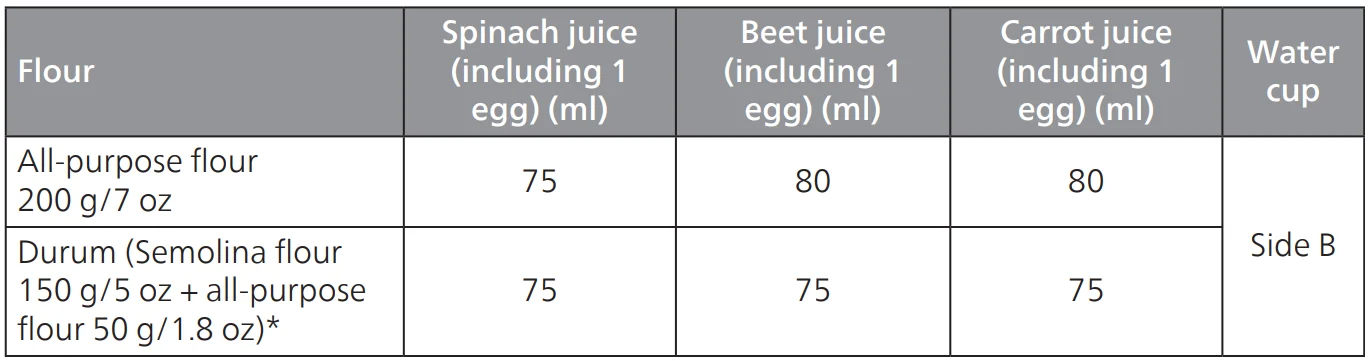
Check the following tables for the detailed water and flour ratios.
Note: These tables show the flour-liquid ratiobasedde on 200 g/7 oz of flour. When using 400 g/14 oz of flour to make pasta, double the liquid volume (including egg) to get the right flour-liquid ratio.
- When using egg mixture to make pasta, crack 1 egg into the water cup. Add water up to the required amount as shown below, and then whisk the water and egg to combine.

- When using pure water to make pasta, add water to the required amount as shown below.

- When using vegetable juice (including 1 egg) to make pasta, crack 1 egg into the water cup. Add vegetable juice up to the required amount as shown below, and then whisk the juice and egg to combine.
 * Use a kitchen scale to measure the weight more accurately.

 * Use a
 Important
- The pasta recipes provided in the recipe book have been tested for success. If you experiment with or use other pasta recipes, the flour and water/egg ratios will need to be adjusted to the flour and water cup ratios included with the Pasta maker. The Pasta maker will not operate successfully without adjusting the new recipe accordingly.
Note:
- For best results, use all-purpose flour with the recommended liquid proportions indicated on the cup.
- Seasonal changes, using ingredients from different regi,,ons may affect the flour/water ratio.
- “Gluten” is a bithatwhich ensures the pasta does not break easily. Gluten-free flour does not contain a bi;der, therefore,, it needs a thickener to act as a “bind,er” eg, Xanthan gum or Guar. Various kinds of gluten-free flour perform differently when making pasta. Some flours are not suitable for making varieties of pasta, such as coconut flour and white rice flour; some flour varieties work well, such as quinoa and buckwheat.
• See the recipe book provided for more delicious pasta and noodle ideas.
Starting thepasta-makingg program
Important
- Do not select the extra extrusion program before the dough mixing is complete. Otherwise, this will damage the Pasta maker and its lifetime.
- Do not disconnect the power cord before the processing is complete. If you have to stop the pasta-making process, turn the control knob to “OFF” to stop the working process and then disconnect the power cord from the outlet before performing other operations.
- Do not exceed the maximum operation cycle of 2 cycles continuously at all applications. To better protect the lifetime of the appliance, you can restart using the appliance after 30 minutes upon 2 continuous operation cycles.
- If you intend to use the appliance continuously, clean each shaping disc with the supplied cleaning tool each time after the pasta-making session. For easy cleaning, do not soak the shaping disc directly in water.
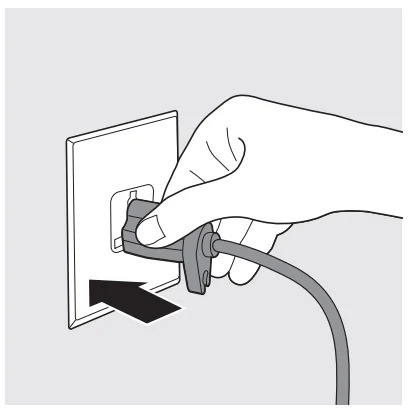
- Plug the appliance into the power outlet. The Pasta maker will sound once.
 Note:
Note:- Make sure all the parts are well assembled before plugging in.
- Attach the lid to the mixing chamber. Note:
- The appliance will not start working if the chamber lid is not properly closed. During the pasta-making process, if the chamber lid becomes loose, the appliance will automatically stop working.
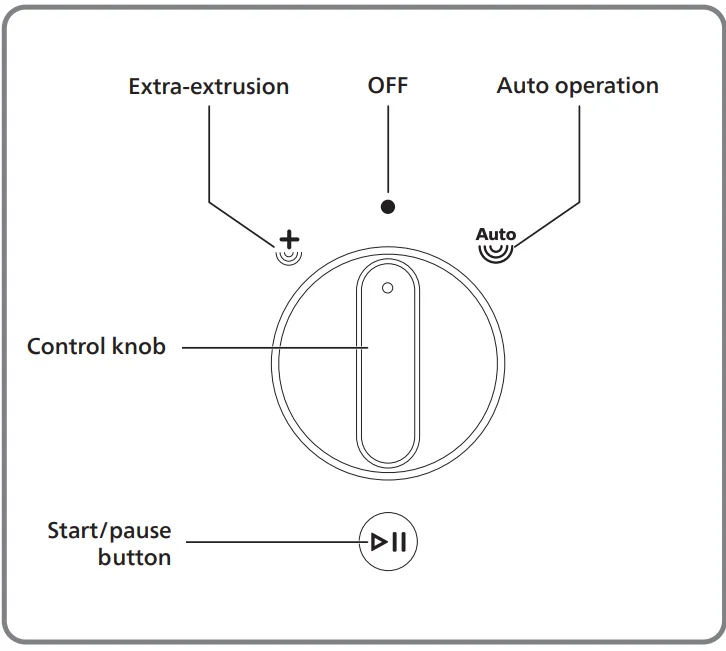
- Turn the control knob to select the automatic pasta-making process, and then press the Start/Pause button.
 Note:
Note:- The whole working process (including kneading and extruding) takes around 12 minutes for 200 g/7 oz of flour and 18 minutes for 400 g/14 oz of flour.
- After the kneading starts, slowly pour in the liquid along the entire length of the slot in the lid. Note:
- During dough mixing, do not add other ingredients after you have poured in the liquid. Otherwise, it will affect the results of the pasta texture.
- After the Pasta maker finishes kneading, it will beep a few times,, and the pasta extrusion will start after a few seconds. Place a container right under the outlet. Cut the pasta into the desired length with the cleaning tool.
 Note:
Note:- If the ratio of liquid and flour is not correct, the extrusion will not succeed. In this case, prepare the ingredients again.
- Move the cleaning tool downwards to cut the pasta.
- When the extrusion process is complete, the appliance will beep a few times.
Note:- Do not turn the control knob to the “OFF” position before the whole process is over (you will hear the “beep” sound).
- After the pasta making is complete, if you notice some leftover dough inside the chamber, you can turn the control knob to the OFF position first, and then turn the control knob to the extra-extrusion position. Press the Start/Pause button to start the extra-extrusion program.
 Note:
Note:- You may find some fine pasta threads on the pasta surface. This is normal.
- The cooking time of the pasta varies depending on personal preferences, pasta shapes, anthe d the number of servings.
 Note:
Note: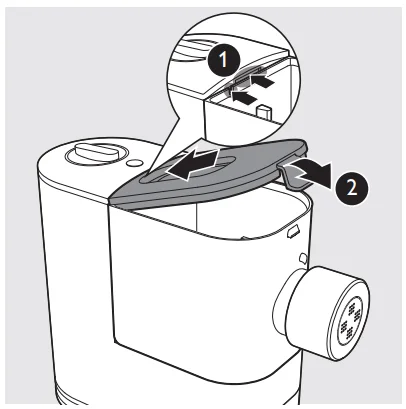 Note:
Note: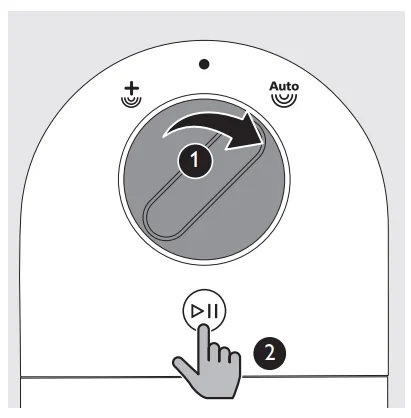 Note:
Note: Note:
Note: Note:
Note: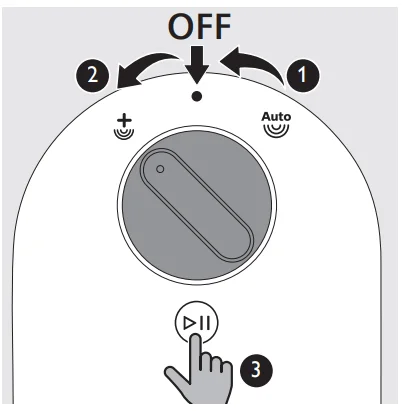 Note:
Note:Cleaning
Important
- Turn the control knob to “OFF”, disconnect the power,, and remove the power cord before cleaning or disassembling this appliance.
- Do not immerse the main unit in water.
- Do not use a scouring pad, caustic cleaners, or abrasive cleaners (foexamples, gasoline, alcohol, and propanol) to clean the appliance.
- Clean the appliance each time after use, or the appliance might not operate properly.
- Take extra caution when cleaning the appliance to avoid getting cut by any sharp edges.
- The shaping discs and all detachable parts of the appliance are dishwasher safe. When you clean them in a dishwasher, make sure to select the proper program that has a maximum temperature of no higher than 60°C (140°F).
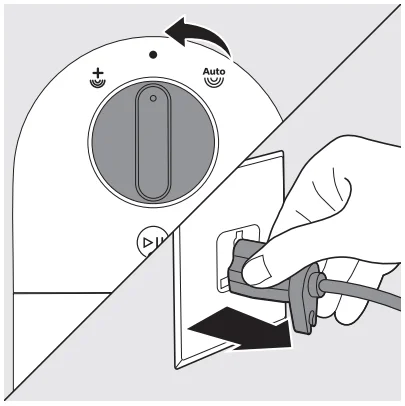
- Turn the control knob to “OFF” and disconnect the plug from the power outlet.

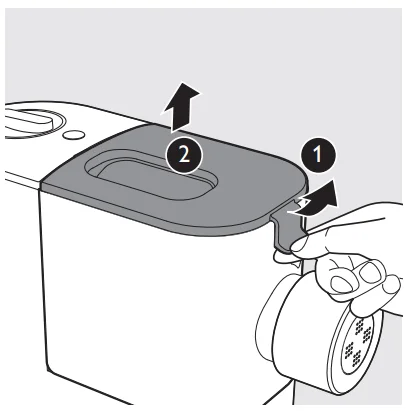
- Pull the lid to unlock it and then remove the lid from the mixing chamber.

- Slide the mixing chamber off the main unit.
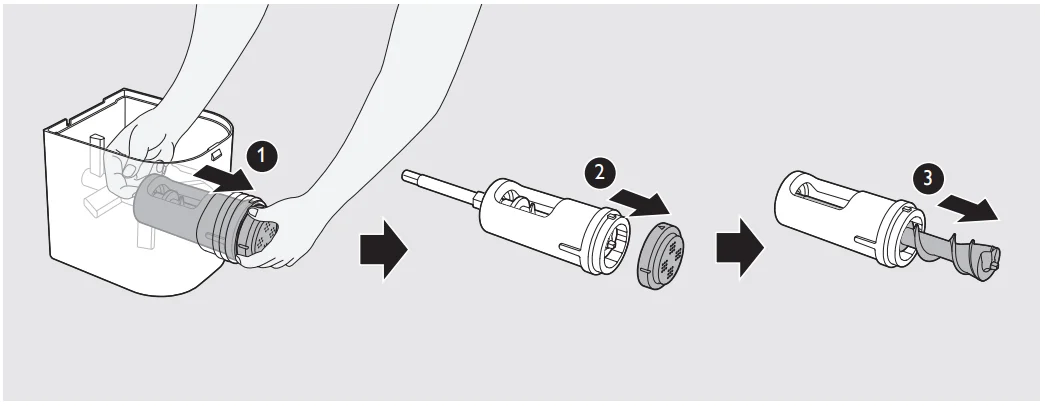
- Turn the shaping disc holder counterclockwise to remove it from the mixing chamber outlet.
- Put your finger in the mixing chamber and push the squeezing tube outwards to slide it out of the mixing chamber outlet. Detach the shaping disc, and then pull the squeezing bar out of the squeezing tube.

- Take the mixing paddle out of the mixing chamber.

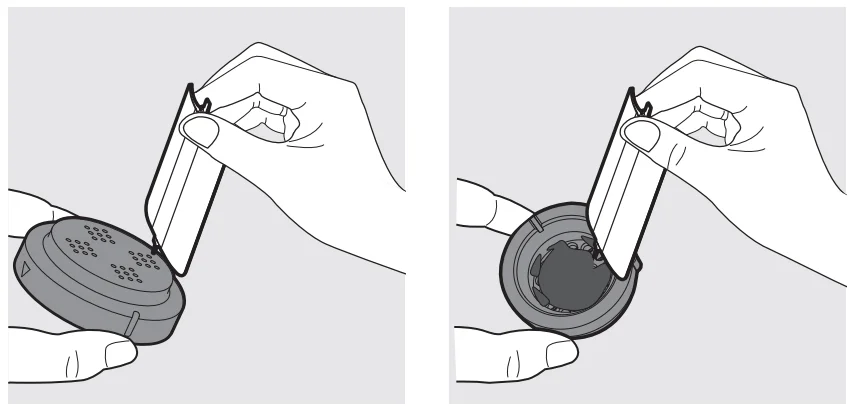
- Clean the shaping disc with the supplied cleaning tool to remove the dough residues. After that, you can clean it with water.

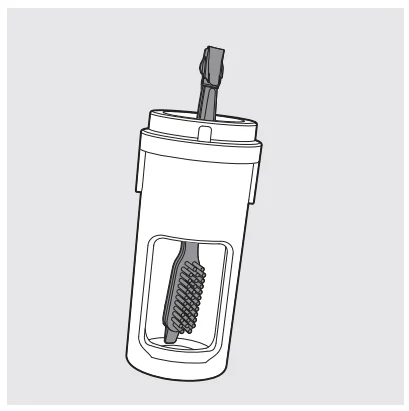
- Use the supplied cleaning brush to clean all detachable parts with dishwashing liquid and warm water,, or clean in the dishwasher. Wipe all parts dry. Tip:
- Use thpointedg end of the cleaning brush to clean the inner bottom of the squeezing tube.
- Use a dry cloth to clean the main unit, control knob, and the exterior of the pasta maker. Note:
- After cleaning, make sure all parts and the shaping disc air dry thoroughly before storing. Assemble the pasta maker back for next use.



 Tip:
Tip: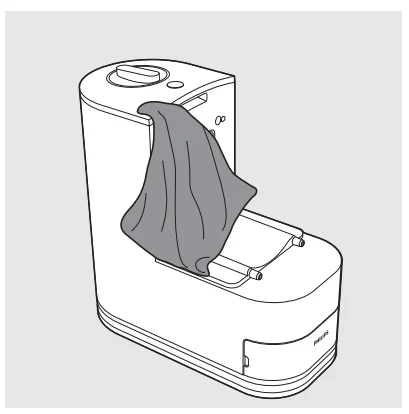 Note:
Note:This appliance has no other user-serviceable parts. For assistance in the U.S. or Canada only call 1-866-309-8817.
Storage
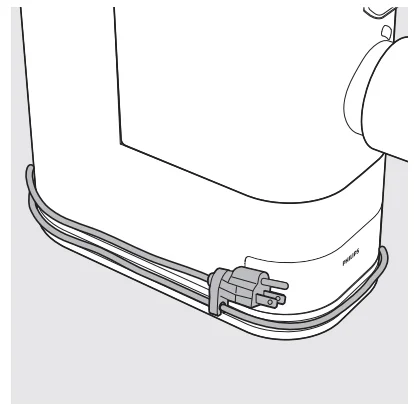
- Set the power cord in the clip on the power plug and wind the power cord around the cord storage wrap.

- Dry the shaping discs and store them in the storage box.
The small groove in the storage box is designed for the cleaning tool of the angel hair shaping disc, which is not included in this pasta maker. They will be launched and sold separately.
- Store the pasta maker in a dry, well-ventilated place after use.

Troubleshooting
This chapter summarizes the most common problems you could encounter with the appliance. If you are unable to solve the problem with the information below, visit www.philips.com/support or, in the U.S. or Canada only, call 1-866-309-8817 for assistance.
The appliance does not sound after the plug is putinton the wall outlet.
- The plug is not connected properly, or the outlet is not connected to a power source.
Check whether the power plug is plugged correctly and the outlet is working properly.
The appliance does not start the pasta-making process after the plug is put into the wall outlet.
- You have not chosen a pasta-making program or pressed the start button
 .
.
Choose a pasta-making program and press the start button.
 .
.After pressing the start button  , the appliance makes alarm sounds and does not work.
- The chamber lid is not assembled properly.
Make sure you follow the user manual to assemble the chamber lid properly.
The chamber lid is pushed open from the inside.
- There’s too much flour in the mixing chamber.
The maximum amount of flour for each batch is 400 g/14 oz. If you have put more than 400 g/14 oz of flour in the mixing chamber, reduce the amount and make another batch of pasta. - The ratio of flour and water provided in the “Flour/water ratio table” was not followed. The dough is too wet.
Disconnect from the power source, clean the pasta maker, and follow the user manual again to restart the pasta making. - The chamber lid is not assembled properly.
Make sure you follow the user manual to assemble the chamber lid properly.
During processing, the appliance stops working when you open the lid.
- For safety reasons, the appliance always stops working when the lid is opened during processing.
If you need to resume the previous operation, close the lid properly, and press the Start/pause button.
During the pasta-making process, the appliance stops working, and there is no alarm sound.
- The pasta maker has overheated due to long and continuous working time.
Disconnect from the power source, and allow the pasta maker to cool down. To better protect the lifetime of the appliance, the continuous working time should be less than 40 minutes. You can use the appliance again after 30 minutes of rest.
Disposal
Your product is designed and manufactured with high-quality materials and components, which can be recycled and reused. For recycling information, please contact your local waste management facilities or visit www.recycle.philips.com.
Warranty
One-Year Limited Warranty
Philips warrants that this product shall be free from defects in material, workmanship,, and assembly, under normal use, in accordance with the specifications and warnings, for a period of one year from the date of purchase. This warranty extends only to the original purchaser of the product, and is not transferable. To exercise your rights under this warranty, you must provide proof of purchase in the form of an original sales receipt that shows the product name and the date of purchase. For customer support or to obtain warranty service, please visit our website www.philips.com/support. THERE ARE NO OTHER EXPRESS OR IMPLIED WARRANTIES. Philips’ liability is limited to repair or, at its sole option, replacement of the product. Incidental, speci,,al and consequential damages are disclaimed where permitted by law. This warranty gives you specific legal rights. You may also have other rights that vary from state to state, province to prov,,ince or country to country.
In the U.S. only
Importer
Philips Domestic Appliances North America Corporation
1600 Summer Street,
Stamford, CT 06905,
United States of America
Canada only
Imported by
Philips Domestic Appliances Canada, Inc.
40 University Avenue, Suite 904,
Toronto, Ontario M5J 1T1 Canada
Manufactured for:
- Colombia: 01 8000 423 558
- Costa Rica: 0800-507-7445
- República Dominicana: 1-800-751-2673
- Ecuador: 1-800-10-1045
- El Salvador: 800-6024
- Guatemala: 1-800-299-0007
- Honduras: 8002-791-9273
- México: 0800 837 0900
- Nicaragua: 1-800-507-0018
- Panamá: 800-8300
PHILIPS and Philips Shield are Registered Trademarks of Koninklijke Philips N.V. ©2021 Philips Domestic Appliances North America Corporation. All rights reserved.
For more manuals by Philips, visit ManualsLibraryy
Philips Viva Collection Pasta-Noodle Maker- FAQs
Can I use 00 flour in the Philips Pasta Maker?
Yes. The machine works well with 00 flour, all-purpose flour, semolina, rice flour, almond flour, and more. Water absorption varies depending on the flour type.
Do I really need 00 flour for pasta?
No, but 00 flour creates a smooth, soft dough that’s easy to handle. All-purpose or semolina flour also works great.
Is a pasta extruder like the Philips Viva Collection really worth it?
Yes. Extruder machines mix, knead, and shape dough automatically—making pasta faster and easier than manual rollers.
Do I need to oil the pasta maker?
If you hear squeaking, apply a few drops of food-grade oil (e.g., mineral oil) to the roller ends. Otherwise, no lubrication is required.
Can the Philips Pasta Maker make ravioli?
Yes. The machine produces thin, even sheets (like lasagna sheets) that you can cut into ravioli shapes and fill as desired.
What is the ideal egg-to-flour ratio for fresh pasta?
Common chef’s rule: 1 egg per 100 g of flour. Adjust water slightly depending on dough consistency.
How long does the Philips Pasta Maker take to make pasta?
The machine typically mixes and extrudes pasta in about 10 minutes from start to finish.
Can I use all-purpose flour in the Philips Pasta Maker?
Yes. All-purpose flour works well and is easy to find. You may need to adjust the liquid slightly.
What are some common pasta-making mistakes to avoid?
Common issues include using too much water, choosing the wrong flour, not kneading enough, skipping rest time, or letting the dough dry out.