
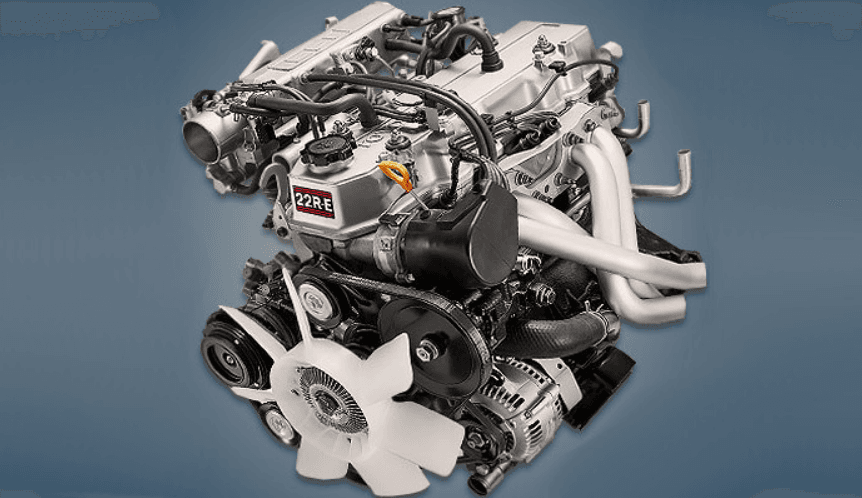

Toyota 22RE Engine
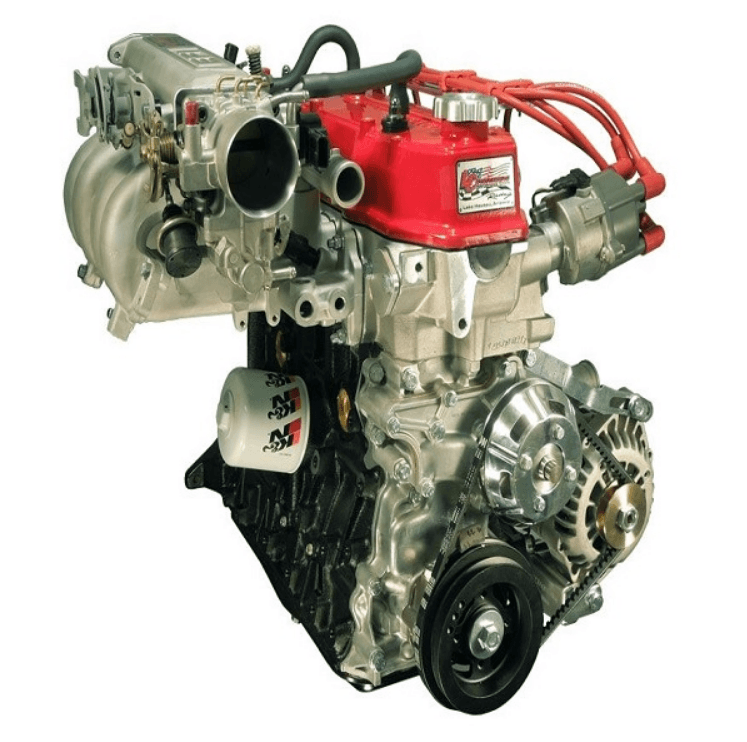
REPAIR PROCEDURES
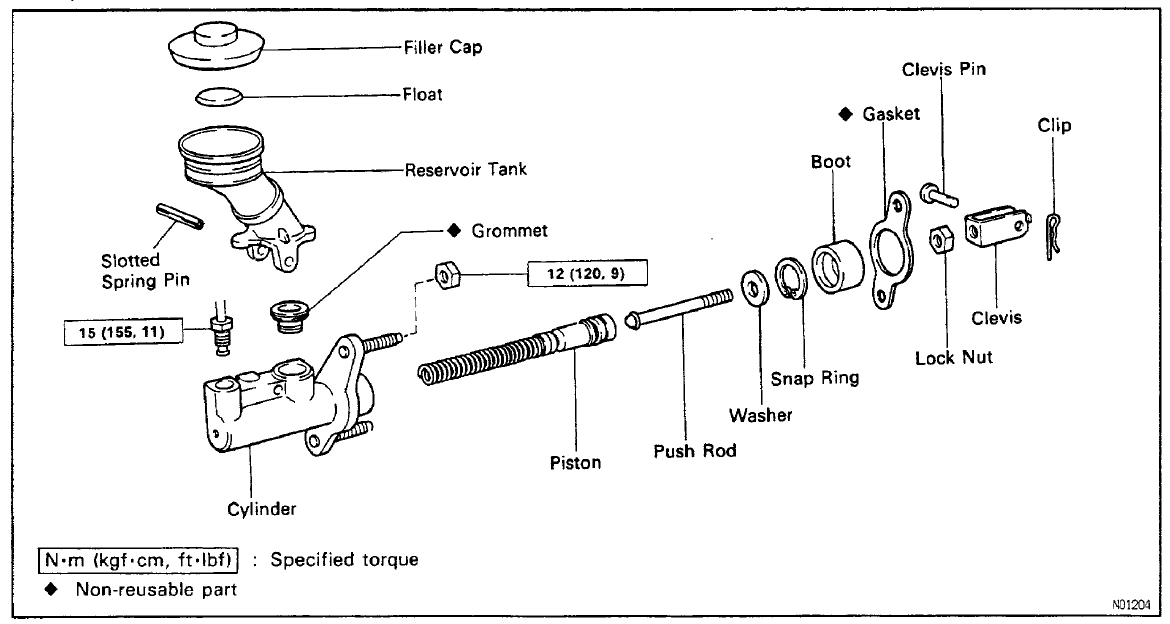
Most repair operations begin with an overview illustration. It identifies the components and shows how the parts fit together.
Example:
IDENTIFICATION INFORMATION
VEHICLE IDENTIFICATION NUMBER
The vehicle identification number is stamped on the vehicle identification number plate and certification label.
- A. Vehicle Identification Number Plate
- B. Certification Label
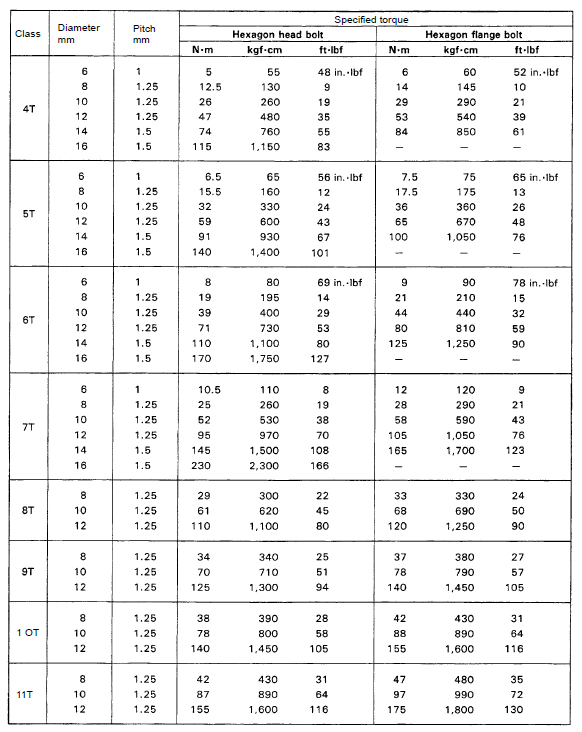
STANDARD BOLT TORQUE SPECIFICATIONS
HOW TO DETERMINE BOLT STRENGTH
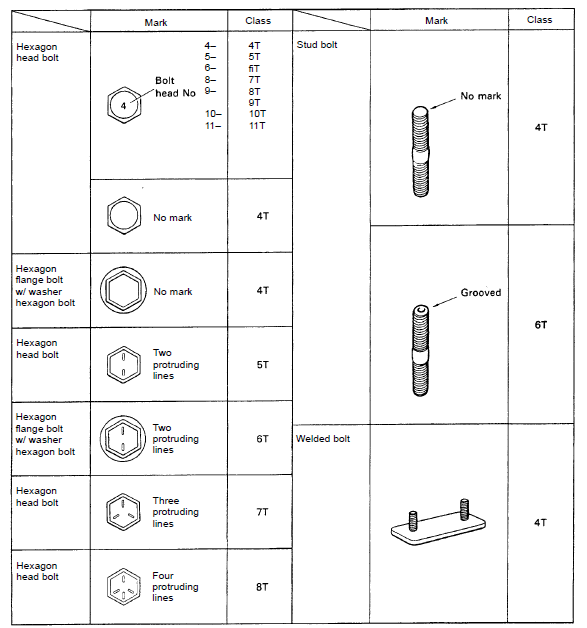
SPECIFIED TORQUE FOR STANDARD BOLTS
MAINTENANCE OPERATIONS ENGINEER
Cold Engine Operations
- (3VZ–E ENGINE)
REPLACE TIMING BELT- (a) Remove the timing belt. (See pages EG–32)
- (b) Install the timing belt. (See pages EG–41)
- INSPECT DRIVE BELTS
- (a) Visually check the belt for excessive wear, frayed cords, etc.
HINT:
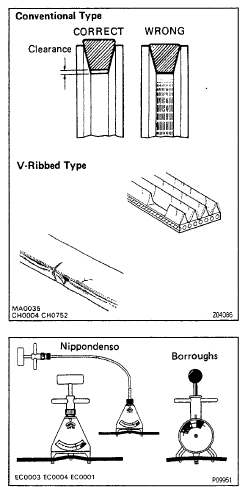
Conventional type: Check that the belt does not touch the bottom of the
pulley groove. If necessary, replace the drive belt.
V–Ribbed type:
Cracks on the ribbed side of the belt are considered acceptable. If the belt has chunks missing from the ribs, it should be replaced.
- (b) Using a belt tension gauge, check the drive belt tension.
Belt tension gauge: Nippondenso BTG–200 (95506–00020) or Borroughs No. BT–33–73F - Drive belt tension: 22R–E Used belt 80 ± 20 lbf
- New belt 125± 25 lbf
- 3VZ – E
- Generator Used belt 100 ± 20 lbf
- New belt 160 ± 20 lbf
- PS Used belt 80 ± 20 lbf
- New belt 125 ± 25 lbf
- A/C Used belt 80 20 lbf
- New belt 125 ± 25 lbf
If necessary, adjust the drive belt tension.
HINT:
- ”New belt” refers to a belt that has been used for less than 5 minutes on a running engine.
- ”Used belt” refers to a belt that has been used on a running engine for 5 minutes or more.
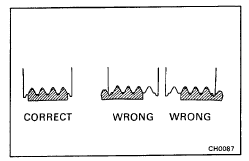
- After replacing the drive belt, check that it fits properly in the ribbed grooves, especially in the places difficult to see.
- After installing a new belt, run the engine for approximately. 5 minutes and then recheck the tension
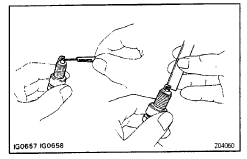
REPLACE SPARK PLUGS
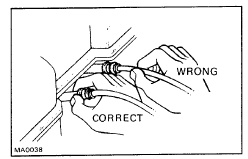
- (a) Disconnect the high–tension cords at the boot. Do not pull on the cords.
- (b) (2213 – E)
Remove the spark plugs.
(3VZ – E)
Using a plug wrench (16 mm), remove the spark plugs. - (c) Check the electrode gap of new spark plugs.

Correct electrode gap: 0.8 mm (0.031 in.)
Recommended spark plugs: 22R–E ND W16EXR–U - NGK BPRSEY
- 3VZ–E ND K76R–U
- NGK BKR5EYA
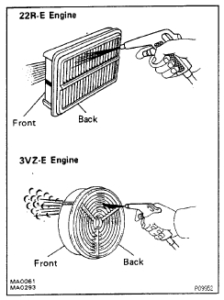
- INSPECT AIR FILTER

- (a) Visually check that the air cleaner element is not excessively dirty, damaged, or oily. HINT: Oiliness may indicate a stuck PCV valve. If necessary, replace the air cleaner element.
- (b) Clean the element with compressed air. First, blow from the back side thoroughly, then blow off the front side of the element.
- REPLACE AIR FILTER Replace the used air cleaner element with a new one.
- REPLACE ENGINE OIL AND OIL FILTER
22R – E (See page EG–236)
3VZ– E (See page EG–278)
Oil grade:
API grade SG Energy – Conserving II multigrade
and recommended viscosity oil
Engine oil capacity: Drain and refill
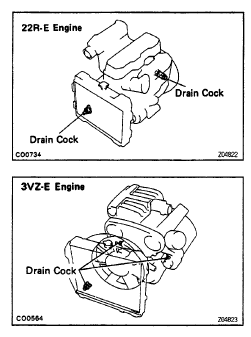
- REPLACE ENGINE COOLANT
- (a) Drain the coolant from the radiator and engine drain cocks.
- (b) Close the drain cocks.
- (c) Fill the system with coolant.
- Coolant capacity (w/ Heater or air conditioner): 22R–E
- Ex. 4WD A/T 8.4 liters (8.8 US qts, 7.4 Imp. qts)
- 4WD A/T 9.1 liters 0.6 US qts, 8.0 Imp. qts)
- 3VZ–E
- 2WD M/T 10.4 liters (11 US qts, 9.2 Imp. qts)
- A/T 10.2 liters (10.8 US qts, 9.5 Imp. qts)
- 4WD M/T 10.5 liters (11.1 US qts, 9.2 Imp. qts)
- A/T 10.3 liters (10.9 US qts, 9.1 Imp. qta)
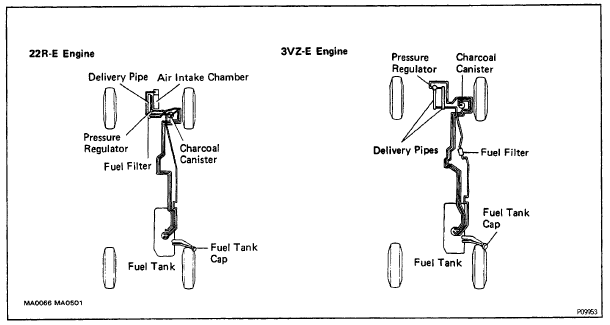
INSPECT CHARCOAL CANISTER
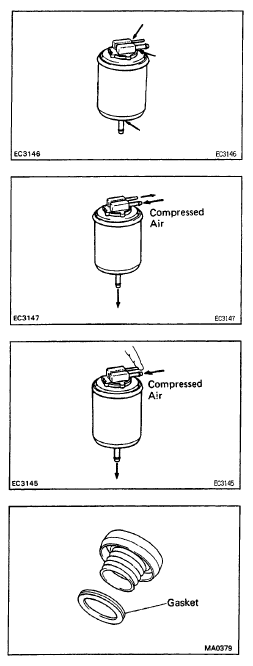
- (a) Remove the charcoal canister. HINT: Label hoses for correct installation.
- (b) Visually inspect the canister case
- (c) Check for a clogged filter and a stuck check valve.
- (1) Using low compressed air (4.71 kPa (48 gf/cm2, 0.68 psi), blow into the tank pipe and check that air flows without resistance from the other pipes.
- (2) Blow air (4.71 kPa (48 gf/cm2, 0.68 psi) into the purge pipe and check that air does not flow from the other pipes. If a problem is found, replace the charcoal canister.
- (d) Clean filter in canister.
- (1) Clean the filter by blowing 294kPa (3 kgf/cm2, 43 psi) of compressed air into the tank pipe while holding the purge pipe closed.
(FEDERAL AND CANADIAN) REPLACE OXYGEN SENSOR
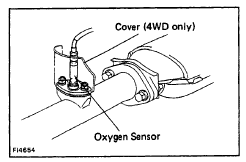
- (a) Disconnect the oxygen sensor wiring connector.
- (b) Remove the cover (4WD), oxygen sensor, and gasket from the exhaust pipe.
- (c) Install a new gasket, oxygen sensor, and cover (4WD) on the exhaust pipe. Torque: 20 N · m (200 kgf · cm, 14 ft · lbf)
- (d) Inspect oxygen sensor operation. Inspect feedback control.
- 22R–E (See page EG–212)
- 3VZ–E (See page EG–252)
Hot Engine Operations
ADJUST VALVE CLEARANCE
- (a) Warm up the engine to normal operating temperature.
- (b) Stop the engine and remove the cylinder head cover.
- (c) Set No.1 cylinder to TDC/compression.
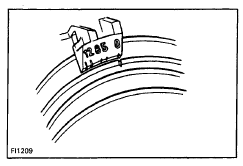
- Turn the crankshaft with a wrench to align the timing marks at TDC. Set the groove on the pulley to the ”O” position.
- Check that the rocker arms on No.1 cylinder are loose and the rocker arms on No.4 cylinder are tight. If not, turn the crankshaft one complete revolution and align marks as above.
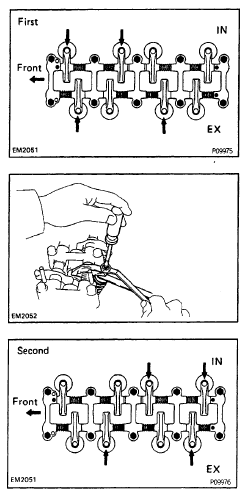
- (d) Adjust the clearance of half of the valves.
- Adjust only the valves indicated by arrows.
- Valve clearance:
- Intake 0.20 mm (0.008 in.)
- Exhaust 0.30 mm (0.012 in.)
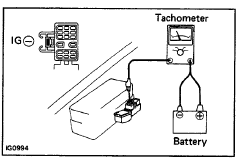
- Connect all vacuum lines (i.e., EVAP, EGR system, etc.)
- Make sure all MFI system wiring connectors are fully connected
- The engine should be at normal operating temperature
- Switch off accessories
- Set the transmission in neutral
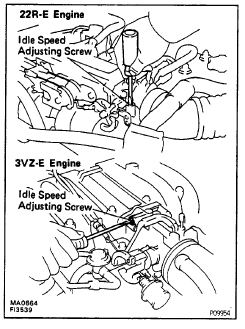
- (c) Race the engine at 2,500 rpm for approx. 2 minutes.
- (d) Set the idle speed by turning the idle speed adjusting screws.
Idle speed:
22R–E 4WD A/T 850 rpm
Ex. 4WD A/T 750 rpm
3VZ–E 800 rpm
(e) Remove the tachometer.

BRAKES
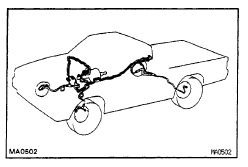
INSPECT BRAKE LINE PIPES AND HOSES
HINT: Inspect in a well–lighted area. Inspect the entire circumference and length of the brake hoses using a mirror as required. Turn the front wheels fully right or left before inspecting the front brake. (a) Check all brake lines and hoses for:
- Damage
- Wear
- Deformation
- Cracks
- Corrosion
- Leaks
- Bends
- Twists
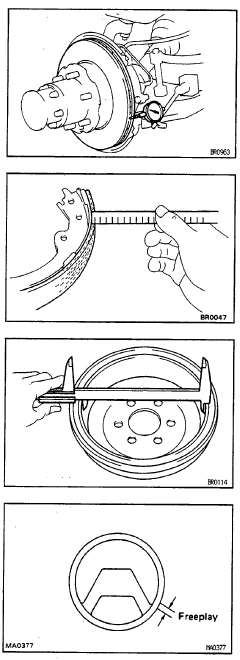
INSPECT FRONT BRAKE PADS AND DISCS

INSPECT REAR BRAKE LININGS AND DRUMS
CHASSIS
INSPECT STEERING LINKAGE
- (a) Check the steering wheel freeplay.
Maximum: 30 mm (1.18 in.) With the vehicle stopped and pointed straight ahead, rock the steering wheel gently back and forth with light finger pressure.
If incorrect, adjust or repair - (b) Check the steering linkage for looseness or damage.

Check that:
- Tie rod ends and relay rod ends do not have excessive play.
- Dust seals are not damaged.
INSPECT BALL JOINTS AND DUST COVERS
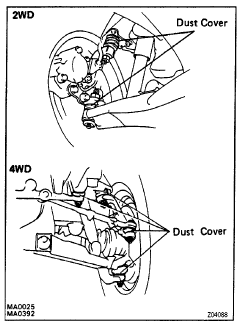
- (a) Inspect the ball joints for excessive looseness. (See SA section)
- (b) Inspect the dust cover for damage
CHECK OIL LEVEL IN MANUAL TRANSMISSION, AUTOMATIC TRANSMISSION, AND DIFFERENTIAL
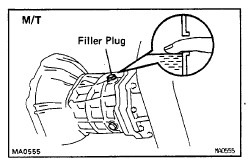
Remove the filler plug and feel inside the hole with your finger. Check that the oil comes to within 5 mm (0.20 in.) of the bottom edge of the hole. If the level is low, add oil until it begins to run out of the filler hole. Transmission oil (M/T) – Oil grade: API GL–4 or GL–5. Viscosity: SAE 75W–90
22R–E ENGINE
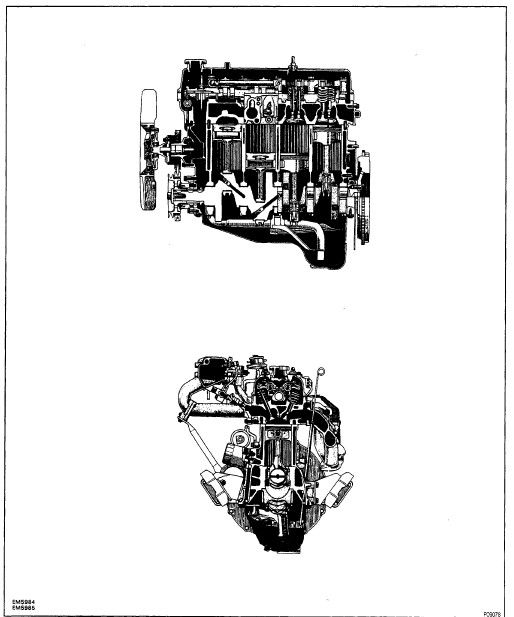
- The 22R–E engine is in–line 4–4-cylinder engine with the cylinders numbered 1, 2, 3, 4 from the front.
- The crankshaft is supported by 5 bearings inside the crankcase. These bearings are made of Kelmet. The crankshaft is integrated with 4 weights, which are cast with it for balance. Oil holes are made in the center of the crankshaft to supply oil to the connecting rods, bearings, pistons, and other components. The firing order is 1–3–4–2.
- The cylinder head is made of aluminum alloy, with cross-flow type intake and exhaust layout, and with pent-roof type combustion chambers. The spark plugs are located to the left of the combustion chambers. Coolant is introduced into the intake manifold, improving drivability during engine warm-up. Exhaust and intake valves are equipped with springs made of special valve spring carbon steel, which are capable of following no matter what the engine speed.
- The camshaft is driven by a timing chain. The cam journal is supported at 3 places, located at the center and the front and rear ends of each cylinder head. Lubrication of the cam journal gear is accomplished by oil supplied through the oil passage in the cylinder head. Adjustment of the valve clearance is done using an adjusting screw on the rocker arm for easy adjustment.
- The timing chain cover is made of aluminum alloy, with a water pump and oil pump on the outside.
- Pistons are made of highly temperature–resistant aluminum alloy, and a depression is built into the piston head to prevent interference with valves. Piston pins are the full–floating type, with the pins fastened to neither the connecting rods nor the piston boss, but with a snap ring fitted to both ends of each pin to prevent it from slipping out. The No. 1 compression ring is made of stainless steel, and the No. 2 compression ring is made of cast iron. The oil ring is made of stainless steel.
- The outer diameter of each piston ring is slightly larger than the diameter of the piston, and the flexibility of the rings allows them to hug the cylinder walls when they are mounted on the piston. No. 1 and No. 2 compression rings work to prevent leakage of gas from the cylinder, and the oil ring works to scrape oil off the cylinder walls to prevent it from entering the combustion chambers.
- The cylinder block is made of cast iron. It has 4 cylinders, which are approximately 2 times the length of the piston stroke. The top of each cylinder is closed off by the cylinder head, and at the lower end of the cylinders, the crankshaft is installed, supported by 5 journals. In addition, the cylinder block contains a water jacket, through which coolant is pumped to cool the cylinders.
- The oil pan is bolted onto the bottom of the cylinder block. The oil pan is an oil reservoir made of pressed steel sheet. A dividing plate is included inside the oil pan to keep sufficient oil in the bottom of the pan even when the vehicle is tilted. The dividing plate prevents the intake of air and allows oil circulation to be maintained even if the oil forms waves when the vehicle brakes suddenly.
PREPARATION
SST (SPECIAL SERVICE TOOLS)
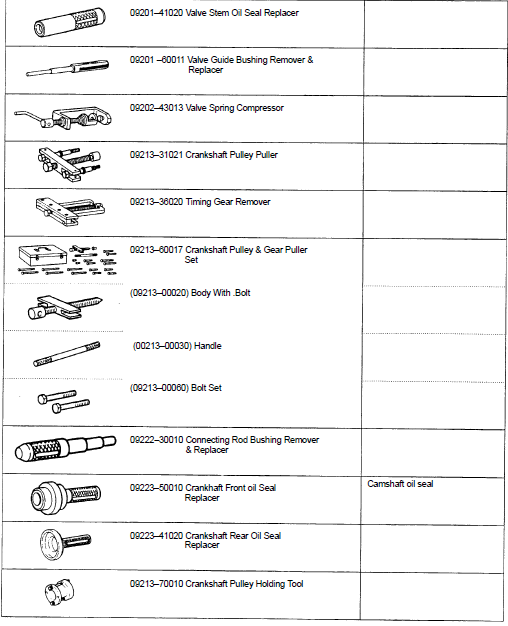
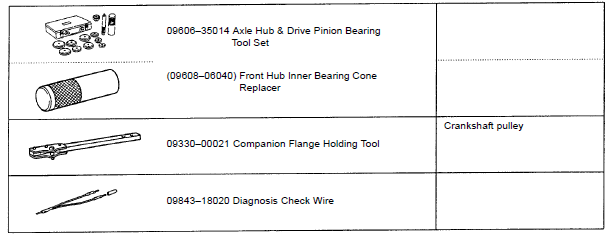
RECOMMENDED TOOLS
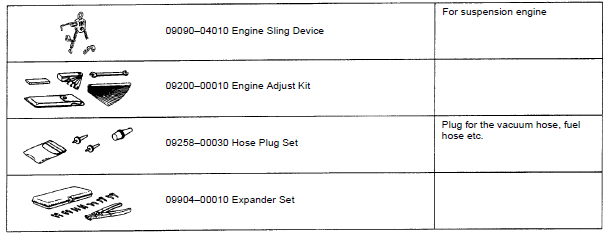
EQUIPMENT

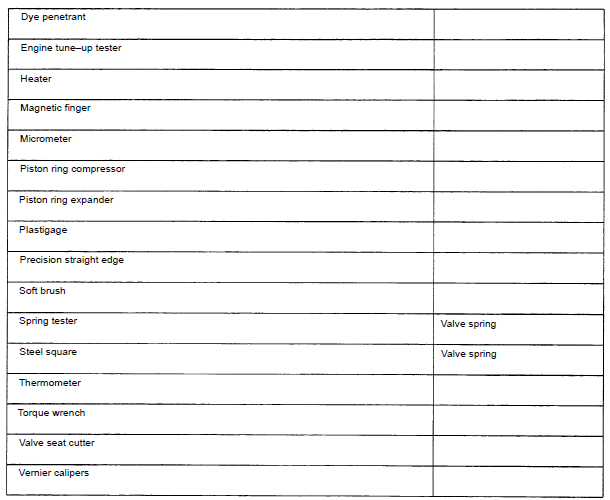
SSM (SERVICE SPECIAL MATERIALS)
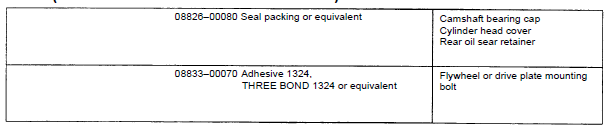
TROUBLESHOOTING
When the malfunction code is not confirmed in the diagnostic trouble code check and the problem still cannot be confirmed in the basic inspection, then proceed to this step and perform troubleshooting according to the numbers in the order given in the table below.


TROUBLESHOOTING
If the HC/CO concentration does not comply with regulations, perform troubleshooting in the order given below.
- Check oxygen sensor operation (See page EG1–212)
- See the table below for possible causes and then inspect and correct the applicable causes if necessary.

FOR MORE MANUALS BY TOYOTA, VISIT MANUALSLIBRARYY
Toyota 22REngine-FAQs’s
How do I obtain a PDF version of the Toyota user or service manuals?
Digital Access: Subscribe to Toyota’s Technical Information System (TIS) at techinfo.toyota.com for manuals for most Toyota models, including the 22RE.
What is the recommended service interval for the 22RE engine?
Oil and Filter Change: Every 3,000 miles (4,800 km) or three months, whichever comes first.
General Service: Toyota recommends major maintenance every 5,000 miles (8,000 km) or 6 months, with additional steps at 15,000 and 30,000-mile intervals.
What is the firing order on the 22RE?
The firing order for the 22RE engine is 1-3-4-2 with a clockwise distributor rotation.
What is the stock bore of a 22RE engine?
The stock bore is 92 mm (3.622″).
Can I turbocharge a stock 22RE engine?
Although possible, the factory 22RE engine’s compression ratio (9.0:1 to 9.4:1) is relatively high for adding a turbo. If you do add a turbo, limit boost to 4–6 psi for engine safety, and note that factory EFI may not support forced induction well without modification.
How do I properly break in a rebuilt 22RE engine?
15 minutes at 1,500–2,000 RPM for proper camshaft break-in and piston ring seating. Watch engine temperature and oil pressure throughout the process.
How much fuel can a Toyota 22RE tank hold?
Typical 22RE-equipped trucks have a 17.2-gallon fuel tank.
What is the recommended oil filter change procedure?
Use a high-quality filter suitable for the 22RE. Replace the filter with each oil change for best engine protection.